Silk Pillowcase for Wrinkles: What the Evidence Actually Supports
The friction argument is weaker than the marketing suggests — but the compression argument underneath it is real, and it points somewhere useful
The pitch for a silk pillowcase is elegant: cotton grips your face, drags it into folds for seven hours a night, and those folds eventually stay. Silk slides. Buy silk, wake up uncreased.
It is a satisfying story, and one part of it is well supported. The other part — the friction part everyone leads with — turns out to be the weakest link in the chain.
What Actually Creases Your Face at Night
Sleep wrinkles are a genuinely distinct category of facial line, and they were characterized carefully in a 2016 review in Aesthetic Surgery Journal [1]. Expression lines run perpendicular to the muscle that makes them: your frown muscle pulls horizontally, so the line etches vertically. Sleep lines do not follow that logic at all. They follow the geometry of your pillow.
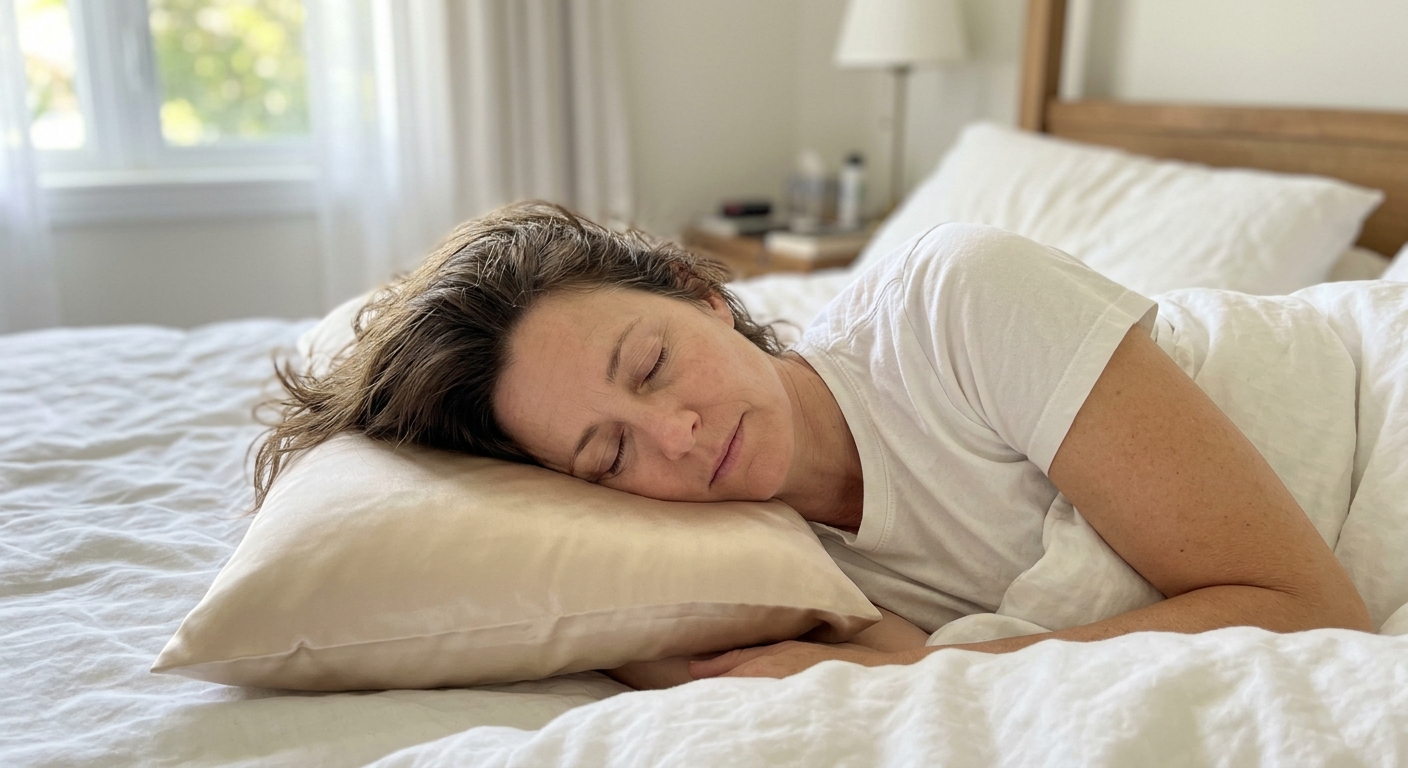
When you sleep on your side or your front, the weight of your head presses one half of your face into a surface. The review identifies three forces at work, and they are not the same thing. Compression flattens tissue downward. Shear slides the surface layers sideways relative to the deeper ones. Stress holds that deformation in place, hour after hour, night after night, for decades.
Notice what is doing most of the damage there. It is the weight of your skull, not the weave of your fabric. A pillowcase can influence how easily the surface slides, but nothing you put on top of a pillow changes the fact that a five-kilogram head is resting on your cheek.
That is also why sleep wrinkles are usually asymmetric. If you always sleep on your right side, the vertical lines on your right cheek are typically deeper. Look in a mirror; most side sleepers can identify their preferred side without being told.
The Friction Claim, Examined Honestly
Here is where the marketing gets ahead of the data. The claim that silk has a dramatically lower coefficient of friction against skin than cotton is not what the tribology literature shows.
If you always sleep on your right side, the vertical lines on your right cheek are typically deeper.
A 2022 review in Materials pulled together the measurements of skin-textile friction across fabric types and body regions [2]. Wool measured highest. Polyamide measured lowest. And in the studies it summarizes, cotton actually recorded lower friction coefficients against skin than silk did at both the palm and the forearm. Silk registered as relatively rough and adhesive to the touch — the opposite of the frictionless-glide image the category is sold on.
That does not make silk pointless. It means the honest case for it rests on different properties than the one usually advertised:
- Absorbency. Cotton is a thirsty fiber. It pulls moisture and applied product off your face and into the pillow. Silk absorbs considerably less, so your night cream is more likely to still be on your skin at 3 a.m. than in your laundry.
- Surface uniformity. Silk is a continuous filament rather than a mass of short spun staples, so it presents a smoother, more consistent surface with fewer micro-ridges to press a pattern into skin. This is a different property from bulk friction, and it is the one people are usually noticing.
- Hair. The reduction in friction against hair is better established than the reduction against skin, which matters if breakage and morning tangles are part of why you are shopping.
It is also worth knowing what happened when silk fabric was put to a proper clinical test for skin benefit. The CLOTHES trial — a randomized, observer-blind study of 300 children with eczema, published in PLoS Medicine — gave one group specialist silk therapeutic garments plus standard care and the other standard care alone [3]. Over six months, the silk garments produced no meaningful improvement in eczema severity, and the authors concluded they were not cost-effective. Silk fabric next to skin is comfortable. It is not medicine.
Why the Crease Stops Springing Back
Here is the part that decides whether a pillowcase matters to you at all.
A crease pressed into young skin disappears within minutes of getting up. The same crease pressed into fifty-year-old skin can still be visible at lunchtime — and eventually it stops leaving. The fabric did not change. The skin did.
If you are buying bedding to look better, the hours of sleep are doing more work than the fiber content.
Two measurable things happen underneath. First, the collagen scaffold degrades. Both ultraviolet exposure and simple chronological aging drive up matrix metalloproteinases, the enzymes that break down dermal collagen, while simultaneously reducing new collagen synthesis — a mechanism laid out in detail by Fisher and colleagues [4]. Second, elastic recovery falls. Cutometer measurements across age groups show net elasticity declining steadily with age, meaning skin that is stretched or folded simply returns to its original shape less completely [5].
That is the whole mechanism of a permanent sleep line. Fold plus poor recovery equals a line that stays. A pillowcase can slightly reduce the fold. Only the dermis controls the recovery.
Sleep quality itself contributes, incidentally. In a study of 60 women, poor sleepers showed higher intrinsic aging scores and measurably worse barrier function — good sleepers recovered about 30% more barrier integrity in the 72 hours after tape stripping [6]. If you are buying bedding to look better, the hours of sleep are doing more work than the fiber content.
What Actually Reduces Sleep Creases
In rough order of how much they change:
- Sleep on your back if you possibly can. This is the only intervention that removes the compression rather than softening it. The 2016 review is blunt that it is also very hard to sustain, since people revert during unconscious sleep. Contoured pillows designed to keep the face off the surface exist for exactly this reason.
- Change sides. If back sleeping is unrealistic, at least stop loading the same cheek every night.
- Use silk or satin for the absorbency and surface-uniformity benefits, and for hair. Treat it as a small marginal gain, not a treatment.
- Rebuild the dermis, because that is the variable that decides whether tonight’s fold is gone by breakfast or still there in five years. This is also the only item on the list that improves existing lines rather than just limiting new ones.
Sleep creasing is one input among several, and it interacts with everything else that thins the dermis — which is why it tends to show up alongside crepey texture on the face rather than in isolation. The mechanics of nighttime facial compression are covered in more depth in our guide to sleep wrinkles.
Where Nanoretinol Comes In
Retinol is the ingredient with the strongest evidence for the recovery problem specifically. In a vehicle-controlled trial in naturally aged skin — not sun-damaged skin, ordinary chronological aging — topical retinol significantly increased glycosaminoglycan levels and procollagen I production, with visible reduction in fine wrinkling [7]. It works on exactly the tissue that decides whether a fold rebounds.
The obstacle has always been delivery. Retinol is a fragile molecule, and conventional formulations get it through the barrier by disrupting that barrier with solvents and petroleum derivatives — which is where the redness, burning, and peeling come from.
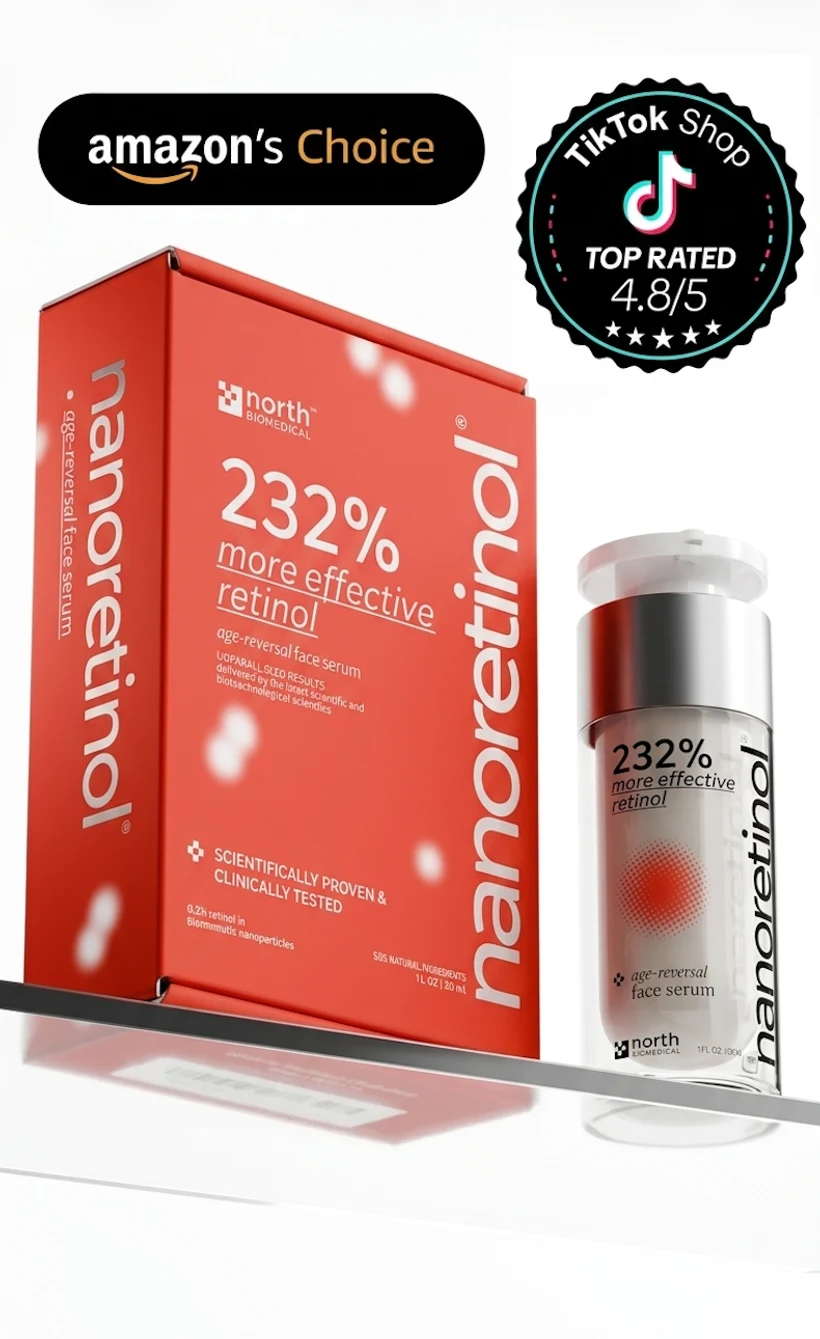
Nanoretinol takes a different route. It carries 0.2% stabilized retinol inside biomimetic lipid nanoparticles that the skin recognizes as “self” and admits through the epithelial barrier intact, without needing to damage it. In North Biomedical’s clinical study, that delivery produced 232% greater collagen recovery and 73% greater elastin recovery than conventional retinol, with drastically reduced cytotoxicity. Over 56 days of use, participants showed a 61% increase in skin firmness and a 56% increase in elasticity — which is, precisely, the property that determines whether a pillow crease is temporary.
A Reasonable Purchase, With Realistic Expectations
Buy the silk pillowcase if you like sleeping on silk, if you want your night cream to stay on your face, or if your hair is the real reason. Those are honest benefits and they are worth the money to plenty of people.
Do not buy it expecting it to stop your face from creasing. The compression that creates sleep lines comes from the weight of your head, and the permanence comes from a dermis that no longer springs back. Fabric addresses neither. Sleep position addresses the first, and what you do for your collagen addresses the second.
References
- Anson G, Kane MAC, Lambros V. “Sleep Wrinkles: Facial Aging and Facial Distortion During Sleep.” Aesthetic Surgery Journal. 2016;36(8):931-940. doi:10.1093/asj/sjw074
- D’Souza B, Kasar AK, Jones J, Skeete A, Rader L, Kumar P, Menezes PL. “A Brief Review on Factors Affecting the Tribological Interaction between Human Skin and Different Textile Materials.” Materials. 2022;15(6):2184. doi:10.3390/ma15062184
- Thomas KS, Bradshaw LE, Sach TH, Batchelor JM, Lawton S, Harrison EF, et al. “Silk garments plus standard care compared with standard care for treating eczema in children: A randomised, controlled, observer-blind, pragmatic trial (CLOTHES Trial).” PLoS Medicine. 2017;14(4):e1002280. doi:10.1371/journal.pmed.1002280
- Fisher GJ, Kang S, Varani J, Bata-Csorgo Z, Wan Y, Datta S, Voorhees JJ. “Mechanisms of photoaging and chronological skin aging.” Archives of Dermatology. 2002;138(11):1462-1470. doi:10.1001/archderm.138.11.1462
- Ryu HS, Joo YH, Kim SO, Park KC, Youn SW. “Influence of age and regional differences on skin elasticity as measured by the Cutometer.” Skin Research and Technology. 2008;14(3):354-358. PMID:19159383
- Oyetakin-White P, Suggs A, Koo B, Matsui MS, Yarosh D, Cooper KD, Baron ED. “Does poor sleep quality affect skin ageing?” Clinical and Experimental Dermatology. 2015;40(1):17-22. PMID:25266053
- Kafi R, Kwak HSR, Schumacher WE, Cho S, Hanft VN, Hamilton TA, et al. “Improvement of naturally aged skin with vitamin A (retinol).” Archives of Dermatology. 2007;143(5):606-612. doi:10.1001/archderm.143.5.606