Collagen Lotion: What It Can and Cannot Do for Crepey Skin
Why the collagen in a body lotion never reaches the layer that sags, what it does do on the surface, and which ingredients actually make your skin build its own
Collagen lotion is one of the easiest promises to buy into. Your skin is losing collagen, the bottle contains collagen, so rubbing one into the other should put it back. Shoppers usually reach for it when the skin on their arms, legs or chest starts to look thin and crinkled, like tissue paper.
The trouble is that skin does not work like a sponge. This guide explains what is really in a collagen lotion, why the collagen cannot go where you need it, what the lotion still does well, and which ingredients do the firming work instead.
What is in a collagen lotion
“Collagen” on a label can mean several things:
- Native or soluble collagen: whole collagen molecules, usually from cattle or fish skin.
- Hydrolyzed collagen: collagen chopped into smaller protein fragments.
- Marine collagen: either of the above, sourced from fish.
- Collagen peptides or “collagen boosters”: sometimes small signal peptides, sometimes just marketing for hydrolyzed collagen.
Most collagen body lotions sit near the bottom of the ingredient list for collagen, below water, glycerin, oils and emulsifiers. In practice, they are ordinary moisturizers with a protein added.
Why the collagen cannot reach your dermis
Collagen sits in the dermis, the deep layer under the outer skin. To get there, a molecule has to cross the stratum corneum, a barrier built to keep things out.
A widely cited rule in dermatology holds that a molecule generally has to weigh less than about 500 daltons to pass that barrier; almost every drug that works through the skin falls under that line [1]. A single collagen molecule is a rope of three protein chains wound into a triple helix [2], roughly 300,000 daltons and about 300 nanometers long. That is around 600 times over the limit.
Hydrolyzed collagen is smaller, but most fragments are still thousands of daltons. And even if a fragment slipped through, the skin would not stitch it into new fibers. Your fibroblasts build collagen from scratch inside the dermis; they do not recycle pieces dropped on the surface.
Your skin cannot absorb collagen from a lotion any more than your arm can absorb a protein shake, so the firming has to come from your own cells.
Your skin cannot absorb collagen from a lotion any more than your arm can absorb a protein shake, so the firming has to come from your own cells.
For a closer look at the evidence on face products, see our guide to whether collagen creams work.
What collagen lotion does do
That does not make it useless. Large proteins hold water and form a thin, flexible film as they dry. On the skin, that film:
- Hydrates the surface and reduces water loss for a few hours.
- Smooths crepey texture temporarily, because plumped surface cells reflect light more evenly.
- Feels tightening as the film dries, which is real but cosmetic.
So a collagen lotion can make dry, crepey skin look and feel better the day you use it. It will not rebuild what is missing underneath, and the effect fades once you stop.
Why body skin turns crepey
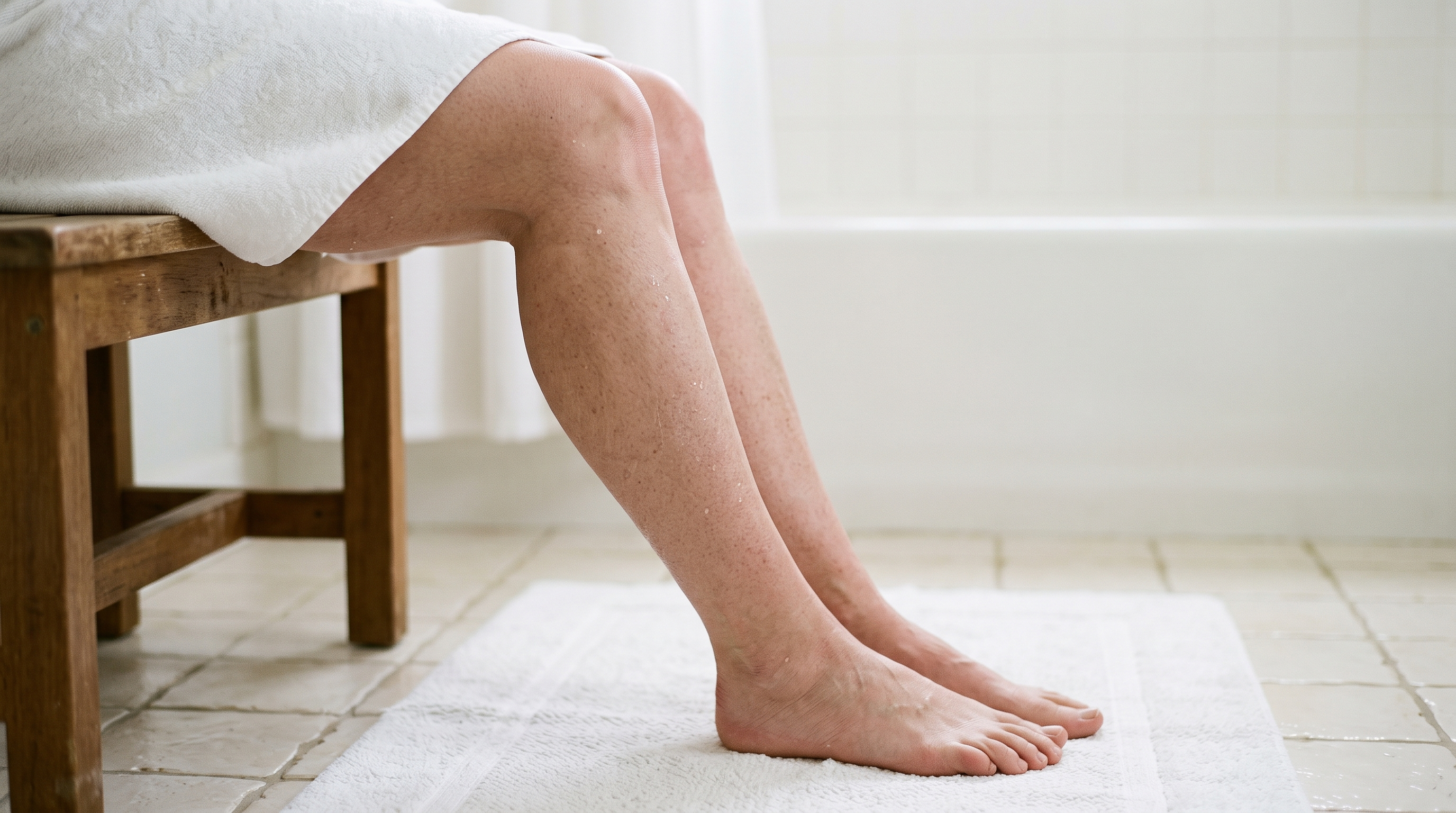
Crepey skin on the arms and legs comes from the dermis, not the surface. In sun-protected skin from people aged 60 and over, researchers found more collagen-degrading enzymes and less new collagen than in younger adults [3]. Add decades of sun exposure on forearms and shins, and the collagen network thins and loosens, so the skin above it wrinkles like loose fabric.
Fixing that means two things: slow the breakdown and make the fibroblasts produce more collagen again. Collagen in a bottle does neither. Several other ingredients do.
Your skin can start making new collagen in as little as 7 days of retinol use, far sooner than the months it takes to see the difference.
Ingredients that help your skin build its own collagen
Retinol
Retinol is the best-studied option for body skin. In a randomized, double-blind trial in adults with an average age of 87, a 0.4% retinol lotion applied to one arm for 24 weeks reduced fine wrinkling and increased procollagen and the water-holding molecules of the dermis compared with the plain lotion on the other arm [4].
Your skin can start making new collagen in as little as 7 days of retinol use, far sooner than the months it takes to see the difference. In skin from people over 80, one week of topical vitamin A raised collagen synthesis and lowered the enzymes that break collagen down [5]. Our roundup of the best retinol body lotion compares body formulas.
Lactic acid
Lactic acid is a gentle exfoliant and humectant that also works below the surface at higher strength. In a 3-month study, 12% lactic acid increased the firmness and thickness of both the epidermis and dermis, while 5% improved only the surface [6]. It is a good partner for retinol on alternate nights, especially on rough, dry shins.
Signal peptides
Some small peptides are designed to tell fibroblasts to make collagen. In a 12-week split-face trial, a moisturizer with palmitoyl pentapeptide reduced fine lines and wrinkles more than the same moisturizer without it [7]. The evidence is smaller than for retinol and comes mostly from facial skin, but peptides are well tolerated.
How to read a collagen lotion label
If you like the feel of a collagen lotion, choose one that also contains something that works:
- Retinol or a retinoid in an opaque, airless pack.
- Lactic acid or urea for rough texture.
- Peptides named specifically, such as palmitoyl pentapeptide.
- Glycerin, ceramides and shea butter for the barrier.
- No added fragrance, especially if you plan to add retinol.
A collagen lotion that lists only collagen, water and fragrance is a pleasant moisturizer at a premium price. Our guide to the best body lotion for aging skin explains which bases suit mature body skin.
A simple routine for crepey arms and legs
- Morning: moisturizer, then broad-spectrum sunscreen on any skin that sees daylight.
- Evening, most nights: a retinol product on arms, legs or chest, followed by a rich lotion.
- Two evenings a week: a lactic acid lotion instead of retinol.
- After showers: apply moisturizer to damp skin within a few minutes.
For extra-thin areas such as the inner arms, a lightweight body serum for crepey skin can sit under the lotion.
Where Nanoretinol fits
The catch with retinol on the body is irritation. Body skin covers large areas, and conventional retinol formulas often rely on chemicals that weaken the skin barrier to push the active through, which leads to dryness, redness and peeling.
Nanoretinol delivers retinol inside biomimetic lipid nanoparticles that the skin recognizes as its own, so it crosses the barrier without damaging it. It is a light, water-based gel with 99% natural ingredients that absorbs fully to a matte finish. In laboratory testing it was 232% more effective in collagen recovery and 73% more effective in elastin recovery than conventional retinol, and in 56 days it increased skin firmness by 61% and elasticity by 56% [8]. Use it at night on crepey areas, under your favorite lotion, collagen or not.
The verdict on collagen lotion
A collagen lotion is a moisturizer, and a decent one can make crepey skin look smoother for a day. It cannot replace the collagen you have lost, because whole collagen is far too large to reach the dermis. For real firming, pair a good lotion with ingredients that make your own skin produce collagen, with retinol at the top of the list, and protect the results with daily sunscreen.
References
- Bos JD, Meinardi MM. “The 500 Dalton rule for the skin penetration of chemical compounds and drugs.” Experimental Dermatology. 2000;9(3):165-169. doi:10.1034/j.1600-0625.2000.009003165.x
- Shoulders MD, Raines RT. “Collagen structure and stability.” Annual Review of Biochemistry. 2009;78:929-958. doi:10.1146/annurev.biochem.77.032207.120833
- Varani J, Dame MK, Rittie L, Fligiel SE, Kang S, Fisher GJ, et al. “Decreased collagen production in chronologically aged skin: roles of age-dependent alteration in fibroblast function and defective mechanical stimulation.” American Journal of Pathology. 2006;168(6):1861-1868. doi:10.2353/ajpath.2006.051302
- Kafi R, Kwak HS, Schumacher WE, Cho S, Hanft VN, Hamilton TA, et al. “Improvement of naturally aged skin with vitamin A (retinol).” Archives of Dermatology. 2007;143(5):606-612. doi:10.1001/archderm.143.5.606
- Varani J, Warner RL, Gharaee-Kermani M, Phan SH, Kang S, Chung JH, et al. “Vitamin A antagonizes decreased cell growth and elevated collagen-degrading matrix metalloproteinases and stimulates collagen accumulation in naturally aged human skin.” Journal of Investigative Dermatology. 2000;114(3):480-486. doi:10.1046/j.1523-1747.2000.00902.x
- Smith WP. “Epidermal and dermal effects of topical lactic acid.” Journal of the American Academy of Dermatology. 1996;35(3 Pt 1):388-391. PubMed 8784274
- Robinson LR, Fitzgerald NC, Doughty DG, Dawes NC, Berge CA, Bissett DL. “Topical palmitoyl pentapeptide provides improvement in photoaged human facial skin.” International Journal of Cosmetic Science. 2005;27(3):155-160. doi:10.1111/j.1467-2494.2005.00261.x
- North Biomedical LLC. “Nanoretinol vs. Conventional Retinol: Efficacy in Collagen and Elastin Recovery.” Clinical Study Summary, 2024. Study summary