Best Retinol Body Lotion: The Four Things Worth Comparing
Concentration, vehicle, packaging and site, in the order they actually decide the result
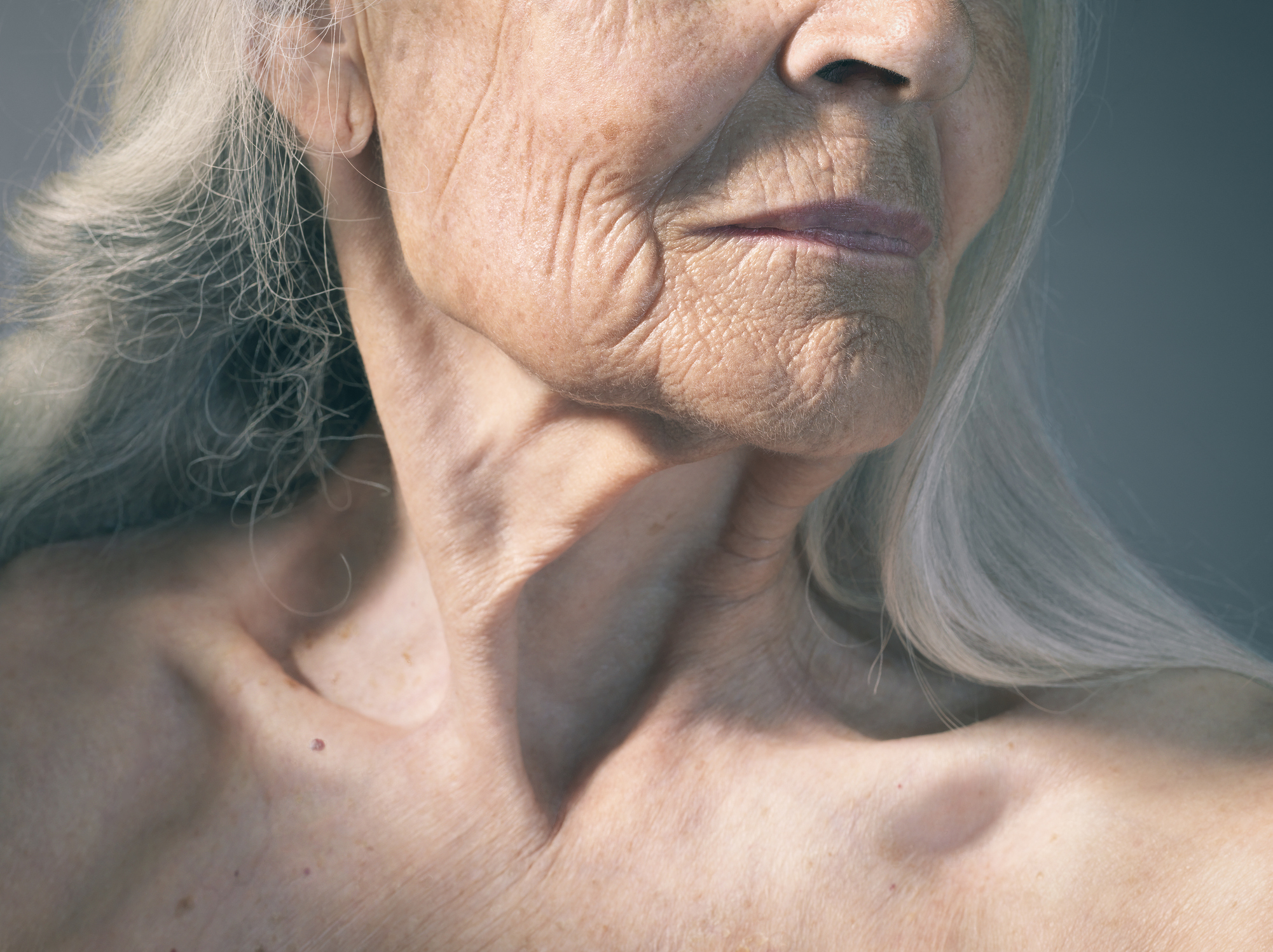
The body aisle caught up with the face aisle in about three years. Retinol now turns up in body lotions at concentrations that would be considered aggressive on a face, sold on the promise of smoothing the crepey texture that shows up on the upper arms and shins long before anyone is ready for it.
The promise is reasonable. Retinoids are the best-evidenced topical there is for exactly this kind of change. What is less reasonable is how these products are compared, which is almost always by percentage on the front of the bottle.
The evidence for using it below the neck
Start with whether it works at all on body skin, because the answer is better documented than most people assume.
In a randomised, vehicle-controlled trial, 0.4% retinol applied three times a week to the forearms of elderly participants produced measurable improvement in fine wrinkling after 24 weeks, alongside increased collagen in biopsied tissue [1]. That study is worth knowing about specifically because it was not a face study. The skin tested was the same forearm skin people are trying to treat when they buy a body lotion.
The mechanism is the same one that makes retinoids the reference treatment for photoaging anywhere. Ultraviolet exposure induces matrix metalloproteinases that break down dermal collagen within hours of a dose too small to cause visible burning, and retinoic acid pretreatment blocks that induction [3]. On skin that has spent decades getting a fraction of the sun protection your face gets, that matters more, not less. Our page on retinol for the body covers the case for extending the routine downward in full.
Concentration is the worst way to rank them
Body lotions commonly run from 0.1% to 2%, and the marketing invites you to read that scale as a strength ladder. The clinical data does not cooperate.
A controlled split-body comparison of 0.3% and 0.5% retinol serums found that the higher concentration produced significantly more peeling, irritation and itching without a matching gain in measured benefit [4]. Higher was not better. Higher was simply more irritating, and irritation is the thing that ends a body routine, because nobody persists with a lotion that makes their arms itch under a sleeve.
Body lotions commonly run from 0.1% to 2%, and the marketing invites you to read that scale as a strength ladder.
Read the percentage as a tolerance setting rather than a potency rating, and start lower than you think you should. Our retinol concentration guide works through the same trade-off in more detail.
Body skin is not one surface
Part of why body retinol tolerates higher numbers is anatomical. The stratum corneum, the outer barrier layer, varies substantially in thickness from one body site to another, with classic ultrastructural work counting markedly different numbers of cell layers between sites [6].
The practical translation is that the same lotion behaves like three different products depending on where it lands. On the shins and outer thighs, where the barrier is thicker and the skin is drier, it is generally well tolerated and slow to show results. On the inner arms, the chest and the neck, the barrier is thinner and closer to facial skin, and a percentage that felt like nothing on the legs can produce a week of flaking.
The chest is where most people learn this. Treat it as face rather than body, apply less, and build up.
The two label details nobody reads
Retinol is chemically fragile. It degrades on exposure to light, air and heat, and a degraded retinol is an expensive moisturiser.
The degree of fragility is easy to underestimate. In stability testing, free retinol in aqueous solution was essentially gone within two days under light exposure, while the same retinol incorporated into liposomes retained around 80% after eight days [5]. Encapsulation is not a marketing flourish. It is the difference between a product that still contains what the box claims and one that does not.
Two things follow, and both are visible from across a shop.
In stability testing, free retinol in aqueous solution was essentially gone within two days under light exposure, while the same retinol incorporated into liposomes retained around 80% after eight days.
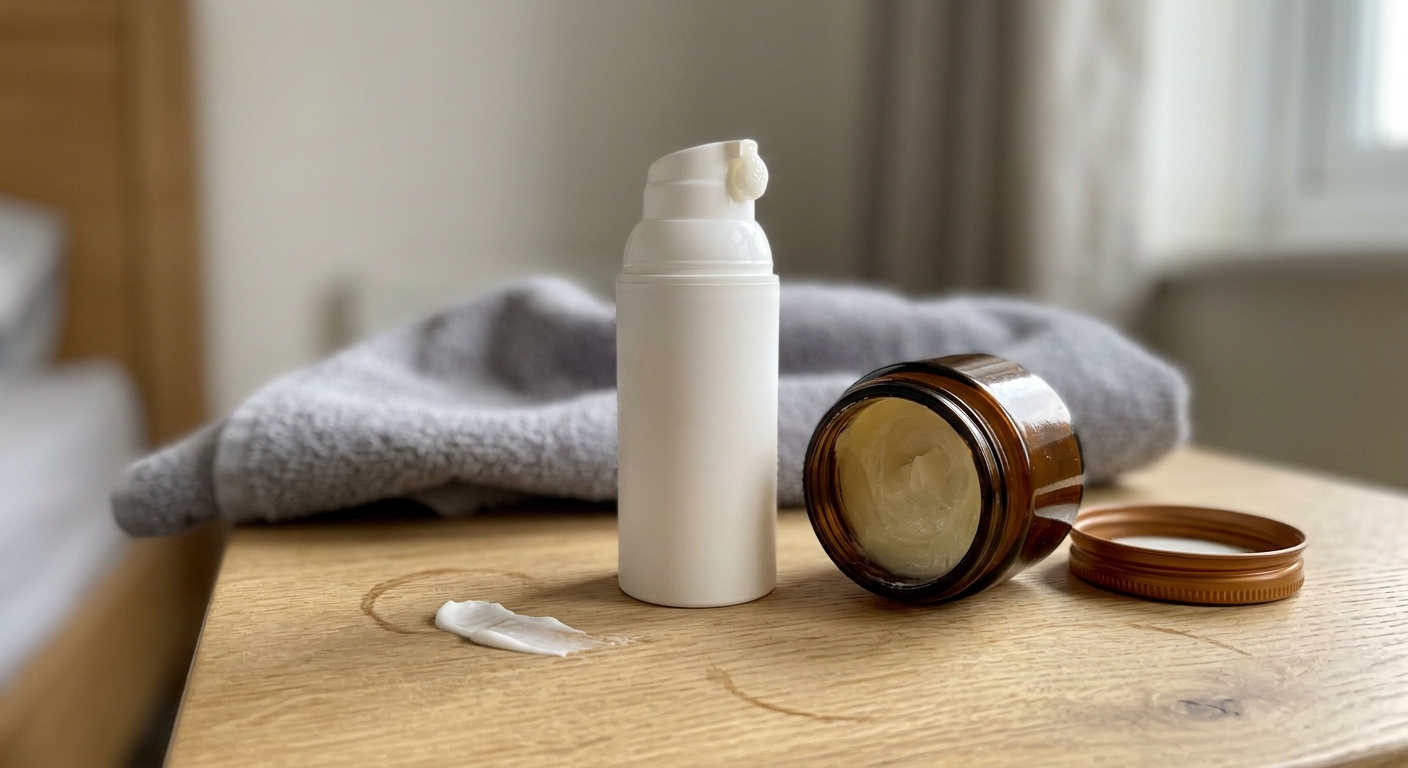
Packaging first. Opaque, airless and pumped is what you want. A wide-mouth jar with a screw lid, sitting open on a bathroom shelf in the light, is the worst available container for this molecule, whatever is inside it.
Vehicle second. Look for language indicating the retinol is encapsulated, stabilised or carried in a delivery system, rather than simply dissolved into the base. Free retinol in a lotion is the version that both degrades fastest and irritates most, because it arrives all at once.
What it can and cannot do for crepey arms
Expectations deserve honesty here. Retinoids rebuild dermal collagen, and the evidence for that is unusually direct: tretinoin applied to photodamaged skin restored new collagen formation in biopsy, against a decline in the vehicle-treated controls [2].
That is a real structural change, and it is slow. Body skin turns over more slowly than facial skin and starts from more accumulated damage, so a fair assessment point is four to six months of consistent use rather than the six weeks people give it. Severe laxity from significant weight change is not going to resolve from a lotion at all, and a product promising otherwise is selling something else.
For what is achievable and over what timeframe, crepey skin on the arms and our general guide to getting rid of crepey skin set out the realistic ceiling.
Where delivery beats concentration
Look at what the four comparison points have in common. Concentration is limited by irritation. Stability is limited by exposure. Site tolerance is limited by the barrier. All three are delivery problems rather than dose problems, which is where formulation science has been focused for the last decade.
Conventional retinol gets through the skin barrier by disrupting it, using solvents and penetration enhancers that loosen the lipid structure holding the barrier together. The retinol arrives, and so does the burning, redness and peeling.
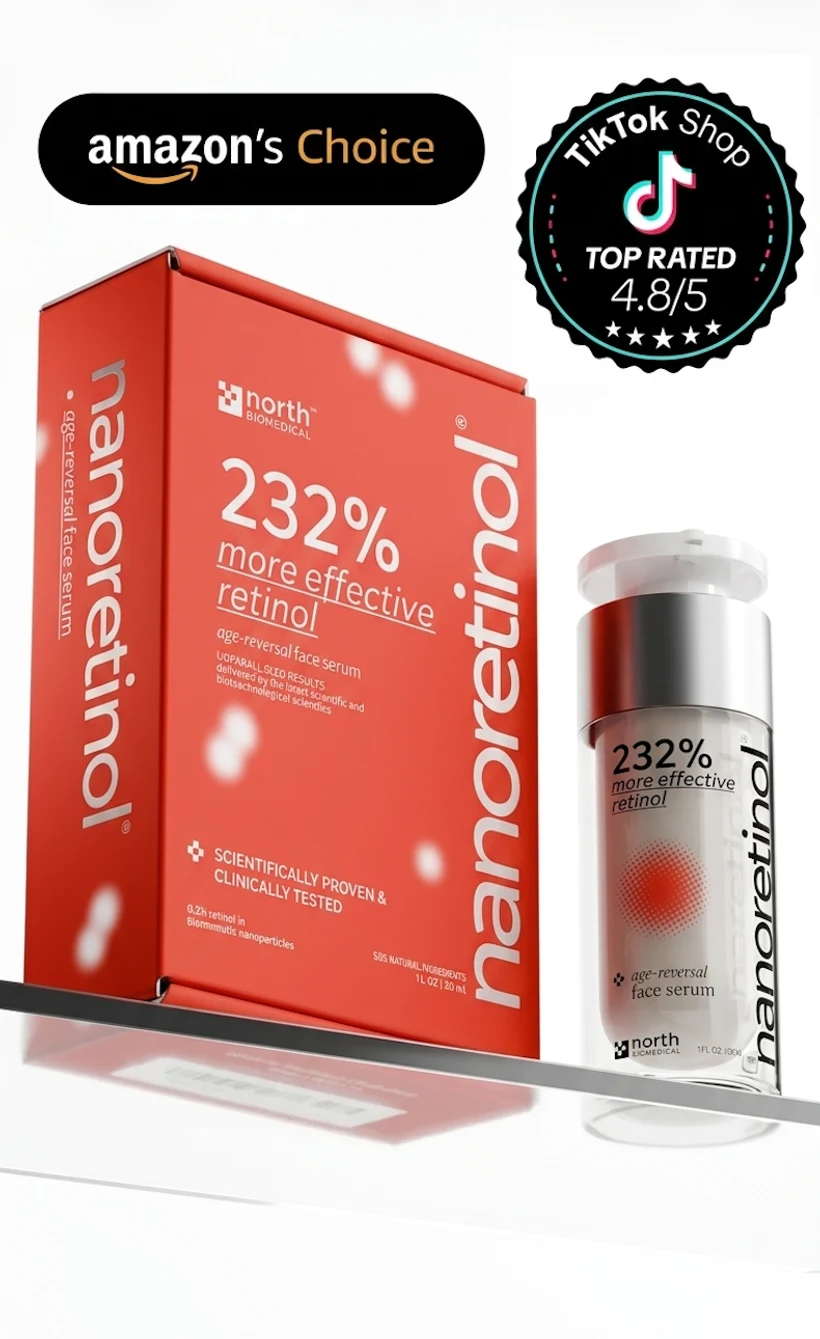
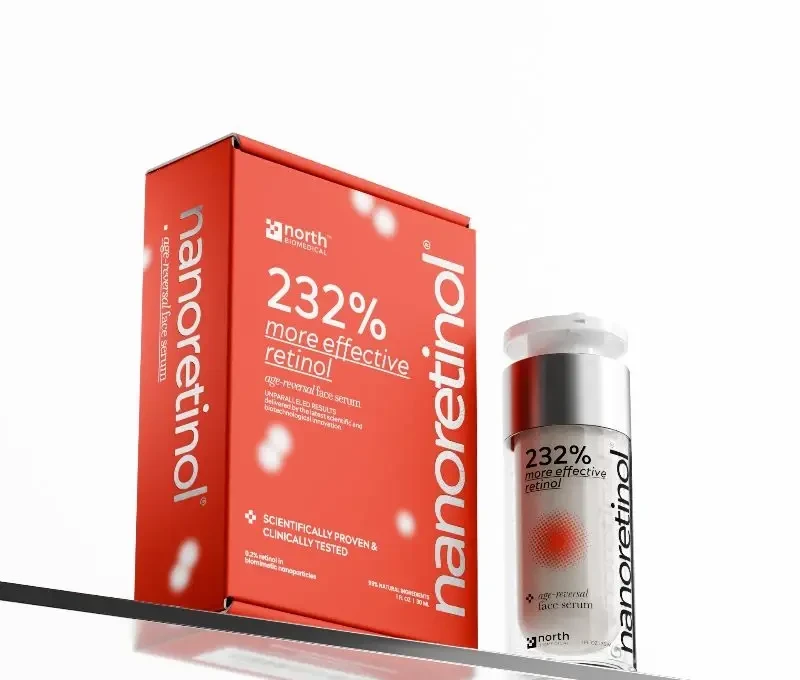
Nanoretinol takes the other route. Its 0.2% retinol is carried inside biomimetic lipid nanoparticles that the skin recognises as self and admits intact, in a water-based, 99% natural formulation suitable for all skin types including sensitive, with no barrier disruption required. Measured against conventional retinol it achieved 232% greater collagen recovery and 73% greater elastin recovery with drastically reduced cytotoxicity, and across 56 days delivered a 61% increase in firmness and a 56% increase in elasticity. Delivery efficiency, rather than the number on the front, is what puts retinol where it needs to be.
Whatever you choose, apply it at night, use sunscreen the following day, and keep it away from broken or sunburnt skin.
Shopping the shelf in ninety seconds
Turn the bottle over. If it is a jar, put it back. If the retinol is not described as encapsulated or stabilised, be sceptical. Then pick the lowest concentration in the range you were considering, because the one you can use four nights a week for six months will outperform the strong one you abandon in February.
That is the whole comparison. It has almost nothing to do with the number on the front.
References
- Kafi R, Kwak HS, Schumacher WE, Cho S, Hanft VN, Hamilton TA, King AL, Neal JD, Varani J, Fisher GJ, Voorhees JJ, Kang S. “Improvement of Naturally Aged Skin With Vitamin A (Retinol).” Archives of Dermatology. 2007;143(5):606-612. PMID: 17515510
- Griffiths CEM, Russman AN, Majmudar G, Singer RS, Hamilton TA, Voorhees JJ. “Restoration of Collagen Formation in Photodamaged Human Skin by Tretinoin (Retinoic Acid).” New England Journal of Medicine. 1993;329(8):530-535. PMID: 8336752
- Fisher GJ, Datta SC, Talwar HS, Wang ZQ, Varani J, Kang S, Voorhees JJ. “Molecular Basis of Sun-Induced Premature Skin Ageing and Retinoid Antagonism.” Nature. 1996;379(6563):335-339. doi:10.1038/379335a0
- Zasada M, Budzisz E, Erkiert-Polguj A. “A Clinical Anti-Ageing Comparative Study of 0.3 and 0.5% Retinol Serums: A Clinically Controlled Trial.” Skin Pharmacology and Physiology. 2020;33(2):102-116. doi:10.1159/000508168
- Lee SC, Yuk HG, Lee DH, Lee KE, Hwang YI, Ludescher RD. “Stabilization of Retinol through Incorporation into Liposomes.” BMB Reports. 2002;35(4):358-363. doi:10.5483/bmbrep.2002.35.4.358
- Holbrook KA, Odland GF. “Regional Differences in the Thickness (Cell Layers) of the Human Stratum Corneum: An Ultrastructural Analysis.” Journal of Investigative Dermatology. 1974;62(4):415-422. PMID: 4820685