Best Body Serum for Crepey Skin: What the Format Can Actually Do
A fast-drying texture is not an anti-aging treatment; the best serum combines a structural active with hydration and a barrier plan
Body serum sounds more advanced than body lotion. It arrives in a smaller bottle, disappears faster and usually costs more per ounce. None of those things prove it can change crepey skin.
“Serum” describes a texture, not an evidence level. A watery formula may carry a useful active efficiently, or it may deliver little more than glycerin and a temporary tightening film. The best body serum for crepey skin has to solve three separate problems: dry surface cells, a weakened barrier and loss of collagen and elastin underneath.
Crepey skin is both a surface and a structure problem
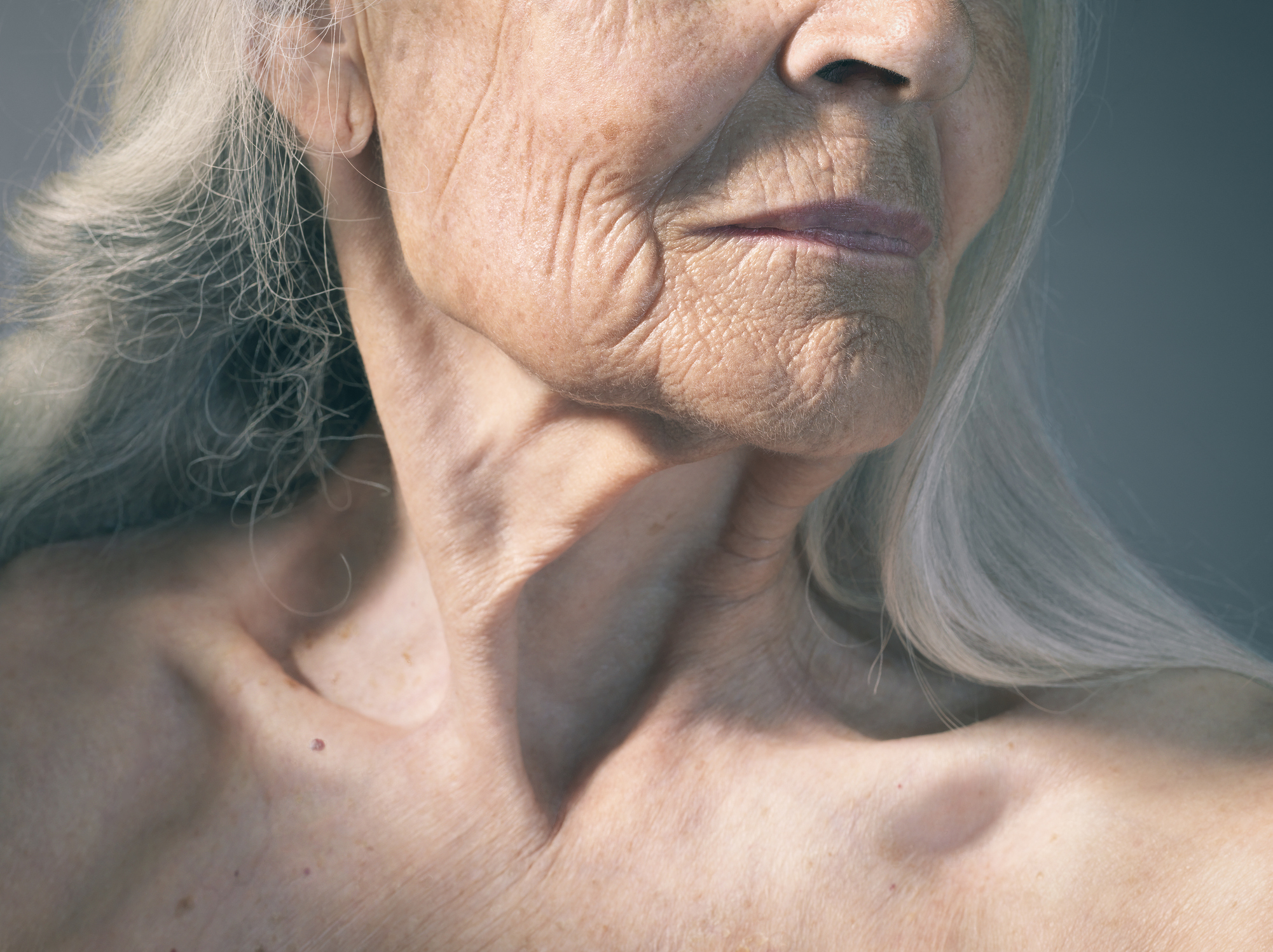
Crepey skin looks thin, finely folded and loose because several layers change together. The surface holds less water, so tiny lines become visible. Barrier lipids decline, so that water escapes more easily. Deeper down, fragmented collagen gives fibroblasts less mechanical support and reduces new collagen production [1].
That is why a hydrating product can make crepey skin look better in minutes without rebuilding it. Water swells the outer cells and softens shadowing between folds. When the water leaves, the effect leaves with it.
For the full biology, start with what causes crepey skin. The practical buying lesson is simpler: a serious serum needs one ingredient for structure and at least one strategy for hydration or barrier support.
What makes a serum different from a lotion
A serum typically uses a lighter water or gel base, less occlusive oil and a higher proportion of selected actives. That can help on the chest, arms or legs when a rich cream feels sticky. It also creates the format’s central weakness: without enough oil or wax, the formula may not stop the newly attracted water from evaporating.
A lotion is an emulsion. It combines water with lipids and usually leaves a more protective film. Our guide to the best body lotion for aging skin explains that category in detail.
The choice is not serum versus lotion as if one must win. For very dry crepey skin, the strongest routine often uses a serum for the active and a plain lotion over it for the seal.
Score the ingredient list in three columns
Column one: structural actives
Retinol has the clearest topical evidence for naturally aged body skin. In a randomized vehicle-controlled trial on elderly participants, 0.4% retinol applied to the arm improved fine wrinkling and increased glycosaminoglycan and procollagen markers over 24 weeks [2]. Another forearm study found that topical retinol restored type I collagen production within four weeks [3].
Concentration alone does not tell you how much active reaches the target or how tolerable the formula will be.
This is the ingredient most likely to change the dermal scaffold rather than only the shine on top. It is also the ingredient most likely to be abandoned if the delivery system causes redness and peeling. Concentration alone does not tell you how much active reaches the target or how tolerable the formula will be.
Niacinamide supports the epidermal side of the problem by increasing synthesis of ceramides and other stratum-corneum lipids [4]. It is not a substitute for retinol’s collagen evidence, but it can make a structural routine easier to tolerate.
Peptides may be useful, but the word “peptide” is too broad to score. A product should name the specific peptide and provide evidence for that molecule in a finished topical formula. An unnamed peptide complex is marketing information, not a mechanism.
Column two: water binders
Glycerin is inexpensive and effective. Controlled work found that glycerol accelerated barrier recovery after experimental disruption [5]. Its unglamorous name is not a reason to discount it.
Hyaluronic acid can improve hydration, but molecular weight and formulation matter. A 2024 randomized trial in older adults with xerosis found different hydration results from different molecular-weight forms [6]. A label that says only “hyaluronic acid” leaves out the specification that may determine performance.
Urea is another useful body-skin ingredient because it attracts water and, at moderate concentrations, softens rough compacted scale. It can sting on cracked or freshly shaved skin, so more is not automatically better.
Column three: the seal
Look for ceramides, squalane, phospholipids or a modest amount of emollient oil. A ceramide review covering clinical formulations found meaningful improvements in hydration and barrier function when the lipid system was properly formulated [7].
A very light serum may contain too little of this third column. That is acceptable if you plan to apply lotion afterward. It is a weakness only when the product claims to replace every other body step.
Judge them as barrier support, not as a facelift in a bottle.
The ingredients that mostly create an illusion
Film-forming polymers can make skin feel tighter as they dry. The effect is real but mechanical: a thin film contracts across the surface. It says nothing about collagen production.
Light-reflecting particles blur shadows between fine folds. They can make legs or arms photograph beautifully, but the result washes off.
Topical collagen is primarily a surface humectant and film former because intact collagen is too large to rebuild dermal fibres from the outside. The label sounds structural; the action is mostly cosmetic.
Botanical oils reduce roughness and add slip. They can be excellent emollients, but most do not have controlled human evidence for rebuilding crepey dermis. Judge them as barrier support, not as a facelift in a bottle.
How to layer a body serum so it earns its price
Apply to slightly damp, intact skin after bathing. Damp does not mean wet enough to dilute the product and make it run. Use enough to create a thin continuous film rather than dotting a facial-sized amount across an entire arm.
If the serum contains retinol, use it at night, start on alternate nights and do not combine it with another retinoid. Reduce frequency if irritation appears. Use sunscreen on exposed areas within 24 hours.
Wait until the serum is no longer wet, then add a fragrance-free lotion when the skin feels dry or tight. The lotion is not blocking the serum; it is reducing evaporation from the hydrated surface. For heavily folded legs, our guide to crepey skin on the legs covers why consistent coverage matters more than a tiny amount of expensive product.
Do not apply retinoids to burned or damaged skin, and avoid them during pregnancy or breastfeeding. Patch-test a new active on a small area before spreading it across the chest or both arms.
Delivery matters more than the word serum
Conventional retinol can be unstable and irritating, so a higher number on the label does not guarantee a better outcome. The delivery vehicle decides how evenly the active is protected, distributed and released.
Nanoretinol provides a useful benchmark. It encapsulates 0.2% retinol in biomimetic lipid nanoparticles. The particles are designed to pass through the epithelial barrier without damaging it, then release retinol while their phospholipid membranes are absorbed. North Biomedical’s study found 232% greater collagen recovery and 73% greater elastin recovery compared with conventional retinol, alongside markedly lower cytotoxicity [8].
That evidence does not mean every product called a nano-serum works, or that a facial bottle is automatically economical for the whole body. It means shoppers should ask about active stability, delivery and tolerability rather than chasing the largest percentage. For the body-specific retinoid comparison, see retinol for crepey skin.
A label test before you buy
Read the first half of the ingredient list and answer four questions.
Is there a named structural active such as retinol? Is there a useful humectant such as glycerin, hyaluronic acid or urea? Is there barrier support in the formula, or are you willing to add lotion? Is the delivery system explained beyond a trademarked blend name?
Then check the packaging. Retinol needs protection from light and air; an opaque airless pump is more credible than a clear open jar. Finally, compare cost per body application rather than cost per bottle. A formula that works only when under-applied is not good value.
The best body serum for crepey skin is not simply the lightest texture or the most luxurious bottle. It is a delivery system with a proven structural active, enough hydration to change the surface and an honest plan for sealing that hydration in.
References
- Quan T, Fisher GJ. “Role of Age-Associated Alterations of the Dermal Extracellular Matrix Microenvironment in Human Skin Aging: A Mini-Review.” Gerontology. 2015;61(5):427-434. doi:10.1159/000371708
- Kafi R, Kwak HS, Schumacher WE, et al. “Improvement of Naturally Aged Skin with Vitamin A (Retinol).” Archives of Dermatology. 2007;143(5):606-612. doi:10.1001/archderm.143.5.606
- Shao Y, He T, Fisher GJ, Voorhees JJ, Quan T. “Topical Retinol Restores Type I Collagen Production in Photoaged Forearm Skin within Four Weeks.” Cosmetics. 2016;3(4):35. doi:10.3390/cosmetics3040035
- Tanno O, Ota Y, Kitamura N, Katsube T, Inoue S. “Nicotinamide Increases Biosynthesis of Ceramides as Well as Other Stratum Corneum Lipids to Improve the Epidermal Permeability Barrier.” British Journal of Dermatology. 2000;143(3):524-531. doi:10.1111/j.1365-2133.2000.03705.x
- Fluhr JW, Gloor M, Lehmann L, Lazzerini S, Distante F, Berardesca E. “Glycerol Accelerates Recovery of Barrier Function In Vivo.” Acta Dermato-Venereologica. 1999;79(6):418-421. doi:10.1080/000155599750009825
- Muhammad P, Novianto E, Setyorini M, et al. “Effectiveness of Topical Hyaluronic Acid of Different Molecular Weights in Xerosis Cutis Treatment in Elderly: A Double-Blind, Randomized Controlled Trial.” Archives of Dermatological Research. 2024;316(6):329. doi:10.1007/s00403-024-03003-2
- Kono T, Miyachi Y, Kawashima M. “Clinical Significance of the Water Retention and Barrier Function-Improving Capabilities of Ceramide-Containing Formulations: A Qualitative Review.” Journal of Dermatology. 2021;48(12):1807-1816. doi:10.1111/1346-8138.16175
- North Biomedical LLC. “Nanoretinol vs. Conventional Retinol: Efficacy in Collagen and Elastin Recovery.” Clinical Study Summary. 2024. Study Summary