Dark Inner Thighs: What Causes Them and How to Actually Fade the Pigmentation
The friction-melanin loop, the medical exclusions, and the topical sequence dermatologists actually use
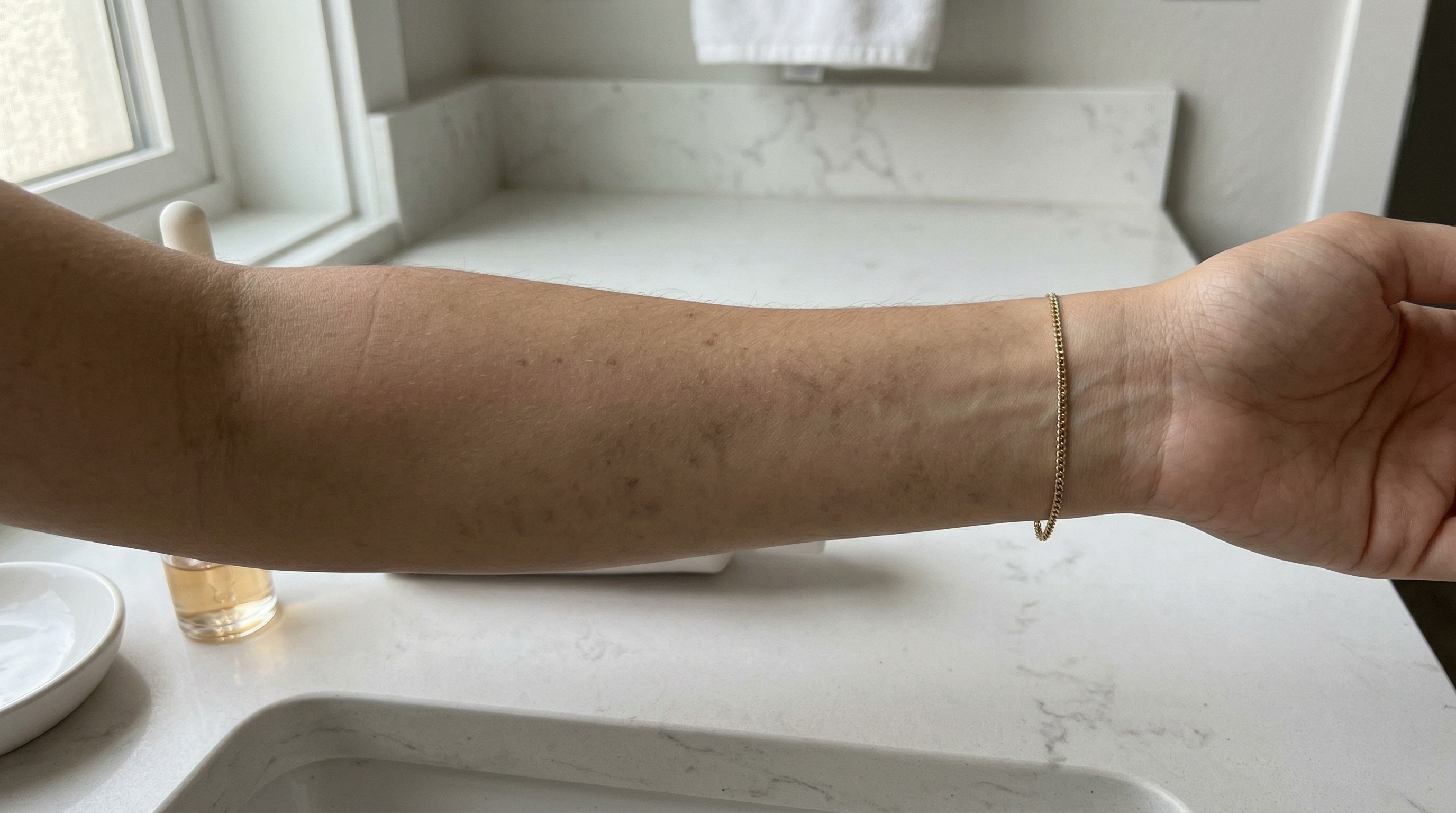
You step out of the shower, glance down, and notice it: a band of skin on the inner thighs that’s noticeably darker than the rest of your legs. The discoloration runs from the upper thigh toward the knee, sometimes patchy, sometimes a smooth gradient. It bothers you in shorts, in swimsuits, in the simple act of sitting bare-legged in the summer. And yet most articles about it either lecture you about being overweight or sell you a “whitening” cream that promises miracles in seven days.
The truth is more useful than either of those. Most cases of dark inner thighs are a specific, well-understood pigmentation pattern called post-inflammatory hyperpigmentation (PIH), driven by friction. A small but important minority are something else entirely — a metabolic skin change called acanthosis nigricans, which behaves differently and means different things. Telling them apart matters, because the treatments that fade PIH won’t reliably touch acanthosis, and the lifestyle changes that affect acanthosis are different from the topical work that fades friction-driven darkness.
Why Friction Makes Skin Darker
The mechanism that turns chafed skin into discolored skin is the same one that turns an acne lesion into a brown spot. When skin is repeatedly irritated, the immune system releases inflammatory mediators — leukotrienes, prostaglandins, interleukins, and reactive oxygen species — that double as melanocyte signaling molecules [1]. Melanocytes, the pigment-producing cells at the bottom of the epidermis, respond to those signals by ramping up melanin production and shipping the pigment up to the surrounding keratinocytes.
The inner thighs are an almost ideal anatomy for this loop. Skin rubs on skin (or on clothing) with every step. Heat builds up. Sweat softens the barrier. Microscopic inflammation develops without ever crossing the threshold of “hurts” or “looks irritated.” Over months and years, the area accumulates what dermatologists call epidermal pigmentation — extra melanin sitting in the keratinocytes — and sometimes deeper dermal pigmentation, where melanin spills past the basement membrane and gets engulfed by macrophages in the upper dermis [1].
This pattern is more visible and more stubborn on melanin-rich skin (Fitzpatrick types IV through VI), where melanocytes respond to inflammatory cues more aggressively and where melanin breakdown is slower [1]. People with lighter skin develop friction PIH too, but it tends to fade faster on its own once the friction stops.
Other contributors layer on top of friction. Hair removal — particularly waxing and razor irritation — adds repeated micro-injuries. Heat and humidity in the warm months accelerate the cycle. Hormonal shifts (pregnancy, hormonal contraceptives, perimenopause) can sensitize melanocytes generally, which makes any friction-driven inflammation more visible. None of these are the underlying cause; they’re amplifiers of the friction loop.
The Medical Exclusion: Acanthosis Nigricans
Before you start fading the area, it’s worth ruling out the one common cause of inner-thigh darkness that needs more than skincare. Acanthosis nigricans (AN) is a velvety, thickened, brownish-black darkening that appears in body folds — the back of the neck, the armpits, sometimes the groin and inner thighs. The skin doesn’t just look darker; it feels different. A thickened, almost suede-like texture is the giveaway [2].
What separates AN from friction PIH is the underlying biology. AN is most often associated with insulin resistance: high circulating insulin activates IGF-1 receptors on keratinocytes, which proliferate and form the velvety overgrowth [2]. It can be a useful early signal of metabolic conditions including type 2 diabetes and polycystic ovary syndrome, which is why dermatologists generally recommend a primary-care visit if the appearance is velvety and textured rather than smoothly pigmented.
You step out of the shower, glance down, and notice it: a band of skin on the inner thighs that’s noticeably darker than the rest of your legs.
A practical test: run your fingers across the dark area. If the texture feels identical to the surrounding lighter skin — just darker — you’re likely looking at PIH and topical fading is the right path. If the area feels raised, soft, slightly furred, especially if it’s also present at the back of your neck or under your arms, talk to a doctor before relying on skincare alone. The two conditions can also coexist on the same body, which is why the fading routines below help with the discoloration component but don’t substitute for medical evaluation when AN is in the picture.
Reducing the Friction Itself
No topical can outwork an active friction source. Before any cream goes on, the cycle has to be interrupted, or the new skincare just runs against a treadmill.
The simplest and least glamorous changes do most of the work. Anti-chafe products — silicone or balm sticks designed for athletes, or a thigh band/short under skirts — eliminate skin-on-skin contact during walking. Looser, breathable underwear and trousers reduce wet heat. Patting (not rubbing) the area dry after showering matters, especially for people who develop chafing easily. If hair removal is part of your routine, switching from razors to a gentler method, or using a fragrance-free post-shave product to calm inflammation, breaks one of the smaller but consistent inflammatory inputs.
The fading work that follows assumes the friction has been substantially reduced. Without that, even the right ingredients in the right vehicle will lose ground every day to fresh inflammation.
The Topical Sequence That Actually Fades PIH
Hyperpigmentation responds to a layered ingredient strategy. No single active does everything; the most effective routines pair a melanin synthesis inhibitor with something that improves melanin disposal and a cell turnover stimulator that brings the pigmented cells to the surface so they can be shed.
Niacinamide is the workhorse you can apply broadly without irritation. A landmark study published in the British Journal of Dermatology demonstrated that niacinamide reduces cutaneous pigmentation by inhibiting the transfer of melanin-containing organelles (melanosomes) from melanocytes to keratinocytes — by 35–68% in cell models — and produced significant clinical lightening at 4 weeks of use [3]. It’s well tolerated on body skin and pairs cleanly with almost every other active.
Alpha arbutin is a tyrosinase inhibitor — it slows the enzyme that melanocytes use to make melanin. A 2021 review in Phytotherapy Research documented alpha arbutin’s superior potency to natural arbutin (the related plant compound) by an order of magnitude on human tyrosinase [4]. The European Scientific Committee on Consumer Safety has cleared it for cosmetic use up to 2%, and most evidence-backed serums sit in the 1–2% range.
Topical retinoids stimulate keratinocyte turnover, which helps shed already-pigmented cells from the upper epidermis and supports remodeling of the deeper layers where some PIH lives [5]. They are also among the most studied general-purpose anti-pigmentation actives in dermatology. The challenge with retinol on inner thighs is irritation: skin in this area is thinner and more occluded than facial skin, and inflammatory irritation from a poorly tolerated retinoid can paradoxically worsen the very PIH you’re trying to fade.
Realistic timeline is 8–16 weeks for noticeable lightening of pigmented friction zones, longer for older, deeper discoloration.
Sunscreen matters even on a body region that rarely sees direct sun. UV passing through swimwear and lightweight clothing is enough to keep melanocytes activated, and the visible light component of sun exposure is now recognized as a separate driver of pigmentation in skin of color [1]. SPF on the inner thighs sounds excessive; on a beach or pool day it’s the difference between fading and stalling.
A sample routine that uses all three actives without overlap: niacinamide-and-alpha-arbutin serum every morning, retinol or retinoid product 3–5 nights a week, mineral or chemical SPF on exposure days. Realistic timeline is 8–16 weeks for noticeable lightening of pigmented friction zones, longer for older, deeper discoloration. PIH that has been present for years, particularly the dermal component, fades more slowly because the pigment is sitting deeper and the macrophages clearing it work in months rather than weeks [1].
Where Conventional Retinol Falls Short on Body Skin
Retinol is the right active for the cell-turnover step of this routine, but conventional formulations have a specific problem on body areas like the inner thighs: irritation potential. The standard approach to getting retinol through the epidermis relies on chemicals and petroleum derivatives that disrupt the lipid mobility of the stratum corneum — they pry the barrier open to push the active through. On facial skin used to retinoids, this is manageable. On thinner, more occluded body skin that is already inflamed from friction, the same delivery method tends to add irritation onto irritation, and inflammation is the very signal melanocytes respond to with more pigment.
Nanoretinol addresses the delivery challenge by encapsulating retinol in biomimetic lipid nanoparticles. The nanoparticles’ outer surface is externally identical to skin cells, so the epithelial barrier recognizes them as “self” and lets them pass without being broken. The active is released near the cells that need it; the phospholipids that made up the particle are absorbed by skin cells as they release their cargo. There’s no need to compromise the barrier to get the retinol in.
In a controlled study, this delivery approach produced 232% greater collagen recovery and 73% greater elastin recovery than conventional retinol, with significantly milder side effects [6]. For the dark inner thigh use case, the relevant facts are the gentler skin tolerance and the cellular delivery efficiency: a 0.2% retinol that actually reaches the relevant cells without setting off new inflammation is precisely what a friction-PIH routine needs from the cell-turnover slot.
For body skin, apply two or three times a week initially, layered over the niacinamide/alpha arbutin in the morning or solo in the evening. Build to nightly use if tolerated. Discontinue 2–3 days before any waxing or laser session in the area to keep the barrier at full strength when it’s mechanically stressed.
What Realistic Improvement Looks Like
Friction PIH on inner thighs that has been accumulating for years won’t disappear in a month, even with a perfect routine. What you should see, in order: reduced new darkening within the first few weeks (because the friction inputs have been reduced); a softening of the most recent, surface-level pigment by weeks 6–10; meaningful overall lightening between months 3 and 6. Older, deeper pigment can take twelve months or longer.
The single biggest reason routines fail is that the friction never stopped. A topical brightener applied diligently to skin that is still being chafed every morning is doing maintenance work, not fading. The second-biggest reason is jumping between products every two weeks, which never gives any single active enough continuous time to demonstrate what it can do. Pick a stack that targets the three steps — synthesis, transfer, turnover — and stay with it long enough to judge it honestly.
Inner thigh discoloration is treatable, in most cases, with patience and a routine that respects how PIH actually works. The skin you have right now is not the skin you’ll have in a year if you address both the cause and the consequence.
References
-
Davis EC, Callender VD. “Postinflammatory Hyperpigmentation: A Review of the Epidemiology, Clinical Features, and Treatment Options in Skin of Color.” The Journal of Clinical and Aesthetic Dermatology. 2010;3(7):20-31. PMID:20725554
-
Phiske MM. “An approach to acanthosis nigricans.” Indian Dermatology Online Journal. 2014;5(3):239-249. doi:10.4103/2229-5178.137765
-
Hakozaki T, Minwalla L, Zhuang J, Chhoa M, Matsubara A, Miyamoto K, et al. “The effect of niacinamide on reducing cutaneous pigmentation and suppression of melanosome transfer.” British Journal of Dermatology. 2002;147(1):20-31. doi:10.1046/j.1365-2133.2002.04834.x
-
Saeedi M, Khezri K, Seyed Zakaryaei A, Mohammadamini H. “A comprehensive review of the therapeutic potential of α-arbutin.” Phytotherapy Research. 2021;35(8):4136-4154. doi:10.1002/ptr.7076
-
Mukherjee S, Date A, Patravale V, Korting HC, Roeder A, Weindl G. “Retinoids in the treatment of skin aging: an overview of clinical efficacy and safety.” Clinical Interventions in Aging. 2006;1(4):327-348. doi:10.2147/ciia.2006.1.4.327
-
North Biomedical LLC. “Nanoretinol vs. Conventional Retinol: Efficacy in Collagen and Elastin Recovery.” Clinical Study Summary, 2024. Read the study