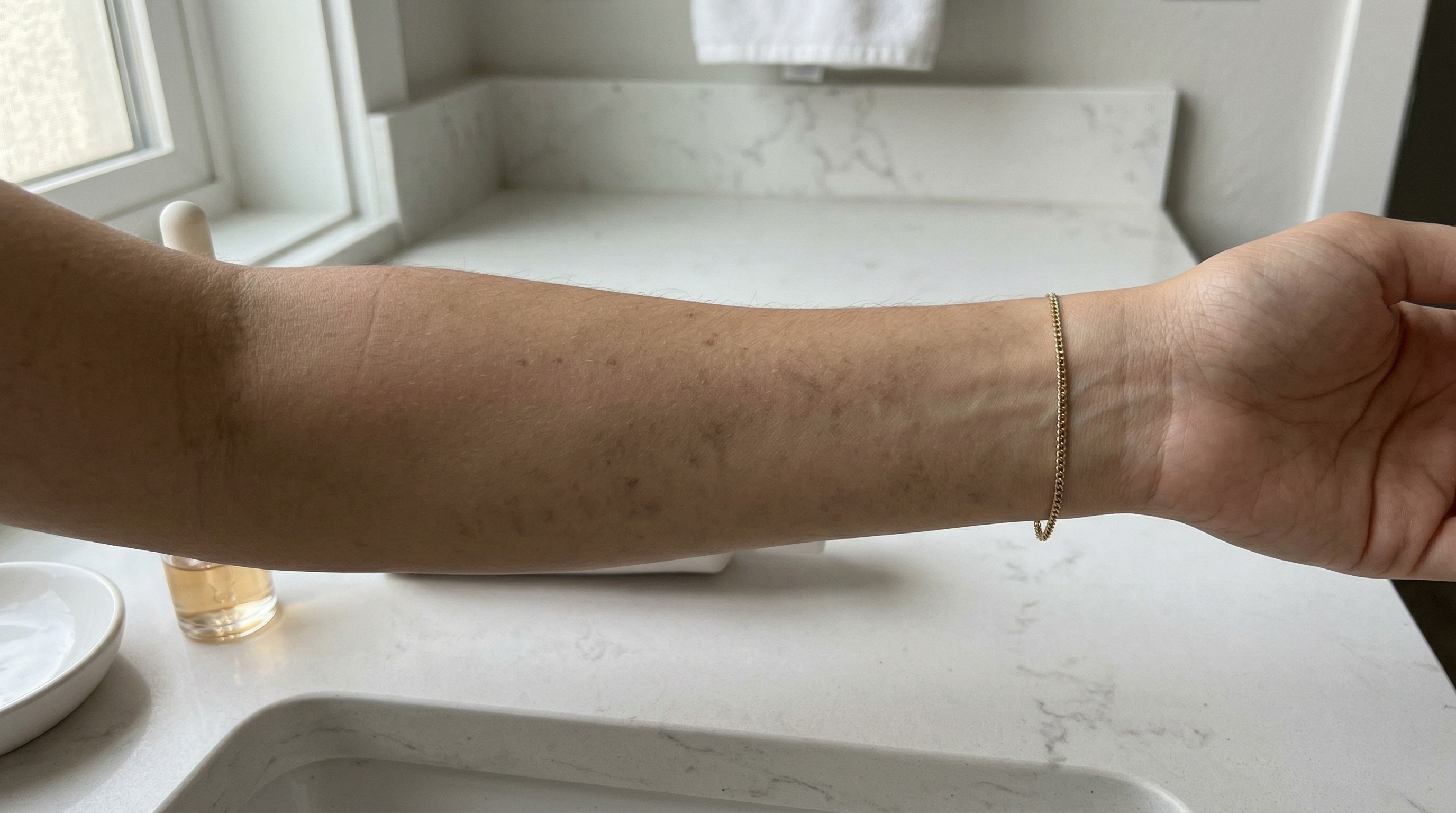
Hyperpigmentation on Legs: Why Dark Spots Appear and How to Fade Them
The real causes of leg discoloration — and an evidence-based plan to even your skin tone
You shave your legs, slip into a skirt, and there they are: a scatter of brown and grey-brown marks where a razor nick, an ingrown hair, or an old bug bite used to be. Hyperpigmentation on legs is one of the most common — and most frustrating — pigment problems, precisely because the legs take so much daily abuse and heal so much more slowly than the face.
The good news is that most leg discoloration is cosmetic, predictable, and treatable. The less convenient news is that it asks for patience. Leg skin turns over slowly, and the pigment that makes a spot dark is often deposited deeper than it is on the face. Understanding exactly what you are looking at is the first step to fading it.
What hyperpigmentation on legs actually is
Hyperpigmentation is not a disease. It is your skin overproducing melanin — the brown pigment made by cells called melanocytes — in response to injury, inflammation, or sun. When melanocytes are triggered, they hand off pigment-filled packages called melanosomes to surrounding skin cells. On the legs, those triggers come constantly: shaving, waxing, ingrown hairs, folliculitis, insect bites, scratches, and healed blemishes.
When pigment forms after this kind of inflammation, dermatologists call it post-inflammatory hyperpigmentation, or PIH. It is one of the most common reasons people of every skin tone seek help for uneven skin, and it is more frequent and more stubborn in deeper skin tones [1]. The other big driver is sun exposure: legs get far less sunscreen than faces, so cumulative ultraviolet light deepens existing marks and adds new ones.
Every dark mark on your legs is your skin doing its job a little too enthusiastically, flooding an injured spot with extra pigment long after the original scratch or bump has healed.
Every dark mark on your legs is your skin doing its job a little too enthusiastically, flooding an injured spot with extra pigment long after the original scratch or bump has healed.
The depth of the pigment matters enormously. When melanin sits high in the epidermis, marks look brown and respond reasonably well to topicals. When inflammation damages the boundary between the upper and lower skin layers, pigment can drop into the dermis, where it looks greyer and fades far more slowly [1]. This is why a mosquito bite you scratched two summers ago can still be faintly visible today.
Why legs are especially prone to dark spots
Three things conspire against your legs. First, mechanical trauma is relentless — a single careless shave can plant a row of new marks. Second, leg skin has fewer oil glands, a more fragile barrier, and slower cell turnover than facial skin, so it both inflames easily and clears pigment grudgingly. Third, legs are chronically under-protected from the sun, which keeps melanocytes primed.
This combination explains the classic patterns: dark dots around hair follicles from shaving and ingrowns, larger faded-brown patches from old bites or eczema flares, and a general mottled tone on the shins from years of incidental sun. None of these are dangerous, but all of them photograph and catch the light in ways that read as “aging” or “tired” skin.
A quick, honest caveat: not every change in leg color is cosmetic. Velvety dark patches in skin folds, rapidly spreading discoloration, a single spot that changes shape or color, or brownish staining around the ankles tied to swelling all deserve a doctor’s eye rather than a serum. If your marks are the everyday brown spots left behind by shaving, sun, and healed bumps, the plan below is built for you.
How to fade hyperpigmentation on legs
There is no single miracle product. Fading leg pigment works the way compound interest works — small, consistent inputs that add up over months. A complete plan attacks the problem from four angles.
If you do not protect the area, even the best fading routine is bailing a boat with a hole still in it.
Stop making new pigment. This is the step everyone skips. Daily broad-spectrum SPF on exposed legs prevents existing marks from deepening, and switching to a sharp razor, shaving with the grain, and exfoliating gently reduces the ingrowns and nicks that start the cycle. If you do not protect the area, even the best fading routine is bailing a boat with a hole still in it.
Slow the handoff of pigment. Niacinamide (vitamin B3) works by interrupting the transfer of melanosomes from melanocytes to surrounding skin cells. In controlled studies, topical niacinamide measurably reduced hyperpigmentation and increased skin lightness compared with vehicle after just four weeks [2]. It is gentle enough for daily use almost anywhere on the body. You can read more about its broader benefits in our guide to niacinamide for skin.
Lighten the pigment already there. Tyrosinase inhibitors — the enzyme that builds melanin — are the lightening workhorses. Options range from gentler agents to prescription-strength choices, and many people layer in tranexamic acid for dark spots for stubborn discoloration.
Speed up turnover so pigmented cells shed faster. This is where retinoids earn their reputation. Topical retinoids increase the rate at which pigment-laden skin cells are replaced, inhibit tyrosinase, and reduce the transfer of melanosomes — a three-front attack on a dark spot [3]. In a landmark 40-week trial, post-inflammatory hyperpigmentation treated with topical tretinoin became significantly lighter than untreated lesions, with epidermal melanin content measurably reduced [4]. Systematic reviews of tretinoin for sun-damaged skin similarly report meaningful improvement in mottled hyperpigmentation [5].
A realistic timeline
Set expectations before you start. Epidermal (brown) marks often show visible improvement in eight to twelve weeks of consistent treatment. Deeper, greyer pigment can take six months or more, and some very old dermal pigment may never fully disappear with topicals alone. The single biggest predictor of success is not which product you buy — it is whether you use it every day and keep the sun off the area while it works. For sun-driven spots specifically, our deeper dive on age spots on legs and sunscreen for hyperpigmentation covers prevention in detail.
Where retinol fits — and a smarter way to deliver it
If you read the research closely, one theme keeps surfacing: the retinoid family does more to address hyperpigmentation than almost any other shelf-stable ingredient, because it works on melanin production, melanin transfer, and cell turnover at the same time [3][4]. The catch is that conventional retinol is harsh, especially on the fragile, barrier-compromised skin of the legs — the redness and peeling it causes can itself trigger more post-inflammatory pigment, the very problem you are trying to fix.
This is the gap Nanoretinol was built to close. Instead of relying on harsh penetration enhancers that disrupt the skin barrier, Nanoretinol encapsulates retinol inside biomimetic lipid nanoparticles that the skin recognizes as “self” and admits without damage. In North Biomedical’s clinical study, this delivery system proved 232% more effective at collagen recovery than conventional retinol while being significantly gentler on skin cells — a meaningful advantage when you are treating an area that scars and re-pigments easily. For the bigger picture on how this active works against pigment, see our guide to retinol for dark spots.
The bottom line on leg discoloration
Hyperpigmentation on legs is the predictable result of constant minor injury, slow healing, and under-protection from the sun. You fade it by protecting the skin, interrupting pigment transfer with niacinamide, lightening existing marks, and accelerating turnover with a well-formulated retinoid — then giving the plan the months it genuinely needs. Consistency, not intensity, wins here. The gentlest routine you will actually follow every day will always beat the aggressive one you abandon after a week of irritation.
References
- Davis EC, Callender VD. “Postinflammatory Hyperpigmentation: A Review of the Epidemiology, Clinical Features, and Treatment Options in Skin of Color.” Journal of Clinical and Aesthetic Dermatology. 2010;3(7):20-31. PMID: 20725554
- Hakozaki T, Minwalla L, Zhuang J, et al. “The effect of niacinamide on reducing cutaneous pigmentation and suppression of melanosome transfer.” British Journal of Dermatology. 2002;147(1):20-31. PMID: 12100180
- Kang HY, Valerio L, Bahadoran P, Ortonne JP. “The role of topical retinoids in the treatment of pigmentary disorders: an evidence-based review.” American Journal of Clinical Dermatology. 2009;10(4):251-260. PMID: 19489658
- Bulengo-Ransby SM, Griffiths CE, Kimbrough-Green CK, et al. “Topical tretinoin (retinoic acid) therapy for hyperpigmented lesions caused by inflammation of the skin in black patients.” New England Journal of Medicine. 1993;328(20):1438-1443. PMID: 8479462
- Sitohang IBS, Makes WI, Sandora N, Suryanegara J. “Topical tretinoin for treating photoaging: A systematic review of randomized controlled trials.” International Journal of Women’s Dermatology. 2022;8(1):e003. PMID: 35620028