
Dimpled Chin: Why Your Chin Looks Like an Orange Peel and How to Smooth It
The cobblestone texture is a muscle problem, a collagen problem, and a fixable one
The first time most women notice it is in a video call. The lighting hits the chin from above, and what should be a smooth surface looks like a quilted handbag — small dimples and ridges, the texture of an orange peel. The clinical name is peau d’orange (literally, orange-peel skin), and dermatologists call it cobblestone chin or pebbled chin. The cosmetic concern is real, but so is the good news: this is one of the more treatable visible signs of facial aging, and it responds to a combination of approaches you can start at home.
Why Your Chin Is Doing This
A dimpled chin is the visible signature of a small muscle called the mentalis behaving like an overworked elastic band. The mentalis is a paired muscle that originates from the front of your jawbone, just below the lower lip, and inserts directly into the dermis of your chin skin. A 2023 anatomical review described the mentalis as having muscle fibers that connect into the dermal layer at depths of 6.7 to 10.7 mm beneath the surface [1]. That direct skin attachment is the whole story of cobblestone chin.
Every time you pout, frown, push food around in your mouth, or even compress your lower lip while concentrating, the mentalis contracts and tugs the overlying skin into ridges. In your twenties, the dermis is thick enough — with enough collagen and elasticity — to bounce flat afterward. By your forties, two things have changed. The mentalis itself has often become hyperactive, contracting at rest from decades of habitual use. And the dermis above it has thinned and lost its bounce.
The result is a chin that looks dimpled even when your face is at rest. A stronger pout makes it dramatic.
The Two Forces You’re Fighting
To plan a treatment, separate the two contributors:
Muscle hyperactivity. The mentalis is one of the most reflexively active muscles in the lower face. It fires unconsciously when you swallow, sip, focus, or feel mildly anxious. With age, this resting tone increases. Hyperactivity isn’t a personal flaw — it correlates with anatomy, oral posture, and habits like nighttime teeth clenching.
In your twenties, the dermis is thick enough — with enough collagen and elasticity — to bounce flat afterward.
Collagen and elastin loss in the chin skin. This is where the dimpled-chin story overlaps with every other facial aging story. Ultraviolet radiation activates matrix metalloproteinases — particularly MMP-1, MMP-3, and MMP-9 — which fragment dermal collagen and elastin [2]. As that scaffolding breaks down, the dermis becomes thinner and less elastic, so the skin no longer recovers when the muscle below it pulls.
Most women in their forties have some of both. The mentalis is more active than it used to be, and the dermis is less able to mask the muscle’s behavior. Treatment works best when it addresses both.
What Smooths It
There are three categories of intervention, and they layer well.
Botulinum toxin into the mentalis. This is the most direct and predictable fix for the muscle component. A small dose — typically 4 to 8 units, placed near the chin point — relaxes the mentalis enough that the skin stops being pulled into dimples. Anatomical guidelines published in Anatomy & Cell Biology recommend a deep-and-superficial injection technique to avoid paradoxical bulging or asymmetry [1]. Effects last about three to four months. For severe cobblestone chin, this is the single most effective intervention. It does not, however, rebuild the skin; it only tells the muscle to stop pulling.
Hyaluronic acid filler. Used judiciously, a small amount of filler placed in the mental crease (the horizontal line where the chin meets the lower lip) or layered into the chin pad itself can fill the dimples from below and restore the smooth contour. This is most useful when the dimpling is paired with chin recession or volume loss, which is common in women over fifty.
The landmark New England Journal of Medicine trial showed an 80% increase in collagen I formation in photodamaged skin after tretinoin treatment, versus a 14% decrease in vehicle-treated controls.
Topical retinoids and a strong dermis. This is the part you control at home, and it is the only piece that addresses the collagen loss directly. Topical retinol and tretinoin both stimulate fibroblasts to produce new collagen. The landmark New England Journal of Medicine trial showed an 80% increase in collagen I formation in photodamaged skin after tretinoin treatment, versus a 14% decrease in vehicle-treated controls [3]. A randomized trial of over-the-counter retinol on naturally aged skin showed similar improvements in fine wrinkles and increased collagen synthesis after consistent use [4]. A 2022 review of clinical evidence confirmed that consistent retinoid use thickens the dermis and improves skin firmness over three to six months [5].
A thicker, more elastic dermis won’t completely hide a hyperactive mentalis on its own, but it makes the dimples shallower and softer at rest, and it dramatically improves the result if you also do a small amount of botulinum toxin.
A Practical Routine
If your dimpled chin is mild — visible only when you intentionally pout — start at home. A nightly retinol, daily SPF, and a peptide moisturizer over six to nine months will measurably thicken the dermis and reduce resting dimpling. Avoid the temptation to massage or pinch the chin aggressively; the mentalis already gets enough mechanical stimulation.
If your chin looks pebbled at rest, combine a topical regimen with a single botulinum toxin appointment. The toxin solves the muscle problem in two weeks; the topical work, run in the background, makes sure that when the toxin wears off, the underlying skin is in better shape than it was.
If the dimpling is paired with mental crease deepening or chin recession, add a syringe of hyaluronic acid filler in that location. This is the most common combination request that experienced injectors see in women in their forties and fifties.
For broader strategies on improving the resilience of aging skin, see our guides on how to improve skin elasticity, skin firmness loss, and chin wrinkles.
Why The Retinol Choice Matters
The chin pad is sensitive. Many women try topical retinol, encounter peeling, redness, and tightness, and quit before they see the collagen-rebuilding benefit. This is the central problem with conventional retinol formulations — most use petroleum-derived solvents to disrupt the skin barrier and force the molecule through, which is mechanistically destructive on thin or reactive skin [6].
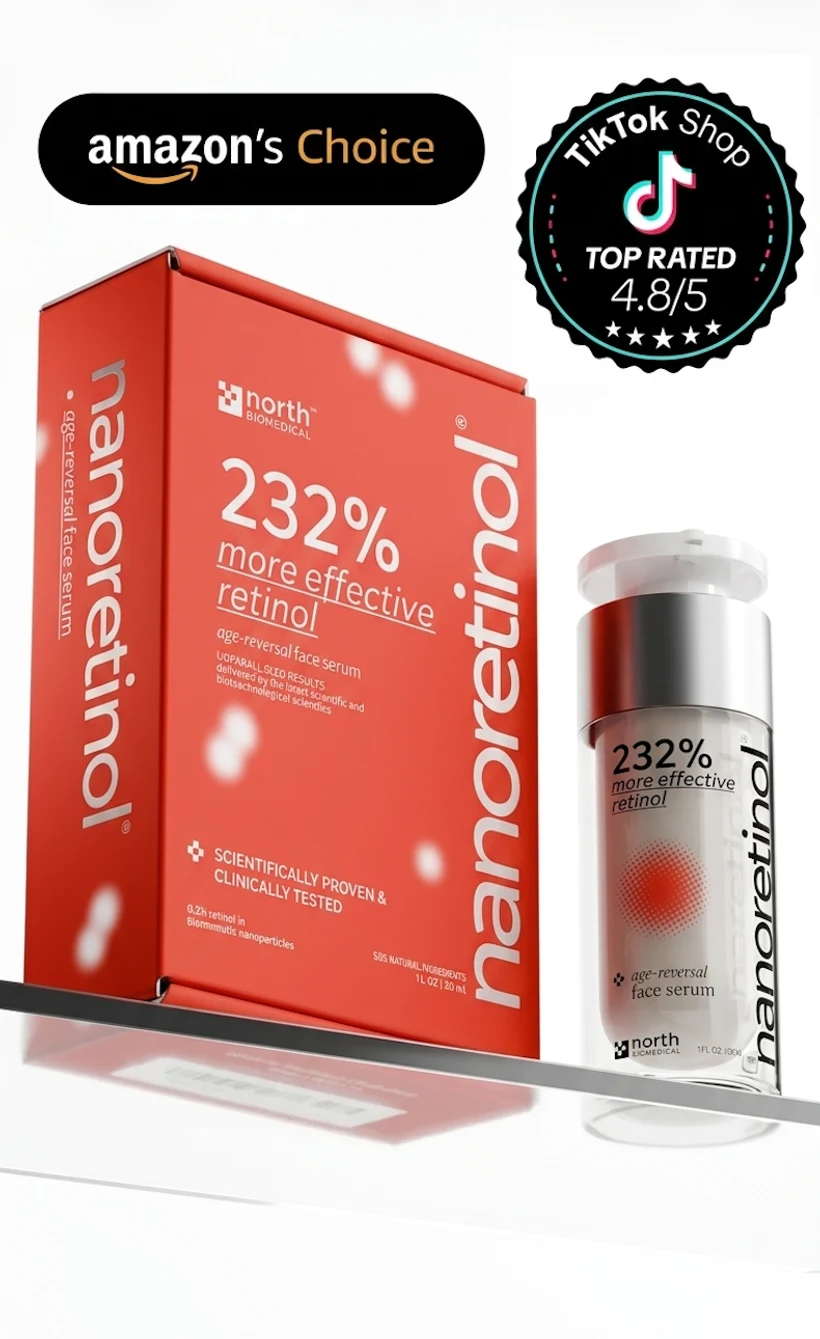
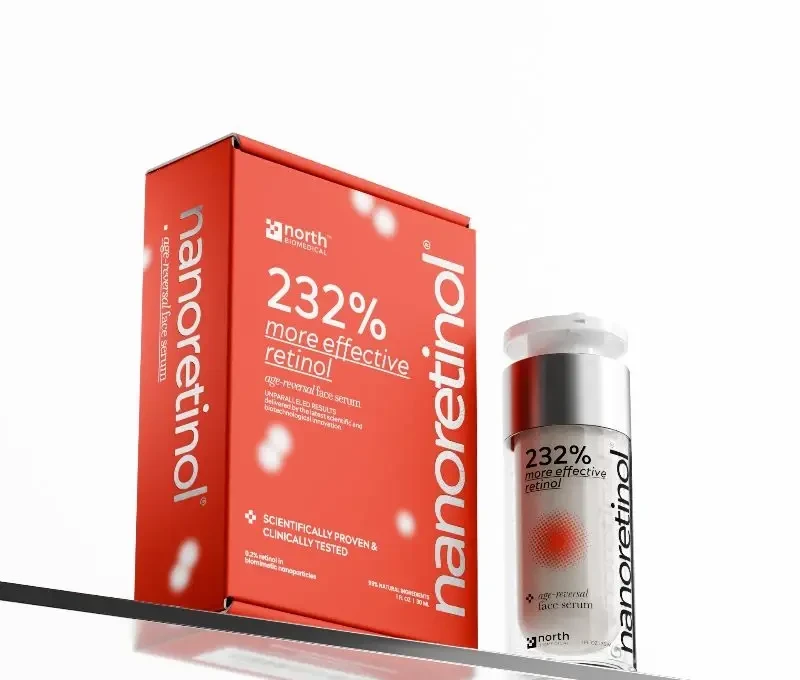
A more recent generation of delivery systems uses lipid nanoparticle encapsulation to ferry retinol through the epithelial barrier without damaging it. The nanoparticles are externally identical to skin cells, so the body recognizes them as “self” and allows passage without barrier compromise. Nanoretinol uses this delivery format, and in North Biomedical’s clinical study it produced 232% greater collagen recovery and 73% greater elastin recovery than conventional retinol — alongside drastically reduced cytotoxicity in cellular assays [7]. For chin skin specifically, where compliance often falls apart from irritation, that combination matters.
The Bigger Picture
A dimpled chin is one of the few signs of facial aging where the mechanism is fully understood and the treatments are predictable. The mentalis is doing too much; the dermis above it is doing too little. Address both, and the texture changes within a few months. For most women in their forties, the at-home retinol regimen alone produces a softer, smoother chin within a season — and it sets up every other intervention to work better.
References
- Yi KH, Lee JH, Hu HW, et al. “Novel anatomical guidelines for botulinum neurotoxin injection in the mentalis muscle: a review.” Anatomy & Cell Biology. 2023;56(3):293-298. doi:10.5115/acb.22.266
- Quan T, Qin Z, Xia W, Shao Y, Voorhees JJ, Fisher GJ. “Matrix-degrading Metalloproteinases in Photoaging.” Journal of Investigative Dermatology Symposium Proceedings. 2009;14(1):20-24. doi:10.1038/jidsymp.2009.8
- Griffiths CE, Russman AN, Majmudar G, Singer RS, Hamilton TA, Voorhees JJ. “Restoration of Collagen Formation in Photodamaged Human Skin by Tretinoin (Retinoic Acid).” New England Journal of Medicine. 1993;329(8):530-535. doi:10.1056/NEJM199308193290803
- Kafi R, Kwak HSR, Schumacher WE, et al. “Improvement of naturally aged skin with vitamin A (retinol).” Archives of Dermatology. 2007;143(5):606-612. doi:10.1001/archderm.143.5.606
- Milosheska D, Roškar R. “Use of Retinoids in Topical Antiaging Treatments: A Focused Review of Clinical Evidence for Conventional and Nanoformulations.” Advances in Therapy. 2022;39(12):5351-5375. doi:10.1007/s12325-022-02319-7
- Mukherjee S, Date A, Patravale V, Korting HC, Roeder A, Weindl G. “Retinoids in the treatment of skin aging: an overview of clinical efficacy and safety.” Clinical Interventions in Aging. 2006;1(4):327-348. doi:10.2147/ciia.2006.1.4.327
- North Biomedical LLC. “Nanoretinol vs. Conventional Retinol: Efficacy in Collagen and Elastin Recovery.” Clinical Study Summary, 2024. https://northbiomedical.com/documents/Nanoretinol-Study_Summary.pdf