Ethylhexyl Palmitate: Does It Clog Pores, and Is It Safe?
The silky ester in foundations, sunscreens and serums: what it does, where its pore-clogging reputation came from, and who should still skip it
If your foundation glides on without drag, or your sunscreen spreads into a thin, even film instead of a sticky paste, there is a fair chance ethylhexyl palmitate is helping. It is one of the most common silky oils in makeup and skincare. It is also one of the ingredients that shows up most often on “avoid if you break out” lists.
Both reputations have some basis. This guide explains what ethylhexyl palmitate is, why formulators like it, where the pore-clogging warning came from, and how to decide whether it belongs in your routine.
What Ethylhexyl Palmitate Is
Ethylhexyl palmitate is an ester, made by joining palmitic acid, a fatty acid abundant in palm oil and in human sebum, to 2-ethylhexanol, a branched alcohol. Older labels call it octyl palmitate, and you may also see it as 2-ethylhexyl palmitate.
The branch in the alcohol part matters. It stops the molecules from packing tightly, so ethylhexyl palmitate stays a thin, clear liquid at room temperature instead of a wax. It spreads easily, absorbs fast and leaves a dry, silky feel rather than the heavy slick of a plant oil.
What It Does in a Formula
- Emollient. It softens and smooths the skin surface. Raman spectroscopy studies of moisturizing ingredients classify it as an emollient rather than a humectant that pulls in water or an occlusive that seals it in [1].
- Slip and spread. It reduces drag, so creams, foundations and sunscreens glide on and leave an even layer.
- Pigment wetting. It coats pigment particles in makeup so the color disperses evenly instead of streaking.
- Solvent. It dissolves oil-soluble ingredients, including many sunscreen filters, which helps them stay evenly spread across the skin.
That combination is why it shows up so often in long-wear foundation, a category our guide to the best foundation for mature skin covers in depth.
Your skin is not a rabbit’s ear, yet most of the pore-clogging scores you see online were built on rabbit ears more than 40 years ago.
Is It Safe?
For most people, yes. The Cosmetic Ingredient Review expert panel assessed 237 alkyl esters, ethylhexyl palmitate among them, in 2015. It concluded that they are safe in cosmetics at current use levels when formulated to be non-irritating [2]. Allergic reactions to ethylhexyl palmitate are rarely reported in the patch-test literature.
The real question most people have is not toxicity. It is pores.
Where the Pore-Clogging Reputation Came From
Your skin is not a rabbit’s ear, yet most of the pore-clogging scores you see online were built on rabbit ears more than 40 years ago.
In 1984, dermatologist James Fulton and colleagues published comedogenicity ratings for dozens of cosmetic ingredients using the rabbit ear assay. The inner ear of a rabbit forms blackhead-like plugs quickly when an irritating or pore-blocking substance is applied, so it became a fast screening model. Fulton listed isopropyl myristate and its relatives as offenders, including octyl palmitate, which is ethylhexyl palmitate under its older name [3]. A later study by the Maibach group confirmed that several of these esters, such as isopropyl palmitate and butyl stearate, produce comedones in the rabbit model [4].
Those ratings spread into the comedogenic charts still circulating today. The trouble is that the rabbit ear is far more sensitive than human facial skin, and the ingredients were tested at full strength, not at the few percent used in a real product.
What Human Testing Shows
Your skin reacts to a finished product, not to a single raw ingredient tested at 100% strength in a lab.
Your skin reacts to a finished product, not to a single raw ingredient tested at 100% strength in a lab.
In 2006, dermatologist Zoe Draelos and Joseph DiNardo tested finished cosmetic products on the upper backs of six people prone to forming comedones, applying them three times a week for four weeks and then counting microcomedones. Their conclusion was blunt: finished products made with comedogenic ingredients are not necessarily comedogenic [5].
That does not mean the old charts are worthless. They flag ingredients worth watching if you break out easily. But a product containing ethylhexyl palmitate low on its label can be perfectly fine for acne-prone skin, while a product built heavily on it may not be. The finished formula, and ideally a non-comedogenic claim backed by human testing, tells you more than any single ingredient. Our guide to non-comedogenic moisturizers explains what to look for on a label.
The Fungal Acne Question
Ethylhexyl palmitate also appears on lists of ingredients to avoid for “fungal acne,” or Malassezia folliculitis. This condition looks like small, uniform, itchy bumps, often on the forehead, chest or back, and is caused by an overgrowth of the yeast Malassezia, which feeds on skin oils [6]. Hot, humid weather and blocked hair follicles are among its risk factors.
Malassezia can break esters apart. A German laboratory study found that the yeast split synthetic fatty acid esters at very different rates depending on the alcohol part of the molecule, and that the fatty acids released fed its growth, with unsaturated fatty acids more stimulating than saturated ones such as palmitic acid [7]. Ethylhexyl palmitate itself was not tested, so the direct evidence is thin. If you have had fungal acne confirmed by a dermatologist, keeping fatty esters out of your products is a reasonable precaution, but there is no proof that ethylhexyl palmitate causes the condition.
How It Compares With Similar Oils
Ethylhexyl palmitate sits in a family of light esters. Isopropyl myristate is lighter still and works as a penetration enhancer, which earns it a harsher place on pore-clogging lists. Caprylic/capric triglyceride, made from coconut-derived fatty acids, feels a little richer and is often preferred in sensitive-skin formulas. All three are safe for most skin, and all three are best judged in the context of the whole product.
Who Should Skip It
- People who break out easily from makeup or sunscreen. If a product with ethylhexyl palmitate high on the list coincides with new blackheads, it is worth testing an ester-free alternative.
- People with confirmed fungal acne. A lighter, ester-free routine is a sensible experiment while treatment works.
- Everyone else can use it freely.
Why the Base Matters for Retinol Too
Retinol is a go-to ingredient for clogged pores and aging skin, but many retinol serums dissolve it in an oil phase built from esters like these. That can make the product feel heavy on oily skin, and many conventional retinol formulas also rely on chemicals and petroleum derivatives that loosen the skin barrier to push retinol through, which is a large part of why they cause redness and peeling.
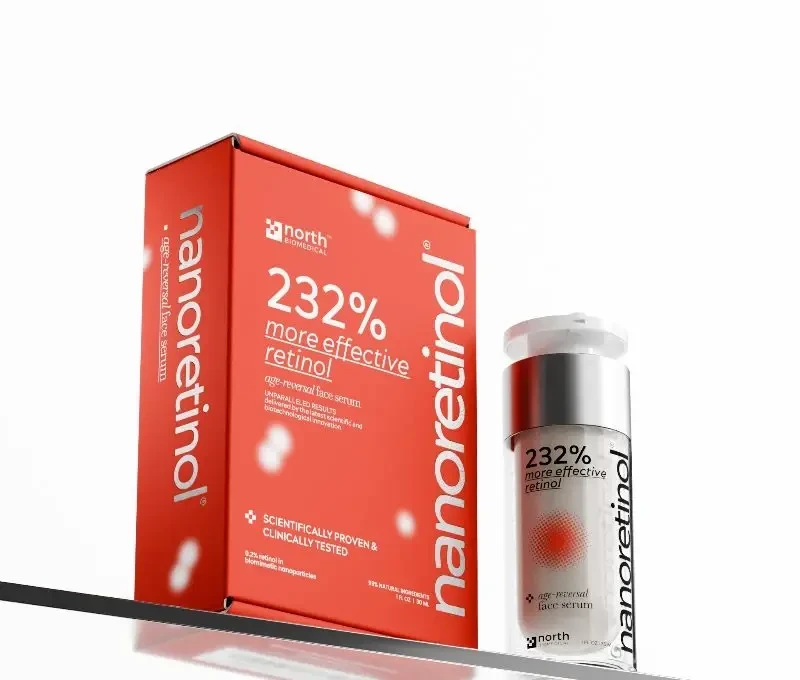
Nanoretinol takes a different route. Its 0.2% retinol is carried inside biomimetic lipid nanoparticles that the skin recognizes as its own, in a water-based gel made with 99% natural ingredients that absorbs completely and leaves a smooth matte finish. In North Biomedical’s study, Nanoretinol was 232% more effective in collagen recovery and 73% more effective in elastin recovery than conventional retinol, with a 61% increase in firmness and a 56% increase in elasticity after 56 days of use [8]. It suits oily, combination and sensitive skin and is applied once daily at night, with sunscreen the next morning.
Silky, Safe and Usually Fine
Ethylhexyl palmitate is a safe, useful emollient that makes makeup and sunscreen pleasant to wear. Its pore-clogging reputation comes from rabbit-ear tests of the raw ingredient, and human testing shows the finished product matters more. If you break out easily or have fungal acne, try ester-free options and watch how your skin responds. Otherwise, there is no need to fear it.
References
- Vyumvuhore R, Tfayli A, Manfait M, Baillet-Guffroy A. “Vibrational spectroscopy coupled to classical least square analysis, a new approach for determination of skin moisturizing agents’ mechanisms.” Skin Research and Technology. 2014;20(3):282-292. doi:10.1111/srt.12117
- Fiume MM, Heldreth BA, Bergfeld WF, et al. “Safety Assessment of Alkyl Esters as Used in Cosmetics.” International Journal of Toxicology. 2015;34(2 Suppl):5S-69S. doi:10.1177/1091581815594027
- Fulton JE Jr, Pay SR, Fulton JE 3rd. “Comedogenicity of current therapeutic products, cosmetics, and ingredients in the rabbit ear.” Journal of the American Academy of Dermatology. 1984;10(1):96-105. PubMed: 6229554
- Nguyen SH, Dang TP, Maibach HI. “Comedogenicity in rabbit: some cosmetic ingredients/vehicles.” Cutaneous and Ocular Toxicology. 2007;26(4):287-292. doi:10.1080/15569520701555383
- Draelos ZD, DiNardo JC. “A re-evaluation of the comedogenicity concept.” Journal of the American Academy of Dermatology. 2006;54(3):507-512. doi:10.1016/j.jaad.2005.11.1058
- Draelos ZD, Barbieri JS, Tanghetti EA, et al. “Malassezia Folliculitis Presentation, Diagnosis, and Treatment: A Review of ‘Fungal Acne’.” Journal of Drugs in Dermatology. 2026;25(5):427-434. doi:10.36849/JDD.9751
- Mayser P, Führer D, Schmidt R, Gründer K. “Hydrolysis of fatty acid esters by Malassezia furfur: different utilization depending on alcohol moiety.” Acta Dermato-Venereologica. 1995;75(2):105-109. doi:10.2340/0001555575105109
- North Biomedical LLC. “Nanoretinol vs. Conventional Retinol: Efficacy in Collagen and Elastin Recovery.” Clinical Study Summary, 2024. Study summary