Caprylic/Capric Triglyceride: What It Is and Is It Good for Skin?
The light coconut-derived oil hiding in thousands of labels: how it differs from coconut oil, why formulators love it, what the safety data show, and who might avoid it
Turn over a moisturizer, a sunscreen, a foundation or a face oil, and there is a good chance you will find caprylic/capric triglyceride near the top of the list. It sounds like something from a lab manual, but it is one of the gentlest, most ordinary oils in cosmetics.
This guide explains what it is, how it differs from the coconut oil it comes from, what it does in a formula, and what the safety evidence says.
What Caprylic/Capric Triglyceride Is
A triglyceride is the basic shape of almost every fat and oil: one glycerin backbone carrying three fatty acids. In caprylic/capric triglyceride, those fatty acids are caprylic acid (8 carbons long) and capric acid (10 carbons long). Because these chains are short by fat standards, chemists call it a medium-chain triglyceride, the same family as the MCT oil sold as a food supplement.
Manufacturers usually start with coconut or palm kernel oil, split it into its fatty acids, keep the caprylic and capric fractions, and rebuild them onto glycerin. The result is a clear, nearly odorless, thin oil that stays liquid in the fridge.
How It Differs From Coconut Oil
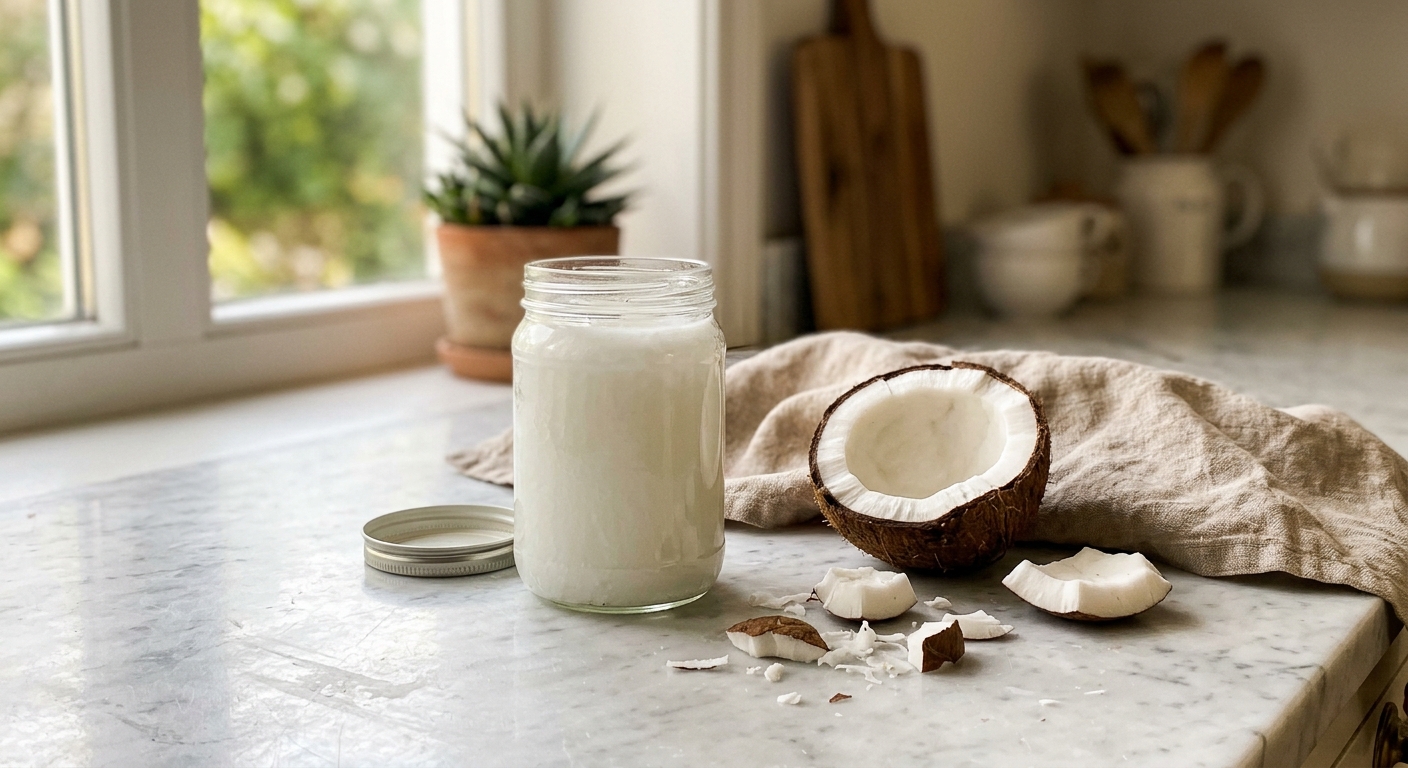
Coconut oil is a mixture of many fatty acids, led by lauric acid (12 carbons), plus longer and partly unsaturated chains. It is solid at cool room temperature, has a noticeable scent, and feels rich on skin. That richness can be a plus: in a 2-week randomized trial in 34 people with dry legs, virgin coconut oil improved hydration as well as mineral oil did, with no change in water loss through the skin [1]. Our guide to coconut oil for skin covers when it helps and when it clogs.
Caprylic/capric triglyceride keeps the light, slippery feel of the medium-chain fraction and leaves out the rest. It is:
Your skin gets the light, silky part of coconut oil without the heavy feel, the coconut scent or the solid texture of the whole oil.
- Lighter. It spreads quickly and sinks in without a heavy film.
- Fully saturated. It has no double bonds for oxygen to attack, so it resists going rancid far better than most plant oils.
- Consistent. Every batch has the same short list of fatty acids, which formulators value.
Your skin gets the light, silky part of coconut oil without the heavy feel, the coconut scent or the solid texture of the whole oil.
What It Does in a Formula
Formulators reach for it because it does several jobs at once:
- Emollient. It smooths and softens the surface of the skin, the core job described in our guide to emollient cream.
- Solvent. It dissolves oil-soluble ingredients such as vitamin E, UV filters and retinol, which is why it appears in many retinol serums and oils.
- Dispersant. It keeps pigments evenly spread in foundations, tinted sunscreens and lipsticks.
- Texture modifier. It thins out heavier waxes and butters so a cream spreads easily.
It often appears alongside other light emollients, such as the ester covered in our guide to isopropyl myristate and the fatty alcohol explained in our guide to cetyl alcohol.
Is Caprylic/Capric Triglyceride Safe?
The safety record is long and reassuring. The Cosmetic Ingredient Review panel assessed the glyceryl triesters, including tricaprylin and tricaprin, the single-fatty-acid cousins of caprylic/capric triglyceride. It found that these oils are used at concentrations from a few tenths of a percent up to 46%, that a related triglyceride stayed at the application site with no measurable absorption in mice, and that they caused no significant irritation in rabbit skin and no sensitization in a guinea pig test [2].
Your skin is far more likely to react to the fragrance in a cream than to caprylic/capric triglyceride, which turns up in only a handful of published allergy reports.
One caveat in that review is worth knowing: tricaprylin and other triglycerides can increase the skin penetration of drugs [2]. That is part of why formulators like them as carriers. It is not a hazard in itself, but it means the oil can help other ingredients in the same product reach deeper.
Can You Be Allergic to It?
Allergy is possible but very rare. Dermatologists in Spain described allergic contact dermatitis caused by caprylic/capric triglyceride in an anti-aging cream in 2020 [3], and a UK team reported a similar facial case from a cosmetic cream in 2022 [4]. For an oil found in so many products, a handful of published cases is a small number.
Your skin is far more likely to react to the fragrance in a cream than to caprylic/capric triglyceride, which turns up in only a handful of published allergy reports. If a product with it ever leaves you itchy and red, a dermatologist can patch test the individual ingredients to find the real culprit.
Is It Comedogenic or a Fungal Acne Trigger?
Caprylic/capric triglyceride is generally considered low on the pore-clogging scale, and its light, non-greasy feel makes it common in products for oily and combination skin. As with any oil, the finished formula matters more than one ingredient.
The fungal acne question comes up often because the yeast behind it, Malassezia, feeds on oils. Medium-chain fats are a poor food for it. In laboratory tests, medium-chain triglycerides and their fatty acids actually suppressed the growth of two Malassezia species instead of feeding them [5]. That is a lab finding, not a skin trial, but it explains why many people who avoid heavier oils tolerate this one well.
Who Might Still Avoid It
- People with a confirmed allergy to it on patch testing.
- Very oily, breakout-prone skin that does better with oil-free gels.
- Anyone who wants a richer occlusive. It is too light to seal in moisture on very dry, cracked skin, where butters or petrolatum work better.
Oils, Carriers and Retinol
Because caprylic/capric triglyceride dissolves retinol so well, it is one of the most common bases for retinol serums and oils. That works, but it is still a bulk oil phase doing the carrying, and many conventional retinol formulas add chemicals and petroleum derivatives that loosen the barrier to push the retinol through. That trade-off is a large part of why retinol can cause redness and peeling.
Nanoretinol is built differently. Its 0.2% retinol travels inside biomimetic lipid nanoparticles that the skin recognizes as its own, so it crosses the barrier without damaging it, in a water-based, gel-like formula with 99% natural ingredients and a smooth matte finish. In North Biomedical’s study, Nanoretinol was 232% more effective in collagen recovery and 73% more effective in elastin recovery than conventional retinol, with a 61% increase in firmness and a 56% increase in elasticity after 56 days of use [6]. It is applied once daily at night, with sunscreen the next day.
What to Take Away
Caprylic/capric triglyceride is a light, stable, coconut-derived oil that helps products feel silky and carry their actives evenly. It rarely irritates, allergy is uncommon, and it is a poor food for the yeast behind fungal acne. If you see it on a label, it is usually a sign of a well-behaved texture rather than a reason to worry.
References
- Agero AL, Verallo-Rowell VM. “A randomized double-blind controlled trial comparing extra virgin coconut oil with mineral oil as a moisturizer for mild to moderate xerosis.” Dermatitis. 2004;15(3):109-116. doi:10.2310/6620.2004.04006
- Johnson W Jr; Cosmetic Ingredient Review Expert Panel. “Final report on the safety assessment of trilaurin, triarachidin, tribehenin, tricaprin, tricaprylin, trierucin, triheptanoin, triheptylundecanoin, triisononanoin, triisopalmitin, triisostearin, trilinolein, trimyristin, trioctanoin, triolein, tripalmitin, tripalmitolein, triricinolein, tristearin, triundecanoin, glyceryl triacetyl hydroxystearate, glyceryl triacetyl ricinoleate, and glyceryl stearate diacetate.” International Journal of Toxicology. 2001;20 Suppl 4:61-94. PubMed 11800053
- Navarro-Triviño FJ, Ruiz-Villaverde R. “Allergic contact dermatitis caused by caprylic/capric triglyceride from an anti-aging cosmetic cream.” Contact Dermatitis. 2020;83(6):508-510. doi:10.1111/cod.13641
- Khan W, Stone N. “Facial allergic contact dermatitis caused by caprylic/capric triglyceride in a cosmetic cream.” Contact Dermatitis. 2022;86(4):310-311. doi:10.1111/cod.14019
- Papavassilis C, Mach KK, Mayser PA. “Medium-chain triglycerides inhibit growth of Malassezia: implications for prevention of systemic infection.” Critical Care Medicine. 1999;27(9):1781-1786. doi:10.1097/00003246-199909000-00013
- North Biomedical LLC. “Nanoretinol vs. Conventional Retinol: Efficacy in Collagen and Elastin Recovery.” Clinical Study Summary, 2024. Study summary