Hyaluronic Acid Cleanser: What It Can and Can't Do for Tight, Dry Skin
Hyaluronic acid rinses off within a minute, so a cleanser built around it works very differently from a serum. Here is what protects your skin during the wash, how to choose one and how to use it with retinol
If your face feels tight a few minutes after you wash it, the cleanser has removed more than makeup and sunscreen. “Hydrating” cleansers promise to fix that, and hyaluronic acid is now the headline ingredient on many of them. The pitch makes intuitive sense, since hyaluronic acid is famous for holding on to water. But a cleanser spends about a minute on your face before it goes down the drain, and that changes what the ingredient can realistically do.
This guide explains what hyaluronic acid adds to a cleanser, what matters more than the name on the front of the bottle, how the formats compare and how to fit one into a routine that includes retinol.
Why washing leaves skin tight
Every cleanser that rinses off with water relies on surfactants, molecules that grab oil at one end and water at the other. They do not stop at dirt. Harsh surfactants bind to proteins in the outer skin layer and dissolve some of the lipids packed between skin cells, which shows up as after-wash tightness, dryness, irritation and sometimes itch [1]. Some surfactant molecules also stay behind after rinsing and keep loosening the barrier [2].
Not every lipid leaves at the same rate. The free fatty acids in the outer layer are pulled out more easily than ceramides, which is why some modern washes add fatty acids back into the formula [3].
Water plays a part too. Healthy skin is slightly acidic, and a study of 330 volunteers estimated its natural surface pH at about 4.7, with skin below pH 5 showing better barrier function, moisture and less scaling than skin above it [4]. Tap water in much of Europe sits around pH 8, and rinsing with it raised skin pH for hours in the same study [4]. Your skin can stay less acidic than normal for up to 6 hours after a plain tap-water rinse, before any cleanser has even touched it. Strongly alkaline solutions at pH 10 also swell the outer layer and change how rigid its lipids are, even without surfactants [1].
What hyaluronic acid actually does in a cleanser
Hyaluronic acid is the skin’s main water-binding molecule, and changes in how it is made, stored and broken down are part of why skin loses moisture as it ages [5]. On the skin, in leave-on products, it has good evidence behind it. In a 60-day trial of 76 women, creams with 0.1% hyaluronic acid improved hydration and elasticity at every molecular weight tested, and the smallest fragments also reduced wrinkle depth, probably because they penetrate better [6]. Our guide to hyaluronic acid benefits covers that research in detail.
Your skin can stay less acidic than normal for up to 6 hours after a plain tap-water rinse, before any cleanser has even touched it.
A cleanser is a different situation. Most of the hyaluronic acid is rinsed away, so its realistic job is to act as one of the humectants that soften the surfactants’ impact during the wash and leave a thin water-binding film behind [1]. That is a genuine benefit, but it is a supporting role.
It also means the molecular weight claims that sell serums matter much less here. There is little reason to expect “multi-weight” or “low molecular weight” hyaluronic acid to change much in a product that is on the skin for a minute. What decides how your face feels afterwards is the surfactant system, the pH and the other moisturizing ingredients.
Gel, cream or milk: choosing the base
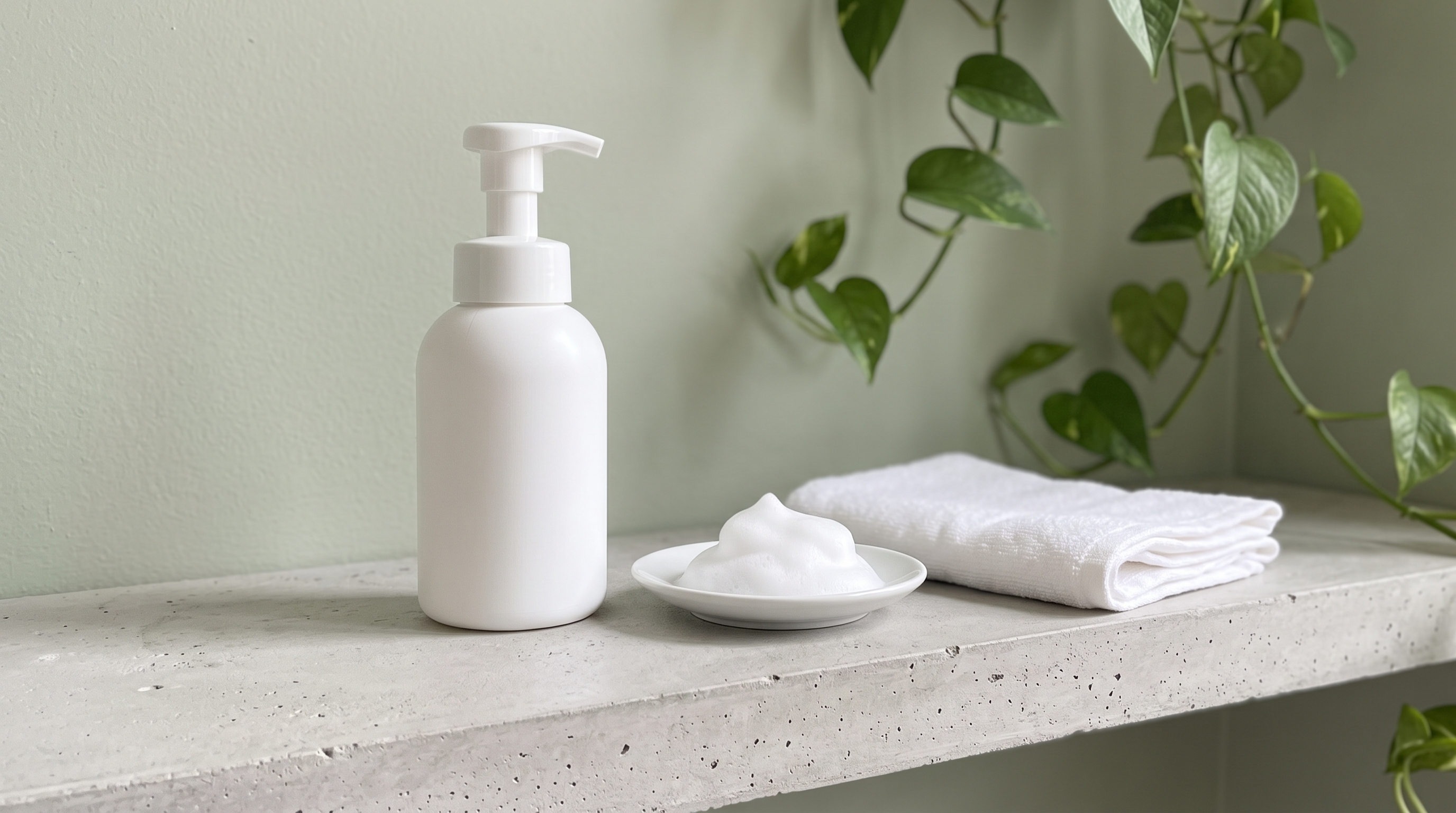
Gel cleansers are clear and lightly foaming. With mild surfactants and hyaluronic acid they rinse clean without that squeaky feel, which makes them a good fit for normal, combination and oily skin.
Cream cleansers carry more lipids and emollients. They leave a softer finish and suit dry and mature skin, especially in winter.
Milky or lotion cleansers barely foam at all. They are the gentlest choice for very dry, reactive or retinol-treated skin, though they may struggle with water-resistant sunscreen on their own.
Whatever the base, synthetic detergent cleansers, often labeled “syndet” or “soap-free”, are kinder to the barrier than traditional alkaline soap [7]. If you wear long-wear makeup or water-resistant sunscreen, start with an oil or balm and use the hyaluronic acid cleanser as the second step, the routine our guide to double cleansing describes.
Your skin needs about 60 days of a leave-on hyaluronic acid cream to show smoother wrinkles, far longer than the 60 seconds a cleanser spends on your face.
How to read the label
- Start with the surfactants: sodium cocoyl isethionate, coco-glucoside, decyl glucoside and cocamidopropyl betaine are gentler than sodium lauryl sulfate near the top of the list.
- Find the hyaluronic acid: it usually appears as sodium hyaluronate. If it sits below the fragrance or the preservatives, there is only a trace of it.
- Check the supporting cast: glycerin, ceramides, fatty acids and squalane help replace what washing removes [3].
- Skip fragrance: dry, sensitive and retinol-treated skin react to it most, and essential oils count.
- Run the five-minute test: your face should feel soft, not tight, five minutes after rinsing.
Our roundup of the best face wash for dry skin compares hyaluronic acid washes with other gentle options.
Who it suits, and what to expect
A hyaluronic acid cleanser makes most sense for dry, dehydrated and mature skin, for anyone who feels tight after washing and for people in the early weeks of a retinol routine. Gel versions also work for oily skin that is dehydrated rather than dry. If you are breakout-prone and wear heavy sunscreen, you may still need a stronger first cleanse.
Keep expectations realistic. Your skin needs about 60 days of a leave-on hyaluronic acid cream to show smoother wrinkles, far longer than the 60 seconds a cleanser spends on your face. A hyaluronic acid cleanser is there to stop the wash from undoing your serum and moisturizer, not to replace them.
Using a hyaluronic acid cleanser with retinol
Retinol speeds up renewal of the outer skin layer, and in the first weeks that often brings dryness and flaking. A stripping cleanser makes that phase much harder. A few habits help:
- Cleanse once at night. If your skin is dry, rinse with lukewarm water alone in the morning or use the same gentle wash.
- Pat the skin dry and wait a few minutes before applying retinol, since damp skin tends to sting more.
- Follow with a moisturizer, and keep scrubs and cleansing brushes away from retinol nights.
Our guide to retinol and the skin barrier explains why that barrier care matters so much in the first month.
Where Nanoretinol comes in
A mild cleanser lowers the irritation baseline, but it cannot change how a conventional retinol formula behaves once it is on your skin. Many conventional formulas rely on chemicals and petroleum derivatives that loosen the barrier’s lipids through lipid mobility, and that is where much of the redness and peeling comes from.
Nanoretinol takes a different route. Its 0.2% retinol is encapsulated in biomimetic lipid nanoparticles that the skin recognizes as its own, so the retinol reaches its target without damaging the epithelial barrier. In North Biomedical’s study it was 232% more effective than conventional retinol in collagen recovery and 73% more effective in elastin recovery, and in 56 days of clinical use it produced a 61% increase in skin firmness and a 56% increase in elasticity [8]. It is a light, water-based gel suited to all skin types, including sensitive skin.
Wash with a gentle hyaluronic acid cleanser at night, apply Nanoretinol to dry skin, follow with a simple moisturizer and wear sunscreen the next morning.
References
- Ananthapadmanabhan KP, Moore DJ, Subramanyan K, Misra M, Meyer F. “Cleansing without compromise: the impact of cleansers on the skin barrier and the technology of mild cleansing.” Dermatologic Therapy. 2004;17(Suppl 1):16-25. doi:10.1111/j.1396-0296.2004.04s1002.x
- Walters RM, Mao G, Gunn ET, Hornby S. “Cleansing formulations that respect skin barrier integrity.” Dermatology Research and Practice. 2012;2012:495917. doi:10.1155/2012/495917
- Ananthapadmanabhan KP, Mukherjee S, Chandar P. “Stratum corneum fatty acids: their critical role in preserving barrier integrity during cleansing.” International Journal of Cosmetic Science. 2013;35(4):337-345. doi:10.1111/ics.12042
- Lambers H, Piessens S, Bloem A, Pronk H, Finkel P. “Natural skin surface pH is on average below 5, which is beneficial for its resident flora.” International Journal of Cosmetic Science. 2006;28(5):359-370. doi:10.1111/j.1467-2494.2006.00344.x
- Papakonstantinou E, Roth M, Karakiulakis G. “Hyaluronic acid: a key molecule in skin aging.” Dermato-Endocrinology. 2012;4(3):253-258. doi:10.4161/derm.21923
- Pavicic T, Gauglitz GG, Lersch P, Schwach-Abdellaoui K, Malle B, Korting HC, Farwick M. “Efficacy of cream-based novel formulations of hyaluronic acid of different molecular weights in anti-wrinkle treatment.” Journal of Drugs in Dermatology. 2011;10(9):990-1000. PubMed: 22052267
- Mijaljica D, Spada F, Harrison IP. “Skin cleansing without or with compromise: soaps and syndets.” Molecules. 2022;27(6):2010. doi:10.3390/molecules27062010
- North Biomedical LLC. “Nanoretinol vs. Conventional Retinol: Efficacy in Collagen and Elastin Recovery.” Clinical Study Summary, 2024. Study summary