Lactic Acid vs Glycolic Acid: Which AHA Your Skin Actually Needs
Two alpha hydroxy acids that look interchangeable on a label behave very differently once they reach your skin
Stand in front of the exfoliant shelf and the two names blur. Lactic acid and glycolic acid are both alpha hydroxy acids, both sold at similar percentages, both promising the same smoother, brighter result. The shorthand most people walk away with is that glycolic is the strong one and lactic is the gentle one.
That shorthand is not wrong. It is just a description of the outcome rather than the cause, and it hides the fact that should actually drive the decision. These are two different-sized molecules with two different relationships to water, and those physical properties determine how deep each one travels, how quickly it gets there, and what it leaves behind when it has finished working.
They do the same job because they share the same architecture
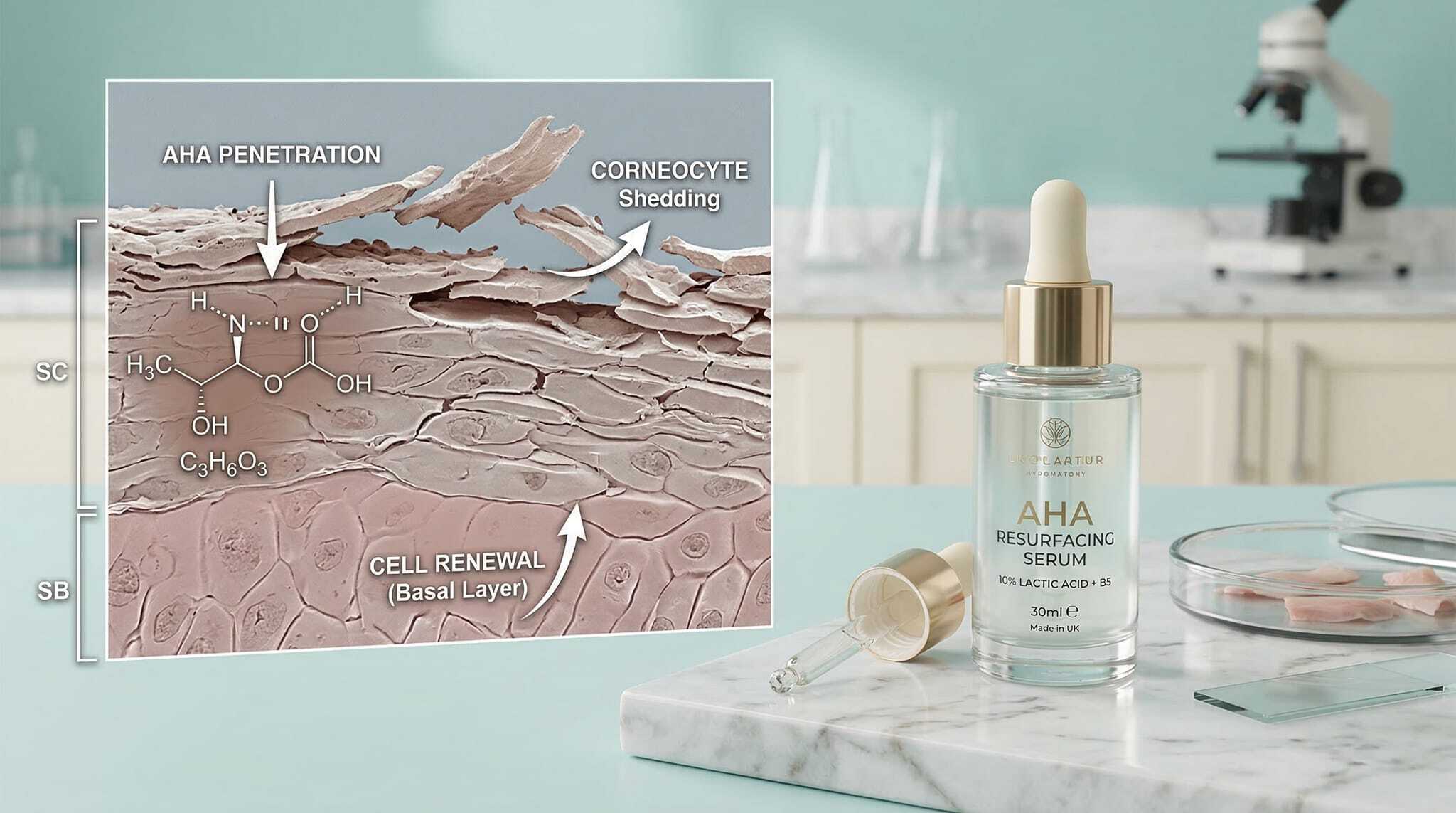
An alpha hydroxy acid is an organic acid carrying a hydroxyl group on the carbon next to the acid group. That shared shape gives the whole family a shared mechanism, described by Eugene Van Scott and Ruey Yu in the paper that still defines the category: AHAs act on corneodesmosomes, the protein rivets holding dead surface cells to one another [1]. Loosen the rivets and the outermost layer releases in an orderly sheet instead of accumulating in patches.
This is worth being precise about, because “exfoliation” makes people picture abrasion. Nothing is being scrubbed off. Cell-to-cell adhesion is being chemically uncoupled at the level where corneocytes are already due to shed, which is why a well-formulated acid leaves skin smoother rather than raw.
The 14-dalton difference
Glycolic acid is the smallest alpha hydroxy acid in cosmetic use at 76 daltons. Lactic acid carries one extra methyl group, which brings it to 90 daltons. Fourteen daltons sounds like a rounding error, but diffusion through the stratum corneum falls away steeply with molecular size, so at matched concentration and matched pH the smaller molecule moves through faster and reaches further.
That is the entire basis of the strong-versus-gentle reputation. Glycolic acid is not chemically more aggressive than lactic acid. It simply arrives in greater quantity at greater depth in the same amount of time, and depth is what your nerve endings and your barrier register as intensity.
The effect is dose-dependent in both directions. A review of hydroxy acid pharmacology describes the split cleanly: at the low concentrations used in leave-on cosmetics the action stays within the stratum corneum, while at the higher concentrations used in professional peels the acid reaches living epidermis and dermis, where it can stimulate matrix synthesis but also raises the skin’s sensitivity to ultraviolet light [2].
Lactate is not a foreign compound arriving on your face.
Lactic acid has a second job that glycolic acid does not
Lactate is not a foreign compound arriving on your face. It is already there, as one of the components of natural moisturizing factor, the mixture of humectants inside corneocytes that holds water in the surface layer. An acid that is also a resident humectant behaves differently from one that is purely an exfoliant.
Laboratory work on keratinocytes found that L-lactic acid increased ceramide synthesis and raised stratum corneum lipid levels, improving barrier function, with the L-isomer clearly outperforming the D-isomer [3]. That is an unusual result for an exfoliating acid: the same molecule that loosens surface adhesion is simultaneously instructing the skin to build more of the lipid mortar that keeps water in.
Clinical work supports the practical version of this. Topical lactic acid applied over three months produced measurable increases in epidermal firmness and thickness at higher strengths, with effects extending into the dermis [4]. For anyone whose skin is already dry, thin, or easily provoked, that combination matters more than raw resurfacing power.
Where glycolic acid genuinely pulls ahead
When the goal is remodeling rather than smoothing, the evidence for glycolic acid is deeper. In a controlled study of photoaged forearm skin treated for six months with a 25% alpha hydroxy acid preparation, treated sites showed roughly 25% greater skin thickness, increased acid mucopolysaccharides, improved quality of elastic fibers, and increased collagen density compared with untreated control sites [5].
A later study went to the molecular level and found that glycolic acid treatment increased type I collagen messenger RNA and the hyaluronic acid content of human skin, in both cultured fibroblasts and treated skin [6]. Those are dermal signaling effects, not surface polish.
The caveat is that both of those results came from concentrations and exposure conditions well beyond what a leave-on product delivers. Buying a 7% glycolic toner does not buy you the outcome of a 25% six-month protocol.
Buying a 7% glycolic toner does not buy you the outcome of a 25% six-month protocol.
The number nobody prints on the box
Concentration is the figure every brand advertises and the least informative one in isolation. An acid only works in its free, un-neutralized form, and how much of it exists in that form is set by pH. Formulation reviews of the category make the point that activity depends jointly on concentration, pH, and vehicle, and that consumer AHA products are generally held at or below 10% with a pH at or above 3.5 [7]. A partially neutralized 10% product at pH 4.5 can easily be milder than a 5% product at pH 3.4.
Neither acid earns you a pass on sun protection either. AHA-treated skin shows increased UV sensitivity, which is a direct consequence of thinning the accumulated dead layer that was providing incidental shade [2]. Exfoliating without daily sunscreen is a net loss.
Matching the acid to the barrier you actually have
The decision is less about your goal than about what your skin can currently absorb.
Lactic acid suits dry, dehydrated, sensitive, mature, or recently over-exfoliated skin, and anyone who has previously reacted badly to acids. You are choosing the molecule that exfoliates while it hydrates.
Glycolic acid suits oily, thicker, resilient, congested, or visibly sun-damaged skin where texture and uneven tone are the complaint and the barrier is intact. You are choosing penetration on purpose. The detail behind each ingredient is covered separately in our guides to lactic acid for skin and glycolic acid benefits.
Two rules apply either way. Do not layer both acids, and do not use either on the same night as a retinoid. And if the real problem is congestion inside the pore rather than roughness on top of it, the answer is a different acid family altogether, which is the comparison we draw in AHA vs BHA. How often to use whichever you pick is its own question, answered in our guide to how often to exfoliate your face.
What neither acid is built to fix
Both molecules work from the top down, and that ceiling is real. Lines that have set into the skin are a dermal problem, produced by collagen that has been degrading since your mid-twenties. A cosmetic-strength acid improves how light scatters off the surface, which reads as brighter and smoother, and at professional strength it can nudge the dermis. It is not a structural intervention.
The category with the longest evidence base for structural repair is the retinoids. Work going back to the 1980s showed that topical retinoic acid enhances repair of ultraviolet-damaged dermal connective tissue, restoring collagen in skin that had already lost it [8]. The obstacle was never whether retinoids work. It was that conventional formulations have to compromise the skin barrier to get the molecule through, which produces the burning and peeling that make people quit.
Nanoretinol was built around that obstacle. Its 0.2% retinol is encapsulated in biomimetic lipid nanoparticles that are externally similar to skin cells, so the body recognizes them as “self” and lets them pass through the epithelial barrier without that barrier being disrupted. North Biomedical’s clinical study found it 232% more effective than conventional retinol in collagen recovery and 73% more effective in elastin recovery, with a 61% increase in firmness and a 56% increase in elasticity over 56 days. It is water-based, 99% natural ingredients, and gentle enough for sensitive skin, which is the point for anyone whose barrier is already carrying an acid.
Picking the Acid Your Barrier Can Afford
Lactic acid and glycolic acid are the same tool in two sizes. The smaller molecule goes deeper and does more, and asks more of your barrier to do it. The larger one does less resurfacing and gives something back in hydration and ceramides. Choose on the state of your skin rather than the ambition of your goal, respect the pH you cannot see, wear sunscreen, and keep the surface work and the structural work on separate nights.
References
- Van Scott EJ, Yu RJ. “Hyperkeratinization, corneocyte cohesion, and alpha hydroxy acids.” Journal of the American Academy of Dermatology. 1984;11(5):867-879. doi:10.1016/S0190-9622(84)80466-1
- Tang SC, Yang JH. “Dual Effects of Alpha-Hydroxy Acids on the Skin.” Molecules. 2018;23(4):863. doi:10.3390/molecules23040863
- Rawlings AV, Davies A, Carlomusto M, Pillai S, Zhang K, Kosturko R, Verdejo P, Feinberg C, Nguyen L, Chandar P. “Effect of lactic acid isomers on keratinocyte ceramide synthesis, stratum corneum lipid levels and stratum corneum barrier function.” Archives of Dermatological Research. 1996;288(7):383-390. doi:10.1007/BF02507107
- Smith WP. “Epidermal and dermal effects of topical lactic acid.” Journal of the American Academy of Dermatology. 1996;35(3):388-391. doi:10.1016/S0190-9622(96)90602-7
- Ditre CM, Griffin TD, Murphy GF, Sueki H, Telegan B, Johnson WC, Yu RJ, Van Scott EJ. “Effects of alpha-hydroxy acids on photoaged skin: A pilot clinical, histologic, and ultrastructural study.” Journal of the American Academy of Dermatology. 1996;34(2):187-195. doi:10.1016/S0190-9622(96)80110-1
- Bernstein EF, Lee J, Brown DB, Yu R, Van Scott E. “Glycolic Acid Treatment Increases Type I Collagen mRNA and Hyaluronic Acid Content of Human Skin.” Dermatologic Surgery. 2001;27(5):429-433. doi:10.1046/j.1524-4725.2001.00234.x
- Kornhauser A, Coelho SG, Hearing VJ. “Applications of hydroxy acids: classification, mechanisms, and photoactivity.” Clinical, Cosmetic and Investigational Dermatology. 2010;3:135-142. doi:10.2147/CCID.S9042
- Kligman LH, Duo CH, Kligman AM. “Topical Retinoic Acid Enhances the Repair of Ultraviolet Damaged Dermal Connective Tissue.” Connective Tissue Research. 1984;12(2):139-150. doi:10.3109/03008208408992779