AHA vs BHA: Which Exfoliating Acid Your Aging Skin Actually Needs
A clear, science-backed guide to alpha and beta hydroxy acids — and when to reach for each
Walk down any skincare aisle and you’ll hit an alphabet soup of acids — glycolic, lactic, salicylic, mandelic — sorted into two mysterious camps labeled AHA and BHA. Most people buy one, hope for the best, and never quite know whether they picked the right tool for their skin. If your complexion looks dull, rough, or congested and you can’t tell which acid to trust, this is the guide that sorts it out.
The One Difference That Explains Everything
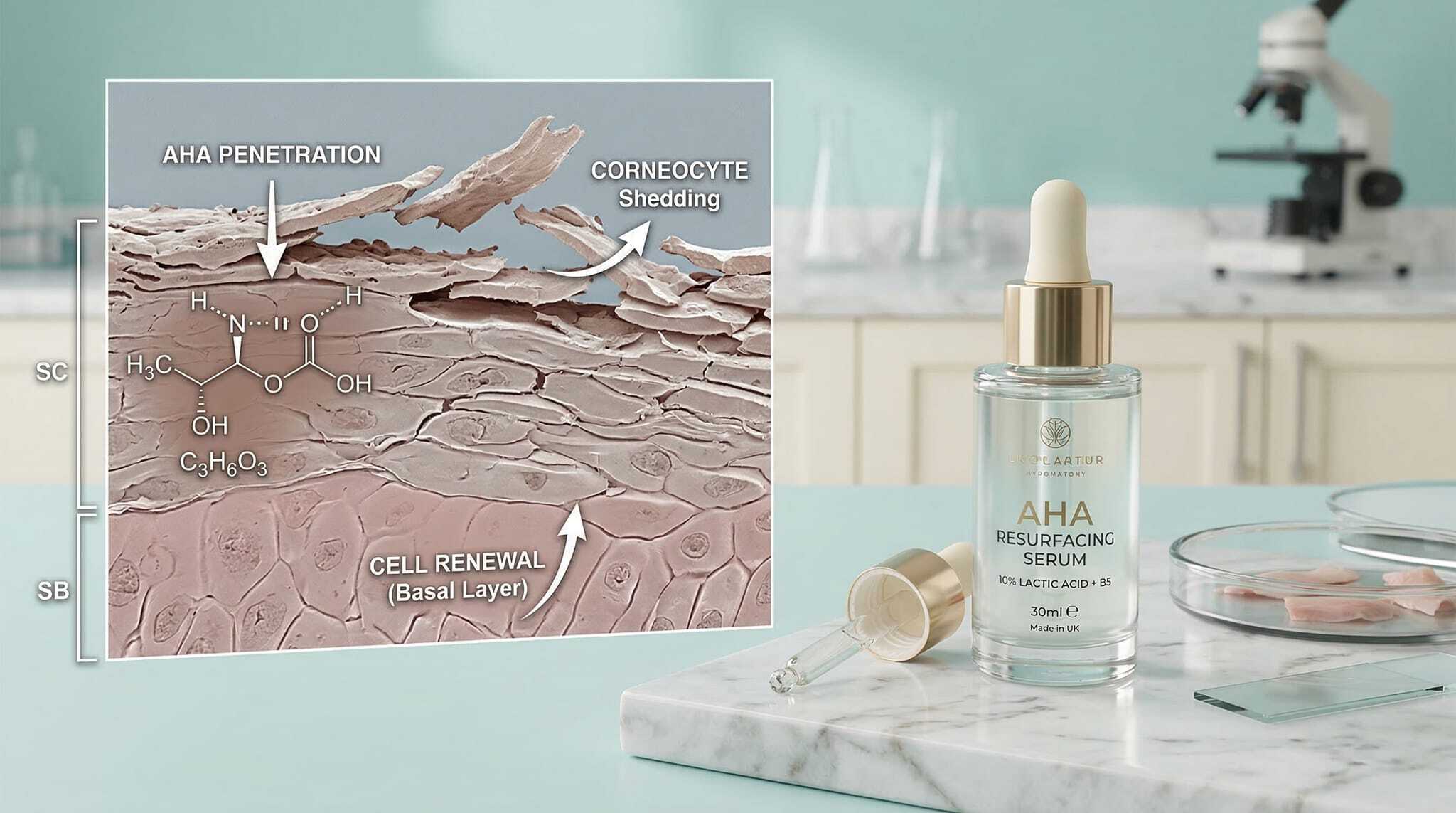
Alpha hydroxy acids (AHAs) and beta hydroxy acids (BHAs) both belong to a family of “hydroxy acids” that loosen the glue holding dead cells to the skin’s surface. The technical name for that glue is the desmosome, and these acids speed up its breakdown so old cells shed and fresh ones surface — a process called desquamation [1]. That shared mechanism is why both fight dullness and rough texture.
The difference that matters is a single chemical trait: solubility.
- AHAs are water-soluble. They work on the skin’s surface and in the moist upper layers. Glycolic acid (the smallest AHA) and lactic acid are the headliners.
- BHAs are oil-soluble. Salicylic acid — essentially the only cosmetic BHA — can dissolve through sebum and travel into the pore lining.
That one property decides almost everything about which acid suits your skin.
Most people buy one, hope for the best, and never quite know whether they picked the right tool for their skin.
What AHAs Do Best
Because AHAs work at the surface and attract water, they shine on dryness, dullness, sun damage, and fine lines. They don’t just exfoliate — over time they remodel the skin underneath. In a controlled study, applying glycolic acid to photoaged skin for months increased epidermal thickness, boosted collagen density, and improved the quality of elastic fibers compared with placebo [2]. Reviews of the category confirm AHAs can measurably reverse markers of photoaging while improving hydration, because they also nudge the skin to hold more of its own moisture [1][4].
Within the AHA camp, molecule size lets you fine-tune:
- Glycolic acid is smallest, penetrates fastest, and is the most potent — best for sun damage and stubborn texture, but the most likely to sting.
- Lactic acid is larger, gentler, and hydrating — a good starting point for dry or reactive skin.
- Mandelic acid is largest and slowest, making it the mildest choice for sensitive or deeper skin tones prone to pigment flare-ups.
What BHA Does Best
Salicylic acid’s oil solubility gives it a talent no AHA has: it gets inside pores. That makes it the go-to for congestion, blackheads, bumpy texture, and oily or breakout-prone skin. It is keratolytic (it sheds dead cells) and comedolytic (it clears the plugs that form blackheads), and it carries a bonus anti-inflammatory, soothing quality that makes it useful even for some redness-prone skin [3]. If your problem is clogged, cloggy, “why is my skin bumpy” congestion rather than dryness or spots, BHA is usually the smarter pick [3].
That gentler delivery is why it tested 232% more effective at collagen recovery than conventional retinol while remaining suitable even for sensitive skin.
AHA vs BHA: A Quick Decision Guide
- Dull, dry, or sun-damaged skin, fine lines → AHA (start with lactic, graduate to glycolic)
- Clogged pores, blackheads, oily or bumpy skin → BHA (salicylic acid)
- Sensitive skin or deeper skin tones → the gentlest AHA (mandelic) or a low-strength PHA, a larger, milder cousin
- Both concerns at once → many people alternate: BHA on oilier zones, AHA on drier ones, on different nights
The universal rule: more is not better. Over-exfoliating strips the barrier, leaving skin tight, stinging, red, and paradoxically flakier. Two to three nights a week is plenty for most people. Chase acids with moisturizer and always wear sunscreen the next morning, since fresh, newly exfoliated skin is more vulnerable to UV [1].
Where Acids Stop — and Retinoids Begin
Here’s the ceiling worth understanding. Exfoliating acids are surface-and-signal tools: they remove dead cells and, at higher strengths over time, coax some collagen improvement [2]. But they are not the most powerful instructions your skin can receive for rebuilding its deep architecture. That job belongs to retinoids.
Retinol works one layer deeper than any acid, directly increasing type I collagen and the water-binding molecules that plump fine lines in genuinely aged skin [5]. Acids and retinoids are complementary — acids smooth and brighten the surface, retinoids remodel the foundation — which is exactly why dermatologists so often pair them (on alternate nights, to avoid over-irritation).
The historical problem with retinol is that it is harsh and unstable, and traditional formulas damage the barrier to get through it — the very over-exfoliation you’re trying to avoid. Nanoretinol by North Biomedical takes a different route. It wraps retinol in biomimetic lipid nanoparticles the skin accepts as “self,” carrying the active across the barrier without breaking it down. That gentler delivery is why it tested 232% more effective at collagen recovery than conventional retinol while remaining suitable even for sensitive skin. Paired with a well-chosen acid a couple of nights a week, it lets you get the smoothing benefit of exfoliation and the rebuilding benefit of a retinoid without pushing your barrier past its limit.
The Takeaway
AHA versus BHA isn’t a rivalry — it’s a matching problem. Reach for an AHA when the issue is dryness, dullness, or sun damage; reach for BHA when the issue is congestion and oil. Use either sparingly, protect the barrier, and let a gentle, well-delivered retinoid do the deeper structural work your acids can only hint at.
References
- Kornhauser A, Coelho SG, Hearing VJ. “Applications of Hydroxy Acids: Classification, Mechanisms, and Photoactivity.” Clinical, Cosmetic and Investigational Dermatology. 2010;3:135-142. doi:10.2147/CCID.S9042
- Ditre CM, Griffin TD, Murphy GF, et al. “Effects of Alpha-Hydroxy Acids on Photoaged Skin: A Pilot Clinical, Histologic, and Ultrastructural Study.” Journal of the American Academy of Dermatology. 1996;34(2 Pt 1):187-195. doi:10.1016/s0190-9622(96)80110-1
- Arif T. “Salicylic Acid as a Peeling Agent: A Comprehensive Review.” Clinical, Cosmetic and Investigational Dermatology. 2015;8:455-461. doi:10.2147/CCID.S84765
- Green BA, Yu RJ, Van Scott EJ. “Clinical and Cosmeceutical Uses of Hydroxyacids.” Clinics in Dermatology. 2009;27(5):495-501. doi:10.1016/j.clindermatol.2009.06.023
- Kafi R, Kwak HSR, Schumacher WE, et al. “Improvement of Naturally Aged Skin With Vitamin A (Retinol).” Archives of Dermatology. 2007;143(5):606-612. doi:10.1001/archderm.143.5.606