Glycolic Acid Toner: What the Percentage on the Front Never Tells You
Two bottles labelled 7% and 10% can deliver opposite amounts of working acid, and the reason is printed nowhere on either one
The glycolic acid toner aisle is sold on a single number. One bottle says 7%, the next says 10%, and the shopping decision collapses into arithmetic. It is the wrong number to shop on, and the number that actually decides the outcome is printed on neither bottle.
Glycolic acid is the smallest alpha hydroxy acid, which is why it became the default. Small molecule, fast penetration, decades of clinical literature behind it. But how much of the acid in a bottle is doing anything at all depends on the formulation pH, and two products at the same labelled percentage can differ severalfold in working strength.
What a glycolic toner is actually doing
Skin sheds itself continuously. Corneocytes at the surface are held together by protein rivets, and shedding happens when those bonds dissolve on schedule. With age, sun damage and dry weather, the schedule slips, the dead layer thickens, and skin looks dull and rough while product sits on top of it instead of sinking in.
Alpha hydroxy acids interrupt that bonding directly. The foundational dermatology work on the mechanism described exactly this: corneocyte cohesion is weakened by water, by retinoids and by alpha hydroxy acids, and strengthened by dehydration and vitamin A deficiency [1]. A glycolic toner is not sanding anything off. It is loosening the glue so the dead layer leaves on its own.
A glycolic toner does not scrub anything away, it dissolves the glue holding dead cells in place so your skin sheds on the schedule it used to keep.
That is also why a toner format makes sense for this particular acid. A leave-on liquid at a low percentage gives short, repeated exposure, which is a different treatment from the high-concentration, timed, neutralized application a clinic uses for a peel.
The percentage is only half the label
Glycolic acid in a bottle exists in two states. Some of it is free acid, which is the form that does the work, and some of it is neutralized salt, which is largely inert against corneocyte bonds. The ratio between them is set by pH, and pH is rarely on the label.
Reviews of hydroxy acid chemistry make the point plainly: the biological effect of these formulations depends on concentration, pH and the vehicle carrying them, and safety evaluations have to account for all three rather than the percentage alone [2]. Comparative testing of the acids themselves found the same thing from the other direction, with partially or fully neutralized formulations behaving as better moisturizers and less irritating products than their unneutralized equivalents at matched concentrations [3].
The practical translation is uncomfortable for shoppers. A 7% toner formulated at pH 3.5 can deliver more free acid than a 10% toner buffered up to pH 4.5, and the 10% bottle will still be marketed as the stronger one. If a brand publishes its pH, that is a meaningful signal about how seriously it treats the chemistry. If it does not, treat the percentage as a rough ceiling rather than a dose.
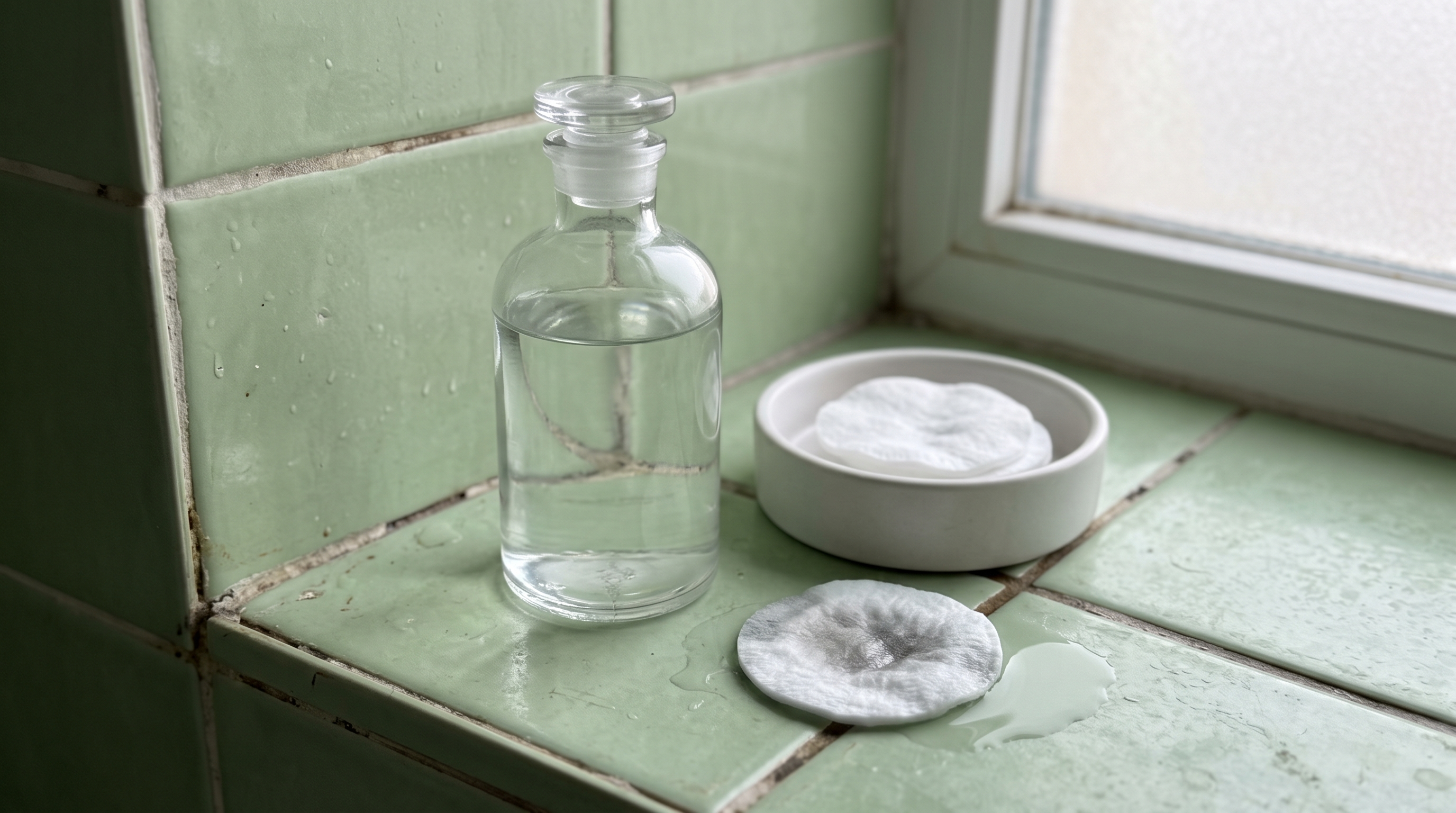
Everything else about the format is dosing discipline. Pads carry whatever solution they were soaked in and give you no control over volume. A liquid decanted onto a cotton pad or pressed on with clean hands lets you keep the dose steady, which matters more than it sounds when you are trying to work out whether two nights a week is enough.
What the evidence supports, and on what timeline
The clinical record for glycolic acid at toner-like strengths is real and fairly narrow. In a 22-week double-blind vehicle-controlled trial, 8% glycolic acid cream applied twice daily improved overall photodamage severity in 76% of patients against 40% on the vehicle, with parallel improvement in sallowness on the forearms [4]. That is a genuine result, achieved at a concentration most toners sit at or below.
Push the concentration higher and the changes reach the dermis. Six months of a 25% alpha hydroxy acid lotion on forearm skin produced roughly a 25% increase in skin thickness, with more acid mucopolysaccharides, better quality elastic fibers and denser collagen on biopsy, and no inflammation [5]. Twenty percent glycolic acid applied twice daily for three months likewise raised type I collagen gene expression and hyaluronic acid content compared with vehicle [6].
The surface improvement arrives in about two weeks, the matrix changes take months, and almost none of the toners sold reach the concentrations where the second thing was measured.
Those dermal studies used concentrations three times what a leave-on toner delivers. Expecting a 7% toner to remodel collagen is expecting it to do the job of a product it is not. Smoother texture, brighter tone and better product absorption are what the format reliably delivers, and those are worth having. Our broader guide to glycolic acid benefits works through the higher-strength evidence in detail.
What it does to your barrier
Acids have a reputation for thinning the skin barrier, and the research is more interesting than the reputation. When four alpha hydroxy acids at 8% were applied twice daily for four weeks and then challenged with sodium lauryl sulfate, the acid-treated sites did not show elevated water loss at week four, and the gentler polyhydroxy and antioxidant acids actually protected against the irritant challenge better than glycolic acid did [7].
So glycolic acid is the effective end of the category and also the sharp end. If your skin runs sensitive, gluconolactone and lactobionic acid are the better trade, a comparison we cover in the AHA versus BHA guide along with where salicylic acid fits for oilier skin.
The sunscreen rule is not general advice here
This one is specific and measurable. Four weeks of 10% glycolic acid at pH 3.5 applied to the back increased sunburn cell formation and lowered the minimal erythema dose, meaning treated skin burned at lower UV exposure than untreated skin. The sensitivity reversed within a week of stopping [8].
Using a glycolic toner without daily sunscreen is therefore self-defeating in a way that most skincare mistakes are not. You are increasing UV damage to the same photoaged skin the acid is meant to improve, and photoaging is the thing that put you in this aisle.
Fitting it around a retinoid
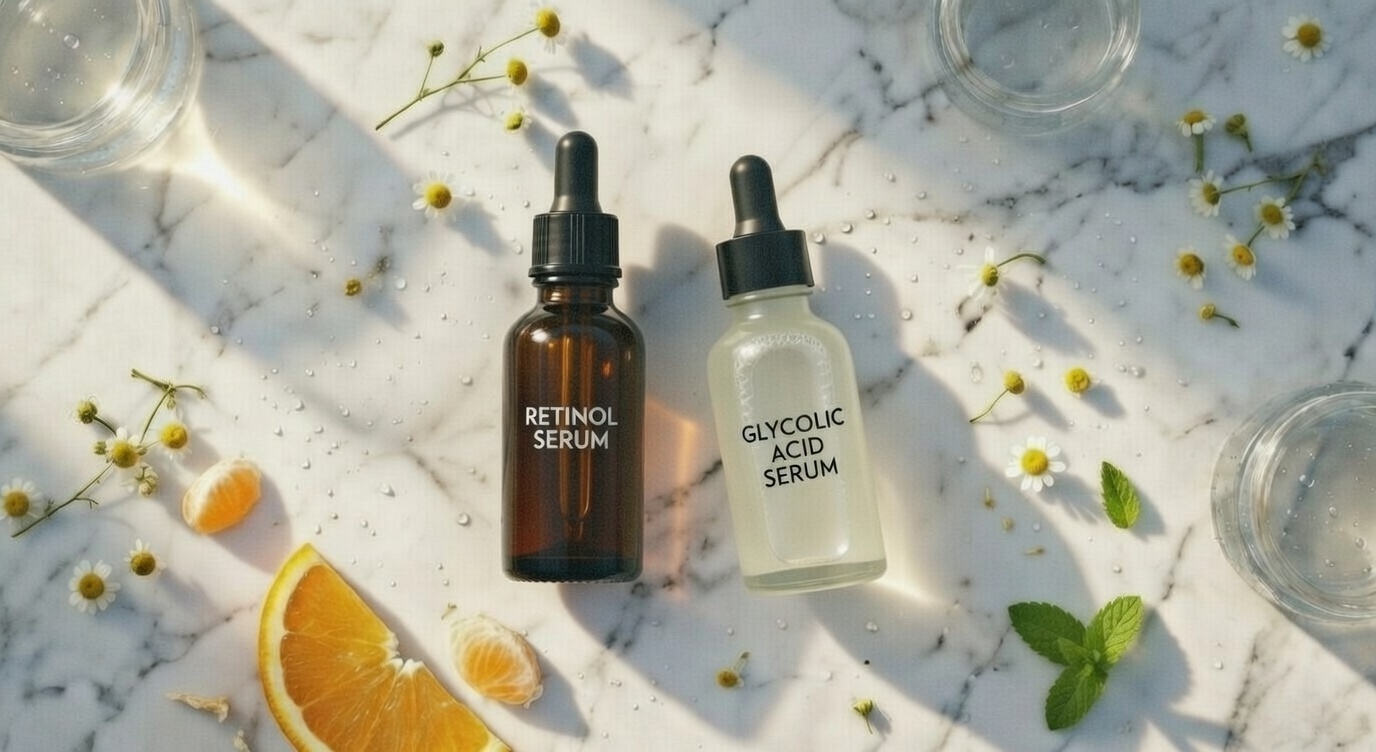
Both glycolic acid and retinoids loosen corneocyte bonds, so stacking them on the same night doubles the irritation without doubling the benefit. Alternate nights work for most people: acid on two or three nights, retinoid on the others, buffered with moisturizer if things get tight. Our detailed schedule for pairing retinol and glycolic acid covers how to stage the introduction, and the best toner for aging skin guide covers what to use on the nights you skip the acid.
Where Nanoretinol fits
There is one experiment that settles what an acid can and cannot do. Photoaged skin was treated with tretinoin, glycolic acid, and a set of irritants and peeling agents. Tretinoin produced a new collagen zone twice the depth of anything the irritants or peeling agents managed, and the peeling agents produced collagen and type III procollagen levels indistinguishable from vehicle [9]. Exfoliation and collagen synthesis are separate biological jobs, and the acid only does the first one.
That is the case for keeping a retinoid in the routine rather than replacing it with acids, and it is also where delivery decides the outcome. Conventional retinol formulations get through the barrier by disrupting it with solvents and petroleum-derived penetration enhancers, which is precisely the wrong companion for a routine that already includes an exfoliating acid. Nanoretinol encapsulates stabilized 0.2% retinol in biomimetic lipid nanoparticles the skin recognizes as its own and admits intact, with no barrier disruption required. North Biomedical’s clinical study summary reports 232% greater effectiveness in collagen recovery and 73% greater effectiveness in elastin recovery than conventional retinol, with drastically reduced cytotoxicity, in a water-based gel that suits sensitive skin. The toner handles the surface. The retinoid handles the structure underneath it.
References
- Van Scott EJ, Yu RJ. “Hyperkeratinization, corneocyte cohesion, and alpha hydroxy acids.” Journal of the American Academy of Dermatology. 1984;11(5 Pt 1):867-879. doi:10.1016/s0190-9622(84)80466-1
- Kornhauser A, Coelho SG, Hearing VJ. “Applications of hydroxy acids: classification, mechanisms, and photoactivity.” Clinical, Cosmetic and Investigational Dermatology. 2010;3:135-142. doi:10.2147/CCID.S9042
- Smith WP. “Comparative effectiveness of alpha-hydroxy acids on skin properties.” International Journal of Cosmetic Science. 1996;18(2):75-83. doi:10.1111/j.1467-2494.1996.tb00137.x
- Stiller MJ, Bartolone J, Stern R, et al. “Topical 8% glycolic acid and 8% L-lactic acid creams for the treatment of photodamaged skin. A double-blind vehicle-controlled clinical trial.” Archives of Dermatology. 1996;132(6):631-636. PMID: 8651713
- Ditre CM, Griffin TD, Murphy GF, et al. “Effects of alpha-hydroxy acids on photoaged skin: a pilot clinical, histologic, and ultrastructural study.” Journal of the American Academy of Dermatology. 1996;34(2 Pt 1):187-195. doi:10.1016/s0190-9622(96)80110-1
- Bernstein EF, Lee J, Brown DB, Yu R, Van Scott E. “Glycolic acid treatment increases type I collagen mRNA and hyaluronic acid content of human skin.” Dermatologic Surgery. 2001;27(5):429-433. doi:10.1046/j.1524-4725.2001.00234.x
- Berardesca E, Distante F, Vignoli GP, Oresajo C, Green B. “Alpha hydroxyacids modulate stratum corneum barrier function.” British Journal of Dermatology. 1997;137(6):934-938. PMID: 9470910
- Kaidbey K, Sutherland B, Bennett P, et al. “Topical glycolic acid enhances photodamage by ultraviolet light.” Photodermatology, Photoimmunology & Photomedicine. 2003;19(1):21-27. doi:10.1034/j.1600-0781.2003.00013.x
- Kligman LH, Sapadin AN, Schwartz E. “Peeling agents and irritants, unlike tretinoin, do not stimulate collagen synthesis in the photoaged hairless mouse.” Archives of Dermatological Research. 1996;288(10):615-620. doi:10.1007/BF02505265