Marine Collagen for Skin: What the Clinical Evidence Actually Shows
Understanding what marine collagen supplements actually do — and what they can't
Why Marine Collagen Has Become the Supplement Category Everyone Is Watching
Walk through any supplement aisle today and marine collagen has moved from niche health food to mainstream beauty staple. The logic seems intuitive: your skin is losing collagen as you age; collagen is a protein; why not consume more of it?
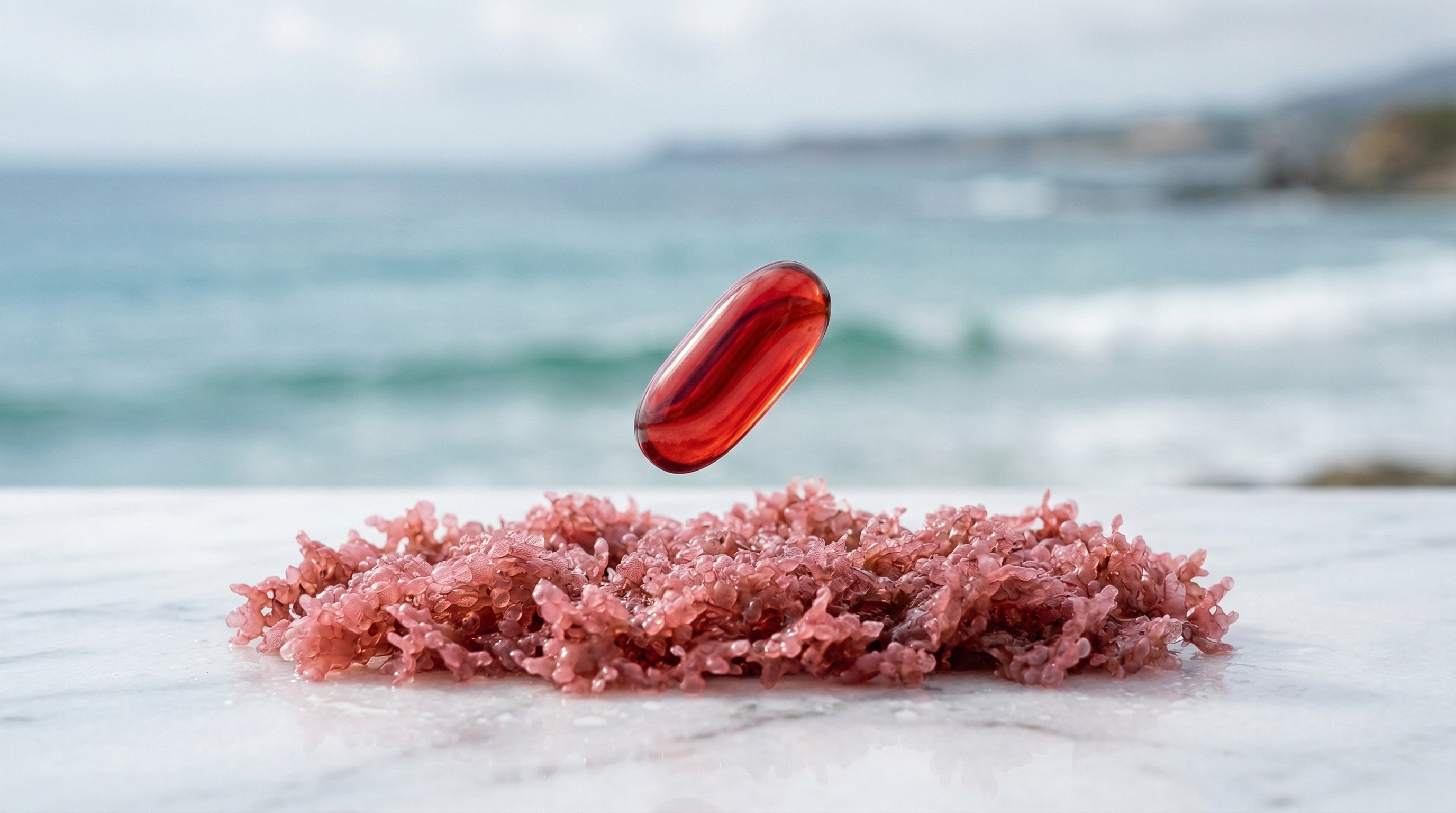
The answer is more nuanced than either the marketing or the skeptics suggest. Marine collagen — derived from fish skin, scales, or cartilage — has a growing body of clinical research behind it. What that research shows, and what it doesn’t, determines whether this supplement is worth adding to a serious anti-aging protocol.
What Marine Collagen Actually Is
All commercial collagen supplements are hydrolyzed — the native protein is broken down via enzymatic treatment into smaller fragments called collagen peptides. These peptides are typically 2,000–5,000 daltons in molecular weight, small enough to pass through the intestinal wall into circulation.
Marine-sourced collagen is predominantly type I collagen, the same variety that makes up 80–90% of the collagen in human skin [1]. This alignment of protein type is one reason fish-derived collagen is highlighted for cosmetic applications over bovine collagen, which contains more type II (cartilage) collagen. The bioavailability case for marine collagen is also credible: marine peptides tend toward the smaller end of the molecular weight range, and some research suggests they absorb more readily than larger bovine peptides.
What the Clinical Trials Show
The evidence base for oral collagen has expanded significantly over the past five years. A 2023 meta-analysis of 26 randomized controlled trials involving 1,721 participants found that hydrolyzed collagen supplementation significantly improved skin hydration and elasticity compared to placebo, with fish-sourced collagen showing particularly strong results for hydration [2].
A double-blind, placebo-controlled trial specifically studying fish-derived hydrolyzed collagen in women aged 45–60 found a 24% greater wrinkle reduction in the treatment group versus placebo at 12 weeks, along with meaningful improvements in cheek elasticity [3]. These results are representative of the better-designed studies in this category.
The mechanism doesn’t involve collagen peptides being deposited directly in the dermis. By the time any protein reaches circulation, it has been further digested into amino acids and short dipeptides — specifically proline-hydroxyproline sequences. These dipeptides appear to act as fibroblast-stimulating signals, increasing both collagen synthesis and hyaluronic acid production in dermal cells [4]. It’s an indirect effect: the supplement signals your cells to make more collagen, rather than adding collagen directly.
The logic seems intuitive: your skin is losing collagen as you age; collagen is a protein; why not consume more of it?
What the Evidence Also Shows — the Nuances
The same meta-analysis that found significant effects carried an important qualifier: studies funded by supplement manufacturers consistently showed significant benefits across all measured outcomes, while independent studies produced more modest results [2]. This doesn’t mean marine collagen supplements are ineffective. It means the evidence is most reliable for modest improvements in hydration and elasticity with consistent daily use over 8–12 weeks, rather than dramatic wrinkle reversal.
A separate 2021 clinical trial found that oral collagen peptides improved skin hydration by increasing natural moisturizing factor (NMF) content in the stratum corneum, but did not produce significant changes in skin elasticity or thickness [4]. The hydration benefit appears more consistently across studies than the structural benefit.
The Fundamental Limitation: Supplements Work Indirectly on Downstream Effects
Here is what marine collagen supplements cannot do: they cannot address the molecular mechanisms actively causing your skin to produce less collagen year over year.
Skin firmness loss is driven by multiple converging processes: fibroblast aging, impaired TGF-β signaling, and chronically elevated matrix metalloproteinases — enzymes that actively degrade existing collagen in the dermis. UV exposure amplifies all of these simultaneously [5]. Even if oral collagen peptides modestly stimulate fibroblast activity, those signals compete against a molecular environment where the enzymes of destruction are running continuously and the primary control pathway for collagen synthesis is impaired.
This is why researchers studying skin aging consistently focus on topical retinoids as the most mechanistically direct intervention: retinoids work at the transcriptional level, directly suppressing MMP production and upregulating the TGF-β signaling pathway that drives new collagen synthesis [6]. They act on the control system, not just the supply chain.
Marine Collagen as Part of a Broader Protocol
This isn’t an either/or question. Marine collagen supplements, taken consistently at clinically meaningful doses (typically 5–10g of hydrolyzed peptides daily), can contribute to improved skin hydration and may support modest elasticity improvements over months. For people whose diets are low in glycine-rich proteins, there’s plausibly a meaningful amino acid substrate benefit as well.
The most effective approach pairs an internal foundation with a topical agent that acts at the signaling level. Collagen-boosting foods and marine collagen supplements address the raw material side, while topical retinoids correct the enzymatic and transcriptional dysregulation that determines whether that raw material gets used effectively.
Here is what marine collagen supplements cannot do: they cannot address the molecular mechanisms actively causing your skin to produce less collagen year over year.
What to Look for If You Buy Marine Collagen
If you decide to add marine collagen to your protocol, these specifications matter:
- Source: Type I-dominant fish (skin and scales, not primarily cartilage) aligns best with skin-specific goals
- Dose: Studies showing meaningful outcomes typically use 5–10g of hydrolyzed peptides daily
- Duration: Minimum 8 weeks to see hydration benefits; 12 or more weeks for any elasticity changes
- Form: Hydrolyzed peptides, not gelatin; peptides have higher bioavailability
Avoid supplements that stack claims — marine collagen with hyaluronic acid, biotin, vitamin C — where each individual ingredient is under-dosed. A single well-dosed marine collagen is more useful than six under-dosed ingredients combined.
Nanoretinol and the Collagen Signaling Problem
Nanoretinol uses lipid nanoparticle encapsulation to deliver retinol through the skin barrier at therapeutic concentrations, without the barrier disruption that limits conventional retinol products. In a clinical study, Nanoretinol demonstrated +232% more effective collagen recovery compared to conventional retinol, and +61% improvement in skin firmness after 56 days. By reaching fibroblasts deep in the dermis, it directly activates the gene expression pathways that marine collagen supplements can only indirectly nudge.
Pairing a daily marine collagen supplement with a topical retinoid like Nanoretinol addresses both the supply and the signaling — the combination where clinical logic and the evidence both converge. For a comprehensive approach to improving skin elasticity, working from the inside and outside simultaneously produces more than either does alone.
The Science in Summary
Marine collagen is the most biologically aligned collagen supplement for skin-specific goals. Clinical trials show real, if modest, improvements in hydration and elasticity. The mechanism is indirect — peptide signaling to fibroblasts — not direct structural deposition. And supplements cannot correct the molecular dysregulation driving accelerating collagen loss with age. For comprehensive skin support, pair the inside-out foundation with a proven topical retinoid that addresses the root cause from the surface.
References
-
Al-Atif H. “Collagen Supplements for Aging and Wrinkles: A Paradigm Shift in the Fields of Dermatology and Cosmetics.” Dermatology Practical & Conceptual. 2022;12(1):e2022018. doi:10.5826/dpc.1201a18
-
Pu SY, Huang YL, Pu CM, et al. “Effects of Oral Collagen for Skin Anti-Aging: A Systematic Review and Meta-Analysis.” Nutrients. 2023;15(9):2080. doi:10.3390/nu15092080
-
Evans M, Lewis ED, Zakaria N, Pelipyagina T, Guthrie N. “A randomized, triple-blind, placebo-controlled, parallel study to evaluate the efficacy of a freshwater marine collagen on skin wrinkles and elasticity.” Journal of Cosmetic Dermatology. 2021;20(3):825–834. doi:10.1111/jocd.13676
-
Miyanaga M, Uchiyama T, Motoyama A, et al. “Oral Supplementation of Collagen Peptides Improves Skin Hydration by Increasing the Natural Moisturizing Factor Content in the Stratum Corneum.” Skin Pharmacology and Physiology. 2021;34(3):115–127. doi:10.1159/000513988
-
Varani J, Dame MK, Rittie L, et al. “Decreased collagen production in chronologically aged skin: roles of age-dependent alteration in fibroblast function and defective mechanical stimulation.” American Journal of Pathology. 2006;168(6):1861–1868. doi:10.2353/ajpath.2006.051302
-
Quan T. “Human Skin Aging and the Anti-Aging Properties of Retinol.” Biomolecules. 2023;13(11):1614. doi:10.3390/biom13111614