Pycnogenol for Skin: What This French Maritime Pine Bark Extract Actually Does
Inside the antioxidant that gets compared to vitamin C — and what its clinical trials really show for women over 40.
Walk into a supplement store and Pycnogenol sits near the antioxidant section, often shelved beside resveratrol and grape seed extract. It has a stronger clinical file than most of its neighbors — and a much narrower one than the marketing suggests. The short version: it’s a useful adjunct for skin antioxidant defense and pigmentation, and a poor substitute for the structural anti-aging work retinoids do.
This guide unpacks what the peer-reviewed trials actually measured, where Pycnogenol fits in a routine, and where it doesn’t.
What Pycnogenol is
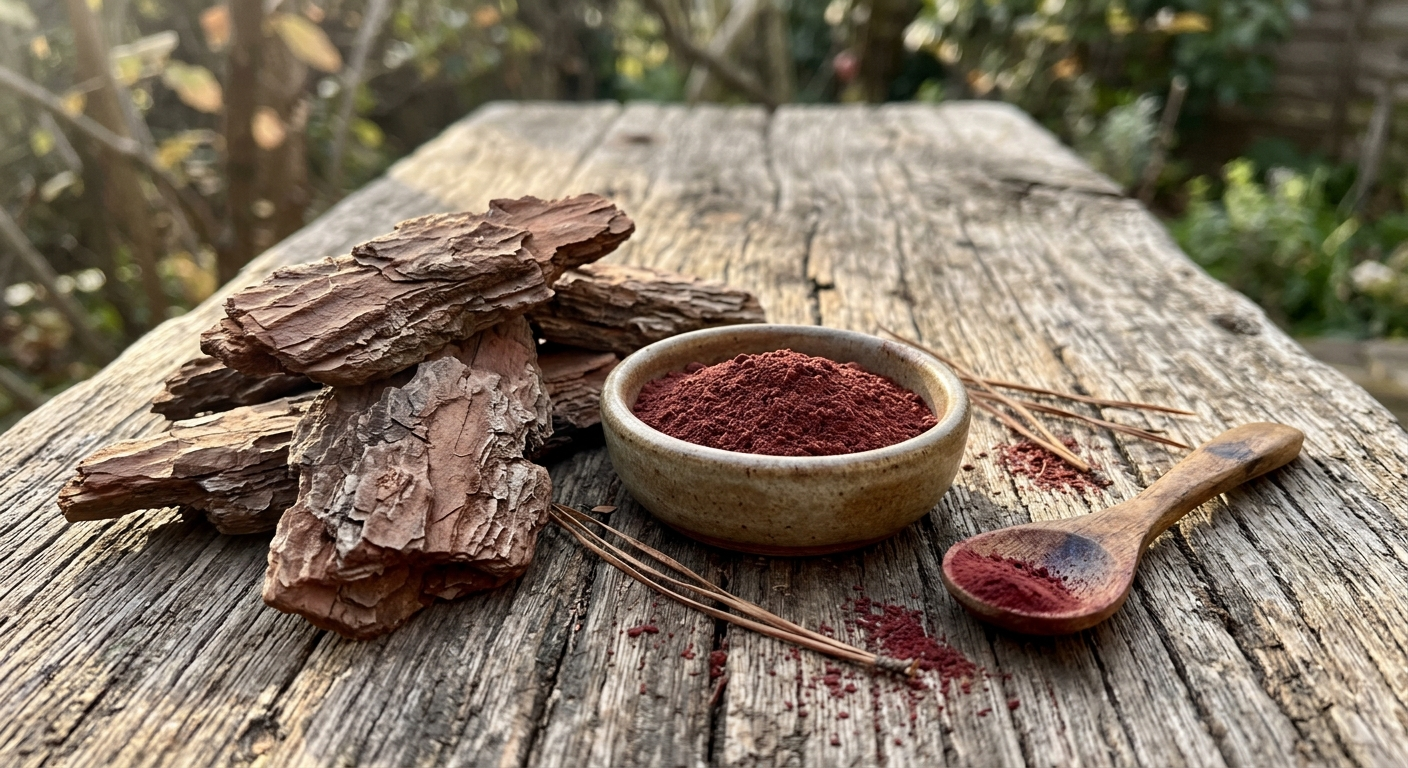
Pycnogenol is the trademarked name for a standardized extract from the bark of the French maritime pine, Pinus pinaster. The active fraction is a complex of procyanidins — polymers of catechin and epicatechin — alongside smaller flavonoids and organic acids [1]. Procyanidins are the same chemical family responsible for the antioxidant capacity of grape seeds, cocoa, and red wine, just at a different concentration and chain length.
The extract is taken orally in most clinical trials (typically 50-100 mg per day) and increasingly appears in topical serums. Its established mechanisms in skin research include free radical scavenging, suppression of inflammatory NF-κB signaling, modulation of nitric oxide pathways, and — at higher doses — inhibition of the tyrosinase enzyme that drives pigment formation [2].
The clinical evidence — what it shows
Four trial threads form the core of Pycnogenol’s skin file. They’re worth understanding individually because each measures something different.
Melasma reduction (oral)
The most-cited skin trial gave 30 women with melasma 75 mg of oral Pycnogenol daily for 30 days. Published in Phytotherapy Research, the study reported significant reductions in melasma surface area and pigmentary intensity compared to baseline [3]. The mechanism is consistent with the broader literature — procyanidins suppress melanocyte activation and quench the oxidative stress that triggers melasma flares.
This is the strongest evidence for a specific clinical use. For broader treatment options including topical actives, see our melasma treatment guide.
The most-cited skin trial gave 30 women with melasma 75 mg of oral Pycnogenol daily for 30 days.
Skin elasticity, hydration, and gene expression (oral)
A 2012 trial in Skin Pharmacology and Physiology gave 20 postmenopausal women 75 mg of Pycnogenol daily for 12 weeks. The researchers measured skin elasticity and hydration before and after, and — more usefully — biopsied skin to measure changes in gene expression for collagen type I and hyaluronic acid synthase [4]. Both increased significantly. Surface elasticity and hydration improved in parallel.
This is one of the few oral supplements with measurable changes in actual collagen-synthesis machinery, rather than self-reported “skin looks better” data.
UV erythema protection (oral)
A 2001 study in Free Radical Biology and Medicine showed that Pycnogenol supplementation increased the minimal erythemal dose — the amount of UV exposure required to redden skin — and modulated UV-induced NF-κB activation in keratinocytes [5]. It’s not a sunscreen substitute, and the authors don’t pretend otherwise. It’s an internal antioxidant buffer that reduces the inflammatory cascade after UV gets through.
Anti-inflammatory mechanism
The broader review literature documents Pycnogenol’s procyanidins inhibiting cyclooxygenase, suppressing inflammatory cytokine release, and quenching reactive oxygen species in cell culture and animal models [2]. This is the throughline behind every other finding — much of skin aging is low-grade inflammation, and dampening it helps.
What Pycnogenol does not do
Pycnogenol is not a structural anti-aging treatment. There’s no peer-reviewed evidence that it rebuilds fragmented collagen networks, smooths established wrinkles the way retinoids do, or reverses photoaging at the dermal level. The 2012 elasticity trial showed real biological change, but the surface effect was modest compared to what retinol delivers in the same timeframe.
This matters because Pycnogenol is sometimes positioned as a retinol alternative — particularly for sensitive skin. The clinical data don’t support that framing. It’s a complement to a retinoid, not a replacement.
There’s no peer-reviewed evidence that it rebuilds fragmented collagen networks, smooths established wrinkles the way retinoids do, or reverses photoaging at the dermal level.
How Pycnogenol compares to other antioxidants
The honest comparison is with the antioxidants that have similar evidence bases — vitamin C, vitamin E, resveratrol, and astaxanthin. Each has a slightly different profile:
- Topical vitamin C has stronger evidence for direct skin lightening and collagen-cofactor effects.
- Oral resveratrol has stronger longevity-pathway data but weaker direct skin trials.
- Astaxanthin has the highest documented antioxidant capacity per molecule but a less developed skin trial base.
- Pycnogenol has the best evidence for oral supplementation affecting measurable skin gene expression in postmenopausal women.
For a broader map of the antioxidant landscape, our antioxidant skin care guide compares ingredient classes side by side.
Topical vs oral — which form to take
Most published trials use oral Pycnogenol. The trial dose range is 50-100 mg per day, split or single. Topical products typically include 0.1-0.5% Pycnogenol alongside other actives, and trial data for topical-only formulations is much thinner.
If your goal is melasma support, elasticity, or post-UV recovery, the oral form has the better evidence. If you’re building an antioxidant serum for daytime use, topical Pycnogenol can sit in the same supporting role as vitamin E — useful, but not the workhorse.
The structural piece Pycnogenol can’t do
If Pycnogenol’s strength is reducing the oxidative and inflammatory damage that erodes collagen, the matching question is: what rebuilds the collagen network that’s already lost? For that, dermatology research keeps returning to the same molecule. A foundational New England Journal of Medicine trial showed that topical tretinoin restored measurable collagen formation in photodamaged skin within months — the only consistently replicated structural intervention in topical anti-aging [6].
Retinol — the over-the-counter cousin of tretinoin — works through the same pathway with a gentler tolerability curve. The catch is delivery. Conventional retinol either fails to penetrate the skin barrier in meaningful concentrations, or penetrates by damaging the barrier on the way through. Most quitters quit not because retinol failed but because the irritation outran the visible benefit.
Nanoretinol takes a different approach: 0.2% retinol packaged inside biomimetic lipid nanoparticles that the skin barrier reads as native and admits without disruption. The internal clinical study reported +232% more collagen recovery and +73% more elastin recovery versus conventional retinol, with +61% firmness and +56% elasticity gains over 56 days. Pair it with daytime antioxidants — vitamin C, Pycnogenol, or both — and you’re doing both halves of the work: protecting what you have and rebuilding what you’ve lost.
A practical Pycnogenol stack
If you decide to add Pycnogenol:
- Oral dose: 50-100 mg per day, with food. Most trials run 4-12 weeks before measuring change.
- Pairing: Works alongside topical vitamin C and broad-spectrum SPF. Doesn’t replace either.
- Cautions: May thin blood slightly; consult a doctor if you take anticoagulants. Limited safety data in pregnancy.
- Time horizon: Expect 8-12 weeks for elasticity and hydration changes; melasma response can appear sooner.
Where Pycnogenol fits
Pycnogenol is one of the better-evidenced botanical antioxidants for skin. It has real clinical data, a sensible mechanism, and a narrow but useful set of effects — pigmentation, elasticity, and UV-recovery buffering. It’s not a structural fix and it’s not a retinol substitute. Used as one piece of a complete routine, it earns its space in the cabinet.
References
- Packer L, Rimbach G, Virgili F. “Antioxidant activity and biologic properties of a procyanidin-rich extract from pine (Pinus maritima) bark, pycnogenol.” Free Radical Biology and Medicine. 1999;27(5-6):704-724. doi:10.1016/s0891-5849(99)00090-8
- D’Andrea G. “Pycnogenol: a blend of procyanidins with multifaceted therapeutic applications?” Fitoterapia. 2010;81(7):724-736. doi:10.1016/j.fitote.2010.06.011
- Ni Z, Mu Y, Gulati O. “Treatment of melasma with Pycnogenol.” Phytotherapy Research. 2002;16(6):567-571. doi:10.1002/ptr.1085
- Marini A, Grether-Beck S, Jaenicke T, et al. “Pycnogenol® effects on skin elasticity and hydration coincide with increased gene expressions of collagen type I and hyaluronic acid synthase in women.” Skin Pharmacology and Physiology. 2012;25(2):86-92. doi:10.1159/000335261
- Saliou C, Rimbach G, Moini H, et al. “Solar ultraviolet-induced erythema in human skin and nuclear factor-kappa-B-dependent gene expression in keratinocytes are modulated by a French maritime pine bark extract.” Free Radical Biology and Medicine. 2001;30(2):154-160. doi:10.1016/s0891-5849(00)00445-7
- Griffiths CE, Russman AN, Majmudar G, Singer RS, Hamilton TA, Voorhees JJ. “Restoration of collagen formation in photodamaged human skin by tretinoin (retinoic acid).” New England Journal of Medicine. 1993;329(8):530-535. doi:10.1056/NEJM199308193290803