Salicylic Acid Body Wash: What It Can Clear on Your Back, Chest and Arms
A salicylic acid body wash targets clogged follicles on the back, chest and arms. Here is what it can clear, why the lather time matters, how strong it should be and what to pair it with
Breakouts on the back and chest, rough bumps on the backs of the arms, dark dots on freshly shaved legs. These problems look different, but they share one source: a hair follicle that has filled with oil and dead skin cells and cannot clear itself.
That shared source is why salicylic acid shows up in so many body washes. It is one of the few exfoliating ingredients that works inside the follicle rather than only on the surface. This guide explains what a salicylic acid body wash can and cannot clear, what strength to look for, why the way you use it matters as much as the formula, and what to add when a wash is not enough.
Why salicylic acid suits follicle problems
Most exfoliating acids, such as glycolic and lactic acid, dissolve in water. They loosen dead cells on the skin surface. Salicylic acid is different because it dissolves in oil, so it can move into the oily lining of a pore, where clogs actually form.
Inside the follicle, it loosens the bonds that hold dead cells together. Dermatologists once described it as a keratolytic agent, one that breaks down keratin, but it is now understood to work mainly by disrupting the junctions between cells, which lets the plug break apart and wash out [1]. That action is why it is valued for blackheads and whiteheads.
Lab work adds a second layer. In human oil-gland cells, salicylic acid reduced oil production and calmed inflammatory signaling, and in an animal acne model it lowered inflammatory proteins around lesions [2]. These are lab findings rather than proof on human backs, but they fit what people see in practice.
What a body wash can clear
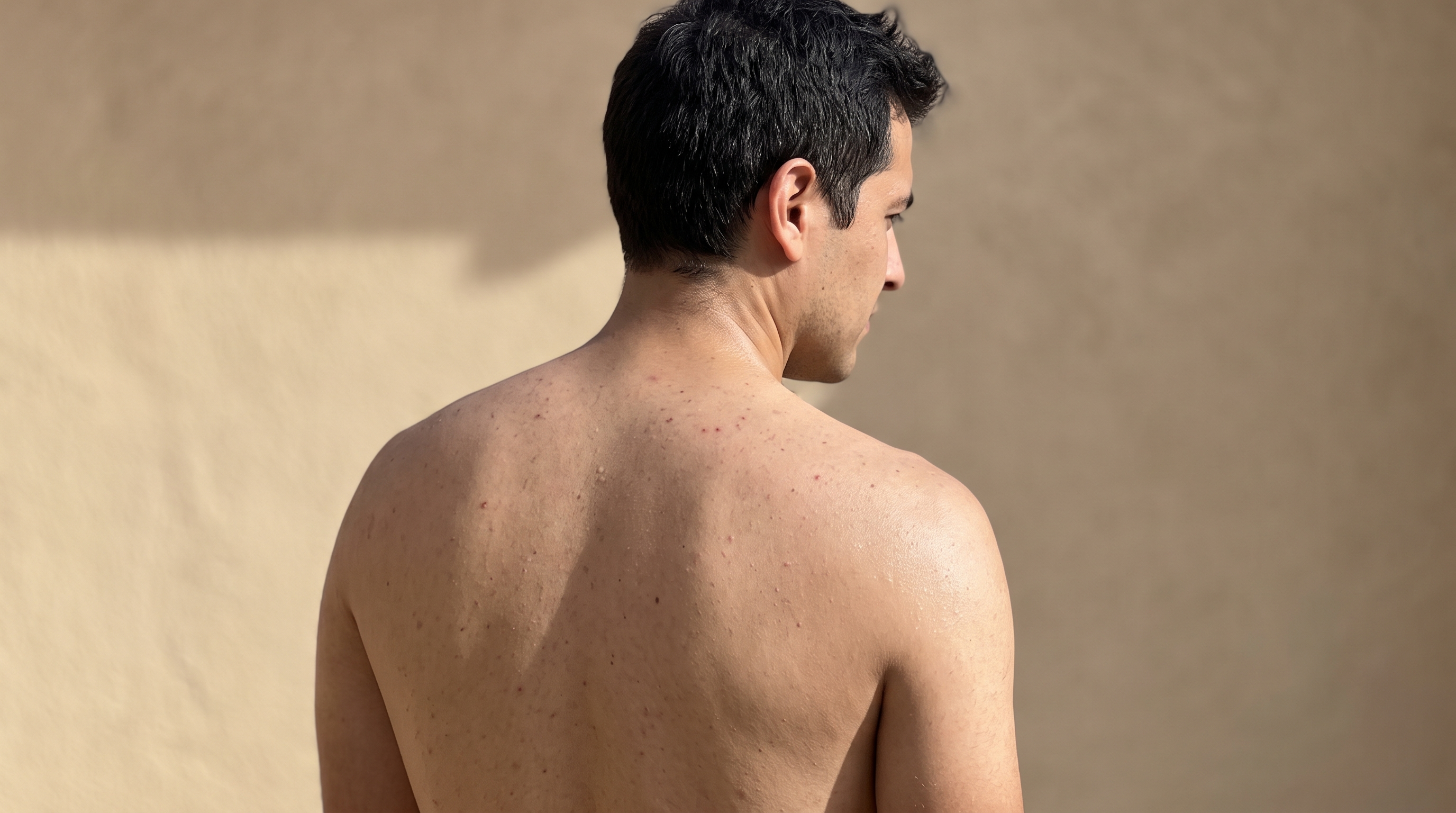
Body acne. Breakouts on the back, shoulders and chest form the same way as facial acne. In a four-week crossover study of 30 people with acne, a 2% salicylic acid cleanser significantly reduced comedones, while a 10% benzoyl peroxide wash did not, and patients who switched from salicylic acid to benzoyl peroxide got worse [3]. The study was small and on facial acne, but it is direct evidence that a wash format can work. Current acne guidelines from the American Academy of Dermatology list salicylic acid among the recommended topical options, while noting that its evidence base is thinner than that of benzoyl peroxide or retinoids [4]. Our guide to back acne covers the wider treatment picture, including what to do about the dark marks breakouts leave behind.
Keratosis pilaris. The rough, goosebump-like texture on the upper arms, thighs and buttocks comes from keratin plugging the follicles [5]. In a survey of dermatologists, lactic acid was the most used first-line treatment and salicylic acid came second [6]. The same survey carried a warning: more than 60% of respondents saw the bumps return within three months of stopping salicylic acid and moisturizer treatment [6]. Our guide to keratosis pilaris treatment explains how to combine exfoliation with moisturizing to keep the texture down.
Your skin can start to look smoother within 4 weeks of steady use, but the bumps usually return faster than they left once you stop.
Your skin can start to look smoother within 4 weeks of steady use, but the bumps usually return faster than they left once you stop.
Strawberry legs. The dark dots that appear on shaved legs are often open, clogged follicles. A salicylic acid wash can keep them clearer, especially when combined with a fresh razor and a moisturizer afterwards.
The contact-time problem
A body wash has one obvious weakness: you rinse it off. A leave-on lotion stays on your skin for hours, while a wash may stay on for a few seconds if you lather and rinse straight away.
There is a simple fix. Lather the wash onto the problem areas first, then wash your hair or shave, and rinse the body last. A minute or two on the skin, rather than a few seconds, gives the salicylic acid far more time to reach the follicles. Our guide to exfoliating body wash compares salicylic acid with glycolic and lactic acid washes, which suit dry, flaky skin better than clogged follicles.
What strength to look for
Over-the-counter acne products in the United States can contain salicylic acid at 0.5% to 2%, and most body washes sit at the top of that range. For a rinse-off product, 2% is the sensible choice. A lower strength spends even less time working.
Check the rest of the label too. A wash built on mild synthetic surfactants is less likely to leave body skin tight and itchy than a high-pH soap base. Fragrance-free formulas are kinder if your skin is already irritated from breakouts or shaving.
Safety on large areas
Salicylic acid is closely related to aspirin. When large amounts are absorbed through the skin, especially from high-strength leave-on products applied over big areas or under occlusion, it can cause salicylate toxicity, called salicylism [7]. Cases are rare, and the same review stressed that how much is absorbed depends heavily on the vehicle [7].
Your skin needs a leave-on ingredient for marks and firmness, because a wash that stays on for 2 minutes cannot rebuild what takes months to form.
A 2% wash that you rinse off is at the low end of that risk, which is one reason the format suits the body. Still, use common sense:
- Skip it if you are allergic to aspirin or have been told to avoid salicylates.
- Talk to a doctor first if you are pregnant or breastfeeding, or if you have kidney or liver disease.
- Avoid broken skin, fresh sunburn and freshly waxed areas, where absorption and stinging both increase.
- Do not stack it with leave-on salicylic acid lotions over the whole body.
How to use a salicylic acid body wash
- Start with three or four showers a week and build to daily use if your skin stays comfortable.
- Apply it to the problem areas only, such as the back, chest or upper arms, and use a gentle wash elsewhere.
- Leave the lather on for one to two minutes before rinsing.
- Moisturize while your skin is still damp. Exfoliated body skin dries out quickly, and dryness makes rough texture worse.
- Wear sunscreen on exposed areas, since freshly exfoliated skin burns more easily.
If your skin feels tight, stings or starts flaking, drop back to every other day.
When a wash is not enough
A salicylic acid wash is good at prevention. It keeps follicles clearer, but it does little for the marks breakouts leave behind, the texture of sun-damaged skin or the slow loss of firmness that shows on the chest and upper arms with age.
High-strength salicylic acid has shown benefits beyond acne. As a 30% peel applied by dermatologists at four-week intervals, it faded pigment spots, reduced surface roughness and softened fine lines on sun-damaged faces [8]. A 2% wash in the shower is not that treatment, and it should not be expected to deliver the same results.
Your skin needs a leave-on ingredient for marks and firmness, because a wash that stays on for 2 minutes cannot rebuild what takes months to form.
Where Nanoretinol fits
For lasting change in tone, texture and firmness, retinol is the better-studied tool. It speeds cell turnover, which also helps keep follicles clear, and it stimulates new collagen. Our guide to retinol for the body explains how to use it on the chest, arms and legs.
The problem is tolerance. Many conventional retinol formulas use chemicals that break down the skin’s protective lipids to push retinol in, which causes the redness and peeling that make people quit, and adding an exfoliating wash on top makes that worse.
Nanoretinol takes a gentler route. Its 0.2% stabilized retinol is carried in biomimetic lipid nanoparticles that the skin recognizes as its own, so it passes the barrier without damaging it. In North Biomedical’s study summary, Nanoretinol was 232% more effective in collagen recovery and 73% more effective in elastin recovery than conventional retinol, and after 56 days of use, skin firmness increased by 61% and elasticity by 56% [9].
A simple routine works well. Use the salicylic acid wash in the morning shower on breakout-prone areas, apply Nanoretinol at night on the face, neck and chest, and avoid layering both on the same patch of skin on the same day while you build tolerance.
References
- Arif T. “Salicylic acid as a peeling agent: a comprehensive review.” Clinical, Cosmetic and Investigational Dermatology. 2015;8:455-461. doi:10.2147/CCID.S84765
- Lu J, Cong T, Wen X, et al. “Salicylic acid treats acne vulgaris by suppressing AMPK/SREBP1 pathway in sebocytes.” Experimental Dermatology. 2019;28(7):786-794. doi:10.1111/exd.13934
- Shalita AR. “Comparison of a salicylic acid cleanser and a benzoyl peroxide wash in the treatment of acne vulgaris.” Clinical Therapeutics. 1989;11(2):264-267. PubMed:2525420
- Zaenglein AL, Pathy AL, Schlosser BJ, et al. “Guidelines of care for the management of acne vulgaris.” Journal of the American Academy of Dermatology. 2016;74(5):945-973.e33. doi:10.1016/j.jaad.2015.12.037
- Hwang S, Schwartz RA. “Keratosis pilaris: a common follicular hyperkeratosis.” Cutis. 2008;82(3):177-180. PubMed:18856156
- Greenzaid J, Nussbaum D, Friedman A. “Keratosis Pilaris: Treatment Practices of Board-Certified Dermatologists.” Journal of Drugs in Dermatology. 2023;22(10):985-989. doi:10.36849/JDD.7534
- Madan RK, Levitt J. “A review of toxicity from topical salicylic acid preparations.” Journal of the American Academy of Dermatology. 2014;70(4):788-792. doi:10.1016/j.jaad.2013.12.005
- Kligman D, Kligman AM. “Salicylic acid peels for the treatment of photoaging.” Dermatologic Surgery. 1998;24(3):325-328. doi:10.1111/j.1524-4725.1998.tb04162.x
- North Biomedical LLC. “Nanoretinol vs. Conventional Retinol: Efficacy in Collagen and Elastin Recovery.” Clinical Study Summary, 2024. Study summary