
The Best Skin Care Routine for Your 30s: What to Add, What to Skip
The decade when collagen loss becomes visible is also the decade when it is easiest to do something about.
Something specific happens to skin in the thirties, and it is not dramatic enough to panic about or subtle enough to ignore.
A line that used to vanish when you stopped smiling now lingers for a moment. Skin takes longer to recover from a bad night. Makeup settles into places it did not settle into before. Nothing has failed. What has happened is that a slow, steady process that began years ago has finally crossed the threshold of visibility.
Understanding that process tells you exactly what your routine needs — and, just as usefully, what it does not.
What is actually happening under the surface
Skin collagen declines with age, and the decline starts far earlier than most people expect. The foundational measurements, taken across a wide age range, established that skin collagen content falls steadily through adult life and that women carry less at every age [1]. The commonly cited figure — roughly 1% lost per year from the mid-twenties — comes from this body of work.
In your twenties, that loss is invisible because you are starting from a surplus. By your mid-thirties, a decade of compounding has removed enough structural protein for the change to show up in a mirror.
The mechanism is not only that collagen breaks down. Production slows too. Research examining chronologically aged skin found that fibroblasts — the cells responsible for manufacturing collagen — become less productive with age, partly because the collapsing collagen network around them no longer provides the mechanical stretch that normally signals them to keep working [2]. It is a feedback loop that accelerates once it starts.
Layered on top of that is photoaging, which is a separate process from chronological ageing and, for most people, the larger contributor. Ultraviolet exposure drives the enzymatic breakdown of dermal collagen through mechanisms that have been mapped in detail [3]. The face you have at forty is substantially a record of how much sun the face you had at twenty absorbed.
Why the thirties are the highest-return decade
Here is the case for acting now rather than later.
At this stage the damage is real but shallow. Fibroblasts are less productive than they were, but they are still responsive. The collagen network is thinner, but it is intact. You are not trying to reverse decades of accumulated structural loss — you are intervening in a process that is still early.
The evidence that prevention works at this stage is unusually good. In a randomised controlled trial that followed adults under 55 over four and a half years, the group assigned to daily sunscreen showed no detectable increase in skin ageing, while the discretionary-use group aged measurably [4]. Not a slower rate of ageing. No detectable increase. That is the kind of result that rarely appears in skincare research.
In your twenties, that loss is invisible because you are starting from a surplus.
Our piece on collagen banking covers this preventive logic in more depth.
The morning routine
Four steps, and one of them carries most of the weight.
Cleanse gently, or just rinse. Unless you went to bed in makeup or sunscreen, water is often enough. Aggressive morning cleansing strips a barrier that spent the night rebuilding itself.
Antioxidant serum. Vitamin C is the best-studied option, contributing to collagen synthesis as an essential cofactor and providing photoprotective support alongside sunscreen rather than instead of it [5]. This is the step that reduces the damage sunscreen does not catch.
Moisturiser. Match it to your skin, not to your age. A thirty-four-year-old with oily skin does not need a rich cream because a label says “anti-ageing”.
Sunscreen. Every day. This is not the boring obligatory item at the end of the list. Based on the trial evidence above, it is the single highest-value product in the routine, and it is not close. Broad-spectrum, SPF 30 or higher, applied properly and reapplied when you are outdoors for long stretches.
If layering order confuses you, our guide to skincare routine order sorts it out.
The night routine
Cleanse properly. This is the cleanse that matters — sunscreen, makeup and a day’s worth of airborne debris all need to come off.
A retinoid. This is the addition that defines a thirties routine, and the reason follows directly from the biology above. Retinoids are the most extensively studied topical class for skin ageing, with a clinical record spanning decades for improving fine lines, texture and tone by increasing collagen production and accelerating cell turnover [6]. Everything else in your routine protects or hydrates. This is the step that instructs your fibroblasts to rebuild.
Broad-spectrum, SPF 30 or higher, applied properly and reapplied when you are outdoors for long stretches.
Start two nights a week. Increase slowly. Irritation is not a sign that it is working.
Moisturiser. Applied after the retinoid, to support the barrier while your skin adjusts.
That is the whole routine. Seven steps across two parts of the day.
What you can skip for now
The thirties are when marketing arrives in force, so it is worth naming what is not yet earning its place.
Eye creams as a separate purchase. Most are moisturiser at a markup in a smaller jar. A well-formulated retinoid used carefully around the orbital bone does more.
Collagen creams. Collagen molecules are far too large to penetrate skin and reach the dermis. They sit on the surface as decent humectants — which is fine, but it is not what the packaging implies.
Aggressive exfoliating stacks. Combining a strong acid, a scrub and a retinoid does not accelerate results. It damages your barrier, and a compromised barrier ages faster.
Multiple actives at once. Pick a retinoid, a vitamin C, a sunscreen, and be consistent for six months. Consistency beats complexity by a wide margin at this stage.
The one upgrade worth making
If a single change is going to matter over the next ten years, it is a retinoid you can actually tolerate — because a retinoid used twice and abandoned does nothing at all.
That tolerance problem is a delivery problem. Retinol has to cross the epithelial barrier to reach the cells that build collagen, and conventional formulations are poor at it. The traditional workaround is to force passage using chemicals and petroleum derivatives that disrupt the barrier through lipid mobility. That mechanism is destructive by design, which is why so many people’s first experience of retinol is burning, redness and peeling — followed by quitting.
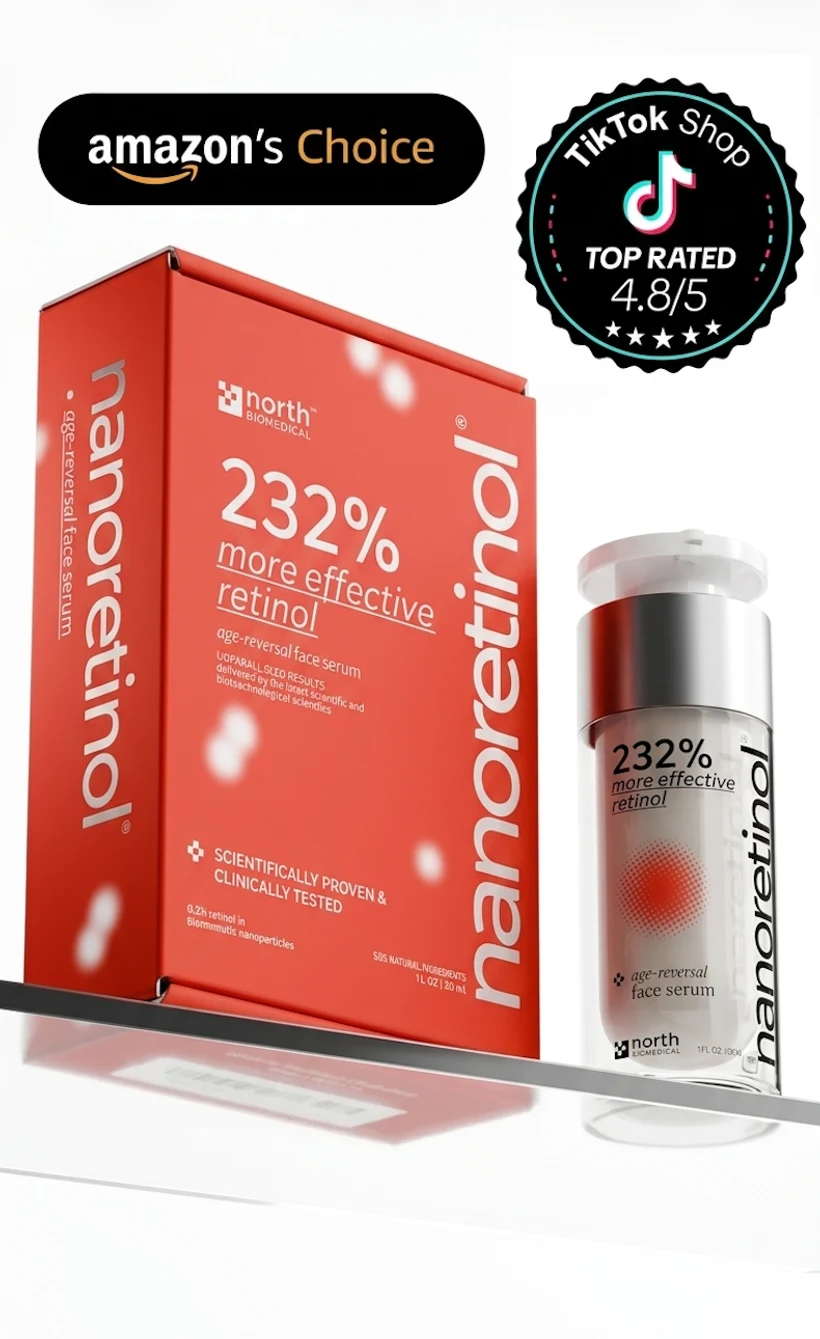
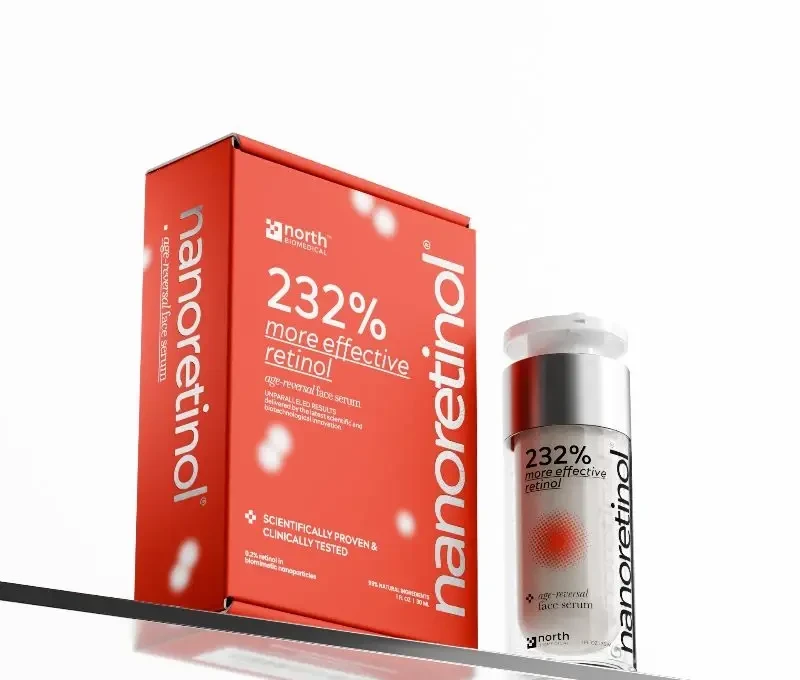
Nanoretinol was engineered around the delivery problem rather than around it. Its retinol is encapsulated in biomimetic lipid nanoparticles that are externally identical to skin cells, so the body recognises them as “self” and permits passage through the epithelial barrier without damaging it — the same class of nanotechnology used in modern drug delivery. In North Biomedical’s clinical study, that approach proved 232% more effective in collagen recovery and 73% more effective in elastin recovery than conventional retinol, at a 0.2% concentration, while proving significantly gentler on skin cells [7]. Because it is water-based and made with 99% natural ingredients, it suits sensitive and combination skin — which is precisely the group that gives up on conventional retinol first.
Delivery efficiency, not concentration, is what decides whether an ingredient works.
Starting now buys you the most
There is no emergency here. Skin in the thirties is skin in good condition that has begun a predictable decline, and the interventions that work are neither expensive nor complicated.
What makes this decade valuable is leverage. The same sunscreen and the same retinoid applied at thirty-five and at fifty-five do not produce the same outcome, because at thirty-five you are preserving structure that still exists. If you want to see where the road leads, our guide to looking younger at 40 covers the next stage, and our overview of how to prevent wrinkles goes deeper on the preventive side.
Seven steps, done consistently. That really is the whole answer.
References
- Shuster S, Black MM, McVitie E. “The influence of age and sex on skin thickness, skin collagen and density.” British Journal of Dermatology. 1975;93(6):639-643. doi:10.1111/j.1365-2133.1975.tb05113.x
- Varani J, Dame MK, Rittié L, Fligiel SEG, Kang S, Fisher GJ, Voorhees JJ. “Decreased collagen production in chronologically aged skin: roles of age-dependent alteration in fibroblast function and defective mechanical stimulation.” The American Journal of Pathology. 2006;168(6):1861-1868. doi:10.2353/ajpath.2006.051302
- Fisher GJ, Kang S, Varani J, Bata-Csorgo Z, Wan Y, Datta S, Voorhees JJ. “Mechanisms of photoaging and chronological skin aging.” Archives of Dermatology. 2002;138(11):1462-1470. doi:10.1001/archderm.138.11.1462
- Hughes MCB, Williams GM, Baker P, Green AC. “Sunscreen and prevention of skin aging: a randomized trial.” Annals of Internal Medicine. 2013;158(11):781-790. doi:10.7326/0003-4819-158-11-201306040-00002
- Pullar JM, Carr AC, Vissers MCM. “The Roles of Vitamin C in Skin Health.” Nutrients. 2017;9(8):866. doi:10.3390/nu9080866
- Mukherjee S, Date A, Patravale V, Korting HC, Roeder A, Weindl G. “Retinoids in the treatment of skin aging: an overview of clinical efficacy and safety.” Clinical Interventions in Aging. 2006;1(4):327-348. doi:10.2147/ciia.2006.1.4.327
- North Biomedical LLC. “Nanoretinol vs. Conventional Retinol: Efficacy in Collagen and Elastin Recovery.” Clinical Study Summary, 2024. https://northbiomedical.com/documents/Nanoretinol-Study_Summary.pdf