Thermal Water: Does a Spring Water Spray Really Calm Your Skin?
What sets thermal spring water apart from tap or mineral water, what the studies show for redness and retinoid irritation, and how to use a spray so it does not dry you out
Thermal water is one of the oddest products in skincare: a can of water from a particular spring, sold at many times the price of the bottled water in your fridge. French pharmacies have recommended it for decades for sensitive and irritated skin, and dermatologists still hand out samples after procedures.
Is it more than marketing? Partly. Some thermal waters have real laboratory and clinical data behind them, and one small trial suggests they can make harsh acne and retinoid treatments easier to tolerate. But a spray of water can also leave skin drier than before if you use it wrong. Here is what the evidence supports.
What thermal water is
Thermal spring water comes from underground sources where rainwater has filtered through rock for years, sometimes centuries, picking up a stable mix of minerals and trace elements on the way. Each spring has its own fingerprint.
Two features set the skincare springs apart:
- Trace elements. Some French spring waters are naturally rich in selenium, a trace element involved in the skin’s antioxidant defenses [1].
- Low mineral load. Others are unusually low in mineral salts. Hydrochemical studies of one such spring show its composition is stable because it is set by slow natural equilibrium with the rock it passes through [2].
Some springs also carry their own harmless bacteria, and extracts of those microbes are now being studied as soothing ingredients in their own right.
How it differs from tap and mineral water
Ordinary tap water is not neutral for skin. Your skin can feel tighter and drier after a hard, alkaline tap water rinse than after a splash of softer, low-mineral water. Water itself can act as a mild irritant, especially when it is hard, alkaline or left to soak the skin, and it can wash out the natural moisturizing factors that keep the outer layer supple [3]. Our guide to hard water and your skin covers why the calcium and magnesium in tap water leave some people feeling tight after every single wash, and what a shower filter or a final rinse can and cannot change about that.
The type of mineral content seems to matter. In one laboratory study on skin samples, a mineral-rich spring water made the surface layers more compact and rigid after three applications, while a low-mineral thermal water left the surface unchanged [4]. That is a lab finding, not a clinical one, but it fits the idea that softer, low-mineral water is kinder to a fragile barrier.
Your skin can feel tighter and drier after a hard, alkaline tap water rinse than after a splash of softer, low-mineral water.
What the studies show
Redness and inflammation
In a cell study comparing two thermal spring waters with two drinking mineral waters, the thermal waters reduced inflammatory signals and the burst of reactive oxygen species after UVB exposure, while the drinking waters had a weaker effect. The authors suggest trace elements such as selenium and zinc may explain the difference [5].
That is promising, but it is a cell culture result. Most of the clinical work on thermal water comes from the spring owners themselves, so treat the evidence as encouraging rather than settled.
Retinoid irritation
The most practical evidence comes from acne treatment. In a randomized, evaluator-blinded split-face trial, 31 people using standard acne therapy, mostly adapalene, tretinoin and benzoyl peroxide, sprayed thermal water on one side of the face four times a day [6].
Your skin can sting less after just 2 weeks of thermal water sprays, far sooner than most people expect a gentler routine to pay off. In the trial, the sprayed side stung less from week 2, and by 6 weeks it was better hydrated at the forehead, cheek and jaw, and people reported less dryness and more suppleness there. Water loss, oiliness and skin pH did not differ between the two sides.
For anyone whose skin protests at retinoids, that is the clearest reason to keep a can nearby. If redness is your main concern, our guide to face redness explains the common causes.
The catch: water evaporates
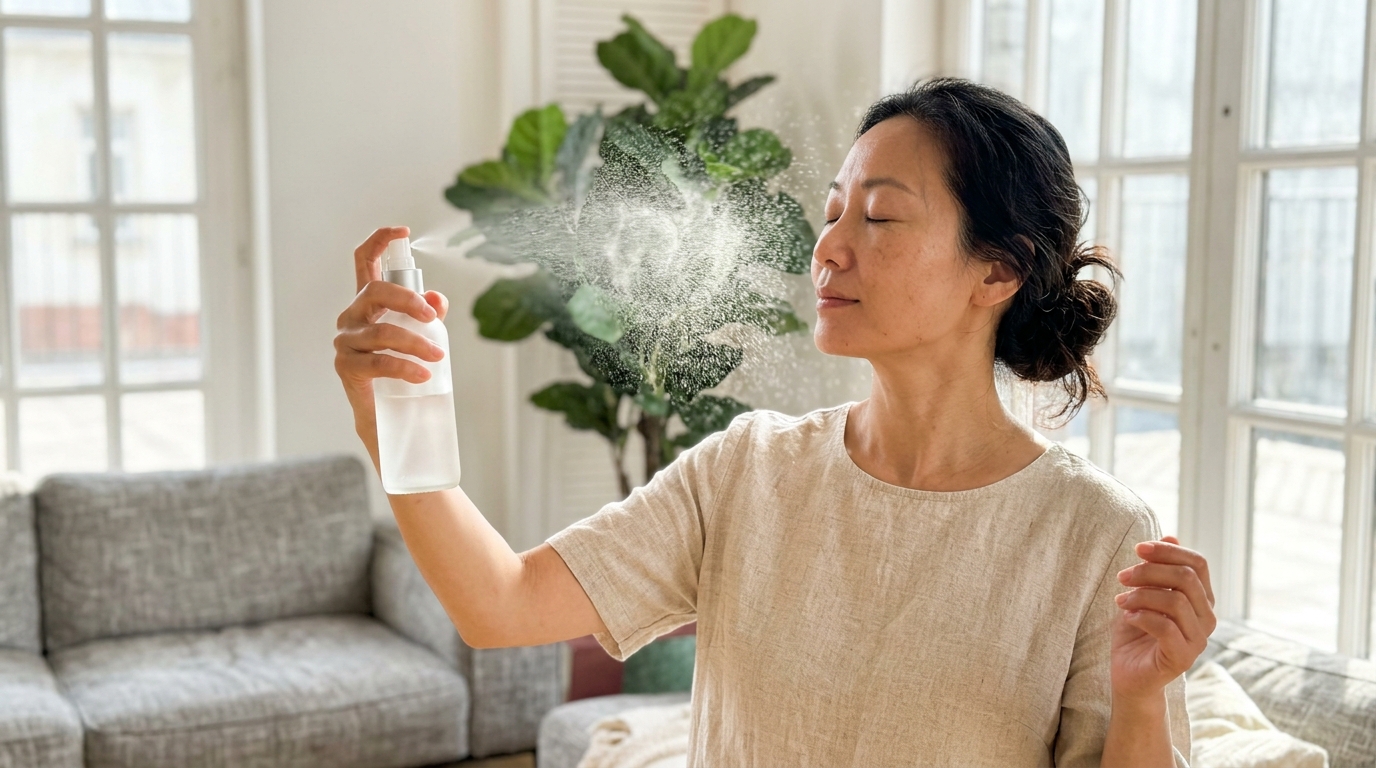
Spraying water on your face and letting it dry in the air can leave skin tighter than before. As the droplets evaporate, they can take some of the skin’s own water with them.
Your skin can sting less after just 2 weeks of thermal water sprays, far sooner than most people expect a gentler routine to pay off.
The fix is simple: always follow a spray with something that holds the water in. Thermal water should be the first step of a routine, not the whole routine.
How to use a thermal water spray
- After cleansing, spray thermal water instead of splashing with tap water.
- Leave it for 10 to 20 seconds, then pat off the excess with a clean towel.
- Apply your serum or moisturizer while the skin is still damp.
- Seal very dry or irritated skin with a richer cream at night.
- During the day, mist over makeup or after sun and wind, then press in a little moisturizer or pat dry.
It also works as a cooling step after shaving, exercise or a long flight, and as a soothing rinse when a new active stings. If you prefer a mist with added humectants, a hydrating face mist combines water with glycerin or hyaluronic acid so it hydrates rather than just cools.
Who benefits most
- Sensitive and reactive skin that stings with tap water or new products.
- People starting retinoids or acne treatments, during the first weeks of adjustment.
- Skin after procedures, when your dermatologist allows it.
- Anyone in a hard-water area, as a final rinse.
If your skin is not sensitive, thermal water is a pleasant extra rather than an essential. It will not fade lines or spots.
Thermal water and retinol
Retinol remains one of the best-studied ingredients for aging skin, but conventional formulas are hard on sensitive faces. They often rely on chemicals that weaken the skin barrier to push the active through, which leads to stinging, redness and peeling. That is exactly the irritation thermal water is used to soothe.
A gentle routine pairs the two: mist after cleansing, apply retinol at night, then moisturizer, and use the spray again in the morning before sunscreen. Our guide to retinol for sensitive skin covers how to start slowly.
A gentler retinol from the start
Soothing irritation is useful; avoiding it is better. Nanoretinol encapsulates 0.2% retinol in biomimetic lipid nanoparticles that the skin recognizes as its own, so it passes the barrier without damaging it. The water-based, gel-like formula has 99% natural ingredients and is suitable for sensitive skin and the eye contour.
In laboratory testing Nanoretinol was 232% more effective in collagen recovery than conventional retinol, and clinical trials confirm minimal side effects, milder than those caused by conventional retinol when they occur [7]. Paired with a thermal water spray and a good moisturizer, it makes a retinol routine that sensitive skin can live with.
Should you buy thermal water?
Thermal spring water is not magic, but it is not just water either. The best springs are low in harsh minerals and rich in trace elements, lab studies show calming effects, and a small trial found it eased the sting of retinoid acne treatment. Use it as a first step, always seal it with moisturizer, and pair it with a retinol gentle enough that you need the spray less.
References
- Seite S. “Thermal waters as cosmeceuticals: La Roche-Posay thermal spring water example.” Clinical, Cosmetic and Investigational Dermatology. 2013;6:23-28. doi:10.2147/CCID.S39082
- Lions J. “Hydrochemistry of Avène thermal waters (Avène-les-Bains, France).” Journal of the European Academy of Dermatology and Venereology. 2020;34 Suppl 5:4-7. doi:10.1111/jdv.16336
- Tsai TF, Maibach HI. “How irritant is water? An overview.” Contact Dermatitis. 1999;41(6):311-314. doi:10.1111/j.1600-0536.1999.tb06990.x
- Mias C, Stennevin A, Doat G, Catté A, Chlasta J, Bessou-Touya S, et al. “Effect of a low-mineralized thermal spring water on skin barrier mechanical properties using atomic force microscopy.” Experimental Dermatology. 2024;33(6):e15113. doi:10.1111/exd.15113
- Zöller N, Valesky E, Hofmann M, Bereiter-Hahn J, Bernd A, Kaufmann R, et al. “Impact of different spa waters on inflammation parameters in human keratinocyte HaCaT cells.” Annals of Dermatology. 2015;27(6):709-714. doi:10.5021/ad.2015.27.6.709
- Faisal UA, Jamil A, Jaafar H, Aqma WS, Arumugam M. “Effects of Malaysian thermal spring water as adjunct therapy for mild to moderate acne vulgaris: a prospective, randomised, controlled, split face study.” Medical Journal of Malaysia. 2024;79(2):157-164. PubMed 38553920
- North Biomedical LLC. “Nanoretinol vs. Conventional Retinol: Efficacy in Collagen and Elastin Recovery.” Clinical Study Summary, 2024. Study summary