Beta Glucan Serum: How to Choose One for Calm, Hydrated, Resilient Skin
Beta glucan has become a favorite soothing ingredient in serums. Here is what the human studies show, why the source and molecule size matter, and how it fits with retinol
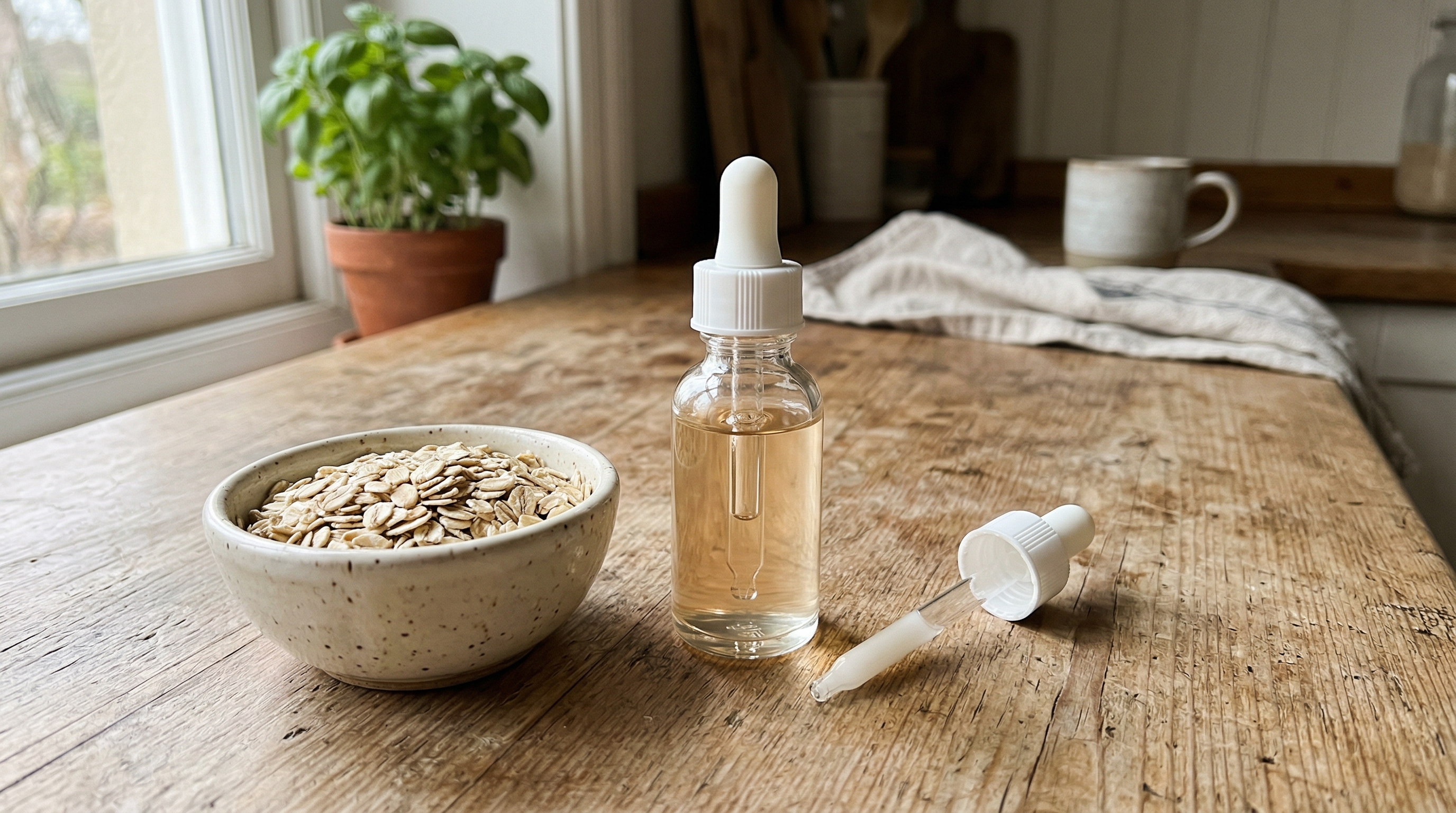
Beta glucan is a family of sugar chains that form the cell walls of oats, barley, yeast, mushrooms and some seaweeds and bacteria [1]. In skincare, it has earned a reputation as a calming, hydrating ingredient, the kind of serum people reach for when their skin feels tight, reactive or worn out from too many actives.
That reputation is partly earned and partly marketing. The laboratory evidence is broad and exciting, while the human evidence is smaller and more modest. Knowing which is which makes it much easier to choose a serum that will actually help.
What beta glucan does for skin
Beta glucans are what scientists call biological response modifiers: they interact with immune and repair cells rather than simply sitting on the surface [2]. In skin, the main targets are keratinocytes, fibroblasts and macrophages. In wound-healing research, beta glucans increase macrophage activity, encourage new tissue and collagen deposition and speed resurfacing of the skin [2].
They are also strong humectants. Like hyaluronic acid, beta glucan holds water at the surface, which is why a good serum makes skin feel soft and comfortable within minutes. Reviews of the topical research describe antioxidant, moisturizing, anti-wrinkle and UV-protective effects, along with some ability to penetrate the skin [1].
Source and molecule size decide how far it goes
Not all beta glucans behave the same way. Yeast beta glucan is usually modified into a water-soluble form called carboxymethyl beta glucan, or CM-glucan, so it can be used in light formulas [3]. Oat beta glucan is common in sensitive-skin products. Mushroom glucans such as those from split-gill or reishi appear in Korean and Japanese serums.
Molecular weight matters as much as the source. Large glucan molecules mostly stay on the surface, forming a moisture-holding film. Researchers have broken oat beta glucan into fragments of about 1 kDa and found they passed into skin more easily and boosted fibroblast activity in laboratory tests [4]. The same pattern has been seen with hyaluronic acid, where lower-weight forms reduced wrinkle depth more than larger ones in a 60-day trial [5].
Your serum’s label rarely lists molecular weight, so the source and the order on the ingredient list tell you more than the word “beta glucan” on the front.
Your serum’s label rarely lists molecular weight, so the source and the order on the ingredient list tell you more than the word “beta glucan” on the front.
What the human studies show
The clinical evidence is real but limited. In placebo-controlled studies with healthy volunteers, pre-treating skin with yeast CM-glucan gave substantial protection against damage from a detergent challenge and from UVA light, and it increased the renewal rate of the outer skin layer [3].
A related ingredient, a chitin-glucan complex from fungal cell walls, was tested in two randomized, double-blind trials. In 13 people with sensitive skin, it raised water retention in the outer layer and modestly reduced water loss over six weeks without causing redness. In 20 men with aging skin, a 1.5% formula applied twice daily for 16 weeks progressively increased firmness and hydration and reduced roughness [6].
Much of the newer, more dramatic research, such as CM-glucan switching on barrier proteins and type I collagen, comes from cell cultures and 3D skin models [7]. The authors themselves say clinical studies are still needed. That makes beta glucan a dependable comfort and barrier ingredient, but not a proven wrinkle treatment on its own.
Your skin can hold more water after 6 weeks of a glucan formula than it did with a placebo, without the redness that many active serums trigger.
Your skin can hold more water after 6 weeks of a glucan formula than it did with a placebo, without the redness that many active serums trigger.
Beta glucan or hyaluronic acid?
Both are water-binding sugars, and both improve hydration. Hyaluronic acid has the larger body of human data on hydration and fine lines [5]. Beta glucan’s edge is its calming, immune-modulating activity, which makes it a better pick when skin is red, reactive or recovering. Many serums combine the two, and that is a sensible pairing. If hydration alone is the goal, our guide to hyaluronic acid serums and our overview of hydrating serums cover the options.
How to choose a beta glucan serum
Look for:
- Placement: beta glucan in the first few ingredients, not near the end after the preservatives.
- Named source: oat, yeast (often listed as sodium carboxymethyl beta-glucan), or a named mushroom, so you know what you are buying.
- A simple formula: humectants such as glycerin, a soothing partner such as panthenol or ceramides, and no fragrance or essential oils.
- No strong acids in the same bottle, because a calming serum should not also be exfoliating.
Apply it to damp skin after cleansing, morning or evening, and follow with moisturizer. Because it is gentle, it suits almost every skin type and can be used daily.
Set your expectations by timeline. The plumper, more comfortable feel arrives within minutes, because that is the humectant effect at work. Changes in how well your skin holds water and resists irritation build more slowly, and the chitin-glucan trials above measured them over six to sixteen weeks of twice-daily use [6]. If your skin feels calmer but your fine lines look the same after two months, the serum is doing exactly what the evidence says it can do. For background on the ingredient itself, see our deeper explainer on beta glucan for skin.
The partner that makes retinol easier
Beta glucan calms and hydrates, but the strongest evidence for rebuilding collagen still belongs to retinoids. In adults with an average age of 87, a 0.4% retinol lotion improved fine wrinkling and increased new collagen within 24 weeks [8].
The problem is that conventional retinol often stings and peels, especially on sensitive skin, and many people stop before they see results. Our guide to retinol and the skin barrier explains why that happens and how to avoid it.
Nanoretinol approaches the problem from the delivery side. It carries 0.2% stabilized retinol in biomimetic lipid nanoparticles that the skin recognizes as its own, so it reaches skin cells without breaking down the barrier the way conventional formulations can. In North Biomedical’s study summary, Nanoretinol was 232% more effective in collagen recovery and 73% more effective in elastin recovery than conventional retinol, and its side effects were minimal and milder [9].
A simple routine for sensitive or stressed skin: beta glucan serum and sunscreen in the morning, then Nanoretinol at night followed by a thin layer of beta glucan serum or moisturizer if your skin feels dry. The serum keeps skin comfortable while the retinol does the long-term rebuilding.
References
- Du B, Bian Z, Xu B. “Skin health promotion effects of natural beta-glucan derived from cereals and microorganisms: a review.” Phytotherapy Research. 2014;28(2):159-166. doi:10.1002/ptr.4963
- Majtan J, Jesenak M. “β-Glucans: Multi-Functional Modulator of Wound Healing.” Molecules. 2018;23(4):806. doi:10.3390/molecules23040806
- Zulli F, Suter F, Biltz H, Nissen HP. “Improving skin function with CM-glucan, a biological response modifier from yeast.” International Journal of Cosmetic Science. 1998;20(2):79-86. doi:10.1046/j.1467-2494.1998.171740.x
- Jiang H, Li J, Luo S, et al. “Oat β-Glucooligosaccharides: Preparation, characterization, skin permeability, and photodamage repair for skincare applications.” Carbohydrate Research. 2025;557:109648. doi:10.1016/j.carres.2025.109648
- Pavicic T, Gauglitz GG, Lersch P, et al. “Efficacy of cream-based novel formulations of hyaluronic acid of different molecular weights in anti-wrinkle treatment.” Journal of Drugs in Dermatology. 2011;10(9):990-1000. PubMed:22052267
- Gautier S, Xhauflaire-Uhoda E, Gonry P, Piérard GE. “Chitin-glucan, a natural cell scaffold for skin moisturization and rejuvenation.” International Journal of Cosmetic Science. 2008;30(6):459-469. doi:10.1111/j.1468-2494.2008.00470.x
- Pichon C, Marat X, Brule A, Black A, Gueniche A. “The harnessing potential of carboxymethyl beta glucan: A driver of skin repair.” International Journal of Cosmetic Science. 2026. doi:10.1111/ics.70111
- Kafi R, Kwak HS, Schumacher WE, et al. “Improvement of naturally aged skin with vitamin A (retinol).” Archives of Dermatology. 2007;143(5):606-612. doi:10.1001/archderm.143.5.606
- North Biomedical LLC. “Nanoretinol vs. Conventional Retinol: Efficacy in Collagen and Elastin Recovery.” Clinical Study Summary, 2024. Study summary