Age Spot Cream: Which Ingredients Actually Fade Sun Spots
Age spot creams use everything from retinoids to vitamin C. Here is what the solar lentigo trials measured for each ingredient, how long fading takes, and how to choose a cream for your face, hands or chest
Age spots creep in quietly. One flat brown mark on the back of a hand becomes five, then a scattering across the cheeks and chest, and suddenly your skin looks older than you feel. The shelf of creams promising to fade them is long, and the labels all sound the same.
The ingredient list is what separates a cream that can work from one that cannot. This guide compares the ingredients used in age spot creams on what clinical trials actually measured, explains why these spots fade slowly, and shows how to pick a cream for your face, hands or chest.
What an age spot is
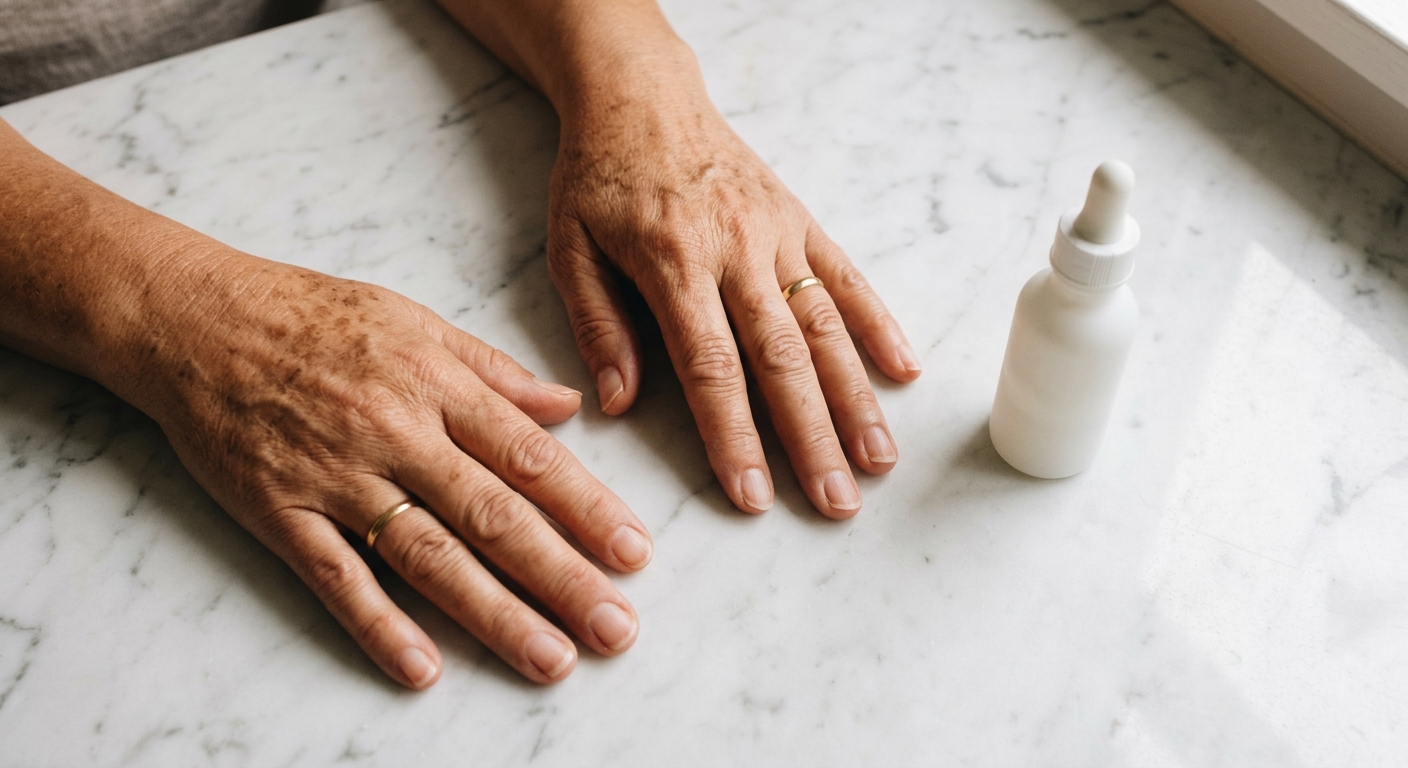
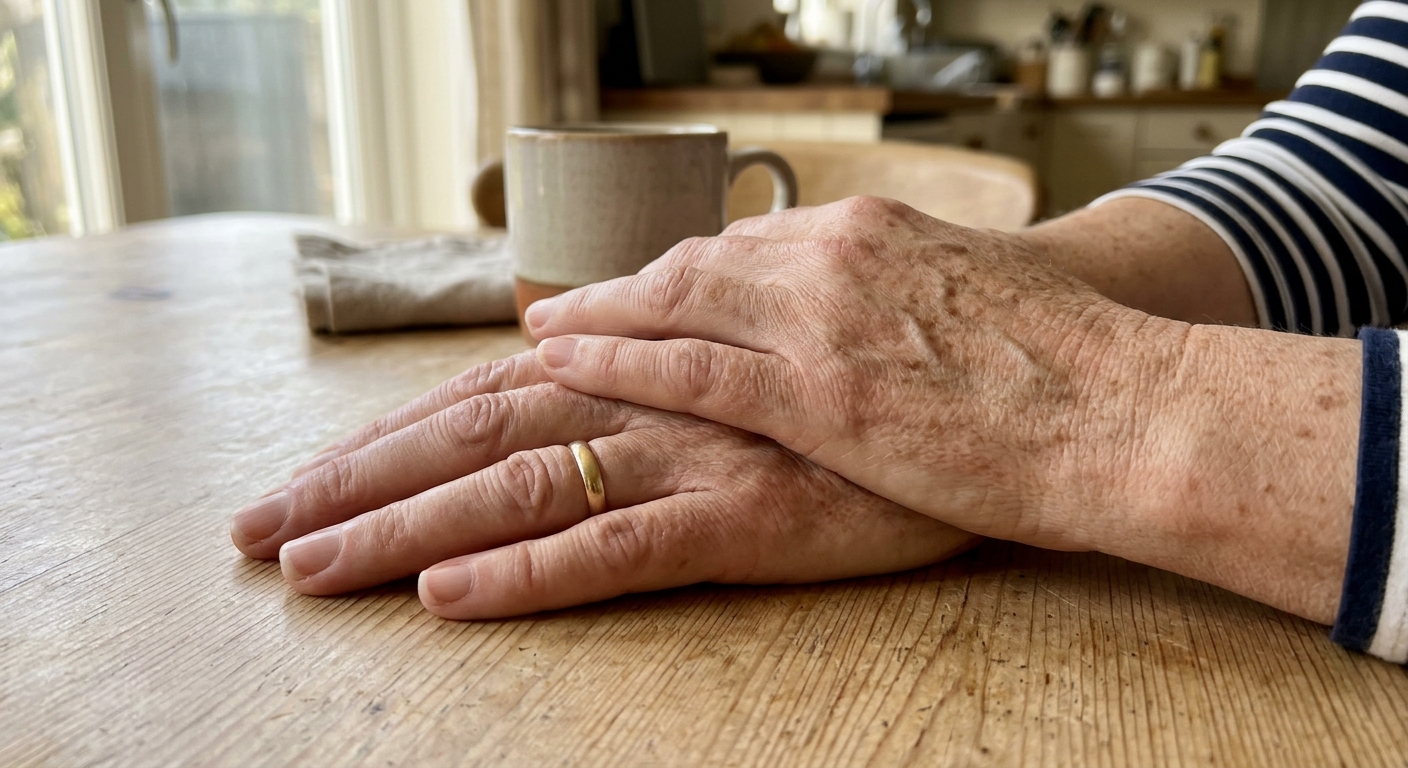
Age spots, also called sun spots, liver spots or solar lentigines, are flat, sharply edged patches of extra pigment that develop after years of sun exposure. They have nothing to do with the liver. Inside a spot, pigment cells produce more melanin and the surface layer of skin holds on to it, so the patch stays darker than the skin around it.
Because the cause is cumulative sunlight, the spots appear where skin has been exposed longest: the face, the backs of the hands, the forearms and the chest. Our guide to age spots on the face covers why they cluster on the cheeks and temples and how they differ from freckles and melasma.
Your skin started lightening age spots after just 4 weeks of daily retinoid use in one trial, far sooner than most people expect from a cream.
What the experts rank first
An expert consensus that reviewed 20 years of studies on solar lentigines concluded that in-office ablative treatment, mainly cryotherapy, was first-line, with good evidence for lasers as well [1]. For topical treatment, the group found good evidence for a fixed double combination cream and for retinoids such as tretinoin and adapalene, and noted that topicals also work as maintenance after an in-office treatment [1].
Your skin started lightening age spots after just 4 weeks of daily retinoid use in one trial, far sooner than most people expect from a cream.
In other words, retinoids are not a fringe option. They are the topical ingredient group with the strongest evidence for age spots.
Retinoids: the best-studied cream ingredient
The landmark trial gave 58 patients either 0.1% tretinoin cream or a plain cream every day for 10 months [2]. Lightening was already significant after one month. By the end, 83% of patients treated on the face had lighter spots, compared with 29% on the plain cream, and the results on the arms were similar [2]. Biopsies showed less pigment in the outer layer of skin.
A later trial tested adapalene, another retinoid, in 90 patients with sun damage. After 9 months, 57% to 59% of those using adapalene had lighter spots, compared with 36% on the plain gel, and blinded dermatologists also saw improvement in wrinkles [3]. Our article on retinol for dark spots explains how retinoids speed up the turnover that carries pigment out of the skin and how over-the-counter retinol compares with prescription forms.
Hydroquinone and combination creams
Hydroquinone blocks tyrosinase, the enzyme that makes melanin, and it has long been the reference lightening agent. In the United States it is now prescription-only. A related compound, mequinol, was combined with a low dose of tretinoin and tested in two large trials on spots on the face, forearms and hands. The combination beat each ingredient alone and the plain solution in most comparisons over 24 weeks [4].
Combinations work because they hit pigment from two directions: one ingredient slows melanin production and the retinoid moves existing pigment out faster. For a closer look at strengths, side effects and safe cycling, see our guide to hydroquinone for dark spots, which also covers the gentler alternatives that dermatologists suggest for long-term use.
Your skin can hold on to the gains: age spots that faded during 10 months of daily retinoid use had not returned 6 months after treatment stopped.
Niacinamide, vitamin C and other brighteners
Several gentler ingredients have smaller but real evidence:
- Niacinamide does not block melanin production; it slows the transfer of pigment into surrounding skin cells. A 5% niacinamide moisturizer significantly reduced facial hyperpigmentation compared with a plain moisturizer after 4 weeks [5].
- Vitamin C lowers melanin production and protects against the sunlight that creates new spots. In a trial on solar lentigines, a serum with 10% L-ascorbic acid and 2% phytic acid reduced spot pigmentation over 3 months, compared with the plain serum on the other side of the body [6].
- Arbutin, kojic acid and licorice extract are plant-derived tyrosinase inhibitors. They are common in brightening creams, but most of their clinical data is on melasma or general dark spots rather than age spots specifically.
Your skin can hold on to the gains: age spots that faded during 10 months of daily retinoid use had not returned 6 months after treatment stopped.
How long a cream takes
Age spots fade more slowly than acne marks, because the pigment sits in skin that has been sun damaged for decades. Expect early lightening after one to three months, with the biggest change after six months or more of daily use [2, 3]. The 10-month retinoid trial found that spots that cleared did not come back during six months of follow-up, and most patients who kept using the cream continued to improve [2].
Two habits decide whether that progress lasts:
- Daily sunscreen. Every unprotected day undoes part of the work. Use a broad-spectrum SPF 30 or higher on the face, hands and chest.
- Consistency. A cream used every night for six months beats a stronger one used on and off.
How to choose a cream
- For the face: a retinoid at night and vitamin C or niacinamide in the morning under sunscreen is the most evidence-based pairing.
- For the hands and chest: skin here is thinner and drier, so pick a cream base rather than a gel, and add a moisturizer on top if a retinoid stings.
- Claims to ignore: “instant” fading, “bleaching” without an ingredient list, and anything promising permanent removal.
Some brown spots are not age spots. See a dermatologist about any spot that is growing, changing colour, bleeding, itching or has an irregular edge, and read our guide to liver spots for the signs that separate a harmless sun spot from one that needs a closer look.
The retinol step that does double duty
Retinoids are the cream ingredient with the strongest evidence for age spots, and they also rebuild the collagen that sun damage breaks down. The challenge has always been irritation, especially on thin skin over the hands and chest.
Nanoretinol carries 0.2% retinol in biomimetic lipid nanoparticles, in a light, water-based gel that also contains a stable vitamin C derivative, sodium ascorbyl phosphate. In North Biomedical’s clinical study it was 232% more effective in collagen recovery than conventional retinol and produced a 61% increase in firmness after 56 days, with milder side effects than conventional retinol [7]. Apply it at night to the face, hands or chest, and pair it with sunscreen every morning so the spots you fade stay faded.
References
- Ortonne JP, Pandya AG, Lui H, Hexsel D. “Treatment of Solar Lentigines.” Journal of the American Academy of Dermatology. 2006;54(5 Suppl 2):S262-S271. doi:10.1016/j.jaad.2005.12.043
- Rafal ES, Griffiths CE, Ditre CM, Finkel LJ, Hamilton TA, Ellis CN, Voorhees JJ. “Topical Tretinoin (Retinoic Acid) Treatment for Liver Spots Associated with Photodamage.” New England Journal of Medicine. 1992;326(6):368-374. doi:10.1056/NEJM199202063260603
- Kang S, Goldfarb MT, Weiss JS, Metz RD, Hamilton TA, Voorhees JJ, Griffiths CE. “Assessment of Adapalene Gel for the Treatment of Actinic Keratoses and Lentigines: A Randomized Trial.” Journal of the American Academy of Dermatology. 2003;49(1):83-90. doi:10.1067/mjd.2003.451
- Fleischer AB Jr, Schwartzel EH, Colby SI, Altman DJ. “The Combination of 2% 4-Hydroxyanisole (Mequinol) and 0.01% Tretinoin Is Effective in Improving the Appearance of Solar Lentigines and Related Hyperpigmented Lesions in Two Double-Blind Multicenter Clinical Studies.” Journal of the American Academy of Dermatology. 2000;42(3):459-467. PubMed: 10688717
- Hakozaki T, Minwalla L, Zhuang J, Chhoa M, Matsubara A, Miyamoto K, et al. “The Effect of Niacinamide on Reducing Cutaneous Pigmentation and Suppression of Melanosome Transfer.” British Journal of Dermatology. 2002;147(1):20-31. doi:10.1046/j.1365-2133.2002.04834.x
- Khemis A, Cabou J, Dubois J, Ortonne JP. “A Randomized Controlled Study to Evaluate the Depigmenting Activity of L-Ascorbic Acid Plus Phytic Acid-Serum vs. Placebo on Solar Lentigines.” Journal of Cosmetic Dermatology. 2011;10(4):266-272. doi:10.1111/j.1473-2165.2011.00588.x
- North Biomedical LLC. “Nanoretinol vs. Conventional Retinol: Efficacy in Collagen and Elastin Recovery.” Clinical Study Summary, 2024. Study summary