Alpha Arbutin Serum: What the Evidence Supports, and How to Choose One
Alpha arbutin is the brightener people reach for when they want hydroquinone's target without hydroquinone's reputation. Here is what the studies used, the safety limit that matters, and how long it really takes
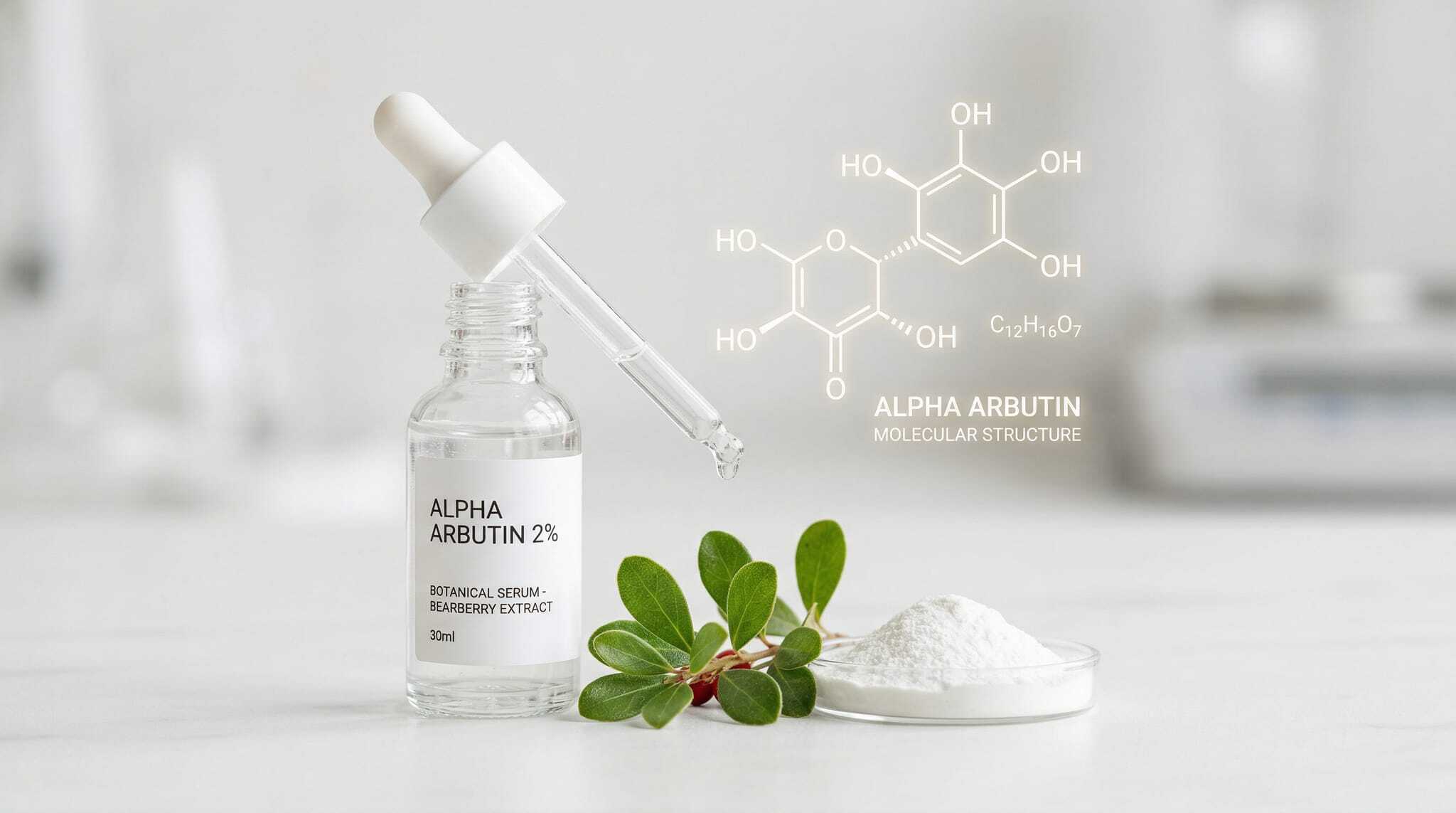
Alpha arbutin has a slightly awkward family secret. Chemically, it is hydroquinone with a sugar molecule attached, the same hydroquinone that dermatologists prescribe for stubborn pigment and that many shoppers now go out of their way to avoid [1]. The sugar changes how the molecule behaves, and that is the whole reason an alpha arbutin serum can sit on an open drugstore shelf.
That origin explains both the appeal and the fine print. Alpha arbutin aims at the same enzyme as hydroquinone, but more gently, and its evidence comes mostly from laboratory models and small trials rather than large, long studies. Knowing that tells you what a good serum looks like, what strength makes sense, and how long you should wait before judging it.
How alpha arbutin slows pigment
Melanin is made inside cells called melanocytes by an enzyme called tyrosinase, and alpha arbutin resembles the enzyme’s natural starting material closely enough to get in the way, so less tyrosine is converted into pigment. In cultured human pigment cells, alpha arbutin lowered melanin production to 76% of untreated levels without harming the cells, and in a three-dimensional human skin model, melanin fell to 40% of the control [2].
The key limitation is timing. A tyrosinase blocker works upstream, on pigment that has not been made yet. Your existing dark spot is melanin that has already been packaged and delivered to surface skin cells, so an arbutin serum fades it only as those cells are naturally shed and replaced by lighter ones.
Your skin replaces its surface layer roughly once a month, which is why no tyrosinase blocker can visibly fade a dark spot in a week.
Our overview of alpha arbutin as a skin brightener covers the ingredient’s history and how it compares with other options.
Alpha versus beta: why the label matters
Arbutin comes in two mirror-image forms. Beta arbutin is the version found naturally in bearberry and some other plants. Alpha arbutin is made in the laboratory by enzymatically linking glucose to hydroquinone in the other orientation.
Your skin replaces its surface layer roughly once a month, which is why no tyrosinase blocker can visibly fade a dark spot in a week.
That small structural difference matters. When the two were tested against tyrosinase from mouse melanoma cells, alpha arbutin inhibited the enzyme about 10 times as strongly as beta arbutin [3]. This is enzyme data, not a head-to-head trial on human faces, but it is the main reason serum brands specify “alpha” on the label. If a product just says “arbutin” or lists bearberry extract, you are likely getting the beta form, and the amount is often unknown.
What the human studies show
Human evidence for arbutin is real but modest, and it rarely isolates arbutin by itself.
- Beta arbutin from a plant extract. In a randomized, placebo-controlled trial, 102 women with melasma or sun spots applied a cream containing 2.51% arbutin from five-leaf serratula leaves, or a placebo, twice a day for eight weeks. Lightening was seen in about three in four women with melasma and just over half of those with sun spots [4].
- Alpha arbutin in a combination. In an open-label study of 124 Indian women with dark spots or melasma, a regimen of 2% alpha arbutin with another brightening glucoside, plus daily sunscreen, reduced the melanin content of spots by about 16% over 90 days, with no reported irritation [5]. There was no placebo group, so it is impossible to say how much came from the arbutin itself.
A review of the best-supported cosmeceuticals for facial pigmentation includes arbutin among the top 10 options, alongside kojic acid, vitamin C, retinol and niacinamide, while noting that the evidence base for most of them is still small [6]. That is a fair summary: alpha arbutin is a reasonable, well-tolerated brightener, not a substitute for prescription-strength treatment.
The safety limit that should set your strength
Because arbutin can release small amounts of hydroquinone, especially as a formula breaks down, regulators have looked at it closely [1]. The European Commission’s Scientific Committee on Consumer Safety concluded that alpha arbutin is safe in cosmetics at up to 2% in face creams and up to 0.5% in body lotions. The committee also noted that combining it with other ingredients that release hydroquinone had not been evaluated [7].
Your alpha arbutin serum gains nothing from going past 2%, because the published safety ceiling matters more than any efficacy claim on a facial product.
Your alpha arbutin serum gains nothing from going past 2%, because the published safety ceiling matters more than any efficacy claim on a facial product.
This matters for shopping, because some serums advertise 5% or even higher. A bigger number does not buy faster results; it moves the product outside the range that has been assessed for daily use.
Choosing an alpha arbutin serum
Use the evidence as a checklist:
- Alpha arbutin named specifically, at 1% to 2%. This is the range used in studies and covered by the safety assessment.
- No stacking of hydroquinone sources. Avoid using an arbutin serum alongside hydroquinone, or layering several arbutin products at once.
- Supportive partners. Niacinamide works at a different step, limiting the transfer of pigment to skin cells, and tranexamic acid calms some of the signals that switch pigment production on. Our guide to tranexamic acid serums explains how that ingredient fits in.
- Opaque or airless packaging and a short shelf life once opened. Stability is the main reason arbutin formulas lose strength.
- Fragrance-free. Arbutin itself rarely causes dermatitis, so fragrance is often the more likely culprit when a brightening serum stings [1].
If you are deciding between brighteners, our comparison of kojic acid serums is a useful counterpoint: kojic acid acts on the same enzyme, but carries a higher risk of allergy and turns brown as it degrades.
How to use it, and how long to wait
Apply your alpha arbutin serum once or twice daily to clean skin, followed by moisturizer. It is gentle enough for mornings, where it pairs naturally with sunscreen, which is not optional. Every brightener is working against steady UV and visible light exposure, and a few unprotected weekends can undo weeks of progress.
Judge results at 8 to 12 weeks, not 8 to 12 days. That is the time frame used in the trials, and it reflects the slow rhythm of skin renewal rather than any weakness in the ingredient.
Where arbutin stops, and retinol takes over
Alpha arbutin is a brake on new pigment. It does nothing to speed up the turnover that carries old pigment out of your skin, and that is exactly the job retinoids do well. In a 40-week vehicle-controlled trial in Chinese and Japanese patients, 0.1% tretinoin lightened sun-related dark spots in 90% of people, compared with 33% on the plain vehicle, and reduced epidermal pigment by 41% [8]. Our guide to retinol for dark spots explains how over-the-counter retinol uses the same pathway more gently.
Retinol also does something arbutin cannot: it rebuilds. In adults with an average age of 87, a 0.4% retinol lotion improved fine wrinkling and increased new collagen production within 24 weeks [9].
The problem is irritation. Inflamed, peeling skin tends to produce more pigment, not less, which is self-defeating when your goal is an even tone.
A gentler pairing for an even tone
That is where Nanoretinol fits. It delivers 0.2% stabilized retinol inside biomimetic lipid nanoparticles that the skin recognizes as its own, so the retinol reaches skin cells without breaking down the barrier the way conventional formulations can. In North Biomedical’s study summary, Nanoretinol was 232% more effective in collagen recovery than conventional retinol, and side effects were minimal and milder than with conventional retinol [10].
A simple split works well: alpha arbutin in the morning under broad-spectrum sunscreen, and Nanoretinol at night on clean, dry skin. Arbutin slows the new pigment, retinol clears the old and supports collagen, and sunscreen keeps the cycle from restarting.
References
- Boo YC. “Arbutin as a Skin Depigmenting Agent with Antimelanogenic and Antioxidant Properties.” Antioxidants. 2021;10(7):1129. doi:10.3390/antiox10071129
- Sugimoto K, Nishimura T, Nomura K, Sugimoto K, Kuriki T. “Inhibitory effects of alpha-arbutin on melanin synthesis in cultured human melanoma cells and a three-dimensional human skin model.” Biological & Pharmaceutical Bulletin. 2004;27(4):510-514. doi:10.1248/bpb.27.510
- Funayama M, Arakawa H, Yamamoto R, Nishino T, Shin T, Murao S. “Effects of alpha- and beta-arbutin on activity of tyrosinases from mushroom and mouse melanoma.” Bioscience, Biotechnology, and Biochemistry. 1995;59(1):143-144. doi:10.1271/bbb.59.143
- Morag M, Nawrot J, Siatkowski I, et al. “A double-blind, placebo-controlled randomized trial of Serratulae quinquefoliae folium, a new source of β-arbutin, in selected skin hyperpigmentations.” Journal of Cosmetic Dermatology. 2015;14(3):185-190. doi:10.1111/jocd.12147
- Gabhane M, Patil R, Dharmadhikari S, Shah P, Khandhedia C, Mehta S. “Efficacy and Safety of a Topical Formulation Containing Trihydroxybenzoic Acid Glucoside and α-Arbutin, Applied Along With a Sunscreen: A Noncomparative, Prospective, Interventional Study in Indian Females With Facial Melasma or Dark Spots.” Journal of Cosmetic Dermatology. 2025;24(2):e70017. doi:10.1111/jocd.70017
- Searle T, Al-Niaimi F, Ali FR. “The top 10 cosmeceuticals for facial hyperpigmentation.” Dermatologic Therapy. 2020;33(6):e14095. doi:10.1111/dth.14095
- Scientific Committee on Consumer Safety (SCCS), Degen GH. “Opinion of the Scientific Committee on Consumer safety (SCCS) — Opinion on the safety of the use of α-arbutin in cosmetic products.” Regulatory Toxicology and Pharmacology. 2016;74:75-76. doi:10.1016/j.yrtph.2015.11.008
- Griffiths CE, Goldfarb MT, Finkel LJ, et al. “Topical tretinoin (retinoic acid) treatment of hyperpigmented lesions associated with photoaging in Chinese and Japanese patients: a vehicle-controlled trial.” Journal of the American Academy of Dermatology. 1994;30(1):76-84. PubMed:8277035
- Kafi R, Kwak HS, Schumacher WE, et al. “Improvement of naturally aged skin with vitamin A (retinol).” Archives of Dermatology. 2007;143(5):606-612. doi:10.1001/archderm.143.5.606
- North Biomedical LLC. “Nanoretinol vs. Conventional Retinol: Efficacy in Collagen and Elastin Recovery.” Clinical Study Summary, 2024. Study summary