Alpha Arbutin: The Science-Backed Skin Brightener Women Over 40 Should Know
How this tyrosinase inhibitor fades dark spots without the risks of hydroquinone — and why delivery matters
The Dark Spot Problem After 40
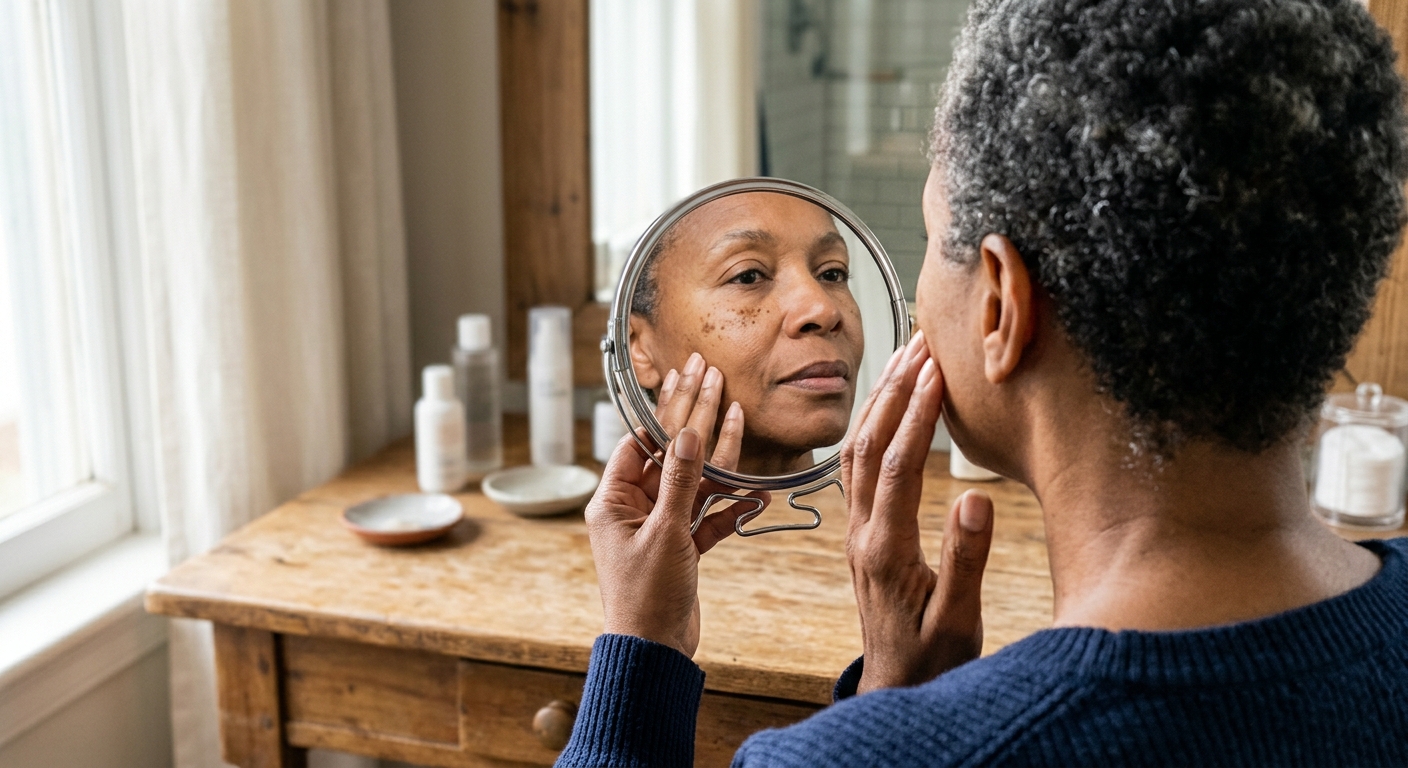
Dark spots have a way of appearing exactly where you do not want them — along the cheekbones, across the forehead, scattered over the backs of your hands. By 40, most women have accumulated enough cumulative UV exposure for melanin irregularities to become visible, and hormonal shifts during perimenopause can make matters worse. Melasma, post-inflammatory hyperpigmentation, and solar lentigines are not just cosmetic concerns — they are biological markers of disrupted melanin regulation.
The skincare industry has thrown dozens of ingredients at this problem. Hydroquinone was the gold standard for decades, but its cytotoxic mechanism of action and association with a rare but serious condition called ochronosis led the European Union to ban it from cosmetics in 2001 [1]. That regulatory shift created a vacuum — and alpha arbutin quietly filled it.
Unlike many trending ingredients that arrive with fanfare and exit with disappointment, alpha arbutin has over 20 years of peer-reviewed research behind it. It works through a specific, well-characterized mechanism, and its safety profile is substantially better than the ingredient it was designed to replace.
How Alpha Arbutin Stops Dark Spots at the Source
Melanin production in your skin follows a cascade that starts with the amino acid tyrosine and ends with polymerized melanin deposited into keratinocytes. The rate-limiting enzyme in this entire pathway is tyrosinase — the molecular gatekeeper that controls how much melanin your melanocytes produce [2].
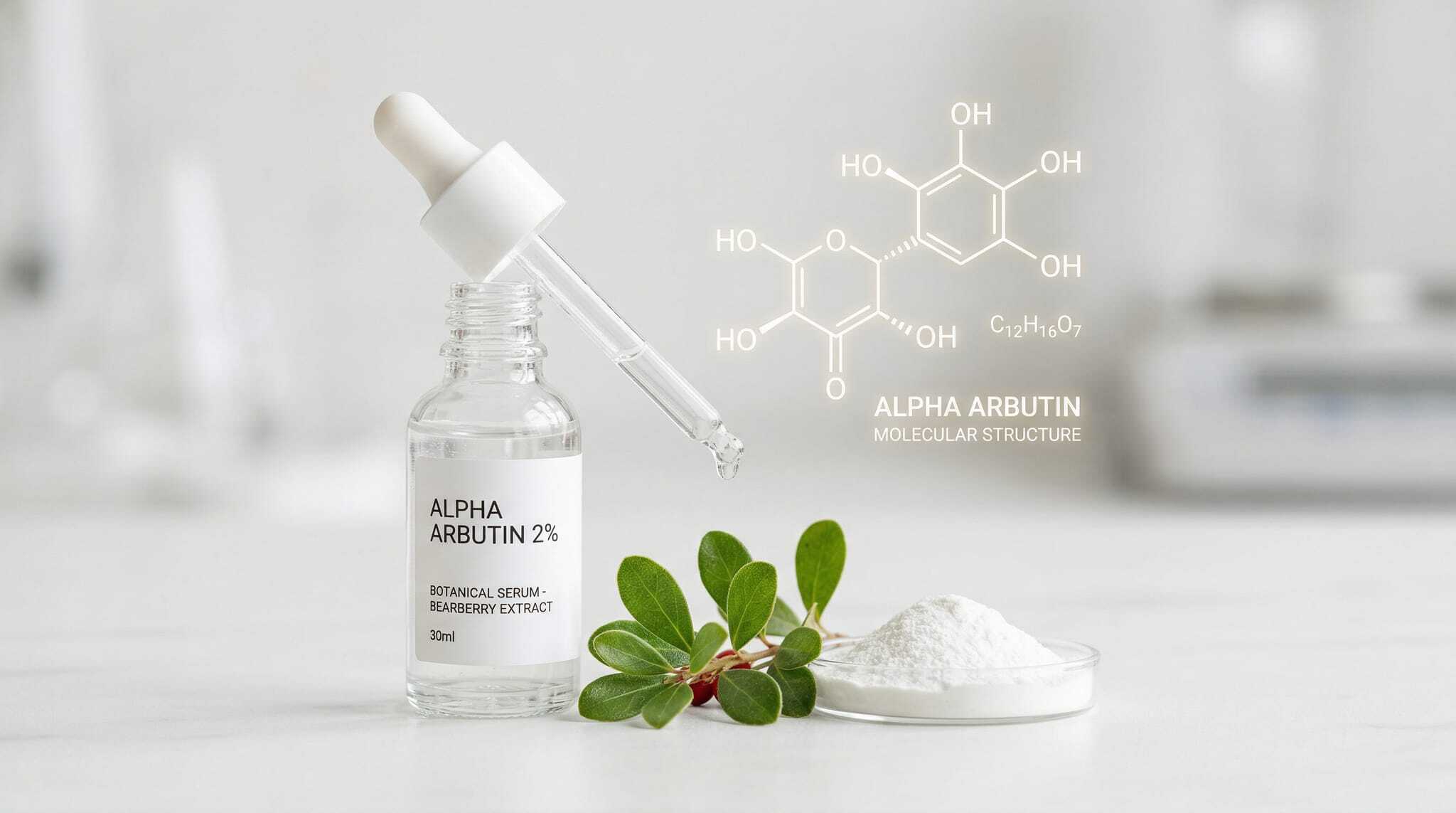
Alpha arbutin is a glycosylated form of hydroquinone: one molecule of hydroquinone bonded to the alpha-anomer of D-glucose. This structural addition fundamentally changes its behavior. Where hydroquinone acts like a demolition crew — destroying melanosomes and killing melanocytes outright — alpha arbutin operates more like a dimmer switch. It competitively inhibits tyrosinase activity without damaging the cells that house the enzyme [3]. That places it firmly among the tyrosinase inhibitors, one of the three mechanism classes our brightening serum guide sorts the category into.
In laboratory studies, alpha arbutin at 0.5 mM reduced melanin synthesis to 76% of untreated levels in human melanoma cells, while showing no inhibitory effect on cell growth at concentrations up to 1.0 mM [3]. The cellular tyrosinase activity decreased significantly, but — and this is the important part — the expression of tyrosinase mRNA remained unchanged. Alpha arbutin does not alter gene expression; it interferes with the enzyme after it has already been produced.
This distinction matters because it means alpha arbutin’s effects are reversible and dose-dependent. Stop using it, and your melanocytes gradually resume normal melanin production. There is no permanent depigmentation risk of the kind that has made hydroquinone controversial.
The rate-limiting enzyme in this entire pathway is tyrosinase — the molecular gatekeeper that controls how much melanin your melanocytes produce.
Alpha Arbutin vs. Beta Arbutin: The Isomer That Matters
Not all arbutin is equal. The two commercially available forms — alpha arbutin and beta arbutin — differ in the stereochemistry of their glucose bond, and this structural difference translates into a roughly tenfold difference in potency.
Alpha arbutin (4-hydroxyphenyl α-D-glucopyranoside) inhibits tyrosinase activity approximately 10 times more effectively than beta arbutin at equivalent concentrations [1]. Beta arbutin is the form found naturally in bearberry, pear, and wheat — which is why older research on “arbutin” from botanical extracts may understate the ingredient’s potential. Most modern formulations use synthetic alpha arbutin precisely because of this potency advantage.
When reading product labels or research papers, the distinction is critical. A product containing 2% beta arbutin and one containing 2% alpha arbutin are not delivering equivalent melanin inhibition. If brightening efficacy is the goal, the alpha isomer is the one supported by the stronger data.
Beyond Brightening: Anti-Inflammatory and Antioxidant Effects
Recent research has expanded the story beyond tyrosinase inhibition alone. A 2024 study investigating alpha arbutin’s effects on UVB-induced skin damage found that it significantly reduced inflammatory markers — TNF-α, IL-6, and IL-1β — in UV-exposed skin, while simultaneously increasing type I collagen expression [4]. The same study demonstrated a dose-dependent decrease in mast cell infiltration, suggesting that alpha arbutin actively combats UV-driven skin inflammation rather than merely suppressing pigment.
These findings reposition alpha arbutin from a one-dimensional brightening ingredient to something more nuanced: a compound that addresses the inflammatory cascade upstream of hyperpigmentation, potentially preventing dark spots from forming in the first place rather than only fading existing ones.
The emerging antioxidant properties of arbutin further support this broader protective role. By scavenging reactive oxygen species, alpha arbutin may help protect melanocytes and surrounding keratinocytes from oxidative stress — the same cellular damage pathway that UV exposure, pollution, and hormonal fluctuations exploit to trigger irregular pigmentation [1].
The result — 232% more effective collagen recovery and 73% greater elastin recovery compared to conventional retinol — demonstrates what happens when delivery science catches up to ingredient science.
Optimal Concentrations and What to Look For
The European Union’s Scientific Committee on Consumer Safety has evaluated alpha arbutin for cosmetic use and confirmed its safety at concentrations up to 2% in face products [5]. Most commercial serums fall within the 1–2% range, which aligns with the concentrations shown to be effective in laboratory and clinical models.
Below 0.5%, the effect on tyrosinase activity becomes marginal. Above 2%, the risk-benefit ratio has not been sufficiently evaluated in long-term human studies, and there is a theoretical concern about hydrolysis: skin bacteria can cleave arbutin’s glucose bond, releasing free hydroquinone [1]. At recommended concentrations, the amount of hydroquinone generated through this mechanism is considered negligible, but it is a reason to respect the dosing boundaries rather than assuming more is always better.
What matters equally is the formulation vehicle. Alpha arbutin is water-soluble and relatively stable, but its ability to penetrate the stratum corneum and reach the melanocytes in the basal layer depends entirely on how well the delivery system moves it past the skin’s outermost barrier. This is the same fundamental challenge that every topical active faces — and it is where delivery technology makes or breaks a product’s real-world efficacy.
The Delivery Problem — And Why It Applies to Every Active
The conversation about alpha arbutin concentrations mirrors a broader truth in skincare science: what you put on the surface is not necessarily what arrives at the target cell. The skin barrier exists specifically to keep molecules out, and most conventional formulations lose the majority of their active ingredient to evaporation, degradation, or simple failure to penetrate.
This challenge is well-documented for retinol, where a 1% retinol in a poor vehicle can deliver less active ingredient to dermal fibroblasts than a 0.2% retinol in a superior delivery system. Nanoretinol® was engineered around exactly this principle: biomimetic lipid nanoparticles that the skin recognizes as “self,” allowing retinol to bypass the epithelial barrier without the chemical penetration enhancers that cause redness, peeling, and irritation with conventional formulations.
The result — 232% more effective collagen recovery and 73% greater elastin recovery compared to conventional retinol [6] — demonstrates what happens when delivery science catches up to ingredient science. For women over 40 combining alpha arbutin with retinol to address both dark spots and wrinkles simultaneously, the efficiency of each product’s delivery system determines whether you get additive results or mostly wasted product.
Building a Brightening Routine That Works
Alpha arbutin pairs well with several other evidence-based actives. Niacinamide inhibits melanosome transfer from melanocytes to keratinocytes — a different step in the pigmentation pathway — making the combination logically complementary rather than redundant. Vitamin C adds antioxidant protection and provides an additional, independent mechanism of tyrosinase inhibition.
Retinol accelerates the turnover of pigmented keratinocytes from the skin surface, essentially speeding up the removal of cells that already contain excess melanin. Alpha arbutin, meanwhile, slows the production of new melanin at the source. Together, they address hyperpigmentation from both directions — reducing supply while accelerating clearance.
The practical routine: apply alpha arbutin in the morning (it is photostable and pairs well with sunscreen), and retinol at night when cell turnover peaks. Consistency over 8 to 12 weeks is essential — melanin regulation is a slow biological process, and expecting visible results in days reveals a misunderstanding of how the pathway operates.
And sunscreen is non-negotiable. No brightening active in existence can outpace the melanin production triggered by unprotected UV exposure. If you are treating dark spots without daily SPF 30+, you are filling a bathtub with the drain open.
References
- Boo YC. “Arbutin as a Skin Depigmenting Agent with Antimelanogenic and Antioxidant Properties.” Antioxidants. 2021;10(7):1129. doi:10.3390/antiox10071129
- Lai X, Wichers HJ, Soler-Lopez M, Dijkstra BW. “Structure and Function of Human Tyrosinase and Tyrosinase-Related Proteins.” Chemistry — A European Journal. 2018;24(1):47-55. doi:10.1002/chem.201704410
- Sugimoto K, Nishimura T, Nomura K, Sugimoto K, Kuriki T. “Inhibitory Effects of Alpha-Arbutin on Melanin Synthesis in Cultured Human Melanoma Cells and a Three-Dimensional Human Skin Model.” Biological and Pharmaceutical Bulletin. 2004;27(4):510-514. doi:10.1248/bpb.27.510
- Yang C, Wu B, Ji L, You P, Wang S, Bi Y. “The Effect of α-Arbutin on UVB-Induced Damage and Its Underlying Mechanism.” Molecules. 2024;29(9):1921. doi:10.3390/molecules29091921
- Scientific Committee on Consumer Safety (SCCS). “Opinion on the Safety of Alpha-Arbutin and Beta-Arbutin in Cosmetic Products.” European Commission, SCCS/1642/22. 2023. Available at: ec.europa.eu
- North Biomedical LLC. “Nanoretinol® vs. Conventional Retinol: Efficacy in Collagen and Elastin Recovery.” Clinical Study Summary, 2024.
- Lim YJ, Lee EH, Kang TH, Ha SK, Oh MS, Kim SM, Yoon TJ, Kang C, Park JH, Kim SY. “Inhibitory Effects of Arbutin on Melanin Biosynthesis of Alpha-Melanocyte Stimulating Hormone-Induced Hyperpigmentation in Cultured Brownish Guinea Pig Skin Tissues.” Archives of Pharmacal Research. 2009;32(3):367-373. doi:10.1007/s12272-009-1309-8