Argireline for Skin: Does the 'Botox in a Bottle' Peptide Actually Work?
What the clinical trials really show about acetyl hexapeptide-8, where it falls short, and what to pair it with
Argireline gets searched roughly 12,000 times a month. Most of those searches are looking for one specific thing: a topical alternative to Botox. The marketing copy on Argireline-containing serums leans hard into that promise — “Botox in a bottle” appears on labels, in product names, and in influencer videos.
The peptide is real. The mechanism it claims to use is real, in theory. But the clinical evidence is messier than the marketing implies, and the gap between what Argireline does and what an injection does is wider than most consumers realize. This article unpacks what the published trials actually show, where the peptide is genuinely useful, and what to pair it with if your goal is fewer wrinkles long-term.
What Argireline Is
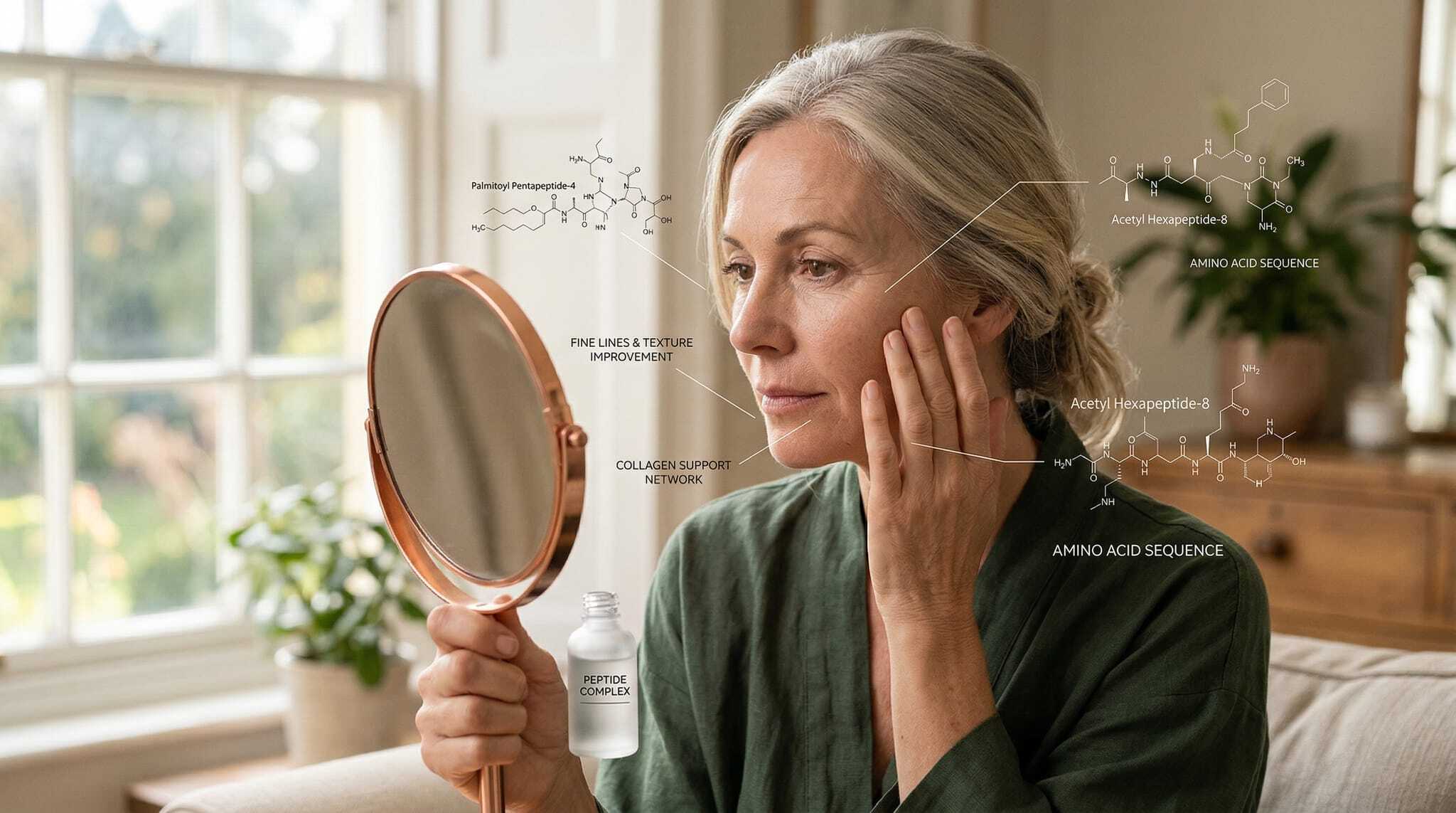
Argireline is the trade name for acetyl hexapeptide-8 (AH-8), a synthetic chain of six amino acids first introduced into cosmeceutical formulations in the early 2000s [3]. The peptide is a fragment of SNAP-25 — the same protein that botulinum toxin (Botox) targets. The theoretical mechanism is mimicry: AH-8 is supposed to compete with SNAP-25 at the neuromuscular junction, blocking the signal that tells facial muscles to contract. Less contraction means fewer dynamic wrinkles.
That’s the theory. The reality is more complicated.
What the Clinical Trials Actually Found
Three studies are repeatedly cited in Argireline marketing. They tell different stories, and the differences matter.
The supportive trial. A 2013 randomized, placebo-controlled study by Wang et al. in the American Journal of Clinical Dermatology applied 10% Argireline twice daily for four weeks in Chinese subjects. The investigators reported that “the total anti-wrinkle efficacy in the Argireline group was 48.9%, compared with 0% in the placebo group,” with measured reductions in skin roughness [1].
The skeptical trial. A 2023 study in GMS Interdisciplinary Plastic and Reconstructive Surgery tested an Argireline + hyaluronic acid serum on 19 women using objective imaging via Visia Complexion Analysis. The wrinkle scores improved slightly, but “differences between both sides of the face that were treated with and without Argireline were not statistically significant.” The authors concluded that Argireline “is not deemed to be an alternative treatment to botulinum toxin” [2].
The peptide doesn’t compete with retinoids, vitamin C, or peptides like Matrixyl, so layering is reasonable.
The 2025 systematic review. A comprehensive review published in the International Journal of Molecular Sciences in 2025 surfaced a more uncomfortable problem: most of the supportive trials don’t actually demonstrate the claimed mechanism. The review noted that “none of the in vivo application studies confirmed the peptide’s inhibitory effect on muscle contractions.” Skin penetration data was equally split — one study found 30% of applied peptide penetrated the stratum corneum, while another found only 0.22% with no detection in deeper layers after 24 hours [3].
The honest summary: Argireline produces measurable but modest improvements in some trials and no significant improvement in others, and the proposed neuromuscular mechanism has not been verified in human skin. Whatever benefit users do see is likely happening at the surface (epidermal level), not at the muscle.
Where Argireline Is Genuinely Useful
This isn’t a verdict that Argireline is useless. Read carefully, the evidence supports a narrower use case than the marketing claims:
- For very fine expression lines — the early ”11s” between the brows, the first hint of crow’s feet — Argireline may produce a subtle softening over weeks.
- As an evening or twice-daily layered treatment rather than a one-and-done overnight fix.
- In combination with other actives that work on different pathways. The peptide doesn’t compete with retinoids, vitamin C, or peptides like Matrixyl, so layering is reasonable.
What it cannot do:
- Erase deep, set-in wrinkles. Once a fold is etched into the dermis, surface peptides don’t touch it.
- Replace Botox for anyone using injections to manage moderate-to-severe expression lines.
- Address the underlying structural cause of aging skin, which is collagen and elastin loss in the dermis.
What Argireline Doesn’t Do (And Why It Matters)
The mechanism Argireline targets — muscle contraction — accounts for only one type of wrinkle. There are three:
- Dynamic wrinkles appear with expression and disappear at rest. Botox addresses these.
- Static wrinkles are visible at rest — the lines you see when your face is relaxed. They’re caused by structural collagen and elastin loss, not muscle activity.
- Photoaging wrinkles result from cumulative UV damage to dermal proteins.
Static wrinkles are visible at rest — the lines you see when your face is relaxed.
By 50, the wrinkles people most want to address are static or photoaging wrinkles, not dynamic ones. A peptide that may modestly soften muscle-driven lines won’t touch the structural problem — and that’s where retinoids do their work.
A landmark study in the International Journal of Cosmetic Science showed that retinol “enhanced elastin fibre formation” — something Argireline cannot do [4]. A separate review documented that retinoids stimulate dermal collagen synthesis while inhibiting matrix metalloproteinases (the enzymes that degrade collagen) [5]. This is the structural rebuild that addresses the wrinkles Argireline can’t reach.
Layering Argireline with Retinol
If you’re going to use Argireline, the most useful pairing is with a retinoid. The two work on different mechanisms:
- Argireline operates at the surface, possibly affecting expression-driven creasing.
- Retinol operates in the dermis, rebuilding the collagen and elastin scaffolding that determines whether a wrinkle becomes permanent.
A practical pairing:
Morning: Argireline serum (if using) → vitamin C → moisturizer → SPF. Evening: Cleanse → retinoid → ceramide moisturizer.
The two don’t antagonize each other and address complementary pathways. The constraint, as always with conventional retinol, is irritation — which is what makes nanoencapsulated formulations useful. Nanoretinol at 0.2% delivers retinol through the skin barrier in lipid carriers rather than forcing across it, which is why it pairs well with surface-active peptides without compounding irritation [6].
For a deeper read on how to combine actives, see our guides on retinol and peptides and retinol for wrinkles.
Setting Realistic Expectations
If you’re considering an Argireline serum, a few realistic expectations:
- Results, where they exist, take 4-12 weeks of consistent use.
- The change will be subtle. If a serum makes a dramatic, fast difference, it’s almost certainly a moisturizing or light-reflecting effect, not the peptide.
- Concentration matters less than people think. Most clinical trials used 5-10%; higher concentrations don’t reliably produce better results because penetration is the limiting factor.
- It will not replace injections for anyone for whom injections are working. The mechanisms differ in scale, not just degree.
The Practical Takeaway
Argireline is a reasonable supporting actor, not a leading one. It has a plausible mechanism, modest clinical support for fine expression lines, and no real downside other than cost. What it isn’t is a replacement for the structural work that retinoids do in the dermis, or for the procedural work that injections do at the muscle.
If you’re choosing between an Argireline serum and a retinoid for the same budget, the retinoid is the better investment by a wide margin. If you can do both, layering them is sensible — they work in different layers of the skin and don’t interfere.
A peptide that might soften the lines that come from squinting is a small piece of an anti-aging routine. The bigger pieces — daily sunscreen, a tolerable retinoid, a barrier-supporting moisturizer — do more for visible aging than any single peptide can.
References
- Wang Y, Wang M, Xiao S, et al. “The anti-wrinkle efficacy of argireline, a synthetic hexapeptide, in Chinese subjects: a randomized, placebo-controlled study.” American Journal of Clinical Dermatology. 2013;14(2):147-153. doi:10.1007/s40257-013-0009-9
- Henseler H. “Investigating the effects of Argireline in a skin serum containing hyaluronic acids on skin surface wrinkles using the Visia Complexion Analysis camera system for objective skin analysis.” GMS Interdisciplinary Plastic and Reconstructive Surgery DGPW. 2023;12:Doc09. doi:10.3205/iprs000179
- Zdrada-Nowak J, Surgiel-Gemza A, Szatkowska M. “Acetyl hexapeptide-8 in cosmeceuticals — a review of skin permeability and efficacy.” International Journal of Molecular Sciences. 2025;26(12):5722. doi:10.3390/ijms26125722
- Rossetti D, Kielmanowicz MG, Vigodman S, et al. “A novel anti-ageing mechanism for retinol: induction of dermal elastin synthesis and elastin fibre formation.” International Journal of Cosmetic Science. 2011;33(1):62-69. doi:10.1111/j.1468-2494.2010.00588.x
- Mukherjee S, Date A, Patravale V, et al. “Retinoids in the treatment of skin aging: an overview of clinical efficacy and safety.” Clinical Interventions in Aging. 2006;1(4):327-348. doi:10.2147/ciia.2006.1.4.327
- North Biomedical LLC. “Nanoretinol vs. Conventional Retinol: Efficacy in Collagen and Elastin Recovery.” Clinical Study Summary, 2024. https://northbiomedical.com/documents/Nanoretinol-Study_Summary.pdf