Matrixyl 3000: What This Peptide Actually Does, and Where It Falls Short
The peptide that promised to be retinol without the irritation. The clinical evidence is more interesting than the marketing.
If you have spent any time reading skincare ingredient lists in the last decade, you have seen Matrixyl 3000 on a serum bottle. It shows up in budget formulations from The Ordinary, in mid-tier brands like Drunk Elephant, in luxury creams that cost more than a flight to Paris. The marketing pitch is consistent across all of them: a peptide complex that boosts collagen, smooths wrinkles, and delivers retinol-like results without retinol-like irritation.
That last claim — retinol’s effects without retinol’s downsides — is what made Matrixyl 3000 famous. It is also where the gap between marketing language and clinical evidence is widest. The peptide does real work in skin. It also does considerably less work than retinol does, in narrower contexts than the brands tend to admit. Understanding what it actually is, what it actually does, and where it sits in the anti-aging hierarchy makes it easier to decide whether you need it in your routine.
What Matrixyl 3000 Actually Is
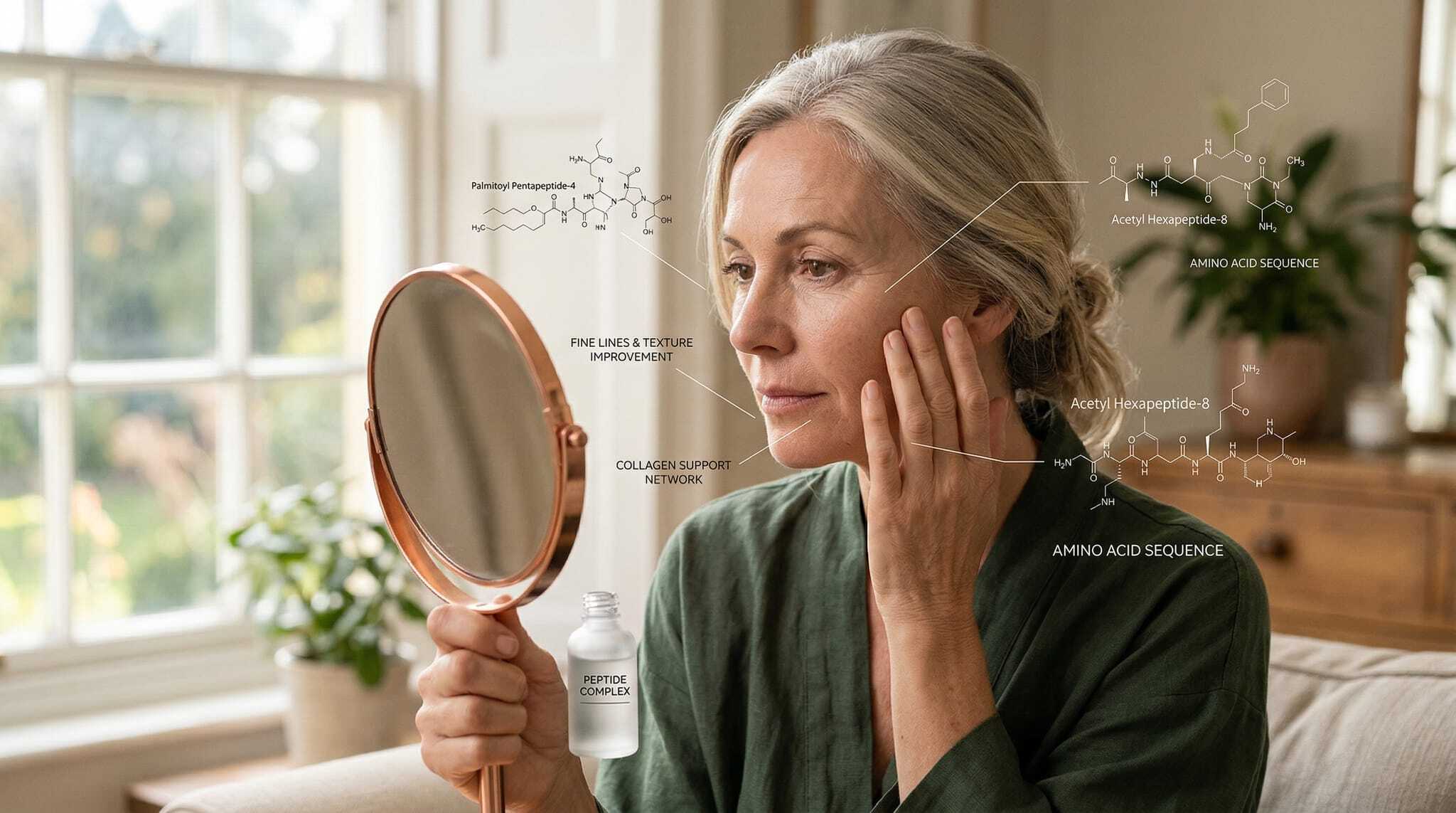
The first thing to clear up is that “Matrixyl 3000” is a trade name for a specific blend of two peptides developed by Sederma, a French specialty ingredients company. The blend pairs:
- Palmitoyl tripeptide-1 (Pal-GHK), a three-amino-acid signal peptide attached to a fatty acid tail to help it pass through the skin barrier.
- Palmitoyl tetrapeptide-7 (Pal-GQPR), a four-amino-acid peptide with an anti-inflammatory mechanism.
This is different from the original “Matrixyl” — palmitoyl pentapeptide-4 (Pal-KTTKS), launched a few years earlier and still sold under the same parent brand. The two are routinely confused, including by people writing about skincare. They are not the same molecule and the studies do not always transfer between them.
The “signal peptide” mechanism is what makes both versions interesting in theory. Skin remodels itself constantly, and that remodeling is coordinated by short protein fragments that fibroblasts release and respond to. A synthetic peptide designed to mimic those signals can, in principle, tell fibroblasts to produce more collagen and extracellular matrix proteins — without binding to a nuclear receptor and triggering the wholesale gene expression changes that retinoids cause.
Less aggressive activation. Less irritation. That’s the elegant idea.
What the Research Actually Shows
The headline study most brands cite for Matrixyl 3000 was conducted by the manufacturer and reported about a 45% reduction in deep wrinkle area and a roughly 20% increase in skin tonicity after two months of twice-daily application. That study has been quoted in countless product descriptions for almost two decades.
Understanding what it actually is, what it actually does, and where it sits in the anti-aging hierarchy makes it easier to decide whether you need it in your routine.
It is also a manufacturer-sponsored study, with all the caveats that implies. Independent peer-reviewed evidence for Matrixyl 3000 specifically is thinner than the marketing volume would suggest. Most of the published clinical research on “Matrixyl-type” ingredients actually examined the original Pal-KTTKS, not the newer two-peptide blend.
The evidence for Pal-KTTKS itself is real but modest. A 2005 placebo-controlled study published in the International Journal of Cosmetic Science applied a 0.005% pal-KTTKS solution to the periocular area of subjects twice daily for 28 days. The results showed an 18% reduction in wrinkle depth, a 37% reduction in fold thickness, and a 21% reduction in skin rigidity [1]. A separate double-blind randomized trial in 2023 compared palmitoyl pentapeptide-4 cream against acetylhexapeptide-3 (Argireline) cream for crow’s feet over 12 weeks, finding both produced statistically significant improvements over baseline, with palmitoyl pentapeptide-4 showing slightly better results on overall wrinkle severity [2].
A 2022 in vivo study published in ACS Omega examined Matrixyl in two delivery formats — a microneedle patch versus a conventional cream — and found the patch substantially outperformed the cream on wound healing markers, suggesting that the peptide’s effect is meaningfully limited by how poorly conventional creams deliver it through the stratum corneum [3].
Across these studies, Matrixyl-class peptides reliably produce measurable but modest improvements: small reductions in fine wrinkle depth, slight increases in dermal density, no irritation. The benefits are real. They are also smaller than what well-formulated retinol delivers in the same timeframe.
Where It Sits Compared to Retinol
This is the comparison the skincare industry tends to fudge. Brands that sell Matrixyl-based serums describe it as a “gentle alternative to retinol.” Brands that sell both keep the language vague enough that you might think the two are roughly equivalent. The clinical literature is clearer.
Retinol does three things that signal peptides do not. First, it binds to nuclear retinoic acid receptors and triggers wholesale gene expression changes — including upregulation of type I and type III collagen, downregulation of matrix metalloproteinases, and increased glycosaminoglycan synthesis [4]. Second, it stimulates production of tropoelastin and fibrillin-1, the precursors of new elastic fibers — one of the few topical interventions shown to do this in adult human skin [5]. Third, it accelerates epidermal turnover, which improves surface texture and pigmentation in a way no peptide does.
The 2007 Archives of Dermatology trial that established the modern evidence base for over-the-counter retinol used a 0.4% concentration applied three times a week to aged skin. After 24 weeks, the retinol-treated arms showed reduced fine wrinkles, increased dermal glycosaminoglycans by 40%, and structural improvements in the dermis [6]. The effect size dwarfs what Matrixyl-class peptides have shown in the same kind of trial.
This does not mean Matrixyl 3000 is useless. It means it is best understood as a supporting actor — something that earns a spot in a routine because it adds incremental benefit without irritation, not because it can stand in for a retinoid.
If you are using Matrixyl 3000 because you read that it was “as effective as retinol” — that is the part of the marketing that the research does not back up.
When Matrixyl 3000 Earns Its Place
There are situations where peptide-only routines genuinely make sense.
Pregnancy and breastfeeding — when retinoids are contraindicated entirely. Matrixyl 3000 is one of the safer “active” ingredients to keep some anti-aging signaling in the routine.
Highly reactive or rosacea-prone skin — where any retinoid, even at the lowest concentrations and frequencies, triggers flares. Peptide serums offer a path to mild dermal stimulation without the inflammatory cost.
Maintenance during retinoid breaks — for people who cycle off retinol periodically (during peak summer, after a chemical peel, during recovery from a skin barrier crisis), peptides keep fibroblast activity from dropping to baseline.
Augmenting a retinol routine — used in the morning while retinol is used at night, peptides may add some incremental support without competing for the same skin signaling pathways. The evidence here is more theoretical than clinical, but the safety profile makes it low-risk.
If you are using Matrixyl 3000 because you read that it was “as effective as retinol” — that is the part of the marketing that the research does not back up.
The Real Lesson — Delivery Matters More Than the Active
There is a quieter point in the Matrixyl literature that gets less attention. The 2022 microneedle-patch study found that the same peptide, in the same concentration, produced dramatically different biological effects depending on whether it was delivered through a patch (bypassing the stratum corneum) or a cream (relying on passive diffusion through it) [3]. The cream version worked. The patch version worked much better.
This is not a Matrixyl-specific phenomenon. It is the central problem of topical skincare. Most actives — peptides, antioxidants, retinoids — are too large or too unstable to pass through the skin barrier in their unmodified form. The barrier is doing exactly what evolution selected for: keeping foreign molecules out.
The conventional industry workarounds are crude. Heavy oils to slow evaporation. Penetration enhancers like propylene glycol and petroleum derivatives that loosen the lipid matrix of the barrier (and damage it in the process). Higher concentrations to push more molecules through by sheer mass action. None of these solve the fundamental problem; they just brute-force around it.
Nanoretinol takes a different approach. Rather than trying to push a destabilizing solvent through the skin barrier, it encapsulates 0.2% retinol inside biomimetic lipid nanoparticles — particles externally identical to skin cells, which the epidermal barrier recognizes as “self” and lets pass intact. The retinol arrives at the dermis stable, biologically active, and without the irritation profile that defines conventional retinol. North Biomedical’s clinical evaluation showed 232% greater collagen recovery and 73% greater elastin recovery compared to conventional retinol — the kind of effect size that peptides have not been able to replicate.
The deeper takeaway from the Matrixyl literature is not “peptides are great” or “peptides are oversold.” It is that the active ingredient is only half the question. How well you can get it to the cells that need it is the other half — and for most of the actives in your bathroom cabinet, that’s where the real performance gap lives.
A Practical Way to Think About It
If your routine currently centers on a Matrixyl 3000 serum because you have been told it’s a gentler retinol, consider what you actually want from your skincare. If your goals are modest — mild texture improvement, no irritation, easy to maintain through busy seasons — Matrixyl 3000 is reasonable. If your goals include meaningful change to fine lines, firmness, dermal density, or photoaging — the evidence pushes you toward retinol, ideally one formulated to actually reach the dermis.
The peptide is not a scam. It is also not a substitute for the most studied anti-aging ingredient in dermatology. Use it for what it does well, and use a properly delivered retinol for what only retinoids can do.
References
- Robinson LR, Fitzgerald NC, Doughty DG, Dawes NC, Berge CA, Bissett DL. “Topical palmitoyl pentapeptide provides improvement in photoaged human facial skin.” International Journal of Cosmetic Science. 2005;27(3):155-160. doi:10.1111/j.1467-2494.2005.00261.x
- Aruan RR, Hutabarat H, Widodo AA, Firdiyono MTC, Wirawanty C, Fransiska L. “Double-blind, Randomized Trial on the Effectiveness of Acetylhexapeptide-3 Cream and Palmitoyl Pentapeptide-4 Cream for Crow’s Feet.” The Journal of Clinical and Aesthetic Dermatology. 2023;16(2):37-43. PMC: PMC10005804
- Kachooeian M, Mousivand Z, Sharifikolouei E, Shirangi M, Firoozpour L, Raoufi M, Sharifzadeh M. “Matrixyl Patch vs Matrixyl Cream: A Comparative In Vivo Investigation of Matrixyl (MTI) Effect on Wound Healing.” ACS Omega. 2022;7(28):24695-24704. doi:10.1021/acsomega.2c02592
- Mukherjee S, Date A, Patravale V, Korting HC, Roeder A, Weindl G. “Retinoids in the treatment of skin aging: an overview of clinical efficacy and safety.” Clinical Interventions in Aging. 2006;1(4):327-348. doi:10.2147/ciia.2006.1.4.327
- Rossetti D, Kielmanowicz MG, Vigodman S, Hu YP, Chen N, Nkengne A, Oddos T, Fischer D, Seiberg M, Lin CB. “A novel anti-ageing mechanism for retinol: induction of dermal elastin synthesis and elastin fibre formation.” International Journal of Cosmetic Science. 2011;33(1):62-69. doi:10.1111/j.1468-2494.2010.00588.x
- Kafi R, Kwak HSR, Schumacher WE, Cho S, Hanft VN, Hamilton TA, King AL, Neal JD, Varani J, Fisher GJ, Voorhees JJ, Kang S. “Improvement of Naturally Aged Skin With Vitamin A (Retinol).” Archives of Dermatology. 2007;143(5):606-612. doi:10.1001/archderm.143.5.606
- Baumann L, Bernstein EF, Weiss AS, Bates D, Humphrey S, Silberberg M, Daniels R. “Clinical Relevance of Elastin in the Structure and Function of Skin.” Aesthetic Surgery Journal Open Forum. 2021;3(3):ojab019. doi:10.1093/asjof/ojab019
- North Biomedical LLC. “Nanoretinol vs. Conventional Retinol: Efficacy in Collagen and Elastin Recovery.” Clinical Study Summary, 2024.