Retinol and Peptides: Should You Use Them Together?
How two of skincare's most powerful anti-aging ingredients work in tandem — and the right way to combine them
If retinol is the workhorse of anti-aging skincare, peptides are the precision instruments. One remodels your skin from the cellular level up. The other sends targeted signals that tell specific processes to activate or calm down. The natural question: what happens when you use both?
The short answer: they’re complementary, not competitive. But the details of how you combine them — which peptides, what order, and whether your retinol formulation allows for it — determine whether you get synergy or just more products on your shelf.
What Peptides Actually Do (The Mechanism)
Peptides are short chains of amino acids — the building blocks of proteins. In skincare, they function as signaling molecules. When specific peptide sequences contact skin cells, they trigger biological responses: collagen production, muscle relaxation, melanin inhibition, or barrier repair, depending on the peptide [1].
Think of peptides as text messages sent to your skin cells. Each peptide sequence is a different message with a different instruction. Unlike retinol, which works through a broad nuclear receptor pathway affecting hundreds of genes simultaneously, peptides are targeted — they activate specific processes without the widespread cellular disruption [2].
This fundamental difference in mechanism is exactly why the combination works.
The Four Peptide Categories That Matter
Not all peptides are relevant to an anti-aging routine. Here are the four categories with clinical evidence:
Signal Peptides (Matrixyl, GHK-Cu)
These peptides mimic collagen fragments, tricking your skin into thinking collagen has been broken down and needs replacement. Palmitoyl pentapeptide-4 (Matrixyl) is the most studied, with clinical trials demonstrating measurable wrinkle reduction and collagen stimulation [3]. Copper peptide (GHK-Cu) goes further — it promotes wound healing, collagen synthesis, and has anti-inflammatory properties [1].
Neurotransmitter-Inhibiting Peptides (Argireline)
Acetyl hexapeptide-3 (Argireline) partially inhibits the SNARE complex involved in muscle contraction, reducing the intensity of facial expressions. It’s sometimes called “topical Botox,” though the mechanism is much milder. Clinical studies show modest but real reductions in expression-line depth with consistent use [2].
Carrier Peptides
These deliver trace elements (primarily copper) to skin cells, enhancing enzymatic processes involved in collagen production and wound healing. GHK-Cu doubles as both a signal and carrier peptide [1].
Enzyme-Inhibiting Peptides
These block enzymes that degrade skin structure — particularly matrix metalloproteinases (MMPs), the same collagen-degrading enzymes that retinol also targets. This is where the overlap with retinol gets interesting.
Why Retinol and Peptides Are Complementary
The combination works because they attack skin aging through fundamentally different pathways.
One remodels your skin from the cellular level up.
Retinol converts to retinoic acid, which binds to nuclear receptors (RARs) and alters gene expression across the board: accelerated cell turnover, increased collagen gene transcription, MMP suppression, and melanocyte normalization. It’s a broad-spectrum cellular reprogramming tool [4].
Peptides operate at the extracellular signaling level. They bind to cell surface receptors and trigger specific intracellular cascades without entering the nucleus or altering gene expression directly. A signal peptide like Matrixyl stimulates collagen production through the TGF-β pathway — the same endpoint as retinol, but through a completely separate door [3].
A 2026 clinical study explicitly tested this synergy: a serum combining retinol with peptides and silybin showed that the multi-active formulation activated TGF-β/Smad signaling and enhanced extracellular matrix gene expression more effectively than individual components, confirming that the pathways are additive [5].
The analogy: retinol is like renovating the entire house (structural overhaul), while peptides are like hiring specialists for specific rooms (targeted improvements). You don’t have to choose — they address different aspects of the same problem.
Which Peptides Pair Best With Retinol
Best Combinations
Matrixyl (Palmitoyl pentapeptide-4) + Retinol: Both stimulate collagen production through different mechanisms. Matrixyl via TGF-β signaling, retinol via RAR-mediated gene expression. Clinical evidence supports both independently; the dual pathway activation is theoretically and practically additive [3][4].
GHK-Cu (Copper peptides) + Retinol: Copper peptides promote wound healing and anti-inflammatory responses, which can offset retinol-induced irritation while independently boosting collagen synthesis. This pairing is particularly smart for retinol users who experience sensitivity [1].
Argireline + Retinol: Retinol addresses structural aging (collagen loss, cell turnover). Argireline addresses dynamic aging (expression lines). They target completely different aspects of wrinkle formation, making the combination complementary by definition [2].
Exercise Caution
AHA/BHA acids + Peptides + Retinol (all at once): Too many actives in one routine can overwhelm the skin barrier. If you’re using retinol and peptides together, save strong chemical exfoliants for alternate nights.
Very low pH products + Peptides: Extremely acidic environments can denature peptide bonds, reducing their efficacy. Most retinol products aren’t acidic enough to cause this issue, but if you’re layering vitamin C (L-ascorbic acid at pH 2.5-3.5) alongside peptides and retinol, sequence matters.
How to Layer Them: The Practical Guide
The layering order depends on whether your retinol and peptide products are separate or combined.
Separate Products (Most Common)
Evening routine:
- Cleanse
- Apply peptide serum (water-based, absorbs quickly)
- Wait 1-2 minutes
- Apply retinol
- Moisturizer
Retinol should always go in your evening routine (it degrades in UV light and increases photosensitivity).
Peptides go first because they’re typically in lighter, water-based vehicles that absorb quickly. Retinol formulations are often slightly heavier and serve as the treatment layer. The peptides don’t interfere with retinol absorption — they’re working at different receptor sites on and in the cells.
Combined Formulations
Multi-active serums containing both retinol and peptides are increasingly common and supported by clinical evidence. The Shen et al. study (2026) demonstrated that a combined retinol-peptide-silybin serum produced synergistic improvements in photoaging markers over 8 weeks [5].
The advantage of combined formulations is simplified routine and guaranteed compatibility between the active ingredients.
What About Morning vs Evening?
Retinol should always go in your evening routine (it degrades in UV light and increases photosensitivity). Peptides are stable in daylight, so you can use them morning and evening if desired:
- Morning: Peptide serum → Moisturizer → Sunscreen
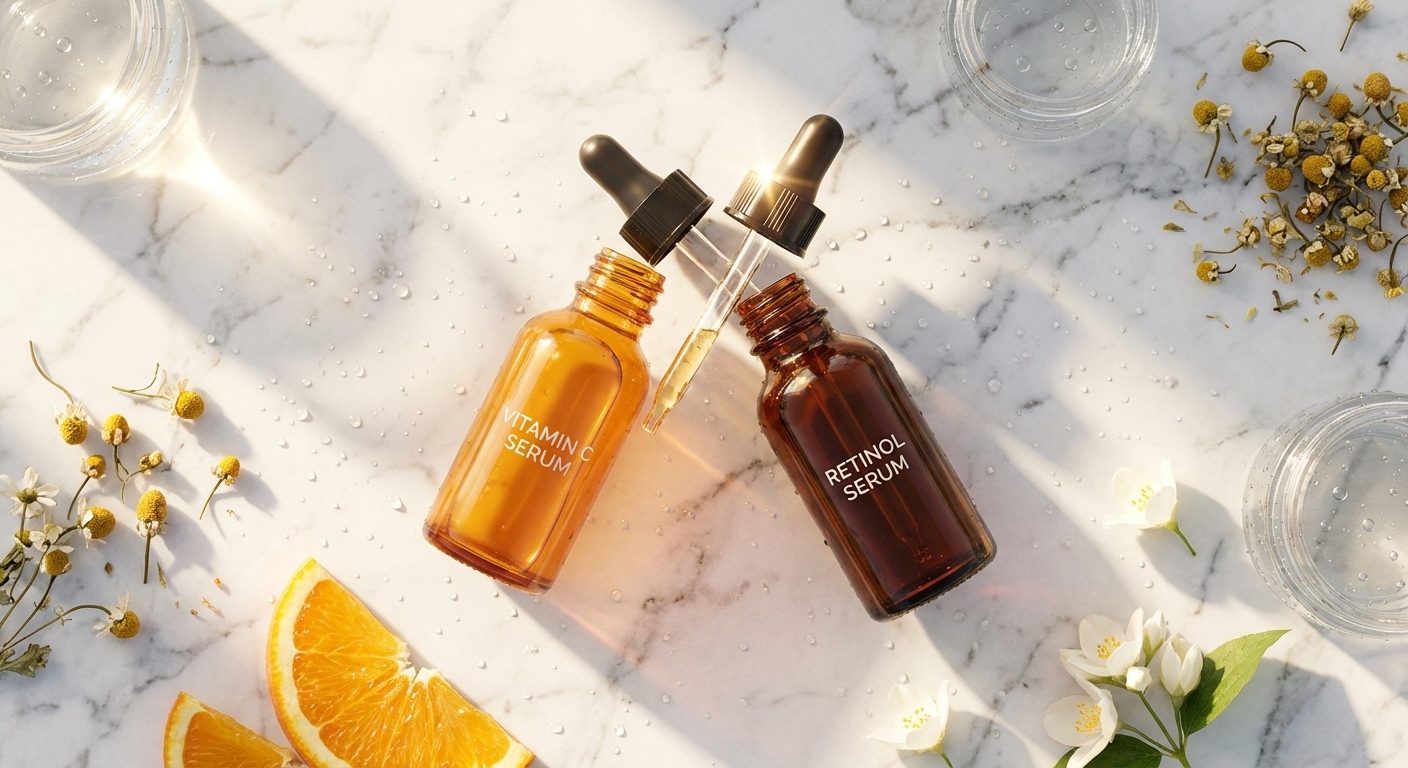
- Evening: Peptide serum → Retinol → Moisturizer
This gives you twice-daily peptide exposure while keeping retinol safely in the PM routine.
The Irritation Factor
Here’s where the combination gets its most practical advantage. Retinol’s biggest limitation isn’t efficacy — it’s tolerability. Many users, especially those over 40 with sensitive skin, reduce or abandon retinol because of irritation during the adjustment period.
Certain peptides — particularly copper peptides (GHK-Cu) and some signal peptides — have anti-inflammatory and barrier-repair properties. Used alongside retinol, they can buffer the irritation response without diminishing retinol’s anti-aging activity [1]. This is especially relevant for the first 2-4 weeks of retinol use, when the adjustment phase peaks. A peptide serum applied before retinol can help maintain barrier function while retinol does its deeper structural work.
How Nanoretinol® Simplifies the Equation
One of the reasons people reach for peptides alongside retinol is to compensate for retinol’s weaknesses: irritation, instability, and inconsistent penetration. But what if those weaknesses were engineered out?
Nanoretinol® by North Biomedical® encapsulates retinol in biomimetic lipid nanoparticles that pass through the epithelial barrier without chemical penetration enhancers. This eliminates the primary source of retinol irritation — barrier disruption — while delivering +232% more effective collagen recovery than conventional retinol.
With drastically reduced irritation and dramatically improved efficacy, the “need” for companion ingredients to buffer retinol’s side effects diminishes. That said, peptides still bring independent value through their targeted signaling mechanisms. They’re not a crutch for bad retinol — they’re a genuine complement to good retinol.
If you’re building a multi-active routine, pairing Nanoretinol® with a quality peptide serum gives you the broadest possible attack surface against skin aging: deep cellular reprogramming via nanoparticle-delivered retinol, plus targeted extracellular signaling via peptides.
Putting It All Together
Retinol and peptides aren’t competing for the same job. Retinol remodels your skin’s cellular machinery. Peptides send targeted instructions to specific processes. Used together, they create a multi-pathway anti-aging strategy that clinical evidence increasingly supports.
The key principles:
- Layer peptides before retinol in your evening routine
- Choose peptides that complement, not duplicate, retinol’s mechanism (signal peptides and copper peptides are ideal)
- Don’t overcomplicate — two or three well-chosen actives outperform a bathroom shelf full of products
- Prioritize your retinol formulation — the most effective peptide routine in the world can’t compensate for a retinol that never reaches your dermis
For a complete guide to starting retinol if you haven’t yet, see our beginner’s guide. And for understanding how retinol works at the cellular level — which helps you understand exactly where peptides fit in — we’ve mapped the full mechanism. And if the real question is which of the two to pick rather than how to stack them, see peptides vs retinol.
References
-
Pintea A, Manea A, Pintea C, Vlad R, Lazar A. “Peptides: Emerging Candidates for the Prevention and Treatment of Skin Senescence: A Review.” Biomolecules. 2025;15(1):88. doi:10.3390/biom15010088
-
Skibska A, Perlikowska R. “Signal Peptides - Promising Ingredients in Cosmetics.” Current Protein and Peptide Science. 2021;22(10):716-728. doi:10.2174/1389203722666210812121129
-
Lau M, Mineroff Gollogly J, Wang JY, Jagdeo J. “Cosmeceuticals for antiaging: a systematic review of safety and efficacy.” Archives of Dermatological Research. 2024;316(5):173. doi:10.1007/s00403-024-02908-2
-
Mukherjee S, Date A, Patravale V, Korting HC, Roeder A, Weindl G. “Retinoids in the treatment of skin aging: an overview of clinical efficacy and safety.” Clinical Interventions in Aging. 2006;1(4):327-348. doi:10.2147/ciia.2006.1.4.327
-
Shen Y, Shi M, Ye Y, Xu C, Feng X, Bi T, Chen Y, Huang J, Li Y, Sun P. “An Innovative Serum With Retinol, Hydroxypinacolone Retinoate, Peptides, and Silybin Improves Mild Photoaged Facial Skin in Middle-Aged Chinese Women.” Journal of Cosmetic Dermatology. 2026;25(1):e70627. doi:10.1111/jocd.70627
-
Milosheska D, Roškar R. “Use of Retinoids in Topical Antiaging Treatments: A Focused Review of Clinical Evidence for Conventional and Nanoformulations.” Advances in Therapy. 2022;39(12):5351-5375. doi:10.1007/s12325-022-02319-7