Best Concealer for Mature Skin: How to Stop It Creasing by Noon
The formula variables that actually matter once skin has thinned, and the one thing no concealer can fix
You buy a new concealer because the last one crept into the lines under your eye by lunchtime. Six weeks later the new one is doing exactly the same thing. The reasonable conclusion is that you have not found the right product yet. The more useful conclusion is that under-eye skin at fifty is a different material than it was at thirty, and most concealers are still built for the thirty-year-old version.
That distinction is worth understanding before you spend another forty dollars, because it changes what you are shopping for.
The hardest place on your face to put makeup
Facial skin thickness is not uniform, and the gap between sites is wider than most people assume. A 2025 high-frequency ultrasound study measured 38 anatomical sites across 45 subjects and found the upper eyelid to be the thinnest skin on the entire face, with a median of 573.50 micrometers [1]. The tissue immediately below the eye sits in the same neighborhood. Everywhere else on your face has more structure underneath to hold a cosmetic film flat.
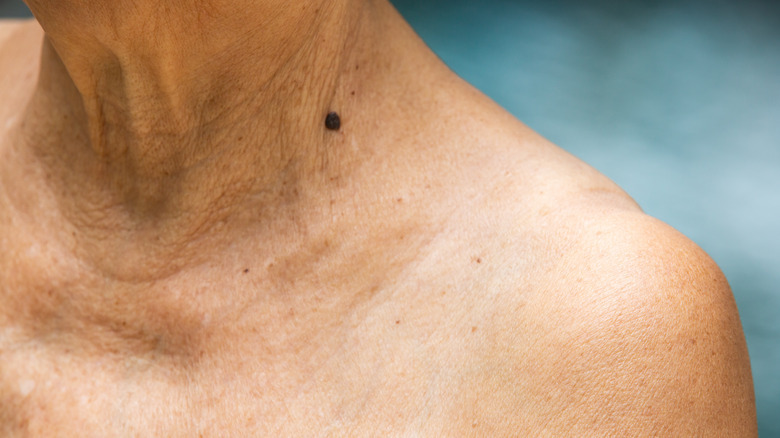
That thin starting point then gets thinner. Work going back to the 1970s established that dermal thickness and skin collagen content both decline measurably with age, and that the two track together [2]. Less collagen means less of the scaffolding that keeps a surface taut between movements, so the skin folds more readily and recovers from folding more slowly.
Add the fact that the area sits over a muscle you contract every few seconds, and the real design problem comes into focus. A concealer under your eye is being asked to stay optically even across a surface that is thin, mobile, and losing its structural support.
Three changes that break a formula that used to work
Lipids. Tape-stripping studies of women across age groups found significant decreases in all major stratum corneum lipid species, ceramides in particular, as age increased [3]. Those lipids are what keep the surface layer pliable. A drier, stiffer surface layer creases along a line rather than flexing across it.
Everywhere else on your face has more structure underneath to hold a cosmetic film flat.
Sebum. The number of sebaceous glands stays roughly constant through life, but their output does not. Sebum production drops sharply in women after menopause [4]. Oil is part of what used to keep a cream product moving and blending on the skin all day. Without it, the same formula sets harder and faster than you remember.
Barrier recovery. After experimental barrier disruption, subjects over eighty recovered only around 15 percent of barrier function at 24 hours, while younger subjects recovered far more in the same window [5]. In practice this means mature under-eye skin tolerates less: less scrubbing product off, less alcohol in a formula, less of a drying long-wear system.
None of these are failures of technique. They are changes in the material you are working on.
What to actually look for
Flexibility over coverage. The most useful trade in this category is pigment load against film flexibility. High-coverage, long-wear formulas achieve their staying power with film formers and a fast set, and a fast-setting rigid film is precisely what cracks along a moving crease. A thinner, more emollient concealer with moderate coverage will usually look better at 3pm than a full-coverage one looked at 9am.
An emollient base rather than a matte one. Matte finishes work by absorbing oil and leaving a powdery surface behind. On skin already low on lipids and sebum, that surface has very little to sit on. Look for formulas built on esters, squalane, or glycerin instead of ones that lead with silica and long-wear polymers.
Hybrid formulas over extra steps. On skin that has lost lipid content, a concealer carrying its own hydration usually outperforms a separate hydrating primer plus a dry concealer, because you finish with one thin film instead of two stacked ones.
Test a shade on your face, never on your hand, and look at it again three hours later before deciding it matched.
Shade behavior, not just shade match. Many concealers oxidize, meaning they darken as they interact with skin and air across a few hours. On mature skin with reduced oil, that shift often reads sallow or gray rather than simply darker. Test a shade on your face, never on your hand, and look at it again three hours later before deciding it matched.
Less product than feels right. Under-eye coverage failures are usually volume failures. A film thin enough to move with the skin cannot also be thick enough to erase a dark circle completely, and trying to get there in a single pass is what guarantees the crease.
If your concealer settles into the same channels every morning, our piece on why concealer creases under the eyes covers the application side in more depth, and setting powder choice matters more here than most people expect.
A test that takes one day
Buy or sample a single product. Apply it on an ordinary morning, with no special preparation, in the amount you would normally use. Photograph the area in indirect daylight at application, at midday, and again in late afternoon. Raking light from a window is the honest test, because it casts the shadows that overhead bathroom lighting flattens out.
You are watching for three specific failures: settling into lines, separation into patches over dry areas, and color shift. A product that survives all three on your face is a better product for you than anything on a ranked list, because the variables that decide it are yours.
The layer that makeup cannot reach
Everything above is surface management, and it is worth doing well. It also has a ceiling. A concealer manages the optics of a surface for a day. Whether that surface starts out smooth is decided in the dermis, by how much collagen is there to hold it.
That layer is reachable, though not by cosmetics. Topical retinoids remain the most rigorously studied intervention for it. A controlled trial published in the New England Journal of Medicine found that tretinoin restored type I procollagen synthesis in photodamaged skin and produced measurable clinical improvement in fine wrinkling across 10 to 12 months of daily use [6].
The practical obstacle has always been delivery. Conventional retinol struggles to cross the epithelial barrier, and the vehicles used to force the issue rely on chemicals and petroleum derivatives that break that barrier down in order to get through it. On under-eye skin measured in hundreds of micrometers, that is a poor trade.
Nanoretinol takes a different route. It encapsulates retinol in biomimetic lipid nanoparticles that the skin reads as its own and allows through the epithelial barrier, with no need to damage the barrier to get there. In testing it proved 232% more effective than conventional retinol at collagen recovery and 73% more effective at elastin recovery, at a 0.2% concentration gentle enough for the eye contour and with drastically reduced cytotoxicity compared with conventional retinol.
Where this leaves you
Choose the concealer that moves with your skin rather than the one promising to stay put, and use less of it than instinct suggests. Then work on what sits underneath, because the best concealer application you will ever get is the one on skin that did not need much concealer. If that is the direction you want to take, our guide to under-eye wrinkles is a sensible next read, as is our overview of what causes dark circles under the eyes in the first place.
References
- Korzekwa S, Matusz K, Kukulski M, Wawrzaszek P, Górna N, Rosiński W, Włosiański J, Przystańska A. “Quantitative Analysis of the Human Face Skin Thickness: A High-Frequency Ultrasound Study.” Journal of Clinical Medicine. 2025;14(23):8401. doi:10.3390/jcm14238401
- Shuster S, Black MM, McVitie E. “The Influence of Age and Sex on Skin Thickness, Skin Collagen and Density.” British Journal of Dermatology. 1975;93(6):639-643. doi:10.1111/j.1365-2133.1975.tb05113.x
- Rogers J, Harding C, Mayo A, Banks J, Rawlings A. “Stratum Corneum Lipids: The Effect of Ageing and the Seasons.” Archives of Dermatological Research. 1996;288(12):765-770. doi:10.1007/BF02505294
- Zouboulis CC, Boschnakow A. “Chronological Ageing and Photoageing of the Human Sebaceous Gland.” Clinical and Experimental Dermatology. 2001;26(7):600-607. doi:10.1046/j.1365-2230.2001.00894.x
- Ghadially R, Brown BE, Sequeira-Martin SM, Feingold KR, Elias PM. “The Aged Epidermal Permeability Barrier: Structural, Functional, and Lipid Biochemical Abnormalities in Humans and a Senescent Murine Model.” Journal of Clinical Investigation. 1995;95(5):2281-2290. doi:10.1172/JCI117919
- Griffiths CEM, Russman AN, Majmudar G, Singer RS, Hamilton TA, Voorhees JJ. “Restoration of Collagen Formation in Photodamaged Human Skin by Tretinoin (Retinoic Acid).” New England Journal of Medicine. 1993;329(8):530-535. doi:10.1056/NEJM199308193290803