Best Setting Powder for Mature Skin: Why It Creases and What to Buy Instead
The particle physics that decides whether powder blurs your lines or draws them in
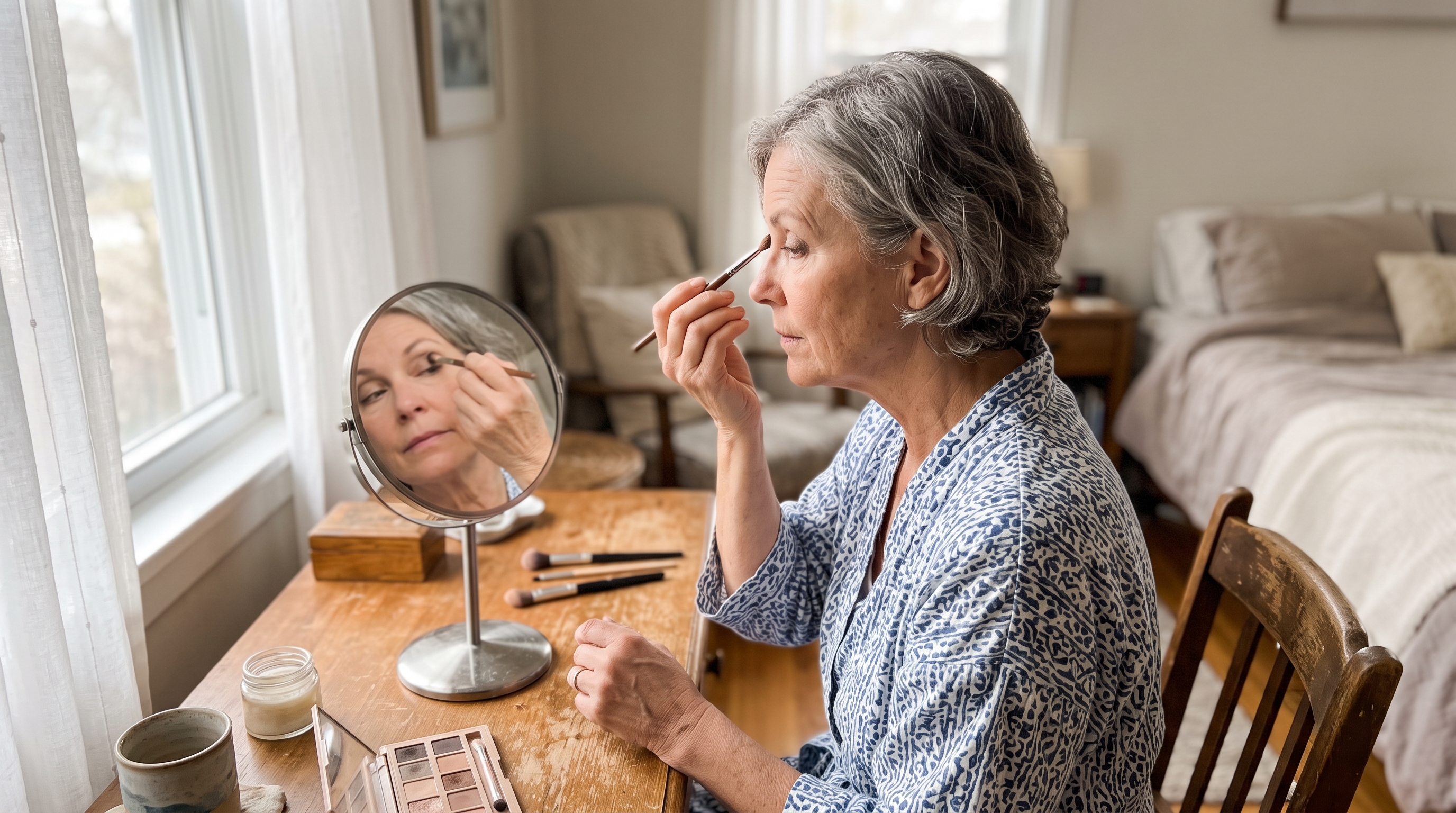
You set your makeup at eight in the morning to stop it moving. By eleven the powder has found every line around your mouth and eyes and settled into them, and now those lines are the first thing anyone sees. The product you used to keep your face looking finished is drawing a map of it instead.
Most advice at this point tells you to use less powder. That works, and it does not explain anything, which means you cannot tell which of the dozen products on the shelf will behave differently. The useful version starts with what powder is physically doing on the surface of your face.
Powder is an optical device
A setting powder does two jobs. It absorbs oil, and it changes how light leaves your skin. The second job is the one that decides whether you look smooth.
Light hitting bare skin partly reflects off the surface and partly enters, bounces around in the tissue and comes back out. When physicists modelled light scattering from a rough skin surface, surface roughness turned out to shift the pattern of diffuse reflectance substantially, so the microscopic texture of skin is itself an optical variable rather than a cosmetic afterthought [1]. Rough surfaces produce directional highlights and hard-edged shadows. Smooth ones produce even, diffuse light.
Cosmetic powder is engineered to intervene in that. A Monte Carlo simulation of light reflection from cosmetic powder particles sitting near the skin surface showed that particle characteristics and their arrangement above the skin control the reflected light distribution, which is the mechanism behind what the industry calls a soft-focus finish [2]. Spherical particles, silica in particular, scatter incoming light forward at wide angles. That fills in the shadow inside a line with scattered light, so the line reads as shallower than it is.
Flat, plate-shaped particles behave differently. Talc and mica lie down in sheets, and on a smooth surface that produces a clean matte or a subtle sheen. What they do not do well is stay suspended over a groove. Gravity, blinking and facial movement walk them into the lowest available point, and once a line is packed with opaque pigment it stops scattering light and starts holding a shadow.
Why the maths changed on your face
Nothing about that physics is age-specific. What changed is the surface you are applying it to, and it changed in three measurable ways.
The product you used to keep your face looking finished is drawing a map of it instead.
Sebum output falls. The sebaceous gland goes through its own chronological ageing, with reduced output and altered lipid composition as the gland ages independently of sun exposure [3]. Powder was designed to sit in a thin film of oil that keeps it slightly mobile and evenly spread. Take the oil away and the powder has nothing to bind to.
Barrier function shifts too. Measured across age groups, ageing skin showed significant differences in transepidermal water loss, stratum corneum hydration and casual sebum content, with drier surface conditions on older skin [4]. A drier stratum corneum lifts at the edges of its cells, which gives dry pigment more to catch on.
Third, the grooves themselves get deeper. Profilometric measurement of wrinkles, which casts and measures the actual surface relief of skin, exists precisely because wrinkle depth is a physical dimension that increases in a quantifiable way [5]. A deeper groove holds more powder and casts a longer shadow once it is full.
Put together: less oil to spread the powder, a rougher surface to catch it, and deeper channels for it to collect in. Our guide to the best primer for mature skin deals with the layer that goes underneath this problem.
What to actually look for
Choose silica-forward, finely milled formulas. Silica microspheres are the particle type that scatters light forward instead of packing flat, and they are what the soft-focus claim is built on. Look for silica high on the ingredient list rather than talc.
Be careful with titanium dioxide. It has a very high refractive index and bounces light back hard, which is what causes white flashback in photographs. A powder that looks invisible in the bathroom can photograph as a pale mask under a camera flash. If you are photographed often, test the powder with your phone flash before you commit to it.
Translucent is not automatically safer. Translucent simply means minimal pigment. It can still be heavily filled with opaque white minerals, which is exactly how a translucent powder leaves a grey or ashy cast on deeper skin tones.
If you are photographed often, test the powder with your phone flash before you commit to it.
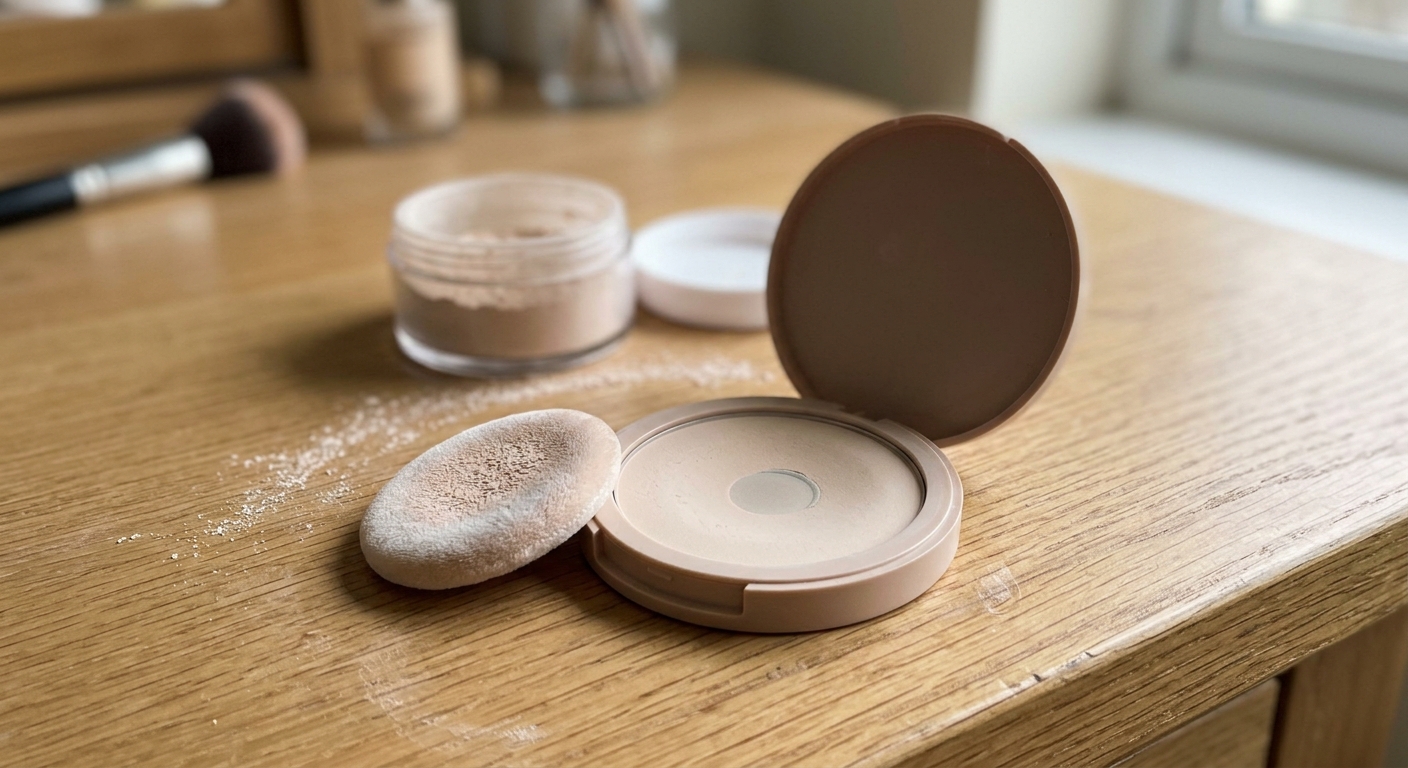
Pressed suits mature skin better than loose. Pressed formulas carry binders and usually some emollient, so they deposit less product per touch and stay put. Loose powder is drier by design and travels into lines more readily.
Application decides half of it
Press, do not sweep. A brush dragged across the face pushes particles horizontally, and horizontal motion is what packs a groove. Pressing with a small velour puff or a dense flat brush sets pigment where it lands.
Powder by zone rather than by face. The only areas that genuinely need setting are the ones that move product: the centre of the forehead, the sides of the nose, the chin. The cheeks near the eye and the perimeter of the face rarely need any at all, and leaving them bare keeps some natural light reflection in the finish.
Use roughly a third of what you think, then wait two minutes before deciding whether to add more, since powder settles into the base and its appearance changes as it does.
The under-eye deserves particular restraint. It is the thinnest skin on the face, it creases with every blink, and a full pass of powder there greys the area and etches the lines. If concealer creasing is your main complaint, our page on concealer creasing under the eyes works through it properly. Set only the inner corner where concealer actually migrates, and leave the rest.
The variable no powder controls
All of this is management. The groove is still a groove.
What created it is the loss of dermal structure underneath. In chronologically aged skin, fibroblasts produce measurably less collagen, in part because a fragmented collagen matrix no longer stretches them mechanically and so no longer signals them to build [6]. Less scaffold means a surface that folds more readily and recovers more slowly, which is a wrinkle in one sentence. Our page on how to fix skin texture covers the surface half of the problem.
The evidence that this is partly reversible is old and strong. In a double-blind vehicle-controlled trial, topical tretinoin significantly improved photoaged skin including fine wrinkling, against vehicle alone [7]. Retinoids remain the best-evidenced topical route to a shallower groove rather than a better-camouflaged one.
Tolerance is the catch. Conventional retinol crosses the barrier by chemically disrupting it, and on skin that is already dry enough to make powder cling, that disruption produces the flaking and redness that ends most attempts inside a month.
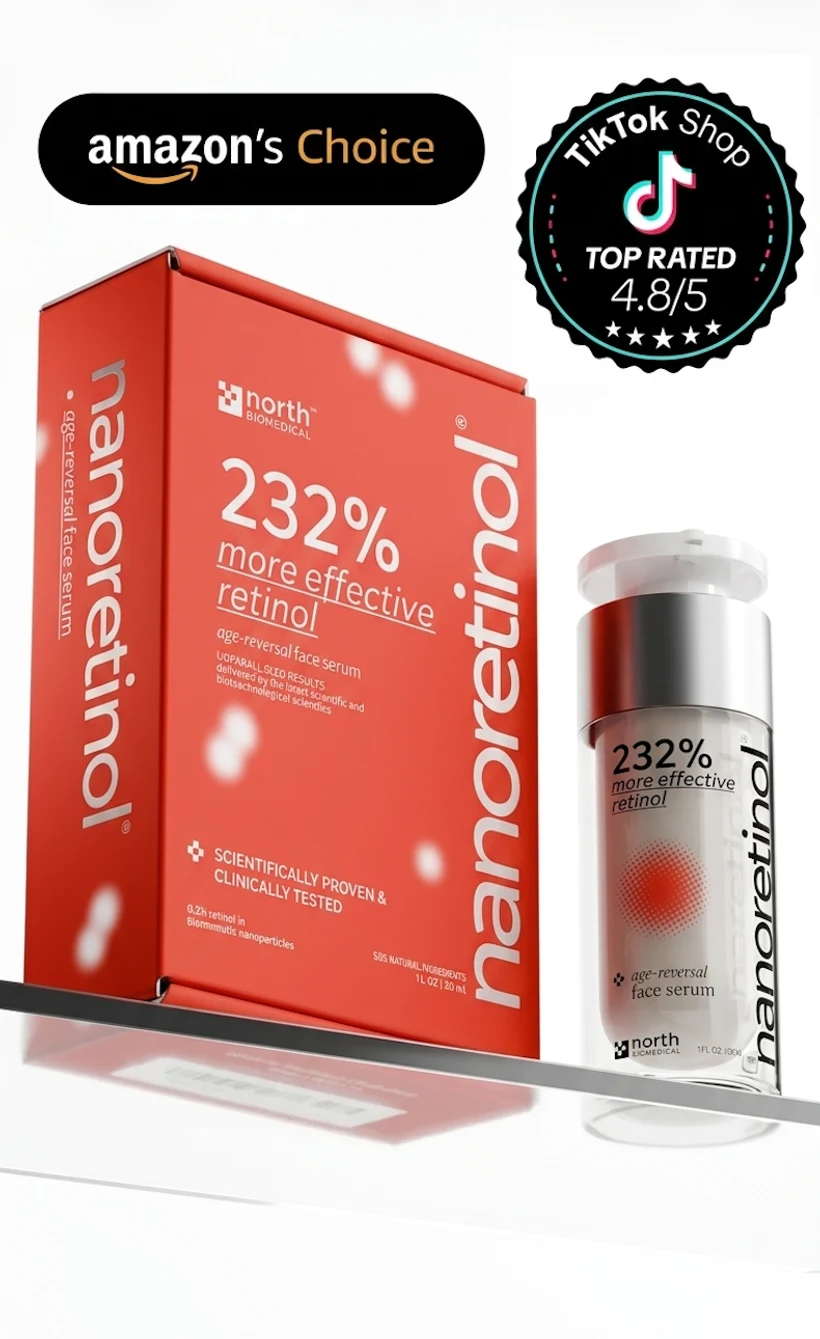
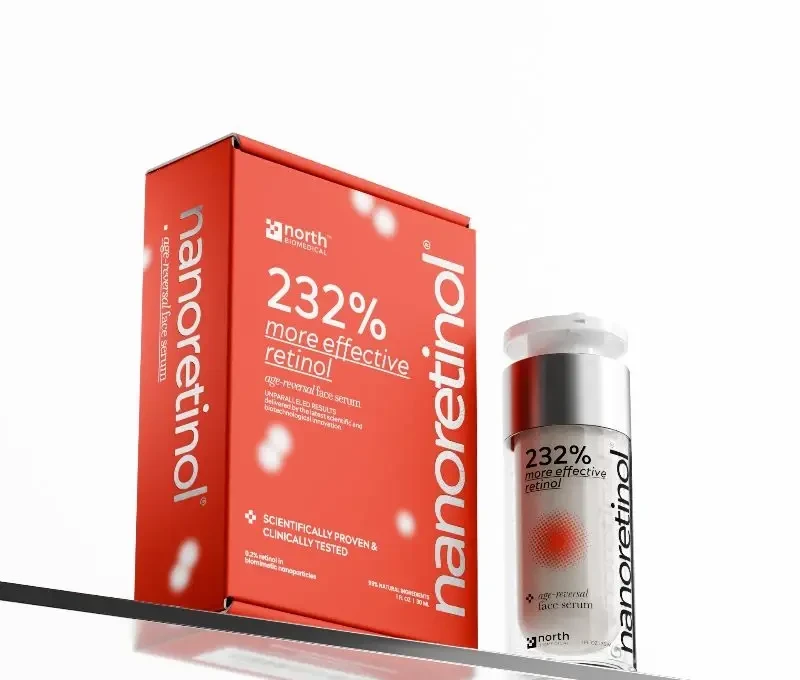
Nanoretinol works differently. Its 0.2% retinol travels inside biomimetic lipid nanoparticles that the skin recognises as self and admits intact, in a water-based, 99% natural formulation suitable for sensitive skin. Against conventional retinol it produced 232% greater collagen recovery and 73% greater elastin recovery with drastically reduced cytotoxicity, and across 56 days of use delivered a 61% increase in firmness and a 56% increase in elasticity. Shallower lines hold less powder, which is the only permanent fix for powder settling into them.
Buying it, briefly
Pressed over loose, silica over talc, minimal titanium dioxide if you are photographed, and a shade tested in daylight rather than under shop lighting. Press it on in three small zones and leave the rest of your face alone. The best foundation for mature skin matters more than what you set it with.
Then remember which layer is doing the real work. Powder buys you a morning. The skin underneath is the part that lasts.
References
- Barun VV, Ivanov AP. “Light Scattering by a Rough Surface of Human Skin. 2. Diffuse Reflectance.” Quantum Electronics. 2013;43(10):979-987. doi:10.1070/QE2013v043n10ABEH015075
- Okamoto T, Kumagawa T, Motoda M, Igarashi T, Nakao K. “Monte Carlo Simulation of Light Reflection from Cosmetic Powder Particles Near the Human Skin Surface.” Journal of Biomedical Optics. 2013;18(6):061232. doi:10.1117/1.JBO.18.6.061232
- Zouboulis CC, Boschnakow A. “Chronological Ageing and Photoageing of the Human Sebaceous Gland.” Clinical and Experimental Dermatology. 2001;26(7):600-607. doi:10.1046/j.1365-2230.2001.00894.x
- Wilhelm KP, Cua AB, Maibach HI. “Skin Aging: Effect on Transepidermal Water Loss, Stratum Corneum Hydration, Skin Surface pH, and Casual Sebum Content.” Archives of Dermatology. 1991;127(12):1806-1809. doi:10.1001/archderm.1991.04520010052006
- Hatzis J. “The Wrinkle and its Measurement: A Skin Surface Profilometric Method.” Micron. 2004;35(3):201-219. PMID: 15036275
- Varani J, Dame MK, Rittie L, Fligiel SE, Kang S, Fisher GJ, Voorhees JJ. “Decreased Collagen Production in Chronologically Aged Skin: Roles of Age-Dependent Alteration in Fibroblast Function and Defective Mechanical Stimulation.” American Journal of Pathology. 2006;168(6):1861-1868. PMID: 16723701
- Weiss JS, Ellis CN, Headington JT, Tincoff T, Hamilton TA, Voorhees JJ. “Topical Tretinoin Improves Photoaged Skin: A Double-Blind Vehicle-Controlled Study.” JAMA. 1988;259(4):527-532. doi:10.1001/jama.1988.03720040019020