Best BB Cream for Mature Skin: What Actually Stops It Creasing
Why the emollient-to-film-former ratio predicts how a base wears better than shade range, coverage, or SPF number
Buying a BB cream for mature skin is not really a coverage decision. Almost any beauty balm will even out tone for the first hour. The decision you are actually making is about hour six — whether the product is still sitting on your skin or has migrated into every line around your eyes and mouth.
That outcome is not random, and it is not about price. It comes down to how a formula is built and what the skin underneath it is doing.
BB cream or CC cream — the difference that matters after 45
BB (“beauty balm”) and CC (“colour correcting”) creams get treated as interchangeable. They are not, and the distinction becomes sharper with age.
BB creams are emollient-led. They were designed as a moisturiser-plus-coverage hybrid, so the base is typically oils, esters and waxes carrying pigment. That gives dewiness and comfort — and it is why a BB cream can slide.
CC creams lean on light-diffusing pigments and film-formers to blur rather than cover. They generally sit drier and stay put longer, which is why many people over 50 drift toward them. If you want that comparison in full, it is covered in our guide to CC creams for mature skin.
For mature skin the honest framing is this: BB creams are the better choice when your skin reads tight, flat or dull and you want it to look hydrated. They are the worse choice when your primary complaint is that makeup collects in lines.
A BB cream does not fail at 9am. It fails at 3pm, when it has had six hours to find every line you have.
The canvas problem
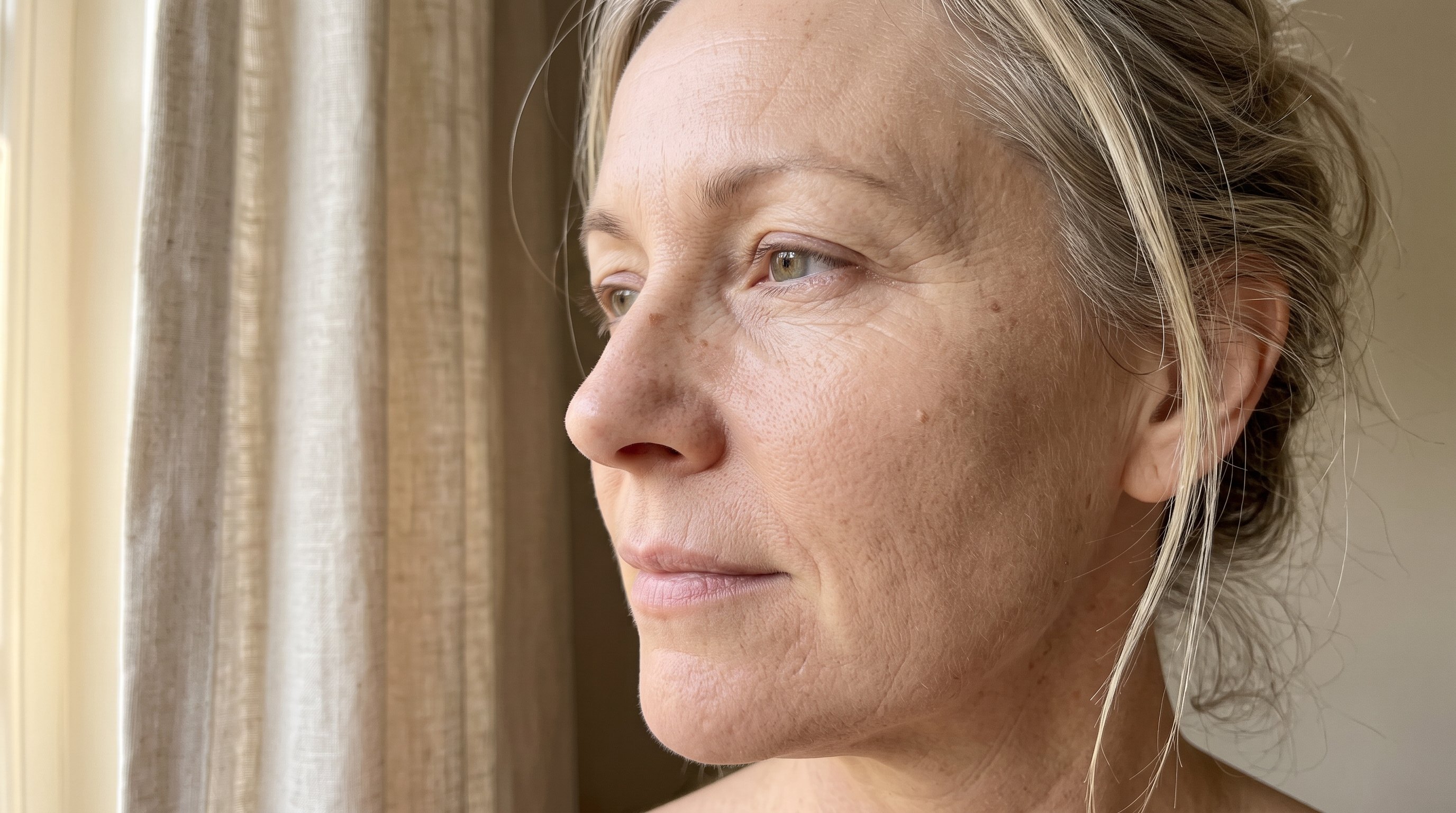
Base makeup settles into skin texture because ageing skin has more texture to settle into — and specifically, a different shape of texture.
Researchers have measured this directly using silicone replicas taken from the skin surface. In an analysis of 103 women aged 5 to 85, surface roughness, pore area and the depth of skin furrows all increased with age, while the number of fine skin ridges and the total area of shallow furrows decreased [1]. The micro-relief does not just get rougher. It consolidates: many shallow channels give way to fewer, deeper ones.
That is a meaningful distinction when you are choosing a product. A fluid pigment suspension has nowhere to go on young skin because the furrows are shallow and numerous. On mature skin, those deep channels act as reservoirs. Anything mobile will find them.
This is the same mechanism behind a complaint we cover separately — why makeup can start to look cakey even when you apply less of it.
The sebum shift nobody mentions
The second variable is oil, and it moves in the opposite direction from what most people assume.
In a study of 150 women aged 18 to 80, measured across the cheek, neck, décolleté, forearm and hand, sebum production fell significantly with age, with the lowest surface lipid levels recorded in the over-70 group. Skin surface pH was also significantly higher in menopausal women [2]. Notably, transepidermal water loss and stratum corneum hydration varied only minimally across age groups — so mature skin is better described as lipid-poor than as barrier-broken.
The menopausal transition itself is measurable. Across repeated Sebumeter readings in postmenopausal women, those not receiving hormone therapy showed a significant decline in forehead sebum excretion rate, longer sebum replacement times and larger mean pore size during the first decade after menopause [3].
Skin after menopause is not simply drier — it produces measurably less surface oil, and that changes how every base product grips.
Why this matters for a BB cream: an emollient-heavy formula on a low-sebum face has nothing to emulsify with. It stays as a discrete film, and discrete films move. The pairing that fails most often is a rich BB cream on skin that produces almost no oil of its own — it never “sets,” so it spends the day drifting.
How to read a formula for creasing risk
You cannot test wear time in a store, but you can read the ingredient list for three signals.
Where the silicones sit. Dimethicone or cyclopentasiloxane in the first five ingredients usually means a film-former-led formula that grips and stays. Silicones appearing far down the list, behind several oils and esters, means emollient-led and mobile. For deep furrows, you want grip.
Whether there is a fixative at all. Look for a film-former such as trimethylsiloxysilicate, acrylates copolymer, or a polymethylsilsesquioxane. Their presence is the single best predictor that a base will hold position through the afternoon. Their absence, in a product otherwise full of shea butter and jojoba, is a warning.
Powder load. Some absorbent powder — silica, starch, or a small amount of mica — helps a low-sebum face. Too much reads chalky on skin that has lost surface lipids. The uncomfortable truth is that a shade matched perfectly at 40 can read ashy at 60, because the skin underneath stopped reflecting light the same way.
If you want more forgiveness than a BB cream offers, the tinted moisturiser comparison covers lighter options that sit closer to bare skin.
Treat the SPF as a bonus, not a strategy
Most BB creams advertise SPF, usually 15 to 30. That number is generated under laboratory application — roughly 2 mg/cm², far more product than anyone applies as makeup.
Daily photoprotection genuinely works. In a randomised trial of 903 adults, skin ageing graded by surface microtopography was 24% lower in the daily broad-spectrum sunscreen group than in the discretionary-use group over four and a half years [4]. That is a real effect, and worth having.
But it was achieved with sunscreen applied as sunscreen. Use a dedicated SPF underneath and count the BB cream’s rating as insurance.
The layer that decides everything
Here is the part the makeup aisle cannot solve. Every criterion above is damage control for a surface you have already accepted. The alternative is changing the surface.
Topical retinoids do this measurably. In two multicentre, double-blind, vehicle-controlled trials, computerised image analysis of silicone skin replicas showed that 24 weeks of prescription tretinoin emollient cream produced significantly greater improvement in skin topography than vehicle [5]. Not smoother-looking — smoother, by replica measurement, on the same instrument used to document the age-related roughening in the first place.
The catch with conventional retinol has always been delivery. Traditional formulations barely cross the epithelial barrier, and the ones that push harder rely on chemicals and petroleum derivatives that disrupt the barrier through lipid mobility — which is the last thing a lipid-poor mature face needs.
This is the problem Nanoretinol was built around. It encapsulates retinol in biomimetic lipid nanoparticles that the body recognises as “self” and allows through the epithelial barrier intact, so no barrier damage is required to get the active where it works. In North Biomedical’s clinical study it proved 232% more effective than conventional retinol in collagen recovery and 73% more effective in elastin recovery, with a 61% increase in skin firmness and 56% increase in elasticity over 56 days — at 0.2% retinol in a water-based, 99% natural formulation that is gentle enough for sensitive skin.
Smoother skin needs less from a BB cream. That is the only durable fix.
Choosing yours
Pick the emollient-led BB cream if your skin looks flat and tight and you are willing to set it. Pick the film-former-led one if lines are your complaint. Check where the silicones sit in the list, confirm there is an actual fixative, and wear real sunscreen underneath regardless.
Then treat the base as what it is: a same-day solution sitting on a surface you can still change. More on working with the skin you have today is in our guide to makeup for wrinkles.
References
- Masuda Y, Oguri M, Morinaga T, Hirao T. “Three-dimensional morphological characterization of the skin surface micro-topography using a skin replica and changes with age.” Skin Research and Technology. 2014;20(3):299-306. doi:10.1111/srt.12119
- Luebberding S, Krueger N, Kerscher M. “Age-related changes in skin barrier function – quantitative evaluation of 150 female subjects.” International Journal of Cosmetic Science. 2013;35(2):183-190. doi:10.1111/ics.12024
- Piérard-Franchimont C, Piérard GE. “Postmenopausal Aging of the Sebaceous Follicle: A Comparison between Women Receiving Hormone Replacement Therapy or Not.” Dermatology. 2002;204(1):17-22. doi:10.1159/000051804
- Hughes MC, Williams GM, Baker P, Green AC. “Sunscreen and prevention of skin aging: a randomized trial.” Annals of Internal Medicine. 2013;158(11):781-790. doi:10.7326/0003-4819-158-11-201306040-00002
- Grove GL, Grove MJ, Leyden JJ, Lufrano L, Schwab B, Perry BH, Thorne EG. “Skin replica analysis of photodamaged skin after therapy with tretinoin emollient cream.” Journal of the American Academy of Dermatology. 1991;25(2 Pt 1):231-237. doi:10.1016/0190-9622(91)70187-7