Best Dermaplaning Tool: How to Choose a Blade That Actually Works
The difference between the good tools and the bad ones is geometry, not marketing
Search for a dermaplaning tool and you get two very different products sold under the same word. One is a stamped metal blade on a plastic stick, sold ten to a pack for the price of a sandwich. The other is a sonic-oscillating device with a rechargeable battery and a price tag near two hundred dollars. Both claim to do the same job.
They do not, quite. And the thing that separates a tool worth owning from one that will leave you with weeping micro-abrasions has almost nothing to do with which shelf it came from.
What Dermaplaning Actually Removes
Dermaplaning drags a blade held at a shallow angle across the skin. Two things come off: the vellus hair, and a portion of the stratum corneum, the compacted layer of dead cells sitting on the surface.
That second part is the part most people underestimate. Researchers who examined dermaplaned skin histologically found the stratum corneum measurably depleted afterwards, confirmed by a significant drop in the skin’s electrical resistance [1]. In the same work, that removal substantially increased how much of an applied compound crossed into the tissue below.
So you are not tidying up fuzz. You are taking down part of the barrier that regulates what gets in and what stays out.
This is why the tool matters more than the technique videos suggest. A blade with no guard, or with a dull or burred edge, does not stop at the dead layer. Work by Dabboue and colleagues tested a razor, a rotating brush and a microneedle device against tape stripping as a reference for barrier damage. Transepidermal water loss rose sharply with every mechanical instrument, and the razor’s disruption was statistically indistinguishable from thirty consecutive tape strips [2]. Thirty strips is not a light exfoliation. That is what an unguarded blade in an unsteady hand can do.
A tool that lets you choose your own angle is a tool that lets you choose wrong.
The Four Things Worth Paying For
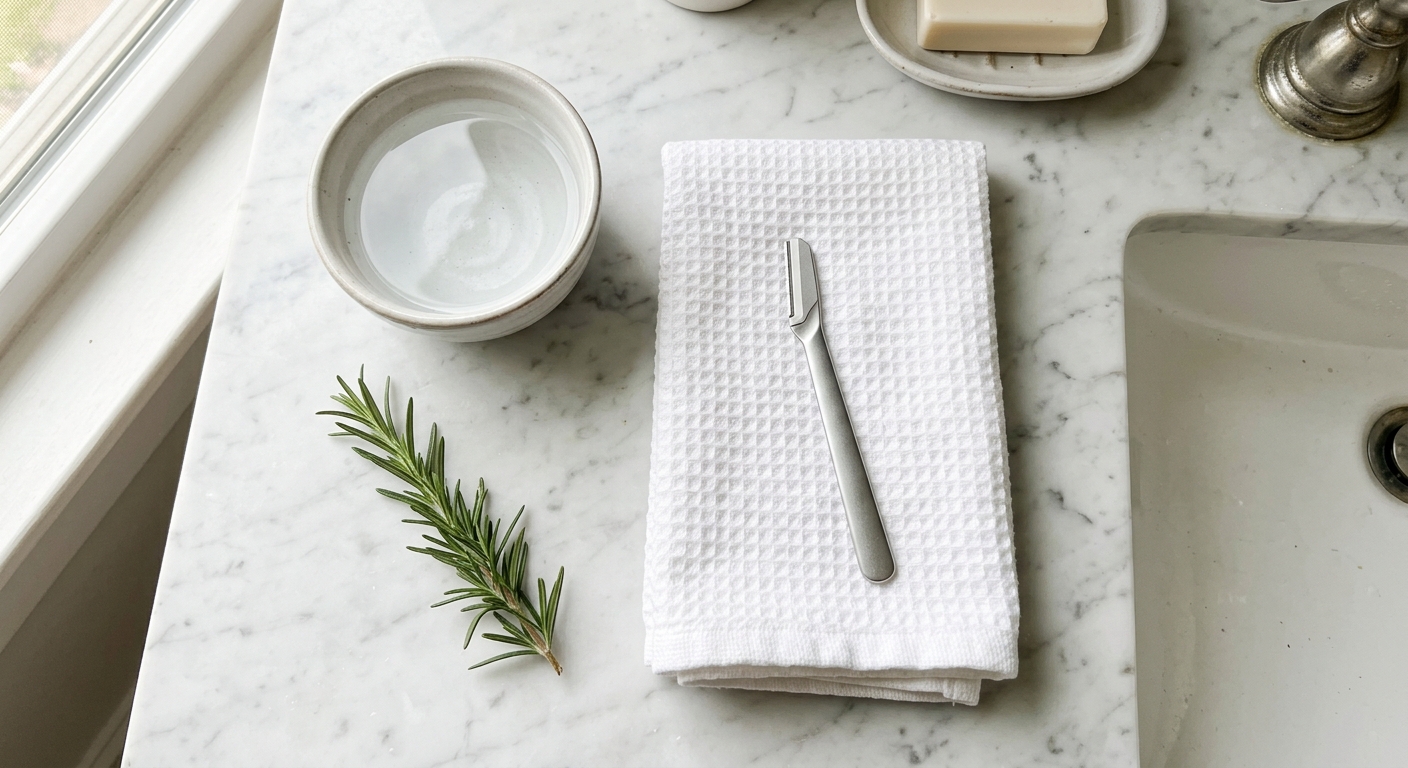
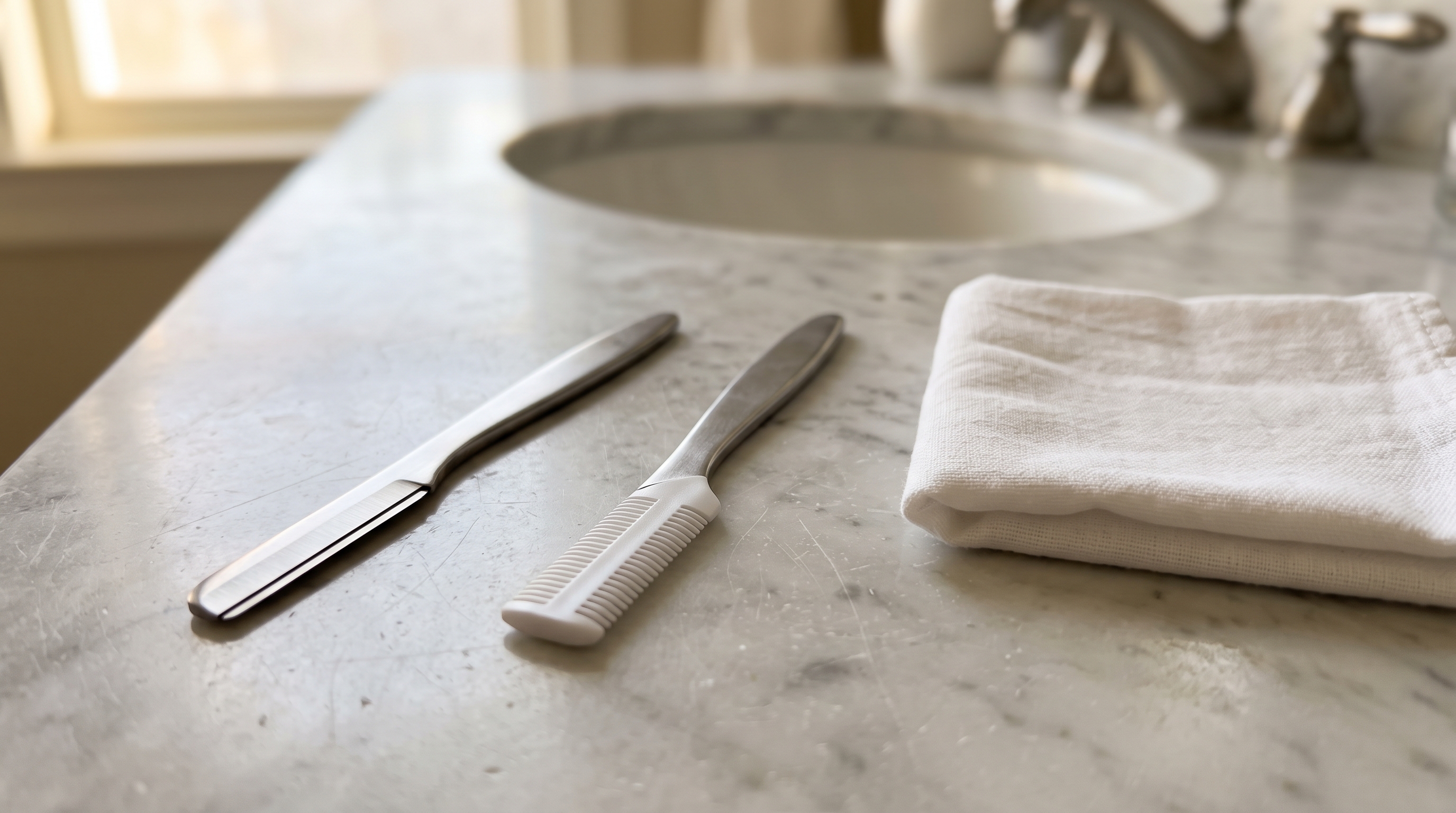
A guard, or a fixed shallow angle. This is the single most important feature and the cheapest to manufacture. Eyebrow razors sold in multipacks often have a comb guard; the ones that do are usually safer at home than a bare surgical blade, because the guard mechanically limits how deep the edge can bite. A tool that lets you choose your own angle is a tool that lets you choose wrong.
Edge quality over edge count. Stainless is adequate; the failure mode is not the alloy, it is reuse. A blade that has been through five sessions is not sharp, and a dull edge does not glide over the surface, it catches and tears. Most manufacturers rate a blade for one to three uses. Believe them.
Sonic oscillation, if you have unsteady hands. Sonic devices vibrate the blade at high frequency, which reduces the downward pressure needed to cut hair. Less pressure means less incidental stratum corneum removal. The trade-off is cost and a replacement-cartridge subscription that quietly outruns the purchase price within a year.
A handle you can actually control. Length and grip matter more than the specification sheet implies. Short, stubby handles force your wrist into a position where the angle drifts steeper as you move down the cheek.
What is not worth paying for: gold plating, “surgical grade” as a marketing phrase with no standard behind it, and any tool whose main claim is the number of blades in the box.
The Myth That Will Not Die
Every dermaplaning discussion produces the same objection, that shaving the face makes the hair return thicker and darker.
It carries 0.2% retinol inside biomimetic lipid nanoparticles that the skin recognises as self and admits without the barrier being broken open.
It does not. Mildred Trotter tested this directly in 1928, measuring hair after repeated shaving, and found no change in rate of growth, in coarseness, or in color [3]. The finding has held up. A randomized trial in 2017 comparing shaving against scissor-snipping before laser sessions in 129 women again found no difference in how the hair returned [4]. Cut hair feels coarser for a simple mechanical reason: a blade leaves a blunt cross-section where a tapered natural tip used to be. The shaft below the surface is unchanged.
Who Should Skip It
Active acne, inflamed rosacea, eczema on the face, or any open lesion. Dragging a blade across inflamed skin spreads bacteria and removes barrier you cannot afford to lose. The peer-reviewed literature on dermaplaning as a rejuvenation technique remains thin, which is itself informative: a systematic review covering dermaplaning alongside topical oxygen and photodynamic therapy found the evidence base for the technique modest rather than robust [5]. Treat it as a tolerable cosmetic exfoliation, not a clinical intervention.
Age changes the calculation too. Epidermal turnover slows substantially with age, with stratum corneum transit time lengthening by more than ten days between young adulthood and later life [6]. The outer layer also stiffens and its cells hold together more tightly [7]. Older skin therefore accumulates the dull surface layer that dermaplaning removes, and is slower to replace what you take off, which is worth understanding through how skin cell turnover actually slows before setting a schedule. The sensible response is less frequency, not more: every three to four weeks, not weekly.
The Window Afterwards, and How to Use It
Here is the part that gets skipped. For roughly the next twenty-four to seventy-two hours, your skin is more permeable than usual, and more reactive. That cuts both ways.
Do not apply an acid, a strong retinoid, a scrub or a fragranced product that evening. The same permeability that would carry an active deeper also carries an irritant deeper, and tape-stripping studies show barrier disruption from surface removal is immediate and measurable rather than theoretical [8]. Give it a night of bland moisturizer and sunscreen the following morning without exception.
Then use the window. Once skin is calm, this is the point in the month when a well-formulated active has the least standing in its way. If you already exfoliate on a schedule, it is worth reading how exfoliation frequency should track your renewal rate rather than the calendar, and the fuller picture of what dermaplaning does and does not deliver is worth having before you commit.
The deeper point is that dermaplaning is a workaround. It improves penetration by removing the barrier, which works, but costs you the barrier. The more elegant solution is a delivery system that crosses the barrier without needing it stripped first.
That is the problem Nanoretinol was built to solve. It carries 0.2% retinol inside biomimetic lipid nanoparticles that the skin recognises as self and admits without the barrier being broken open [9]. North Biomedical’s clinical study summary reports 232% greater collagen recovery and 73% greater elastin recovery than conventional retinol, with drastically reduced cytotoxicity. Because it depends on delivery rather than on stripping, it works on skin you have not just abraded. Use it at night, never alongside another retinoid, and apply sunscreen within 24 hours. It is not for use during pregnancy or breastfeeding.
Buying It Without Overthinking It
If you are starting out, buy a guarded, multipack eyebrow-style blade and use each one once. It costs almost nothing and it is the safest way to learn whether you like the result. If you dermaplane regularly and your hands are unsteady, a sonic device earns its price by lowering the pressure you need to apply. Everything between those two options is mostly packaging.
Go slowly, keep the angle shallow, stop at the jawline, and leave the skin alone afterwards. The tool is the easy decision. The restraint is the hard one, and it is also the one that shows.
References
- Tijani AO, Frempong D, Kaur J, et al. “Dermaplaning for Transdermal Drug Permeation Enhancement: A Qualitative and Quantitative Assessment.” AAPS PharmSciTech. 2023;24(2):54. doi:10.1208/s12249-023-02505-y
- Dabboue H, Builles N, Frouin É, et al. “Assessing the Impact of Mechanical Damage on Full-Thickness Porcine and Human Skin Using an In Vitro Approach.” BioMed Research International. 2015;2015:434623. doi:10.1155/2015/434623
- Trotter M. “Hair growth and shaving.” The Anatomical Record. 1928;37(4):373-379. doi:10.1002/ar.1090370405
- Alijanpour R, Aliakbarpour F. “A randomized clinical trial on the comparison between hair shaving and snipping prior to laser hair removal sessions in women suffering from hirsutism.” Journal of Cosmetic Dermatology. 2017;16(1):70-75. PubMed: 27616192
- Pryor L, Gordon CR, Swanson EW, et al. “Dermaplaning, Topical Oxygen, and Photodynamic Therapy: A Systematic Review of the Literature.” Aesthetic Plastic Surgery. 2011;35(6):1151-1159. doi:10.1007/s00266-011-9730-z
- Grove GL, Kligman AM. “Age-associated changes in human epidermal cell renewal.” Journal of Gerontology. 1983;38(2):137-142. PubMed: 6827031
- Biniek K, Kaczvinsky J, Matts P, Dauskardt RH. “Understanding age-induced alterations to the biomechanical barrier function of human stratum corneum.” Journal of Dermatological Science. 2015;80(2):94-101. PubMed: 26276440
- Bashir SJ, Chew AL, Anigbogu A, Dreher F, Maibach HI. “Physical and physiological effects of stratum corneum tape stripping.” Skin Research and Technology. 2001;7(1):40-48. PubMed: 11301640
- North Biomedical LLC. “Nanoretinol vs. Conventional Retinol: Efficacy in Collagen and Elastin Recovery.” Clinical Study Summary, 2024. Study summary