Best Face Scrub: How to Choose One That Smooths Without Wrecking Your Barrier
Grit size, frequency and what a scrub can genuinely change about your skin.
There is a reason face scrubs outsell almost every other kind of exfoliant. You can feel them working. Ten seconds of circular motion and your skin is warm, pink and noticeably smoother, which is a far more satisfying experience than dabbing on an acid and waiting three weeks. That immediate feedback is also what makes scrubs so easy to misuse.
Choosing the best face scrub is mostly an exercise in understanding what the grit is doing, and what it is physically incapable of doing. Once you know that, the shelf gets much easier to read.
What a Face Scrub Is Actually Removing
The outermost layer of your skin, the stratum corneum, is roughly fifteen to twenty sheets of flattened dead cells called corneocytes. They are held together by protein rivets called corneodesmosomes, and your skin dissolves those rivets on a schedule using its own enzymes, principally the kallikreins KLK5 and KLK7 [1][2]. When the rivets go, the cell lets go. That process is desquamation, and it is happening on your face right now whether you scrub or not.
A scrub removes cells your skin had already finished with and was about to release on its own within a day or two.
A scrub removes cells your skin had already finished with and was about to release on its own within a day or two.
What a scrub changes is the timing and the evenness. As skin ages, the enzymatic process gets sluggish and less uniform, so corneocytes linger and pile up in patches [3]. That uneven pile is what you see as dullness and feel as roughness. Sweeping it off mechanically is a legitimate fix for a legitimate problem, and it is why a good scrub makes foundation sit better and serums absorb faster the same evening.
Scrub Versus Acid: They Are Not Interchangeable
Physical and chemical exfoliation disrupt the barrier through genuinely different routes, and a study comparing the two on ex vivo human skin found measurably different biochemical signatures depending on which method was used [4]. An acid works by loosening the rivets chemically and fairly uniformly across the whole surface. A scrub works by force, and force is distributed by whatever your fingers happen to be doing.
That is the central weakness of the format. Pressure varies across your face, so the thin skin over your cheekbones takes the same abrasion as the thicker skin on your chin and gets more damage from it. Any decent face scrub is designed to compensate for the unevenness of the human hand.
What Separates a Good Face Scrub From a Bad One
Particle shape matters more than particle size. Crushed nut shells, apricot kernels and fruit pits fracture into irregular shards with sharp edges. Spherical particles, jojoba esters, silica beads and rounded cellulose roll across the surface rather than cutting into it. If the ingredient list names a crushed shell or a ground pit, put it back.
The base is half the product. A scrub suspended in a rich cream or an oil cushions the particles and slows them down. The same grit in a thin foaming gel hits the skin much harder. Cream and balm bases are consistently the gentler choice.
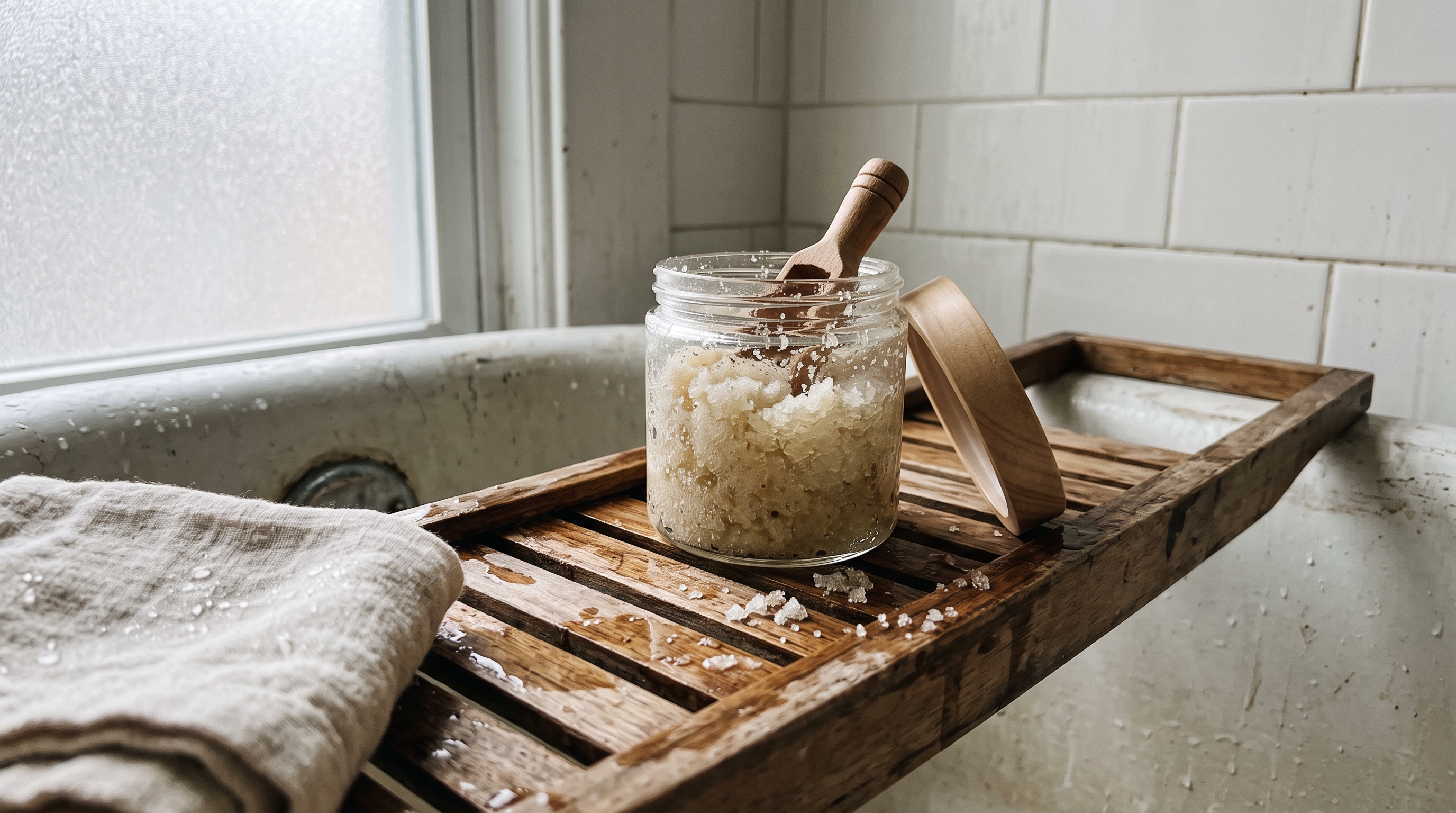
Sugar and salt are for the body. They dissolve as you work, which sounds gentle, but the crystals start out large and edged, and salt in particular stings on any compromised skin. Keep them below the neckline.
Fragrance load should be low. You are about to make the barrier temporarily more permeable, and anything sitting in the formula gets a better route in for the next hour.
If you want the broader comparison across formats and price points, our guide to the best exfoliator for mature skin covers chemical and enzymatic options alongside scrubs, and the AHA versus BHA breakdown explains which acid suits which concern.
How Often Is Genuinely Enough
Once or twice a week is the ceiling for most faces, and once every ten days is plenty for dry or reactive skin. The temptation is to treat a scrub like a cleanser because it feels like one. Resist it. A full desquamation cycle takes roughly two weeks, so scrubbing daily means you are removing cells that are still structurally load-bearing.
If your skin stings when you apply a serum that never used to sting, you have exfoliated past the point of benefit.
If your skin stings when you apply a serum that never used to sting, you have exfoliated past the point of benefit.
The other tells are tightness after cleansing, a shiny or waxy look that is not oil, and new sensitivity to products you have used for years. Barrier disruption, water loss and low-grade inflammation reinforce each other in a loop, so over-exfoliated skin tends to get drier and more reactive the longer it goes unaddressed [5]. The fix is to stop for two to three weeks and rebuild, which our guide to repairing a damaged skin barrier walks through step by step. Pacing advice for every skin type sits in how often to exfoliate your face.
The Ceiling On What a Scrub Can Do
Here is the limit worth being honest about. Exfoliation is subtraction. It takes away what is already dead and reveals what is underneath, which means the result is capped by the quality of the skin you already have. A scrub cannot raise the rate at which your basal cells divide, it cannot thicken a thinning dermis, and it has no effect whatsoever on collagen.
Topical vitamin A is one of the few things that does change those underlying variables. In a controlled study of naturally aged skin, retinol improved fine wrinkling and increased glycosaminoglycan and procollagen expression, which is renewal happening at the source rather than at the surface [6]. Dermatologists have made much the same point about sequencing: surface treatments deliver visible polish, but the compounds that alter skin behaviour do the structural work [7].
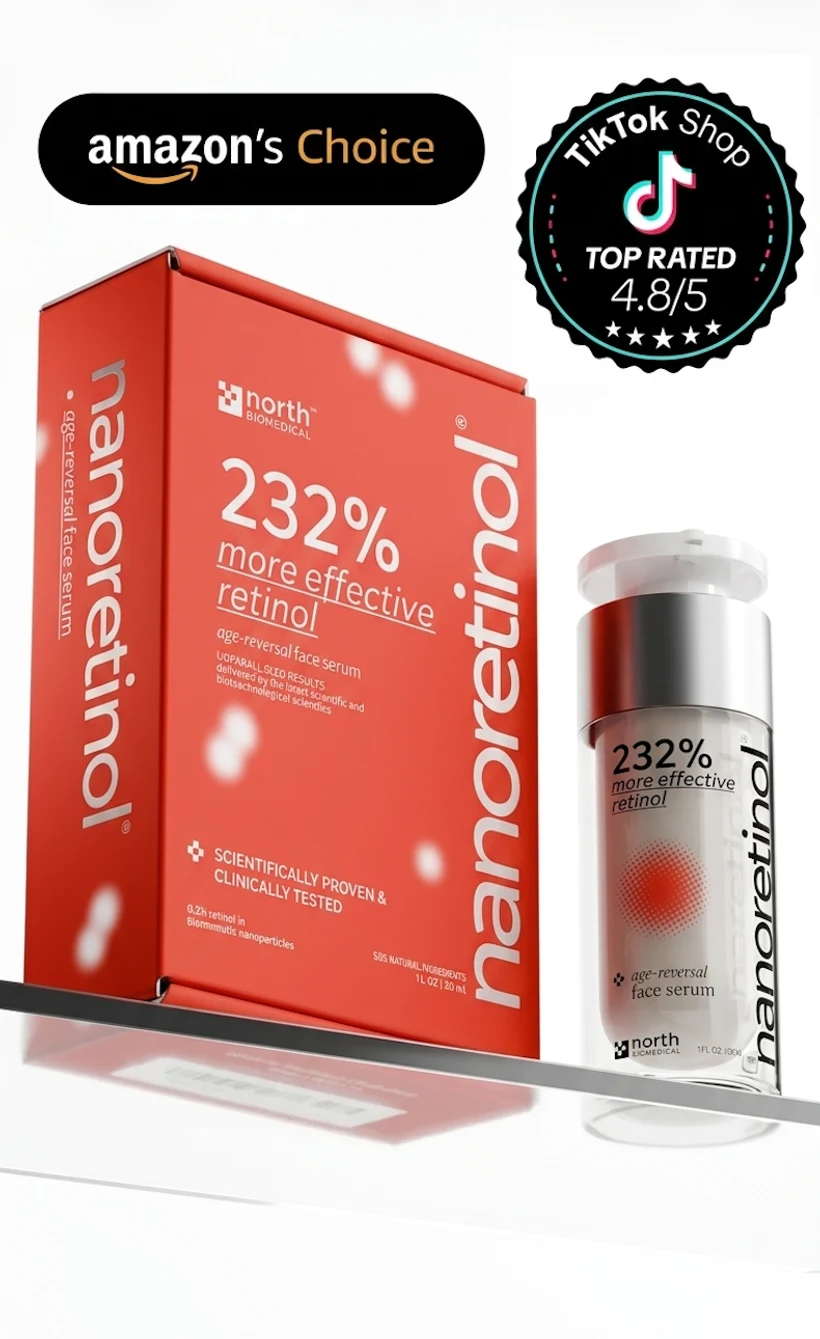
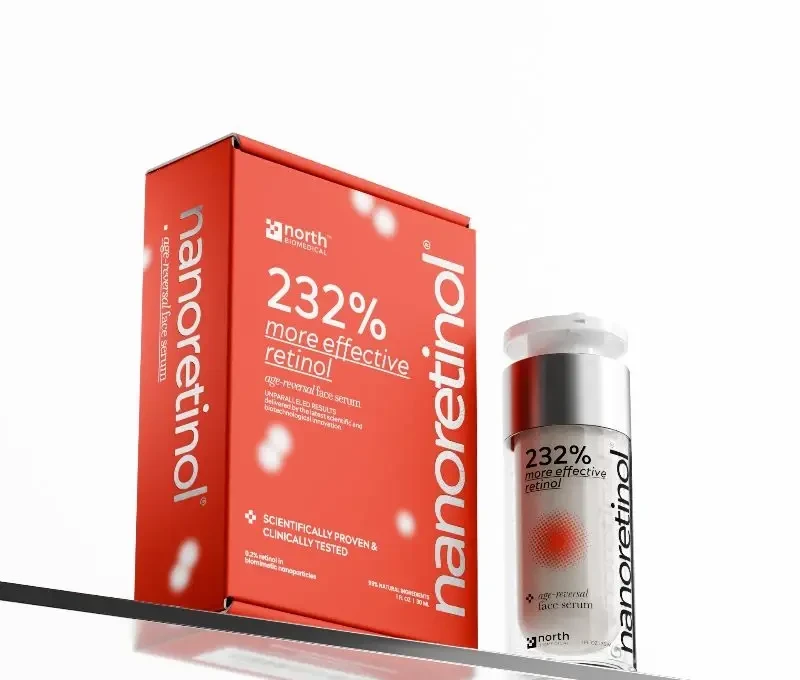
The practical difficulty has always been getting retinol far enough in. Conventional formulations rely on solvents that loosen the barrier to force passage, which is why retinol and irritation are so closely associated in most people’s memory. Nanoretinol takes a different route, encapsulating retinol inside biomimetic lipid nanoparticles that the skin recognises as its own and admits without the barrier being compromised. In North Biomedical’s clinical study summary, Nanoretinol vs. Conventional Retinol: Efficacy in Collagen and Elastin Recovery (2024), that delivery produced 232% greater collagen recovery than conventional retinol while being significantly gentler on skin cells. For anyone who scrubs because their texture is not what it was, that combination is the part of the routine doing the durable work.
Buying One You Will Actually Keep Using
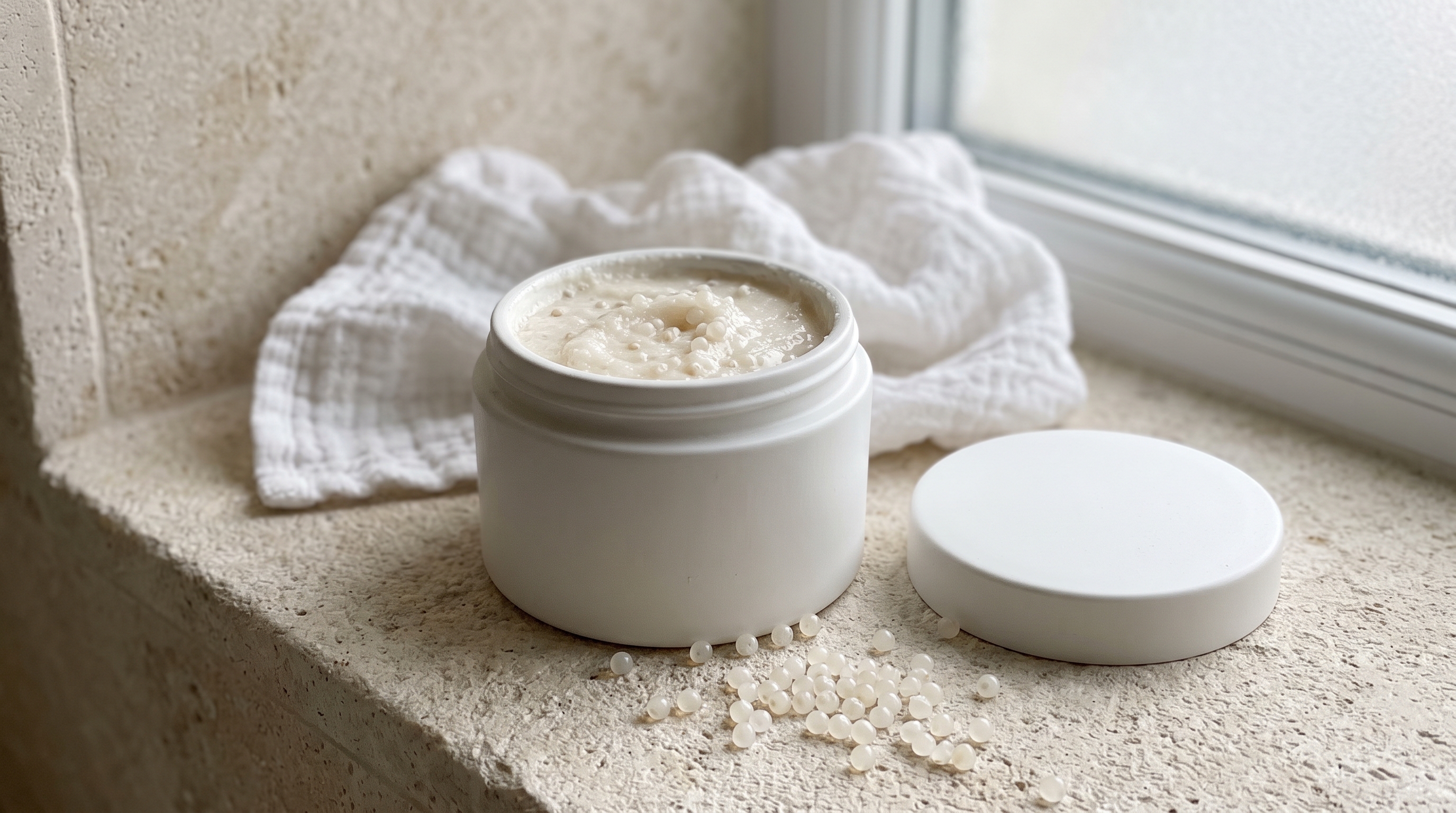
Look for rounded particles in a cream or balm base, a short fragrance list, and a texture you can apply with almost no pressure. Use it twice a week at most, on damp skin, for no more than thirty seconds, then follow with a moisturiser while the skin is still damp. Skip it entirely in any week your skin already feels tight.
A scrub is a finishing tool. Used at that scale it earns its place, and used as a daily habit it slowly costs you the barrier that made your skin look good in the first place.
References
- Stamatas GN. “Protein degradation in the stratum corneum.” International Journal of Cosmetic Science. 2024;46(4):590-597. doi:10.1111/ics.12974
- Caubet C, Jonca N, Brattsand M, Guerrin M, Bernard D, Schmidt R, Egelrud T, Simon M, Serre G. “Degradation of corneodesmosome proteins by two serine proteases of the kallikrein family, SCTE/KLK5/hK5 and SCCE/KLK7/hK7.” Journal of Investigative Dermatology. 2004;122(5):1235-1244. doi:10.1111/j.0022-202X.2004.22512.x
- Ishida-Yamamoto A, Igawa S, Kishibe M. “Order and disorder in corneocyte adhesion.” Journal of Dermatology. 2011;38(7):645-654. doi:10.1111/j.1346-8138.2011.01227.x
- Döge N, Avetisyan A, Hadam S, Pfannes EKB, Rancan F, Blume-Peytavi U, Vogt A. “Assessment of skin barrier function and biochemical changes of ex vivo human skin in response to physical and chemical barrier disruption.” European Journal of Pharmaceutics and Biopharmaceutics. 2017;116:138-148. doi:10.1016/j.ejpb.2016.12.012
- Bize C, Le Gélébart E, Moga A, Payré B, Garcia C. “Barrier disruption, dehydration and inflammation: Investigation of the vicious circle underlying dry skin.” International Journal of Cosmetic Science. 2021;43(6):729-737. doi:10.1111/ics.12748
- Kafi R, Kwak HSR, Schumacher WE, Cho S, Hanft VN, Hamilton TA, King AL, Neal JD, Varani J, Fisher GJ, Voorhees JJ, Kang S. “Improvement of naturally aged skin with vitamin A (retinol).” Archives of Dermatology. 2007;143(5):606-612. doi:10.1001/archderm.143.5.606
- Rodan K, Fields K, Majewski G, Falla T. “Skincare Bootcamp: The Evolving Role of Skincare.” Plastic and Reconstructive Surgery Global Open. 2016;4(12 Suppl):e1152. doi:10.1097/GOX.0000000000001152