Makeup for Wrinkles: Why Technique Beats Product Every Time
Wrinkles are a shadow problem before they are a coverage problem, and that changes how you should apply everything
Most advice about makeup for wrinkles is a list of products to buy. That is the wrong starting point, because the two women who look completely different in the same foundation are usually not using different products. They are using different amounts, in a different order, with different pressure.
Understanding why requires one shift in how you think about a wrinkle. You do not actually see a line on someone’s face. You see the shadow inside a groove.
What a wrinkle does to light
Skin is not a flat reflector. Some light bounces straight off the surface, and some travels into the tissue, scatters, and comes back out diffused. That balance between surface reflection and subsurface scattering is what gives skin its particular look, and it measurably shifts with age. In vivo spectroscopy has shown that the skin’s absorption coefficient, scattering coefficient, and refractive index all change as subjects get older [1].
The surface itself changes too, and more dramatically. A study of 80 subjects across two age brackets found that roughness, developed surface area, and peak-to-trough amplitude all increased significantly with age at both the forearm and the temple, while furrow density decreased [2]. In plain terms, older skin has fewer, deeper channels rather than many shallow ones. Deep channels catch shadow. Shallow ones do not.
This is why the same face can look smooth in a bathroom with overhead lighting and heavily lined in raking window light. Nothing about the skin changed between rooms. Only the angle of the light did.
Evenness reads younger than coverage
There is a persistent instinct to solve visible aging with more product. The evidence points elsewhere.
When 353 raters assessed cropped images of cheek skin from 170 women aged 11 to 76, color homogeneity alone correlated positively with perceived attractiveness, health, and youth, and negatively with estimated age, at a correlation of -0.45 [3]. The raters could not see the face shape, the eyes, or the jawline. Evenness of tone by itself was carrying that much of the judgment.
You do not actually see a line on someone’s face.
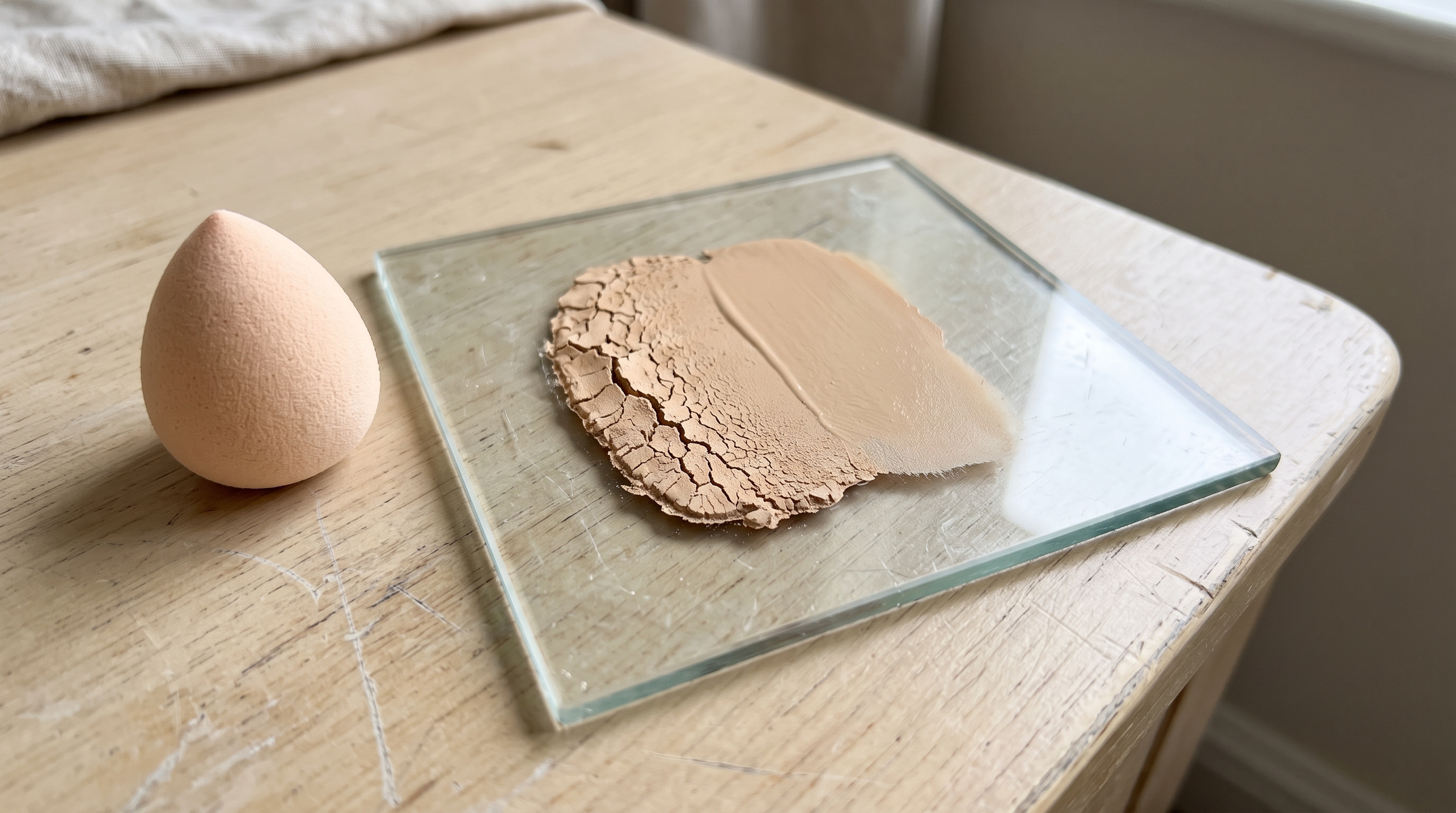
Coverage and evenness are not the same thing, and they pull against each other past a certain point. A thick layer of foundation evens out color, then breaks up as the face moves and becomes conspicuously uneven in exactly the places you were trying to fix. A thin layer that stays intact all day delivers more homogeneity in practice than a thick one that fractures by two in the afternoon.
Hydration is a makeup step
The most underrated variable is not in the makeup bag at all. Stratum corneum water content and thickness correlate significantly with skin surface roughness, and hydrating the surface produces a measurable reduction in roughness [4].
That is a genuinely useful finding. Well-hydrated skin is physically smoother before you apply anything, which means shallower channels for product to migrate into and less shadow for you to fight. Ten minutes between moisturizer and foundation is not a wasted ten minutes. It is the step that decides how the rest behaves.
The application rules that actually change the result
Press, do not drag. Dragging a brush or sponge across the skin pushes product along the surface until it reaches a groove and falls in. Pressing sets pigment where it lands and leaves the grooves comparatively empty. On any area with visible lines this single change does more than switching foundation.
Build thin layers. Two sheer passes with drying time in between hold together far better than one heavy pass, because each film is thinner and more flexible. Flexibility is what survives a smile.
Hydrate before pigment, always. Applying base to skin that has not fully absorbed its moisturizer gives you a mobile layer sitting on a wet one, and mobile layers migrate into lines.
Look at your face beside a window before you leave, because that is closer to what everyone else will see.
Reconsider the blanket ban on powder. The standard advice is to avoid powder entirely after a certain age, and it is half right. Powder is a problem where skin moves and creases, which is under the eye, around the mouth, and across the nasolabial folds. It is genuinely useful where skin does not move much, such as the forehead center, the chin, and the sides of the nose, because it controls the oil that would otherwise break your base apart. Place it by zone rather than banning it. Our guide to setting powder for mature skin covers formula choice.
Match the primer to the actual problem. Blurring primers work by scattering light with soft-focus particles, which softens the shadow in a furrow. They work well at conversational distance and less well in direct raking light, so they are worth using and worth not over-relying on. Gripping primers designed to lock makeup down tend to work against you here, because a locked film is a rigid film. Our overview of primers for mature skin goes through the categories.
Under the eye, use less than feels sufficient. The area is thin and constantly moving, and it is where most makeup failures begin. If your concealer is settling within a couple of hours, our piece on why concealer creases under the eyes works through the causes.
Check your work in the light you live in. Bathroom lighting from above flatters by filling in shadow. Look at your face beside a window before you leave, because that is closer to what everyone else will see.
Where optics stops
Every technique above manipulates how light meets a surface. None of them changes the surface, which is why the effect lasts exactly as long as the makeup does and why the furrows are in the same place tomorrow.
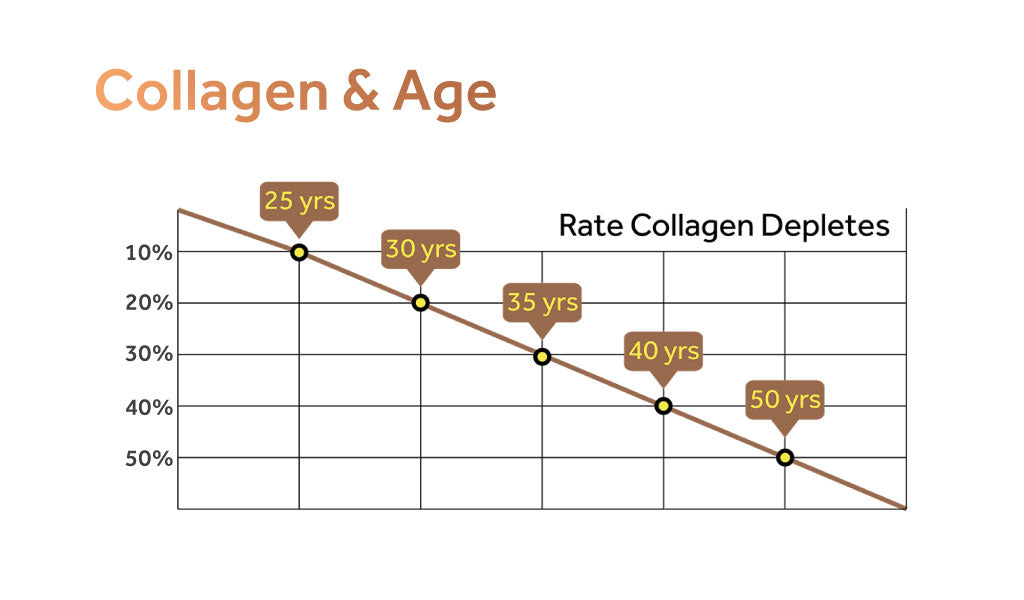
The furrows exist because of what has happened underneath them. Dermal fibroblasts from people aged 80 and over produced significantly less type I procollagen than those from people aged 18 to 29, at 56 against 82 nanograms per milliliter [5]. Less collagen produced means less structure holding the surface taut, which means deeper channels and more shadow. That is the mechanism, and it is upstream of anything in a makeup bag.
It is also treatable. In a randomized, double-blind, vehicle-controlled trial in 36 elderly subjects with a mean age of 87, topical retinol applied three times a week for 24 weeks significantly reduced fine wrinkling, with improvement detectable from week four, and significantly increased collagen I expression against vehicle [6]. Skin that has been aging for eight decades still responded.
The limiting factor in practice has been getting retinol to where the collagen is made. Conventional retinol barely crosses the epithelial barrier, and formulations that force it through rely on chemicals and petroleum derivatives that break the barrier down, which is the source of the burning and peeling that makes people quit.
Nanoretinol solves the delivery problem instead of the concentration one. Its retinol is encapsulated in biomimetic lipid nanoparticles that are externally identical to skin cells, so the body reads them as its own and allows them through the epithelial barrier intact. In testing it proved 232% more effective than conventional retinol at collagen recovery and 73% more effective at elastin recovery, and over 56 days of use produced a 61% increase in skin firmness and a 56% increase in skin elasticity. Firmer, more elastic skin holds a shallower furrow, which means less shadow before any makeup goes on at all.
Two things worth doing tonight
Apply your makeup tomorrow with pressing motions and half the product you used today, on skin you moisturized ten minutes earlier, and check the result beside a window. Most people see the difference immediately, and it cost nothing.
Then start on the layer underneath, because the technique gets easier every month that the surface it is working on gets smoother. If the lines you are working around are already well established, our guide to deep wrinkles on the face sets out what actually moves them.
References
- Calin MA, Parasca SV. “In Vivo Study of Age-Related Changes in the Optical Properties of the Skin.” Lasers in Medical Science. 2010;25(2):269-274. doi:10.1007/s10103-009-0725-9
- Lagarde JM, Rouvrais C, Black D. “Topography and Anisotropy of the Skin Surface with Ageing.” Skin Research and Technology. 2005;11(2):110-119. doi:10.1111/j.1600-0846.2005.00096.x
- Matts PJ, Fink B, Grammer K, Burquest M. “Color Homogeneity and Visual Perception of Age, Health, and Attractiveness of Female Facial Skin.” Journal of the American Academy of Dermatology. 2007;57(6):977-984. doi:10.1016/j.jaad.2007.07.040
- Sato J, Yanai M, Hirao T, Denda M. “Water Content and Thickness of the Stratum Corneum Contribute to Skin Surface Morphology.” Archives of Dermatological Research. 2000;292(8):412-417. doi:10.1007/s004030000143
- Varani J, Dame MK, Rittie L, Fligiel SE, Kang S, Fisher GJ, Voorhees JJ. “Decreased Collagen Production in Chronologically Aged Skin: Roles of Age-Dependent Alteration in Fibroblast Function and Defective Mechanical Stimulation.” American Journal of Pathology. 2006;168(6):1861-1868. doi:10.2353/ajpath.2006.051302
- Kafi R, Kwak HS, Schumacher WE, Cho S, Hanft VN, Hamilton TA, King AL, Neal JD, Varani J, Fisher GJ, Voorhees JJ, Kang S. “Improvement of Naturally Aged Skin with Vitamin A (Retinol).” Archives of Dermatology. 2007;143(5):606-612. doi:10.1001/archderm.143.5.606