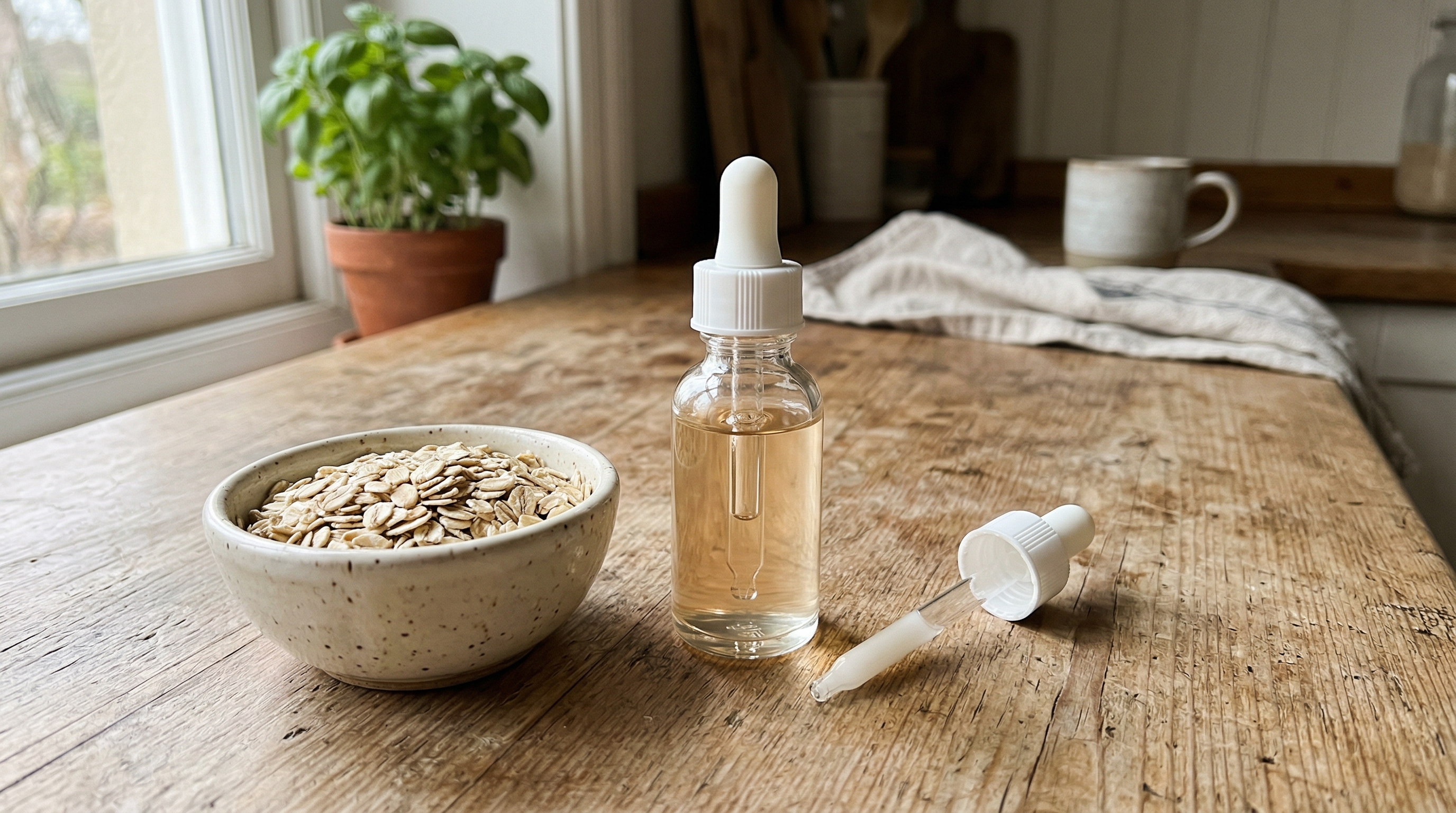
Beta Glucan for Skin: The Quietly Powerful Ingredient That Outperforms Hyaluronic Acid on Barrier Repair
Derived from oats and yeast, beta glucan hydrates deeply, stimulates collagen, and rebuilds the barrier from within
If you have ever noticed that an oat-based moisturizer calms your skin in a way other formulations do not, you have experienced beta glucan at work — you just did not know it had a name.
Beta glucan is a polysaccharide — a long-chain sugar molecule — derived primarily from oats, barley, yeast, and certain medicinal mushrooms. It has been a workhorse in pharmaceutical wound care for decades. In the last ten years it has migrated into skincare, where it is now recognized as one of the most well-evidenced moisturizing and barrier-repairing ingredients available. It is not a trendy molecule. It is simply a very good one that took a long time to appear in consumer products.
What Beta Glucan Is and Where It Comes From
Beta-1,3/1,6-glucan (the form most relevant to skincare) is structurally distinct from beta-1,3/1,4-glucan found in oats and barley. Both forms are biologically active, but through different receptor pathways. The form derived from yeast (Saccharomyces cerevisiae) binds specifically to Dectin-1 receptors on immune cells and keratinocytes, triggering a repair cascade. Oat-derived beta glucan (beta-1,3/1,4-glucan) works primarily through its film-forming and moisture-trapping physical properties while also influencing barrier-related gene expression [5].
The distinction matters because formulations marketed as “beta glucan” may contain either or both, and their relative concentrations determine whether the product skews toward deep moisturization, barrier repair, or immunomodulatory activity. For anti-aging purposes, the yeast-derived form has the more interesting research profile. For sensitive or inflamed skin, oat-derived beta glucan has the more established clinical track record.
How It Hydrates — and Why the Mechanism Differs from Hyaluronic Acid
Hyaluronic acid is the dominant moisturizing ingredient in contemporary skincare, and for good reason: it is an outstanding humectant that can hold up to 1,000 times its weight in water and exists naturally in the skin’s extracellular matrix. But it primarily functions at the skin surface and upper epidermis. In dry or compromised barrier conditions — particularly relevant in mature skin — hyaluronic acid applied topically can actually draw moisture from the skin rather than delivering it, particularly in low-humidity environments without an occlusive layer on top.
Beta glucan hydrates differently. Research demonstrates that beta glucan forms a moisture-retaining film on the skin surface that reduces transepidermal water loss (TEWL) — the passive evaporation of water through the skin barrier — more effectively than hyaluronic acid in clinical comparisons [1]. It also penetrates into the epidermis and triggers fibroblasts to produce more hyaluronic acid endogenously. The result is hydration that comes from both a surface reservoir and stimulated internal production.
If you have ever noticed that an oat-based moisturizer calms your skin in a way other formulations do not, you have experienced beta glucan at work — you just did not know it had a name.
A split-face, double-blinded clinical study evaluated beta glucan-containing skincare regimens for skin recovery after fractional laser treatment — a model for barrier disruption. The beta glucan group showed significantly better skin hydration and reduced TEWL at both Day 7 and Day 14 compared to the vehicle-controlled group, and 63.2% of patients self-reported better outcomes with the beta glucan regimen [3].
Collagen Stimulation: The Anti-Aging Mechanism
This is where beta glucan transitions from a hydration ingredient to a genuine anti-aging one. A study examining beta glucan’s direct effects on human dermal fibroblasts found that glucan stimulates collagen biosynthesis through a nuclear factor-1 dependent mechanism — a pathway that fibroblasts use to upregulate the genes encoding collagen synthesis [4]. This is not an incidental benefit; it positions beta glucan alongside retinol and peptides as an active that does structural repair work in the dermis.
A 2024 study in British Journal of Pharmacology found that oat beta glucan repairs the epidermal barrier by upregulating the expression of epidermal differentiation markers, cell-cell junction proteins, and critical barrier lipids via Dectin-1 receptor activation [5]. This is one of the clearest mechanistic explanations for why oat-based formulations consistently outperform standard moisturizers in barrier-compromised skin: they are not simply sealing the surface; they are signaling keratinocytes to rebuild the lipid architecture from within.
The Immune Modulation Angle
One of beta glucan’s less-discussed properties is its immunomodulatory activity. Beta glucan is a biological response modifier — a compound the immune system reads as a signal to calibrate its activity. In wound healing research, beta glucan consistently increases macrophage infiltration at injury sites, which accelerates the clearance of cellular debris and the deposition of new collagen [6]. In intact but aging skin, chronic low-grade inflammation — sometimes called inflammaging — depletes collagen and accelerates structural degradation. Beta glucan’s ability to modulate this immune environment, rather than simply suppressing or amplifying it, makes it particularly relevant for aging skin.
Barrier Repair: A Critical Context for Retinol Users
If you use retinol — conventional or encapsulated — barrier integrity becomes a recurring consideration. Conventional retinol formulations work by disrupting the epithelial barrier’s lipid architecture to penetrate, which causes the purging, redness, and peeling familiar to most retinol users. Even with excellent results, many people find they can only use retinol three nights per week because more frequent use leads to compromised barrier function.
If you use retinol — conventional or encapsulated — barrier integrity becomes a recurring consideration.
Beta glucan is an excellent companion ingredient precisely here. Its barrier-repairing and soothing properties help maintain the structural integrity of the epithelial layer between retinol applications. Applying a beta glucan serum or moisturizer on the mornings after retinol nights (or layering it beneath a retinol on alternating nights) helps maintain TEWL at normal levels while the retinol does its cell-turnover and collagen-stimulation work.
For users of Nanoretinol specifically, the compatibility is even more straightforward. Because Nanoretinol delivers retinol via biomimetic lipid nanoparticles that do not require barrier disruption to penetrate, the acute irritation associated with conventional retinol is dramatically reduced. The nanoparticles are recognized as “self” by skin cells and pass through the barrier intact, releasing their retinol payload at depth. This means retinol-related barrier compromise is far less of a concern — but beta glucan still adds value as a collagen-stimulating and barrier-supporting complement.
Where to Find Beta Glucan in Formulations
Beta glucan appears in products under several names: beta-1,3-glucan, yeast beta glucan, oat beta glucan, Saccharomyces cerevisiae extract, and sodium carboxymethyl beta-glucan (a modified, more water-soluble form). Concentrations matter: research-supported concentrations typically range from 0.05% to 1% depending on the source and formulation. Products listing it in the first third of the ingredient list are likely to deliver meaningful concentrations; products where it appears near the end are likely using it as a marketing ingredient at sub-therapeutic levels.
Serums offer the highest concentrations and best penetration; moisturizers pair it effectively with occlusives and emollients for barrier-supporting applications. The ingredient is exceptionally well-tolerated across all skin types, including sensitive and reactive skin — there are no known irritation, photosensitization, or interaction risks associated with beta glucan at cosmetic concentrations.
Building a Beta Glucan Routine
A practical approach:
Morning: Cleanse → beta glucan serum → SPF moisturizer. The serum’s TEWL-reducing film paired with SPF creates a robust barrier against both moisture loss and UV.
Evening: Cleanse → retinol or Nanoretinol → beta glucan moisturizer. The retinol does structural work overnight; beta glucan helps maintain barrier integrity through the same period.
Post-procedure or post-irritation: If the skin is compromised — after a laser treatment, a peel, or a retinol purge episode — a beta glucan-focused regimen (serum and moisturizer, multiple times daily) provides measurable barrier recovery in the first two weeks, as shown by the clinical data above [3].
The understated case for beta glucan is that it does several things well: deep hydration, barrier repair, collagen stimulation, and immune modulation — while doing none of them in a way that causes problems. For an ingredient that manages to be both gentle and genuinely effective, it has earned considerably more attention than it typically receives.
References
- Du B, Bian Z, Xu B. “Skin health promotion effects of natural beta-glucan derived from cereals and microorganisms: a review.” Phytother Res. 2014;28(2):159-66. doi:10.1002/ptr.4963
- Sousa P, Tavares-Valente D, Amorim M, et al. “β-Glucan extracts as high-value multifunctional ingredients for skin health: A review.” Carbohydr Polym. 2023;322:121329. doi:10.1016/j.carbpol.2023.121329
- Cao Y, Wang P, Zhang G, et al. “Administration of skin care regimens containing β-glucan for skin recovery after fractional laser therapy: A split-face, double-blinded, vehicle-controlled study.” J Cosmet Dermatol. 2021;20(6):1756-1762. doi:10.1111/jocd.13798
- Wei D, Zhang L, Williams DL, Browder IW. “Glucan stimulates human dermal fibroblast collagen biosynthesis through a nuclear factor-1 dependent mechanism.” Wound Repair Regen. 2002;10(3):161-168. doi:10.1046/j.1524-475x.2002.10804.x
- Jing R, Fu M, Huang Y, et al. “Oat β-glucan repairs the epidermal barrier by upregulating the levels of epidermal differentiation, cell-cell junctions and lipids via Dectin-1.” Br J Pharmacol. 2024;181(11):1596-1613. doi:10.1111/bph.16306
- Feng X, Shang J, Wang Y, Chen Y, Liu Y. “Exploring the Properties and Application Potential of β-Glucan in Skin Care.” Food Sci Nutr. 2025;13(4):e70212. doi:10.1002/fsn3.70212