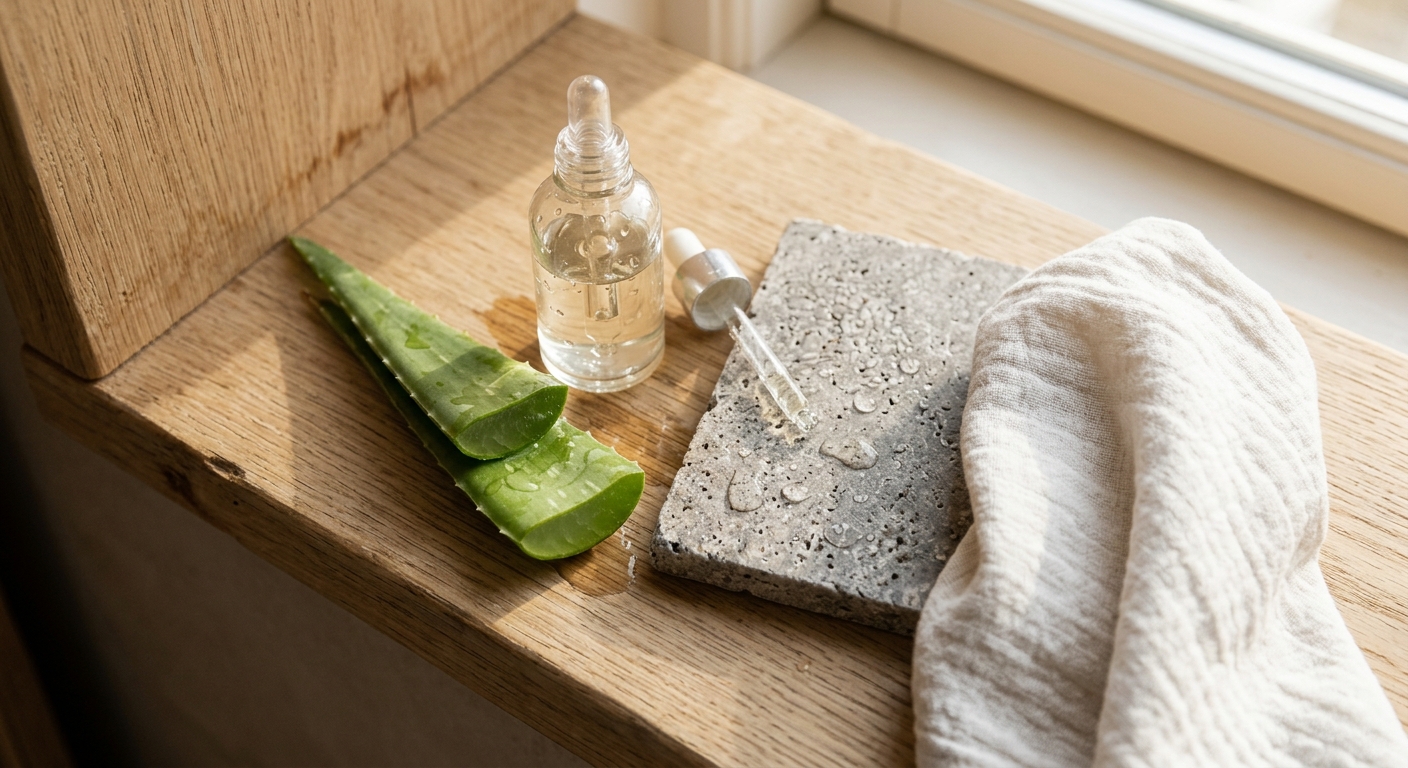
Glycerin for Skin: Why This Quietly Powerful Humectant Matters More After 40
It's in almost every moisturizer you've ever used — but most people don't know what it actually does
If you flipped over every face cream and serum in your bathroom and scanned the ingredient list, glycerin would appear on roughly nine out of ten of them. It’s not a trendy active. It doesn’t get magazine spreads. There are no influencer-led launches built around it.
And yet, in dermatologic literature, glycerin remains one of the single most studied and most clinically validated skin ingredients in existence. It’s in your moisturizer because decades of research keeps confirming it works.
For aging skin specifically — skin that produces less natural moisture, repairs its barrier more slowly, and thins as estrogen declines — understanding what glycerin actually does is worth the five minutes it takes to read this. It changes how you choose products and how you set expectations for what hydration alone can deliver.
What Glycerin Actually Is
Glycerin (also called glycerol) is a simple sugar alcohol — a small, water-loving molecule that has been used in skincare for over a century. It’s the prototypical humectant, an ingredient that draws and binds water to the surface of the skin and into the upper layers of the stratum corneum.
But the “humectant” label undersells what’s happening. Modern research has shown that glycerin does at least four distinct things in skin [1]:
- Binds water in the stratum corneum, increasing hydration that you can measure with corneometry
- Reduces transepidermal water loss by stabilizing skin lipid structures
- Accelerates barrier repair after disruption
- Modulates the activity of corneocyte enzymes that affect desquamation — the natural shedding of dead skin cells
That last property is why your skin feels smoother, not just plumper, with sustained glycerin use. Healthy desquamation prevents the dull, flaky surface that is one of the hallmarks of mature skin.
The Aquaporin-3 Connection
Here’s what makes glycerin biologically different from most humectants: your skin has a dedicated transport system for it.
Aquaporin-3 (AQP3) is a transmembrane protein expressed by keratinocytes — the cells that build your epidermis. AQP3 actively transports water and glycerol from the deeper skin layers up toward the surface [2]. In experimental models where AQP3 is knocked out, skin develops measurably reduced elasticity, poor hydration, and impaired barrier repair. Replacing the missing glycerol — but not other humectants — restores normal function [3].
What this means in practical terms is that glycerin isn’t simply layered on the skin like an occlusive. It integrates into the skin’s own hydration machinery. This is one reason it produces durable, cumulative effects rather than just temporary surface moisture.
Here’s what makes glycerin biologically different from most humectants: your skin has a dedicated transport system for it.
How Glycerin Compares to Hyaluronic Acid
Hyaluronic acid gets most of the marketing attention these days, but in head-to-head clinical comparisons glycerin has held its ground remarkably well. We take that comparison further, including how each behaves in dry indoor air, in hyaluronic acid vs glycerin.
A frequently cited evaluation showed that 10% glycerin produced longer-lasting hydration than 10% propylene glycol or 10% urea over a 3-hour period. In separate studies, glycerin has matched or outperformed hyaluronic acid for stratum corneum hydration metrics over multi-week treatment periods.
Their mechanisms differ:
- Hyaluronic acid is a much larger molecule that binds water primarily at the skin surface and the upper stratum corneum. It plumps the surface visibly within minutes.
- Glycerin is small enough to penetrate deeper layers and integrate into the AQP3 system. It builds hydration cumulatively over time.
The two ingredients are complementary, not competing. Most well-formulated moisturizers contain both.
Why Aging Skin Needs More Glycerin Than Younger Skin
Three changes in mature skin make glycerin specifically valuable after 40:
1. Decreased natural moisturizing factor (NMF). Aging skin produces less of the natural amino acid mixture that holds water in the stratum corneum. Topical humectants partially compensate.
2. Slower barrier repair. Mature skin takes longer to recover from any kind of disruption — over-cleansing, exfoliation, retinoid use, environmental damage. Glycerin has been shown to accelerate barrier repair after acute disruption [4]. This translates into shorter recovery from skin barrier compromise events that become more common with age.
3. Estrogen-driven dryness. Postmenopausal skin loses ceramides and other barrier lipids alongside the broader effects of estrogen decline. Glycerin doesn’t replace those lipids, but it works synergistically with them — improving the function of even a depleted barrier.
This is why nearly every formulation marketed to women over 50 leans heavily on glycerin even when it isn’t the headline ingredient.
The Limit That Marketing Won’t Tell You
Here’s the honest part. Glycerin is excellent at what it does, but what it does isn’t structural.
A frequently cited evaluation showed that 10% glycerin produced longer-lasting hydration than 10% propylene glycol or 10% urea over a 3-hour period.
Mature skin’s most visible problems — wrinkles, sagging, loss of firmness, thinning — are not hydration problems. They are problems of collagen breakdown, elastin damage, and dermal thinning. No amount of glycerin will rebuild collagen. No humectant on the market will reverse photoaging.
Hydration makes existing skin look better. Plumper. Smoother. Less crepey for the day. But the underlying architecture — the dermal matrix that determines whether your skin holds its shape over decades — needs different inputs entirely.
This is the trap many women over 40 fall into: they double-down on hydration when they actually need to add an active that addresses structural decline. A glycerin-rich moisturizer is necessary. It is not sufficient.
Pairing Glycerin With What Aging Skin Actually Needs
The clinical evidence is unambiguous about which active addresses dermal architecture: retinoids. A comprehensive review of retinoid clinical trials found that topical retinoids stimulate procollagen synthesis, increase epidermal thickness, normalize cell turnover, and visibly improve fine wrinkles, pigmentation, and skin texture with consistent use [5].
The combination matters. Retinoids work better in well-hydrated skin. Glycerin reduces the dryness and irritation that makes many people give up on retinol within weeks. The two ingredients address different layers of the same problem — hydration at the surface, remodeling in the dermis.
But conventional retinol has a known weakness: the petroleum-based vehicles and penetration enhancers used in most formulations tend to disrupt the very barrier that glycerin is helping to maintain. The result is the all-too-familiar cycle of dryness, peeling, and starting and stopping retinol.
A Cleaner Way to Combine Both
Nanoretinol takes a fundamentally different approach to delivery. The retinol is encapsulated in biomimetic lipid nanoparticles that pass through the skin barrier without disrupting it [6]. The base is a water-based gel — meaning the formulation itself is humectant-friendly. There are no harsh penetration enhancers competing with glycerin’s barrier-supporting role.
In comparative laboratory studies, this delivery system produced 232% greater collagen recovery and 73% greater elastin recovery than conventional retinol — and clinical trials showed +61% improvement in skin firmness over 56 days. The retinol concentration is just 0.2%: low enough to be gentle, but delivered efficiently enough to work.
For someone building a routine around glycerin’s hydration support, that compatibility matters. You’re not trying to undo your moisturizer with your retinol every other night.
How to Read a Glycerin Label
A few practical notes:
- Glycerin appears in the ingredient list under any of three names: glycerin, glycerol, or its INCI name. Same molecule.
- Concentration matters less than people assume. Anywhere from 3% to 10% is effective; higher concentrations can paradoxically feel sticky and may pull water from deeper skin layers in dry environments.
- Glycerin works best paired with occlusives (a thin layer of moisturizer or oil over the top in dry climates) to lock in the water it draws.
- Vegetable-derived glycerin is identical to synthetic glycerin at the molecular level. There is no skin benefit to one over the other.
The Takeaway
Glycerin is one of the few ingredients in skincare that is both genuinely effective and almost universally agreed upon. It belongs in your moisturizer, your hydrating serum, and probably your cleanser too. It pairs well with everything. It hydrates skin in ways that build cumulatively over weeks and months.
But hydration is the foundation, not the finished house. Build the foundation with glycerin and a good barrier-supporting moisturizer, then add the structural work — sunscreen, vitamin C, and a well-tolerated retinoid — that mature skin actually needs to look its best.
References
-
Fluhr JW, Darlenski R, Surber C. “Glycerol and the skin: holistic approach to its origin and functions.” British Journal of Dermatology. 2008;159(1):23-34. doi:10.1111/j.1365-2133.2008.08643.x
-
Hara-Chikuma M, Verkman AS. “Aquaporin-3 functions as a glycerol transporter in mammalian skin.” Biology of the Cell. 2005;97(7):479-486. doi:10.1042/BC20040104
-
Hara M, Ma T, Verkman AS. “Selectively reduced glycerol in skin of aquaporin-3-deficient mice may account for impaired skin hydration, elasticity and barrier recovery.” Journal of Biological Chemistry. 2002;277(48):46616-46621. doi:10.1074/jbc.M209003200
-
Fluhr JW, Gloor M, Lehmann L, et al. “Glycerol accelerates recovery of barrier function in vivo.” Acta Dermato-Venereologica. 1999;79(6):418-421. doi:10.1080/000155599750009825
-
Mukherjee S, Date A, Patravale V, et al. “Retinoids in the treatment of skin aging: an overview of clinical efficacy and safety.” Clinical Interventions in Aging. 2006;1(4):327-348. doi:10.2147/ciia.2006.1.4.327
-
North Biomedical LLC. “Nanoretinol vs. Conventional Retinol: Efficacy in Collagen and Elastin Recovery.” Clinical Study Summary, 2024. Read the study