Best Hyaluronic Acid Serum: The One Spec That Decides Whether It Works
Why molecular weight, not price or percentage, separates a serum that hydrates from one that sits there
Stand in front of the serum shelf and you will find hyaluronic acid on almost every bottle, at prices from eight dollars to a hundred and eighty. The labels are close to interchangeable. Hydrating, plumping, holds a thousand times its weight in water.
That last claim is true and almost entirely beside the point. A molecule that holds a thousand times its weight in water is only useful if it is holding that water somewhere your skin benefits from. Whether it does comes down to a single specification, and most bottles do not print it.
What hyaluronic acid is actually doing in skin
Hyaluronic acid is not a foreign ingredient being introduced to your face. It is already one of the main structural components of the dermal extracellular matrix, the gel-like medium the collagen and elastin network sits in. It binds water, and that bound water is what gives skin its turgor and resilience.
The reason it appears in anti-aging marketing is that skin loses it. A review of hyaluronic acid in skin aging describes how its content and metabolism decline with both intrinsic and extrinsic aging, reducing the skin’s water-binding capacity and contributing directly to the dryness and loss of plumpness that follows [1].
So the logic of putting it back is sound. The complication is geography. The hyaluronic acid that matters structurally lives in the dermis. A serum lands on the stratum corneum, several layers above it.
Molecular weight is the specification that matters
Hyaluronic acid is not one molecule. It is a chain, and manufacturers can make that chain almost any length they like. Chain length, expressed as molecular weight in kilodaltons, decides where the molecule can go.
Researchers used Raman micro-spectroscopy to track hyaluronic acid of different weights through human skin sections. Low molecular weight hyaluronic acid, in the 20 to 300 kilodalton range, passed through the stratum corneum and into deeper layers. High molecular weight hyaluronic acid, at 1,000 to 1,400 kilodaltons, remained largely impermeable and stayed on the surface [2].
Both do something. Surface-bound high molecular weight hyaluronic acid forms a hydrating film and reduces water loss from the top. Low molecular weight fractions get into the tissue where the hydration reads as plumpness rather than as a damp coating.
Hyaluronic acid is not a foreign ingredient being introduced to your face.
The best-built serums use a blend of several weights deliberately, so that some of the dose works at the surface and some travels. A serum listing sodium hyaluronate, hydrolyzed hyaluronic acid, and sodium acetylated hyaluronate together is usually telling you it was formulated by someone thinking about this.
What the clinical trials actually found
The molecular weight argument is not theoretical. It shows up in outcomes.
A double-blind randomized controlled trial treated elderly patients with dry, rough skin for four weeks. Low molecular weight hyaluronic acid produced significantly higher skin capacitance, the standard instrumental measure of hydration, than high molecular weight hyaluronic acid did, and both beat the vehicle control [3]. Worth noting honestly: transepidermal water loss did not differ significantly between the groups, so the gain was in water held rather than in barrier repair.
A second randomized trial put 0.1 percent hyaluronan creams spanning 50 to 2,000 kilodaltons on the periocular skin of 76 women aged 30 to 60, twice daily. Every formulation significantly improved hydration and elasticity. The 50 kilodalton version produced the greatest reduction in wrinkle depth, which the authors attributed to its superior penetration [4].
That is a real, measurable result on a real wrinkle. It is also a modest one, achieved in a thin-skinned area, and it is worth keeping the scale of it in proportion.
The humectant trap nobody warns you about
Hyaluronic acid is a humectant. Humectants pull water toward themselves, and in low humidity, some of that water can come from the deeper layers of your own skin rather than from the air.
This is why some people find a hyaluronic acid serum leaves their face tighter than before. Applied to bone-dry skin in a dry room with nothing sealed over the top, a strong humectant can work against you.
The fix is structural, not brand-dependent. Stratum corneum hydration is maintained by two systems working together: intercellular lipid lamellae of ceramides, cholesterol and fatty acids that limit water loss, and natural moisturizing factor inside the corneocytes that binds water osmotically [5]. A humectant supports the second system and does nothing for the first. It needs something over it.
Humectants pull water toward themselves, and in low humidity, some of that water can come from the deeper layers of your own skin rather than from the air.
Apply hyaluronic acid to damp skin, then seal it with a moisturizer containing lipids. Our guide to repairing the skin barrier covers what that layer needs to contain, and the broader case for the ingredient is in our hyaluronic acid benefits guide.
Buying rules that survive contact with the shelf
Look for a stated blend of molecular weights. If the brand cannot tell you what weights are in the bottle, you are buying on faith. Multiple hyaluronate forms on the ingredient list is the next best signal.
Ignore the percentage. Concentrations above roughly two percent do not perform better and get progressively stickier. The trial that moved wrinkle depth used 0.1 percent.
Buy the shortest ingredient list you can. Hyaluronic acid is water-soluble and cheap to formulate. A long list usually means you are paying for marketing botanicals riding along.
Price is close to meaningless here. The raw material cost difference between an eight-dollar and a hundred-dollar hyaluronic acid serum is negligible. Formulation intelligence is what you are paying for, and it correlates poorly with price.
Always seal it. A hyaluronic acid serum used without a moisturizer over it is an incomplete step, particularly in winter or in air conditioning.
Where hyaluronic acid runs out of road
Here is the part the category does not advertise. Hyaluronic acid manages water. It does not build anything.
Everything above changes how much water your skin is holding, and hydrated skin genuinely looks better. But the structural loss underneath, the thinning collagen network that makes skin sit differently on the face, is untouched by a humectant. If your serum makes skin look plump in the morning and flat again by evening, that is the distinction announcing itself.
Rebuilding that network is a different job with a different molecule. In a randomized, double-blind, vehicle-controlled trial in naturally aged skin, topical retinol significantly increased glycosaminoglycan expression and procollagen I immunostaining compared with vehicle, and improved fine wrinkling scores by 1.64 points against 0.08 for vehicle [6]. Retinol is the most studied collagen-building topical available, which is why our guide to pairing retinol and hyaluronic acid treats them as complementary rather than competing, and why peptide serums occupy a similar structural tier.
The obstacle with retinol has always been delivery. It penetrates the epithelial barrier poorly, and many formulations use chemicals and petroleum derivatives that break that barrier down to get through, which is where the redness and peeling begin.
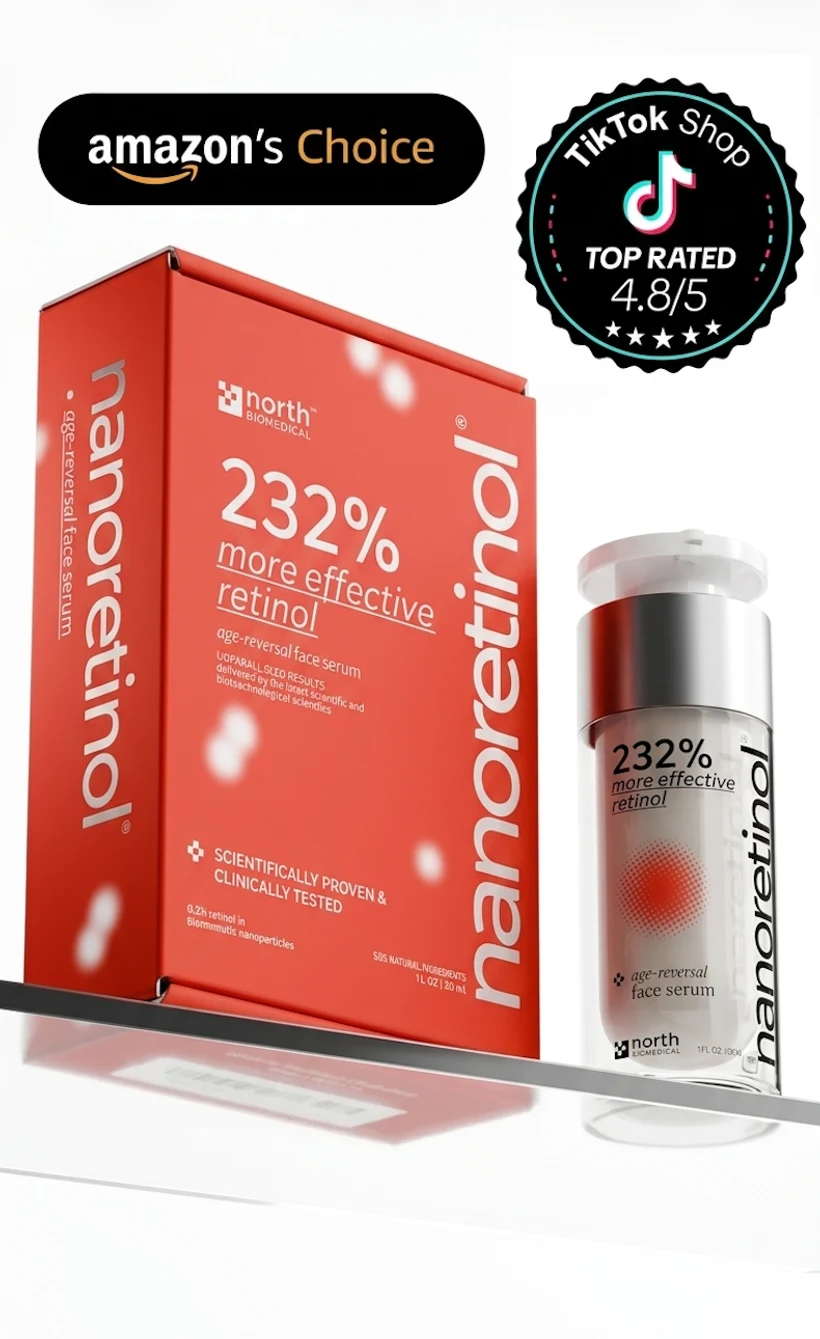
Nanoretinol was designed around that obstacle. It encapsulates 0.2 percent retinol in biomimetic lipid nanoparticles the skin recognizes as self and lets through intact, so nothing has to be damaged to deliver the active. In North Biomedical’s study it proved 232 percent more effective than conventional retinol at collagen recovery and 73 percent more effective at elastin recovery, with drastically reduced cytotoxicity. It is water-based, suits sensitive skin, and is safe on the eye contour.
Getting the pairing right
Buy hyaluronic acid for what it does well. It is inexpensive, reliably hydrating, tolerated by nearly everyone, and it makes the surface look and feel better within days.
Then be clear about what it is not doing, and put the structural work on something built for it. The two occupy different layers and different timescales, which is exactly why the combination outperforms either one bought alone.
References
- Papakonstantinou E, Roth M, Karakiulakis G. “Hyaluronic Acid: A Key Molecule in Skin Aging.” Dermato-Endocrinology. 2012;4(3):253-258. doi:10.4161/derm.21923
- Essendoubi M, Gobinet C, Reynaud R, Angiboust JF, Manfait M, Piot O. “Human Skin Penetration of Hyaluronic Acid of Different Molecular Weights as Probed by Raman Spectroscopy.” Skin Research and Technology. 2016;22(1):55-62. doi:10.1111/srt.12228
- Muhammad P, Novianto E, Setyorini M, Legiawati L, Yusharyahya SN, Menaldi SL, Budianti WK. “Effectiveness of Topical Hyaluronic Acid of Different Molecular Weights in Xerosis Cutis Treatment in Elderly: A Double-Blind, Randomized Controlled Trial.” Archives of Dermatological Research. 2024;316(6):329. doi:10.1007/s00403-024-03003-2
- Pavicic T, Gauglitz GG, Lersch P, Schwach-Abdellaoui K, Malle B, Korting HC, Farwick M. “Efficacy of Cream-Based Novel Formulations of Hyaluronic Acid of Different Molecular Weights in Anti-Wrinkle Treatment.” Journal of Drugs in Dermatology. 2011;10(9):990-1000. PMID: 22052267
- Rawlings AV, Harding CR. “Moisturization and Skin Barrier Function.” Dermatologic Therapy. 2004;17(Suppl 1):43-48. doi:10.1111/j.1396-0296.2004.04s1005.x
- Kafi R, Kwak HS, Schumacher WE, Cho S, Hanft VN, Hamilton TA, King AL, Neal JD, Varani J, Fisher GJ, Voorhees JJ, Kang S. “Improvement of Naturally Aged Skin with Vitamin A (Retinol).” Archives of Dermatology. 2007;143(5):606-612. doi:10.1001/archderm.143.5.606