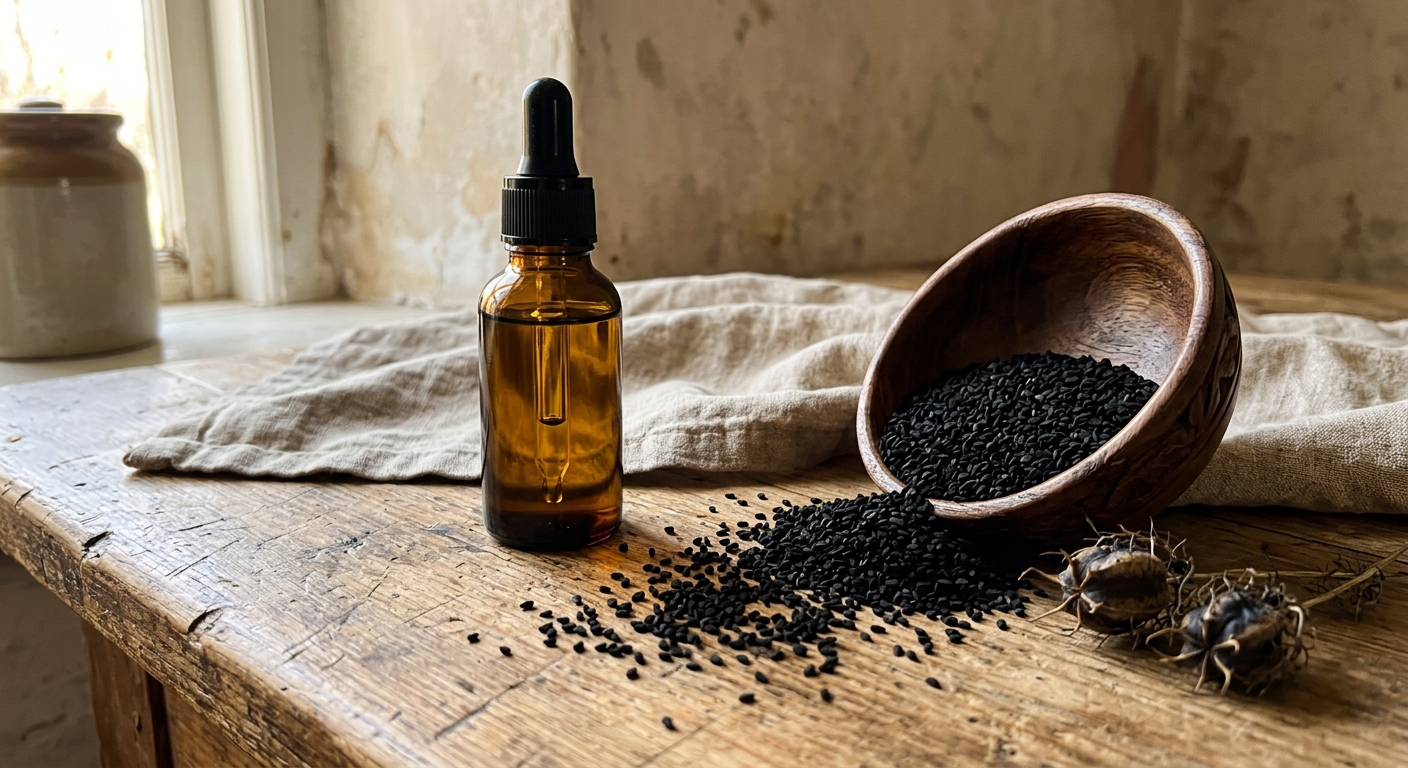
Black Seed Oil for Skin: What Nigella Sativa Can and Cannot Do for Aging Skin
The evidence behind thymoquinone, where it genuinely performs, and the one thing it was never going to fix
Black seed oil arrives with more folklore attached than almost any ingredient in a modern bathroom cabinet. Pressed from the seeds of Nigella sativa, it has been used across North Africa, the Middle East, and South Asia for well over a thousand years, and it carries a reputation — “a remedy for everything but death” — that no cosmetic ingredient could possibly live up to.
What makes it worth taking seriously anyway is that unlike most heritage botanicals, it has been put through actual randomized controlled trials. The results are genuinely good in one direction and conspicuously silent in another, and the gap between those two things is the most useful thing you can know before buying a bottle.
What Is Actually in the Bottle
Cold-pressed Nigella sativa oil is roughly half linoleic acid, with oleic acid making up much of the remainder. That fatty acid profile matters: linoleic acid is a precursor to ceramides, the lipids that hold the outermost layer of skin together and keep water in.
The signature compound, though, is thymoquinone — the constituent responsible for the oil’s sharp, peppery smell and for most of its documented biological activity. Thymoquinone is a potent antioxidant and anti-inflammatory molecule, and it is the reason black seed oil behaves differently from a generic seed oil.
Where the Evidence Is Strong: Inflammation
The best single piece of clinical evidence is a randomized, double-blinded trial in hand eczema that pitted topical Nigella against betamethasone — a genuine prescription corticosteroid — and against a plain emollient [1]. Patients applied their assigned treatment twice daily for four weeks, with severity and quality-of-life scored at baseline, day 14, and day 28.
The result: Nigella performed comparably to betamethasone in reducing severity and improving quality of life. A seed oil matching a topical steroid is not a result anyone expected, and it is not the kind of finding that shows up by accident in a blinded design.
A seed oil matching a topical steroid is not a result anyone expected, and it is not the kind of finding that shows up by accident in a blinded design.
A 2022 systematic review and meta-analysis pooled 14 randomized controlled trials covering 1,159 patients across a range of inflammatory skin conditions and found an odds ratio of 4.59 favoring topical Nigella sativa formulations (95% CI: 2.02-10.39) [2]. The authors were appropriately cautious — trial quality and formulations varied considerably — but the direction of effect is consistent.
The mechanism is well characterized. Thymoquinone suppresses NF-κB activation and reduces pro-inflammatory mediators including IL-1, IL-6, and TNF-α, while enhancing cytoprotective protein expression and keeping reactive oxygen species at non-toxic levels in healing tissue [3]. It also promotes fibroblast proliferation and angiogenesis in wound models.
Where the Evidence Is Weaker: Antioxidant Claims
Black seed oil is marketed heavily on antioxidant capacity, and here the picture is more mixed than the marketing suggests.
A meta-analysis of five randomized controlled trials in 293 participants found that Nigella sativa supplementation significantly raised superoxide dismutase — one of the body’s own antioxidant enzymes — by a weighted mean difference of 48.19 units/mL [4]. But the same analysis found no significant reduction in malondialdehyde, a standard marker of lipid peroxidation, and no significant increase in total antioxidant capacity.
So: it appears to boost one specific enzymatic defense while failing to move the broader oxidative-stress needle. That is a real effect, but it is narrower than “powerful antioxidant” implies. It is also worth noting those trials measured oral supplementation, not topical application to skin.
The Barrier Benefit Is Real
Where black seed oil is quietly reliable is as an occlusive, barrier-supporting facial oil. A review of topical plant oils in dermatology documents that oils rich in linoleic acid support barrier repair and reduce transepidermal water loss, while oils dominated by oleic acid can, in some contexts, do the opposite [5]. Black seed oil’s linoleic-heavy profile puts it on the favorable side of that divide.
The formulation runs at just 0.2% retinol in a water-based, 99% natural base — a low concentration that works precisely because delivery, not dose, was always the bottleneck.
If your skin is reactive, tight, or barrier-damaged — the state a lot of people end up in after over-exfoliating or over-treating — a linoleic-rich oil with a genuinely anti-inflammatory active is a sensible thing to reach for. It belongs in the same mental category as rosehip oil: a repair-and-calm ingredient, not a transformation ingredient.
The Thing It Doesn’t Do
Now the silence. Search the clinical literature on Nigella sativa for wrinkle depth, dermal collagen density, skin firmness, or elasticity in human skin, and you will find essentially nothing. The fibroblast and collagen findings that do exist come from wound-healing models — acute injury repair, which is a different biological process from reversing the slow, decades-long collagen decline of chronological and sun-induced aging.
This is not a knock on the ingredient. It is a category boundary. Botanical oils are excellent at calming, conditioning, and supporting the barrier. Structural remodeling of the dermis requires something that talks directly to fibroblast gene expression, and no seed oil does that.
For that specific job, retinoids remain the most rigorously validated tool in dermatology. In a randomized, double-blind, vehicle-controlled trial in naturally aged skin — participants averaging 87 years old — 0.4% retinol applied up to three times weekly for 24 weeks produced significantly increased glycosaminoglycan levels and collagen production against vehicle control, with visible reduction in fine wrinkling [6]. Aged skin had not lost the ability to rebuild. It had simply stopped being told to.
Closing the Delivery Gap
The complication with retinol has never been whether it works. It is whether enough of it reaches living cells without wrecking the barrier that black seed oil is so good at protecting.
Most conventional retinol formulations rely on solvents and penetration enhancers that increase lipid mobility in the stratum corneum — effectively prying the barrier open to push retinol through. It is why retinol has a reputation for burning, redness, and peeling, and why so many people abandon it in the first month. Using a barrier-repairing oil at night while a barrier-disrupting retinol undoes that work is a strangely common routine.
Nanoretinol resolves the contradiction by changing the delivery mechanism rather than the dose. Retinol is encapsulated inside biomimetic lipid nanoparticles that the skin reads as “self” and admits through the epithelial barrier intact — the same nanoparticle delivery principle used in modern pharmaceutical medicine. In North Biomedical’s clinical study, the encapsulated form was 232% more effective in collagen recovery and 73% more effective in elastin recovery than conventional retinol, and 56 days of clinical use produced a 61% increase in skin firmness and a 56% increase in elasticity. The formulation runs at just 0.2% retinol in a water-based, 99% natural base — a low concentration that works precisely because delivery, not dose, was always the bottleneck.
How to Use It Well
Buy cold-pressed and unrefined, in dark glass, and expect a strong peppery smell — that is the thymoquinone, and its absence suggests a degraded or heavily processed product. Patch test on the inner forearm for a few days; Nigella sativa has a documented, if uncommon, contact-allergy potential. Apply a few drops as the last step at night, over your treatment products rather than under them.
Used that way, black seed oil earns its place: it calms, it conditions, it repairs the barrier, and it has better trial evidence behind it than nine-tenths of the botanicals on the shelf. Just do not ask it to rebuild your collagen. That is a different tool’s job, and it always was.
References
- Yousefi M, Barikbin B, Kamalinejad M, et al. “Comparison of therapeutic effect of topical Nigella with Betamethasone and Eucerin in hand eczema.” Journal of the European Academy of Dermatology and Venereology. 2013;27(12):1498-1504. PMID: 23198836
- Nasiri N, Ilaghi Nezhad M, Sharififar F, Khazaneha M, Najafzadeh MJ, Mohamadi N. “The Therapeutic Effects of Nigella sativa on Skin Disease: A Systematic Review and Meta-Analysis of Randomized Controlled Trials.” Evidence-Based Complementary and Alternative Medicine. 2022;2022:7993579. doi:10.1155/2022/7993579
- Kmail A, Said O, Saad B. “How Thymoquinone from Nigella sativa Accelerates Wound Healing through Multiple Mechanisms and Targets.” Current Issues in Molecular Biology. 2023;45(11):9039-9059. doi:10.3390/cimb45110567
- Ardiana M, Pikir BS, Santoso A, Hermawan HO, Al-Farabi MJ. “Effect of Nigella sativa Supplementation on Oxidative Stress and Antioxidant Parameters: A Meta-Analysis of Randomized Controlled Trials.” The Scientific World Journal. 2020;2020:2390706. doi:10.1155/2020/2390706
- Lin TK, Zhong L, Santiago JL. “Anti-Inflammatory and Skin Barrier Repair Effects of Topical Application of Some Plant Oils.” International Journal of Molecular Sciences. 2017;19(1):70. doi:10.3390/ijms19010070
- Kafi R, Kwak HSR, Schumacher WE, et al. “Improvement of Naturally Aged Skin With Vitamin A (Retinol).” Archives of Dermatology. 2007;143(5):606-612. doi:10.1001/archderm.143.5.606