Dark Spots on Arms: What Causes Them and How to Fade Them for Good
The same UV damage quietly accumulating on your forearms is responsible for most of what you're seeing — here's the science behind it
Most people’s skincare attention stops at the jawline. SPF on the face, retinol at night, vitamin C in the morning — and then sleeves and sunscreen-free arms head out into eight hours of cumulative UV exposure.
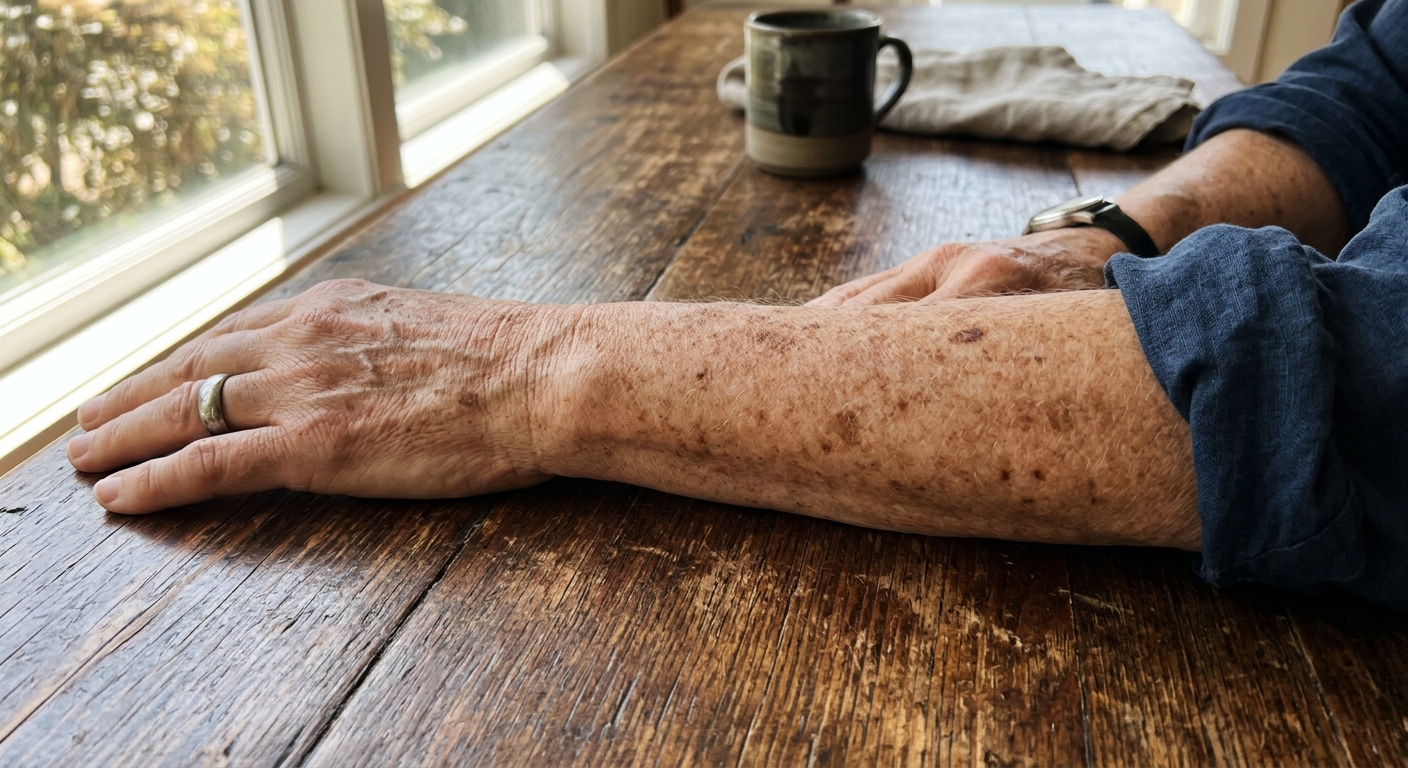
The dark spots that show up on forearms and upper arms in your 40s and 50s are the receipt for that neglect. They’re mostly solar lentigines — UV-induced melanin accumulations that form over years of accumulated photodamage. And the same science that helps fade them on your face works just as well below the collar.
What’s Actually Causing Dark Spots on Your Arms
The most common culprits, in roughly descending order of frequency:
Solar lentigines (age spots / liver spots) account for the majority of dark spots on sun-exposed arms. They’re flat, uniformly pigmented, and range from tan to dark brown. Unlike freckles, which fade in winter, solar lentigines persist year-round. They reflect cumulative UV exposure — the decades-long buildup of photodamage finally becoming visible [1].
Post-inflammatory hyperpigmentation (PIH) follows any skin injury or irritation — a scratch, insect bite, minor burn, or contact dermatitis. The inflammatory response triggers excess melanin production that can linger long after the original injury has healed.
Hormonal hyperpigmentation can affect the arms, though it’s more common on the face. Estrogen and progesterone amplify UV-induced melanin production — which is why spots that seemed stable may deepen during pregnancy or perimenopause [2].
Actinic keratoses are rougher, scaly patches that can resemble dark spots but are caused by precancerous UV damage. If a dark spot on your arm feels rough, has irregular borders, or bleeds spontaneously, see a dermatologist rather than treating it with skincare products.
The dark spots that show up on forearms and upper arms in your 40s and 50s are the receipt for that neglect.
The Mechanism: Why UV Turns Skin Permanently Brown
UV radiation sets off a biochemical cascade in the skin. UVB activates p53, which triggers keratinocytes to release melanocyte-stimulating hormone (MSH). MSH binds to melanocytes and upregulates tyrosinase — the enzyme that converts tyrosine into melanin. The melanin gets packaged into melanosomes and transferred to neighboring keratinocytes, where it accumulates and becomes visible as pigmentation [1].
In young skin, this tanning response is relatively temporary. But with repeated UV exposure over years, something shifts. Melanocyte behavior becomes dysregulated in specific areas. The melanin production in those areas keeps running at an elevated baseline, even without fresh UV stimulation. The result is a persistent, localized darkening — a solar lentigo — that reflects permanently altered melanocyte activity rather than a temporary tan [3].
This is why photoprotection is the single most effective way to prevent new spots: if UV can’t trigger the cascade, the dysregulation can’t progress.
Why Arms Are Often More Affected Than People Realize
People are diligent about facial SPF. Arms get much less attention. A pair of short sleeves, a day of driving (UV penetrates car glass), or a few hours in the garden without reapplication — these exposures feel minor individually. Accumulated over twenty years, they produce measurable photodamage.
The dorsal (outer) forearm is particularly vulnerable. It lacks the sebaceous protection of facial skin, is chronically exposed during normal activities, and tends to receive SPF less consistently than the face. Sun damage presents visibly here earlier than most people expect.
What Actually Works to Fade Them
Retinoids — the evidence-based anchor
Topical retinoids have more evidence behind them for hyperpigmentation than almost any other ingredient class [3]. They work through two mechanisms simultaneously: they accelerate epidermal cell turnover, which physically pushes hyperpigmented cells toward the surface to shed; and they inhibit UV-stimulated tyrosinase activity, reducing the melanin production that created the spot in the first place.
In clinical trials, topical tretinoin has demonstrated significant improvement in solar lentigines and actinic pigmentation on treated areas [4]. The concentration required is generally lower than for facial anti-aging — and for people with sensitive skin, that matters.
Vitamin C (L-ascorbic acid): Inhibits tyrosinase and neutralizes the free radicals that drive post-UV melanin production.
Conventional retinol applied to arms can be irritating, particularly on drier body skin. Formulations that deliver retinol in a stabilized, lower-irritation vehicle — like Nanoretinol, which uses lipid nanoparticle encapsulation — can achieve meaningful cell turnover acceleration at 0.2% without the barrier disruption that higher-concentration formulas often cause. In clinical testing, Nanoretinol showed +232% greater efficacy in collagen recovery versus conventional retinol at the same concentration, and significantly lower cytotoxicity, which also translates to gentler outcomes on thinner, drier body skin.
Brightening agents that complement retinoids
For existing dark spots, the fastest results come from combining retinoids with a dedicated brightening agent:
- Vitamin C (L-ascorbic acid): Inhibits tyrosinase and neutralizes the free radicals that drive post-UV melanin production. Best applied in the morning before SPF. Vitamin C serum applied to arms follows the same rules as on the face.
- Tranexamic acid: One of the most effective newer brightening actives. It interrupts the keratinocyte-to-melanocyte signaling pathway, cutting melanin production upstream. Learn more about how tranexamic acid works on dark spots.
- Azelaic acid: Both brightening and anti-inflammatory, useful for PIH in particular.
- Alpha arbutin: Tyrosinase inhibitor with a gentler profile for sensitive skin.
- Kojic acid: A tyrosinase inhibitor made by fermenting rice, and a leave-on kojic acid lotion is the practical way to cover a whole arm.
These work best as a system: retinoid for cell turnover + brightener for melanin inhibition + SPF to prevent new damage.
Alpha hydroxy acids for texture and turnover
Glycolic acid and lactic acid accelerate surface exfoliation independently of the retinol pathway. On the arms, where skin tends to be drier and less regularly exfoliated than the face, a weekly AHA treatment can dramatically improve the pace at which treated skin sheds hyperpigmented cells. The benefits of glycolic acid for uneven skin tone apply beyond the face.
Sunscreen — essential, not optional
SPF is both treatment and prevention. Without it, any brightening progress made overnight gets partially undone by the next day’s UV exposure. A broad-spectrum SPF 30 or higher applied to the arms daily — including on cloudy days, through car windows, and during incidental outdoor time — is the foundation of any dark spot treatment protocol.
How Long to Expect
Solar lentigines on the arms respond more slowly than facial spots for a few reasons: arm skin is thicker, receives retinol less often, and is harder to apply products to consistently. Realistic timelines:
- Brightening actives (vitamin C, tranexamic acid): 8–12 weeks for visible lightening
- Retinoids: 12–16 weeks for meaningful improvement
- Combined approach with consistent SPF: 4–6 months for significant fading in most cases
Consistency matters more than any single product. A treatment plan for uneven skin tone applied to the face will work on the arms too — it just takes longer.
What Won’t Work
- Lemon juice: Mildly acidic but photosensitizing. Can make spots worse with UV exposure.
- Scrubbing: Physical exfoliation accelerates shedding but doesn’t address melanin production.
- Single-ingredient approaches alone: You need turnover + inhibition + protection working together.
The Honest Bottom Line
Dark spots on arms are among the most correctable signs of skin aging. The mechanism is well understood — UV-triggered melanin dysregulation — and the tools that interrupt it are well studied. Retinoids, tyrosinase inhibitors, AHAs, and consistent SPF, applied with the same discipline people bring to facial skincare, will produce meaningful results.
The arms have just been waiting for someone to pay attention.
References
- Gilchrest BA, Park HY, Eller MS, Yaar M. “Mechanisms of ultraviolet light-induced pigmentation.” Photochemistry and Photobiology. 1996;63(1):1-10. doi:10.1111/j.1751-1097.1996.tb02988.x
- Cario M. “How hormones may modulate human skin pigmentation in melasma: An in vitro perspective.” Experimental Dermatology. 2019;28(6):709-18. doi:10.1111/exd.13915
- Kang HY, Valerio L, Bahadoran P, Ortonne JP. “The role of topical retinoids in the treatment of pigmentary disorders: an evidence-based review.” American Journal of Clinical Dermatology. 2009;10(4):251-60. doi:10.2165/00128071-200910040-00005
- Fleischer AB Jr, Schwartzel EH, Colby SI, Altman DJ. “The combination of 2% 4-hydroxyanisole (Mequinol) and 0.01% tretinoin is effective in improving the appearance of solar lentigines and related hyperpigmented lesions in two double-blind multicenter clinical studies.” Journal of the American Academy of Dermatology. 2000;42(3):459-67. doi:10.1016/s0190-9622(00)90219-6
- Cameli N, Abril E, Agozzino M, Mariano M. “Clinical and instrumental evaluation of the efficacy of a new depigmenting agent containing a combination of a retinoid, a phenolic agent and an antioxidant for the treatment of solar lentigines.” Dermatology. 2015;230(4):360-6. doi:10.1159/000379746