Coconut Oil for Skin: What It's Great For, and Where It Falls Short on Aging
It's the internet's favorite natural moisturizer — but the question for skin over 40 is whether it does anything for wrinkles. Mostly, it doesn't.
Few ingredients enjoy a glow quite like coconut oil. It sits in kitchen cupboards and bathroom shelves, recommended for everything from dry shins to makeup removal to overnight “anti-aging” masks. For a lot of women over 40, the appeal is obvious: it is cheap, it is natural, and it smells like a vacation. The real question — the one the glowing reviews rarely answer honestly — is whether a jar of coconut oil does anything for the lines, the laxity, and the dullness that bring most of us to the skincare aisle in the first place.
The short answer is that coconut oil is a genuinely good moisturizer and a poor anti-aging treatment. Those two things are not in conflict, and understanding why is the whole point.
What’s Actually in the Jar
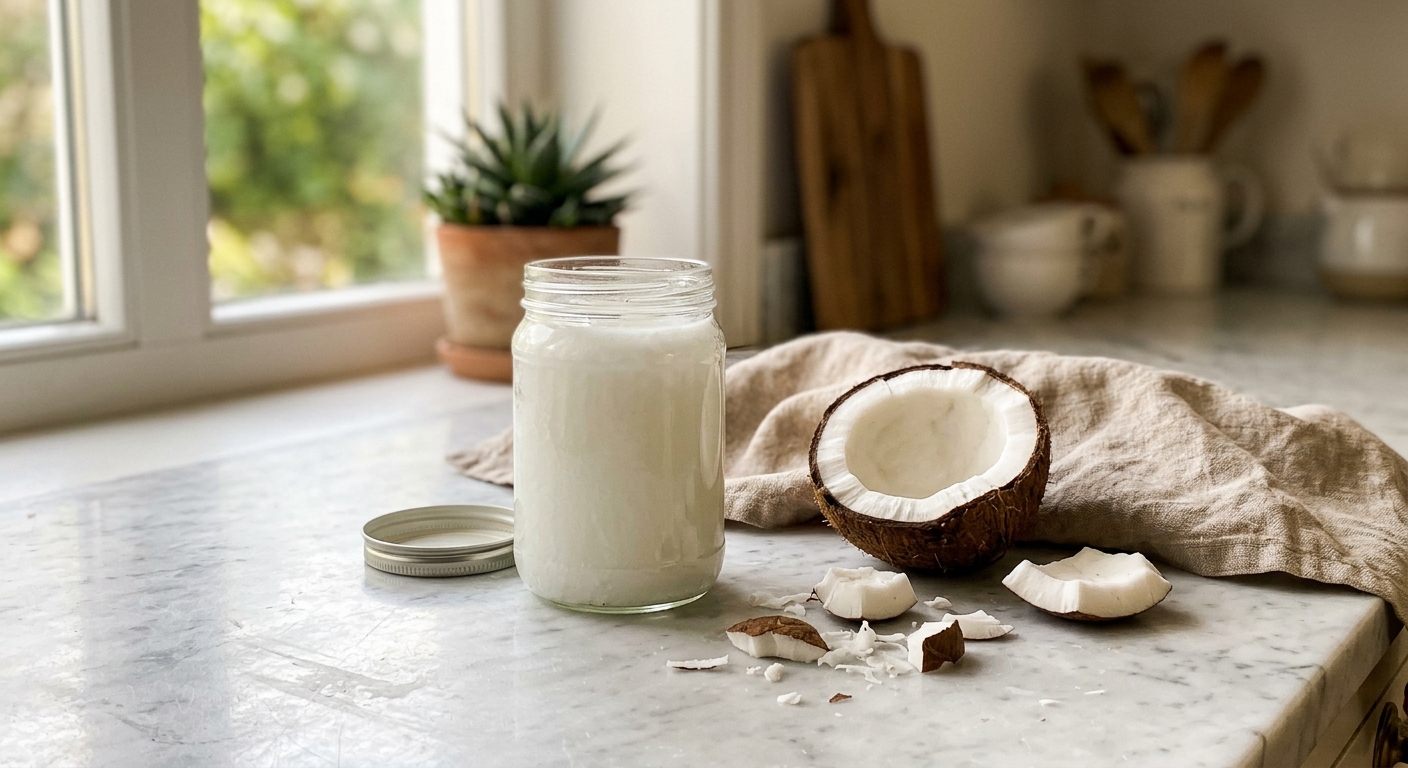
Coconut oil is roughly half lauric acid, a medium-chain saturated fatty acid, with smaller amounts of myristic, caprylic, and other fats. That composition is reviewed in the dermatology literature on topical plant oils, which catalogs coconut oil among the occlusive, fatty-acid-rich oils used on skin [4]. Two features follow from that chemistry. First, it is highly occlusive — it forms a film on the surface that slows water from evaporating out of the skin. Second, lauric acid has notable antimicrobial activity, which turns out to matter more than you would expect.
Where Coconut Oil Genuinely Shines
If your complaint is dry, tight, flaky skin, coconut oil earns its reputation. In a randomized, double-blind trial comparing extra-virgin coconut oil against mineral oil for mild-to-moderate dry skin (xerosis), coconut oil improved skin hydration and surface lipid levels at least as well as mineral oil — the long-standing benchmark moisturizer — and did so safely [1]. For everyday dryness on the body, that is a real, evidence-backed result. (If chronic dryness is your main issue, our guide to dry skin on the face covers the full toolkit.)
If you have ever woken up with new bumps after an oil “treatment,” this is why.
The barrier data is even more striking in compromised skin. In a randomized, double-blind trial in children with atopic dermatitis, topical virgin coconut oil cut the severity score by about 68% and dramatically reduced transepidermal water loss — the technical measure of a leaky barrier — outperforming mineral oil [2]. And that antimicrobial property is not just trivia: in adults with atopic dermatitis, coconut oil markedly reduced colonization by Staphylococcus aureus, the bacterium that drives eczema flares, where virgin olive oil did not [3].
So as a body moisturizer, a barrier supporter, and a soothing layer for irritated, compromised skin, coconut oil is a legitimately good tool.
The Comedogenic Catch
Here is the first place enthusiasm runs ahead of the evidence. Coconut oil is widely considered comedogenic — prone to clogging pores — precisely because it is so occlusive and rich in fatty acids. For skin that is oily or acne-prone, slathering it on the face is a reliable way to trade dry patches for breakouts. The same film that locks moisture in also traps dead cells and oil behind it. On the body this rarely matters; on the face, for many people, it does. If you have ever woken up with new bumps after an oil “treatment,” this is why.
What Coconut Oil Does Not Do
Now the part the anti-aging claims gloss over. There is no credible evidence that coconut oil builds collagen, reverses sun damage, or smooths wrinkles. And mechanistically, you would not expect it to.
There is no credible evidence that coconut oil builds collagen, reverses sun damage, or smooths wrinkles.
Wrinkles, crepiness, and laxity are not surface-dryness problems — they are structural. They come from the slow breakdown and under-production of collagen and elastin in the deeper dermis, accelerated by years of ultraviolet exposure. Coconut oil is an occlusive that works at the very top of the skin: it softens, it smooths the look of fine dehydration lines temporarily, and it makes skin feel supple for a few hours. But it does not penetrate to where collagen is made, and it carries no signal to tell aging fibroblasts to get back to work.
This is the crucial distinction for anyone over 40. A moisturizer can make lined skin look better for the afternoon by plumping the surface with water it has trapped. That is real, and it is worth something. But it is cosmetic and temporary — wash it off, and the underlying architecture is exactly as it was. Confusing “feels softer” with “is younger” is the single most common mistake in natural skincare.
What Actually Changes the Structure
If the goal is to genuinely improve aged skin rather than just coat it, the evidence points overwhelmingly to one ingredient class: the retinoids. Unlike an occlusive oil, vitamin A derivatives are signaling molecules. They reach the living layers of the skin and instruct fibroblasts to rebuild. Prescription tretinoin has been shown to restore collagen formation in photodamaged skin [5], and even gentle over-the-counter retinol increases collagen and water-binding molecules in aged skin while visibly softening fine lines, as a vehicle-controlled trial demonstrated even in very mature skin [6]. That is structural change, not a surface film — the difference between repairing the fabric and ironing it. Our overview of retinol for wrinkles goes deeper on the mechanism.
For the person drawn to coconut oil because it is natural and gentle, there is a way to keep those values without giving up real results. Nanoretinol was designed for exactly that crossover. It is a water-based, gel-light formula made from 99% natural ingredients, carrying a fully stabilized 0.2% retinol inside biomimetic lipid nanoparticles. Those particles are recognized by the skin as “self” and pass through the barrier intact — delivering the active deep enough to do its work without the harsh chemical penetration enhancers that make conventional retinol sting and peel. In North Biomedical’s clinical testing, this delivery made the encapsulated retinol 232% more effective at collagen recovery and 73% more effective at elastin recovery than conventional retinol, with firmness and elasticity gains over 56 days, and it is gentle enough for sensitive skin and the eye area. It is, in short, the thing coconut oil is mistaken for: natural, kind to the skin, and actually capable of reaching the layers where aging happens.
The Honest Takeaway
Keep the coconut oil. For dry shins, rough elbows, a frazzled barrier, and a soothing body balm, it is cheap, natural, and backed by real trials. Just do not ask it to do a job it is not built for. Softening the surface and rebuilding the structure are two different tasks, and only one of them turns back the visible signs of aging. Use coconut oil for comfort — and a well-delivered retinoid for change.
References
- Agero AL, Verallo-Rowell VM. “A randomized double-blind controlled trial comparing extra virgin coconut oil with mineral oil as a moisturizer for mild to moderate xerosis.” Dermatitis. 2004;15(3):109-116. PMID:15724344
- Evangelista MT, Abad-Casintahan F, Lopez-Villafuerte L. “The effect of topical virgin coconut oil on SCORAD index, transepidermal water loss, and skin capacitance in mild to moderate pediatric atopic dermatitis: a randomized, double-blind, clinical trial.” International Journal of Dermatology. 2014;53(1):100-108. doi:10.1111/ijd.12339
- Verallo-Rowell VM, Dillague KM, Syah-Tjundawan BS. “Novel antibacterial and emollient effects of coconut and virgin olive oils in adult atopic dermatitis.” Dermatitis. 2008;19(6):308-315. PMID:19134433
- Lin TK, Zhong L, Santiago JL. “Anti-Inflammatory and Skin Barrier Repair Effects of Topical Application of Some Plant Oils.” International Journal of Molecular Sciences. 2018;19(1):70. doi:10.3390/ijms19010070
- Griffiths CE, Russman AN, Majmudar G, Singer RS, Hamilton TA, Voorhees JJ. “Restoration of Collagen Formation in Photodamaged Human Skin by Tretinoin (Retinoic Acid).” New England Journal of Medicine. 1993;329(8):530-535. doi:10.1056/NEJM199308193290803
- Kafi R, Kwak HSR, Schumacher WE, et al. “Improvement of Naturally Aged Skin With Vitamin A (Retinol).” Archives of Dermatology. 2007;143(5):606-612. doi:10.1001/archderm.143.5.606