
Carbomer in Skincare: What It Is, Why Gels Use It, and Is It Safe?
How a tiny amount of this polymer turns water into a clear gel, what the safety reviews found, where the benzene worry came from, and why it sometimes pills
Pick up almost any clear gel in your bathroom, whether an aloe gel, a gel moisturizer, a hand sanitizer or an eye gel, and there is a good chance carbomer is on the label. It is one of the most widely used thickeners in skincare, yet most people have no idea what it is or why it is there.
This guide explains what carbomer does, why it needs a partner ingredient to work, what the safety reviews concluded, and what to make of the benzene headlines.
What Carbomer Is
Carbomer is the cosmetic name for a family of crosslinked polyacrylic acid polymers. Chemists start with acrylic acid, link it into long chains, and then tie those chains together at intervals with a crosslinking molecule [1]. The result is a fine white powder made of tiny, sponge-like particles.
You may see it listed with a number, such as carbomer 940 or 980, or under the trade name Carbopol. The numbers refer to different grades with slightly different thickness, clarity and feel. Sodium carbomer is a version that has already been partly neutralized.
Your clear gel is mostly water held in place by a polymer network that usually makes up less than 1% of the formula.
How It Turns Water Into Gel
Carbomer does not thicken water on its own. Stirred into water, the powder makes a thin, cloudy, acidic liquid. The magic happens when a formulator adds a mild base, such as triethanolamine, aminomethyl propanol or sodium hydroxide.
Your clear gel is mostly water held in place by a polymer network that usually makes up less than 1% of the formula.
Neutralizing the polymer gives each chain a negative charge. The charges repel one another, so the coiled chains swell open and lock together into a three-dimensional mesh that traps water. The cloudy liquid turns into a clear, bouncy gel within seconds.
That network has properties formulators love. Carbomer gels hold their shape in the jar but thin out when you rub them, which is why a gel looks firm and then spreads easily. Detailed rheology testing found that topical carbomer gels stay remarkably stable across temperatures and keep their texture across a pH range of 5 to 8, which covers most skincare [2]. Carbomers also thicken water and alcohol mixtures, which is why they are the standard base for hand sanitizer gels, although the grade and the neutralizer have to be matched to the alcohol content to keep the gel clear [3].
What It Does in Skincare
- Texture. It gives serums, gels and lotions body without oil, so they feel light and absorb fast.
- Stability. It keeps oil droplets, pigments and particles evenly suspended so a product does not separate.
- Clarity. It makes the crystal-clear gels that suit oily and combination skin, such as the formulas in our guide to the gel moisturizer.
- Mild cleansing bases. It thickens many clear face washes, as explained in our guide to choosing a gel cleanser.
Carbomer does not hydrate skin in the way glycerin or hyaluronic acid does. It is a structural ingredient, there to hold the formula together and deliver whatever actives it carries.
Is Carbomer Safe?
The safety picture is strong, and it comes from several directions.
Carbomer molecules are enormous, far too big to pass through healthy skin. When the European Food Safety Authority reviewed carbomer as a proposed food supplement additive in 2021, it found no evidence that carbomer is absorbed into the body or broken down there, and no concern about genetic toxicity [1].
If you have ever rubbed in a serum and watched little rolls of product form on your skin, carbomer may be part of the reason.
Carbomer is gentle enough for the eye. In a 4-week randomized study of 67 people with dry eye, carbomer-based artificial tears were tolerated as well as cellulose and mineral oil drops, and patients rated them better [4].
Allergy is rare. Dermatologists have published only isolated case reports of allergic contact dermatitis to carbomers, such as two cases described in France in 2020 [5]. For a polymer used in so many products, that is a very small number.
The Benzene Question
The main safety story around carbomer in recent years was not about the polymer itself. Older manufacturing processes used benzene as a solvent, and traces could remain in the finished powder. Benzene is a known human carcinogen, and its discovery in some hand sanitizers and sprays drew public attention to every possible source.
In December 2023, the US Food and Drug Administration issued guidance asking drug makers to assess and phase out benzene-grade carbomer. The US Pharmacopeia set a deadline for discontinuing those grades, later extended to August 1, 2026, to give manufacturers time to reformulate [6]. Modern carbomers are made in other solvents, such as ethyl acetate, so the problem was the process, not the polymer [1].
Why Carbomer Gels Sometimes Pill
If you have ever rubbed in a serum and watched little rolls of product form on your skin, carbomer may be part of the reason. Carbomer gels hold their structure best at a balanced pH and with enough water. Layer a carbomer gel under a product with a very different pH, or a high salt content, and the polymer network can collapse into flakes as the water evaporates.
The fixes are simple: use less product, let each layer settle for a minute, and avoid stacking too many gel products at once. Our guide to moisturizer pilling explains the other common culprits and how to layer around them.
Carbomer Versus Natural Thickeners
Carbomer is a synthetic polymer, and some people prefer products thickened with natural gums such as xanthan gum instead. Both approaches work. Carbomer gives more clarity and a bouncier gel at very low amounts. Xanthan gum, made by bacterial fermentation of sugar, gives a softer, slightly more fluid texture and fits formulas aiming for a high natural-ingredient content.
What This Means for Retinol Gels
Retinol is often sold as a gel because a water-based texture feels lighter and suits oily and combination skin. Our guide to retinol gel covers how gels compare with creams and serums. But the base is only part of the story. Many conventional retinol formulas rely on chemicals and petroleum derivatives that loosen the skin barrier to push retinol through, and that is a large part of why they cause redness and peeling.
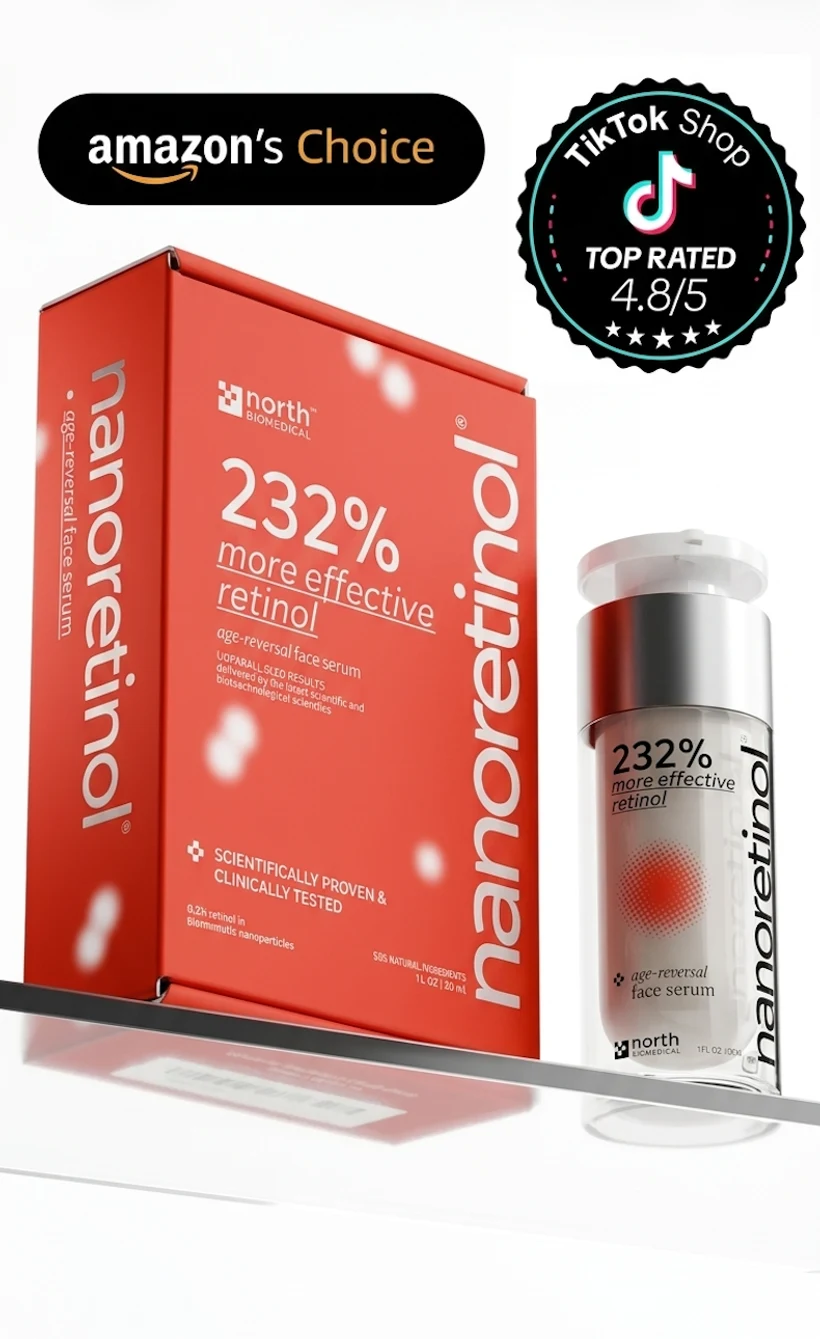
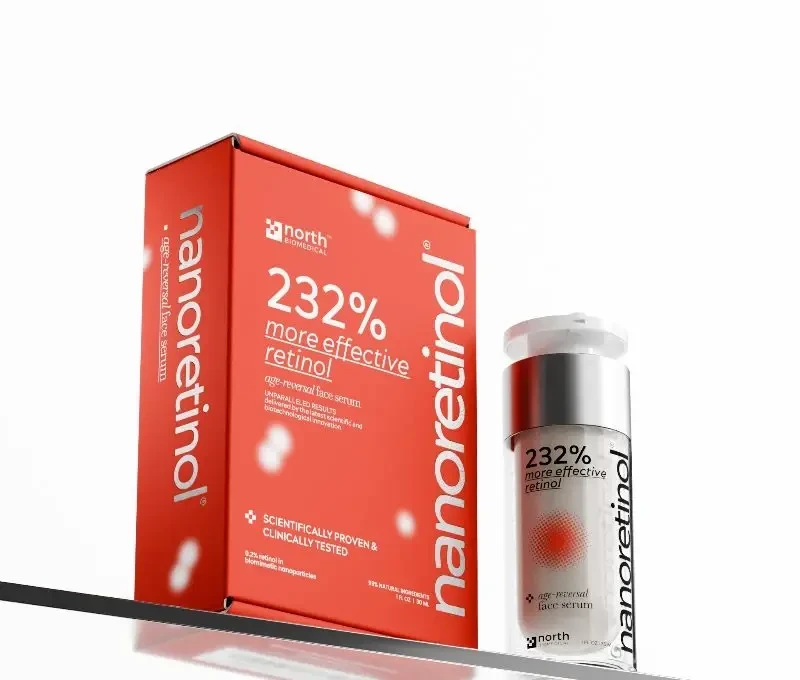
Nanoretinol is a water-based, gel-like formula thickened with xanthan gum and sodium polyacrylate, made with 99% natural ingredients. Its 0.2% retinol sits inside biomimetic lipid nanoparticles that the skin recognizes as its own, so it crosses the barrier without damaging it and leaves a smooth matte finish. In North Biomedical’s study, Nanoretinol was 232% more effective in collagen recovery and 73% more effective in elastin recovery than conventional retinol, with a 61% increase in firmness and a 56% increase in elasticity after 56 days of use [7]. It is applied once daily at night, with sunscreen the next morning.
The Short Version
Carbomer is a gentle, well-studied polymer that turns water into the clear, light gels many people prefer. It is not absorbed, it rarely causes allergy, and the benzene concern was about an outdated manufacturing process that is being phased out. If a gel pills, change how you layer it rather than blaming the ingredient, and judge any product by what it carries and how your skin responds.
References
- EFSA Panel on Food Additives and Flavourings (FAF), Younes M, Aquilina G, et al. “Safety evaluation of crosslinked polyacrylic acid polymers (carbomer) as a new food additive.” EFSA Journal. 2021;19(8):e06693. doi:10.2903/j.efsa.2021.6693
- Islam MT, Rodríguez-Hornedo N, Ciotti S, Ackermann C. “Rheological characterization of topical carbomer gels neutralized to different pH.” Pharmaceutical Research. 2004;21(7):1192-1199. doi:10.1023/b:pham.0000033006.11619.07
- Berardi A, Perinelli DR, Bisharat L, et al. “Factors affecting the rheological behaviour of carbomer dispersions in hydroalcoholic medium: Towards the optimization of hand sanitiser gel formulations.” International Journal of Pharmaceutics. 2022;616:121503. doi:10.1016/j.ijpharm.2022.121503
- Wang IJ, Lin IC, Hou YC, Hu FR. “A comparison of the effect of carbomer-, cellulose- and mineral oil-based artificial tear formulations.” European Journal of Ophthalmology. 2007;17(2):151-159. doi:10.1177/112067210701700202
- Castelain F, Kerre S, Carlet C, et al. “Allergic contact dermatitis from carbomers: two case report.” Contact Dermatitis. 2020;83(4):326-328. doi:10.1111/cod.13616
- Bansal K, Jindal AB. “An Insight Into Risk Assessment and Reformulation of Drug Products Manufactured Using Benzene Grade Carbomer: A Regulatory Perspective.” AAPS PharmSciTech. 2024;25(6):166. doi:10.1208/s12249-024-02885-9
- North Biomedical LLC. “Nanoretinol vs. Conventional Retinol: Efficacy in Collagen and Elastin Recovery.” Clinical Study Summary, 2024. Study summary