Charcoal Face Wash: What Activated Charcoal Can and Cannot Do for Oily Skin
Black foam looks like it is pulling dirt out of your pores. Here is what activated charcoal really does in a 60-second wash, how to choose one, and where lasting pore change comes from
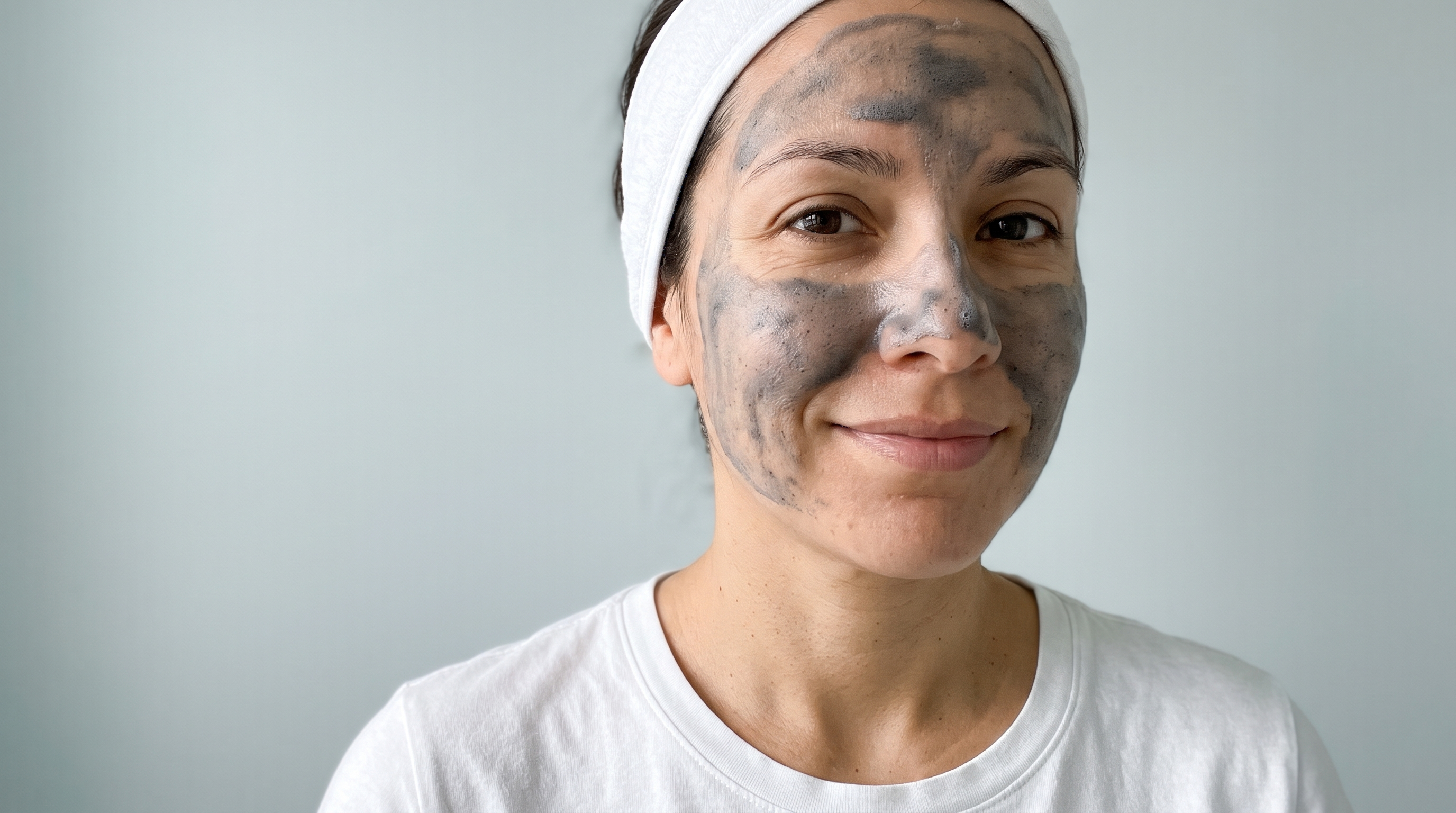
Black foam has become one of the most recognizable looks in skincare. Charcoal face washes promise to draw out dirt, unclog pores and detox oily skin, and the dark lather looks convincingly hard at work. For anyone with a shiny forehead and visible blackheads, that pitch is easy to believe.
Activated charcoal is a real material with a well-understood talent for binding molecules. The question is whether that talent survives a quick wash on a living face. This guide explains what activated charcoal does, what a charcoal wash can realistically achieve, how it compares with other cleansers for oily skin, and where lasting pore change actually comes from.
What activated charcoal actually is
Activated charcoal is carbon, usually made from coconut shells, wood or bamboo, that has been heated and treated until it is riddled with microscopic pores. Those pores give it an enormous surface area, and other molecules stick to that surface by adsorption: they cling to the outside rather than soaking in.
Medicine relies on this property in poisoning. Swallowed activated charcoal binds many drugs and toxins in the gut and reduces how much of them reaches the bloodstream [1]. Even there, the benefit fades quickly with time, which is why it is given as early as possible [1].
That clinical use is where the “detox” language on the label comes from. The medical setting involves large doses, long contact and toxins dissolved in fluid right beside the charcoal. A face wash offers none of those conditions.
Your skin starts replacing the oil a cleanser removes within hours, so a wash that touches it for 60 seconds matters far less than what you leave on overnight.
Why a face wash is a hard place for charcoal to work
Contact time. Most people lather a cleanser for 30 to 60 seconds and rinse. Adsorption needs the target molecules to reach the charcoal surface, and in that window very little does.
Your skin starts replacing the oil a cleanser removes within hours, so a wash that touches it for 60 seconds matters far less than what you leave on overnight.
Dose. Charcoal is usually a minor ingredient, often listed near the end of the label. A small amount of a very dark powder is enough to turn the foam black.
Pores are not open pipes. A blackhead is a plug of hardened oil and skin cells wedged inside the follicle. Charcoal particles sit on the surface and rinse away; they do not travel down the follicle and pull the plug out.
Pore size has deeper causes. A review of facial pores identified three main drivers of enlarged pores: high oil production, loss of elasticity in the skin around the pore, and larger hair follicles [2]. None of those is something a surface particle can change.
What a charcoal face wash can realistically do
A well-made charcoal wash cleans like any good foaming cleanser. It removes surface oil, sweat, sunscreen and the day’s grime, and it may leave the skin feeling less greasy for the next few hours. Some formulas add a mild scrub texture or clay, which gives a polished feel.
What the wash does for your skin depends far more on the rest of the formula than on the charcoal. Cleansers are built on surfactants, and the harsh ones strip the skin’s own lipids and proteins along with the dirt, leaving it tight and dry [3]. Traditional alkaline soaps are the harshest, while synthetic detergents, called syndets, cause less irritation because they are less likely to disturb skin proteins [4].
pH matters too. Healthy skin surface pH sits on average below 5, and skin in that acidic range measured better for barrier function, moisture and scaling than skin above 5 [5]. Even plain tap water raises skin pH for up to 6 hours, and soaps have a stronger effect still [5]. Oily skin that is stripped and irritated often feels oilier and looks redder, not clearer.
Your skin needs 12 weeks or more of nightly leave-on treatment to show real texture change, far longer than any cleanser stays on your face.
Charcoal versus other cleansers for oily skin
Salicylic acid. This is the ingredient with the best case for blackheads. It is oil-soluble, so it can work inside the oily follicle, and it loosens the bonds between dead skin cells, which is why it is used for acne and clogged pores [6]. Our guide to the salicylic acid cleanser covers strengths and how often to use one.
Clay. Kaolin and bentonite absorb oil and can stay on the skin for 10 minutes in a mask, far longer than a wash. A clay mask once or twice a week does more oil control than charcoal foam on a daily rinse.
A gentle syndet gel. For many oily faces, a plain low-pH gel is the right daily wash. Our guide to the best face wash for oily skin explains the two label details that decide it.
Charcoal also appears in pore strips and peel-off masks, and the same rule applies: what comes away is mostly the top of the plug and some fine hair, as our guide to nose strips explains.
Your skin needs 12 weeks or more of nightly leave-on treatment to show real texture change, far longer than any cleanser stays on your face.
How to choose a charcoal face wash
- Read the surfactants first. Glucosides, isethionates, glycinates and betaines are gentler than sodium lauryl sulfate.
- Look for a pH close to 5. Some brands print it; a syndet gel is usually closer than a bar.
- Treat scrub beads with caution. Gritty charcoal washes used daily can irritate acne-prone skin.
- Check for added actives. Salicylic acid, niacinamide or zinc do more for oily skin than the charcoal.
- Skip strong fragrance and menthol if your skin stings. A cooling tingle is not a sign of deep cleaning.
- Notice how your face feels 20 minutes later. Tight, squeaky skin means the wash is too harsh.
A simple routine for oily, congested skin
- Morning: Rinse or use a gentle gel, then a light moisturizer and sunscreen.
- Evening: Wash once with your charcoal or gel cleanser, twice only if you wore heavy sunscreen or makeup.
- Two nights a week: Use a salicylic acid product or a clay mask.
- The other nights: Apply a retinoid after cleansing to work on the pore and texture problem itself, keeping it off the acid nights while your skin adjusts.
Where cleansing ends and retinol begins
A cleanser can only manage what is already on the surface. The changes people with oily skin actually want, less visible pores, smoother texture and fewer clogged follicles, depend on what happens inside the skin over weeks. Topical retinoids are among the treatments reviewed for enlarged pores [2], and they are the best-studied topical option for rebuilding collagen and smoothing texture in aging skin [7].
The trouble is that retinoids can cause burning, scaling and irritation, which limits how many people keep using them [7]. Nanoretinol was built to solve that. It is a light, water-based gel with a smooth matte finish that suits oily and combination skin, and it carries 0.2% retinol inside biomimetic lipid nanoparticles that the skin recognizes as its own, so the retinol passes through without damaging the barrier. In North Biomedical’s study, it was 232% more effective in collagen recovery and 73% more effective in elastin recovery than conventional retinol, and users saw a 61% increase in skin firmness and a 56% increase in skin elasticity after 56 days [8].
Keep the charcoal wash if you like the feel of it. Pair it with Nanoretinol at night and broad-spectrum sunscreen each morning, and judge the routine by how your pores look in two months, not by how black the foam is.
References
- Juurlink DN. “Activated charcoal for acute overdose: a reappraisal.” British Journal of Clinical Pharmacology. 2016;81(3):482-487. doi:10.1111/bcp.12793
- Lee SJ, Seok J, Jeong SY, Park KY, Li K, Seo SJ. “Facial pores: definition, causes, and treatment options.” Dermatologic Surgery. 2016;42(3):277-285. doi:10.1097/DSS.0000000000000657
- Ananthapadmanabhan KP, Moore DJ, Subramanyan K, Misra M, Meyer F. “Cleansing without compromise: the impact of cleansers on the skin barrier and the technology of mild cleansing.” Dermatologic Therapy. 2004;17 Suppl 1:16-25. doi:10.1111/j.1396-0296.2004.04s1002.x
- Draelos ZD. “The science behind skin care: cleansers.” Journal of Cosmetic Dermatology. 2018;17(1):8-14. doi:10.1111/jocd.12469
- Lambers H, Piessens S, Bloem A, Pronk H, Finkel P. “Natural skin surface pH is on average below 5, which is beneficial for its resident flora.” International Journal of Cosmetic Science. 2006;28(5):359-370. doi:10.1111/j.1467-2494.2006.00344.x
- Arif T. “Salicylic acid as a peeling agent: a comprehensive review.” Clinical, Cosmetic and Investigational Dermatology. 2015;8:455-461. doi:10.2147/CCID.S84765
- Mukherjee S, Date A, Patravale V, Korting HC, Roeder A, Weindl G. “Retinoids in the treatment of skin aging: an overview of clinical efficacy and safety.” Clinical Interventions in Aging. 2006;1(4):327-348. doi:10.2147/ciia.2006.1.4.327
- North Biomedical LLC. “Nanoretinol vs. Conventional Retinol: Efficacy in Collagen and Elastin Recovery.” Clinical Study Summary, 2024. Study summary