Best Clay Mask: Choose the Mineral, Not the Jar
Bentonite, kaolin and rhassoul do measurably different things. The strongest one is the wrong choice for most skin over 40.
Almost every clay mask review compares packaging, scent and price, and skips the only variable that changes the result. The mineral in the jar determines what the mask does. Two products at wildly different prices can contain the same clay at the same concentration, and two products in the same price bracket can behave like different categories of product entirely.
Three minerals, three jobs
Clay minerals are layered silicates, and the layers carry a surface charge. That charge is what allows them to bind oils, particulates and charged molecules from a surface. A review of clay minerals in human health lays out the structural basis for their long use in topical and pharmaceutical preparations, and the properties that make one clay behave differently from another [1].
Bentonite, whose active component is montmorillonite, is the swelling clay. Its layers expand as they take up water, exposing a very large internal surface area, and it carries the highest charge density of the three. That makes it the most aggressive oil absorber on the shelf. It is also the one most likely to leave skin tight and stripped.
Kaolin does not swell. Its layers are held together tightly, so the available surface is essentially just the outside of the particle. It absorbs meaningfully less oil and it does so more gently. White kaolin is the mildest form; the pink and red varieties are the same mineral with iron content and are marginally more absorbent.
Rhassoul, a magnesium-rich clay mined in Morocco, sits between them. It absorbs well while leaving skin noticeably less tight than bentonite, which is why it appears in products aimed at people who want oil control without the stripped feeling.
Pore size is mostly a sebum question
Which raises the obvious question: what are you actually trying to change? For most people buying a clay mask, the honest answer is visible pores.
Which raises the obvious question: what are you actually trying to change?
Pore appearance turns out to be strongly tied to how much oil the follicle is producing. Researchers measuring sebum output against pore size found sebum secretion to be a significant contributing factor to the size of facial pores [2]. A broader clinical review of facial pores identifies the same cluster of determinants: sebaceous output, follicular volume, and the loss of dermal support around the pore opening that comes with age [3].
Two of those three are structural. A clay mask influences the first one, temporarily, by removing oil that is already on the surface and in the upper part of the follicle. The pore looks smaller for a few hours because it is emptier. Then it refills, on a schedule set by the sebaceous gland, and nothing about the follicle itself has changed. Our guide to clogged pores covers what does and does not accumulate in them.
Why the answer changes after menopause
Here is the part that makes most clay mask advice actively wrong for a large share of the people reading it.
Sebaceous gland activity is not fixed across life. Classic measurement work tracking sebum production by age found output declining substantially in later decades, with the fall in women beginning around the menopausal transition [4]. Sebum production is androgen-driven, and it drops when that drive drops.
So a woman of 55 with a shiny T-zone and visible pores frequently does not have oily skin in the sense a 25-year-old does. She has less sebum than she used to, a barrier that is more easily disturbed, and pores that look larger because the dermal collagen supporting their walls has thinned. Reaching for the strongest absorbent clay in that situation removes lipids she cannot easily replace.
If it is drying too fast, mist your face lightly and let it stay soft.
For that skin, kaolin is the correct default and bentonite is the wrong one. The same logic explains why enlarged pores respond so poorly to the products that worked twenty years earlier.
The application mistake everyone makes
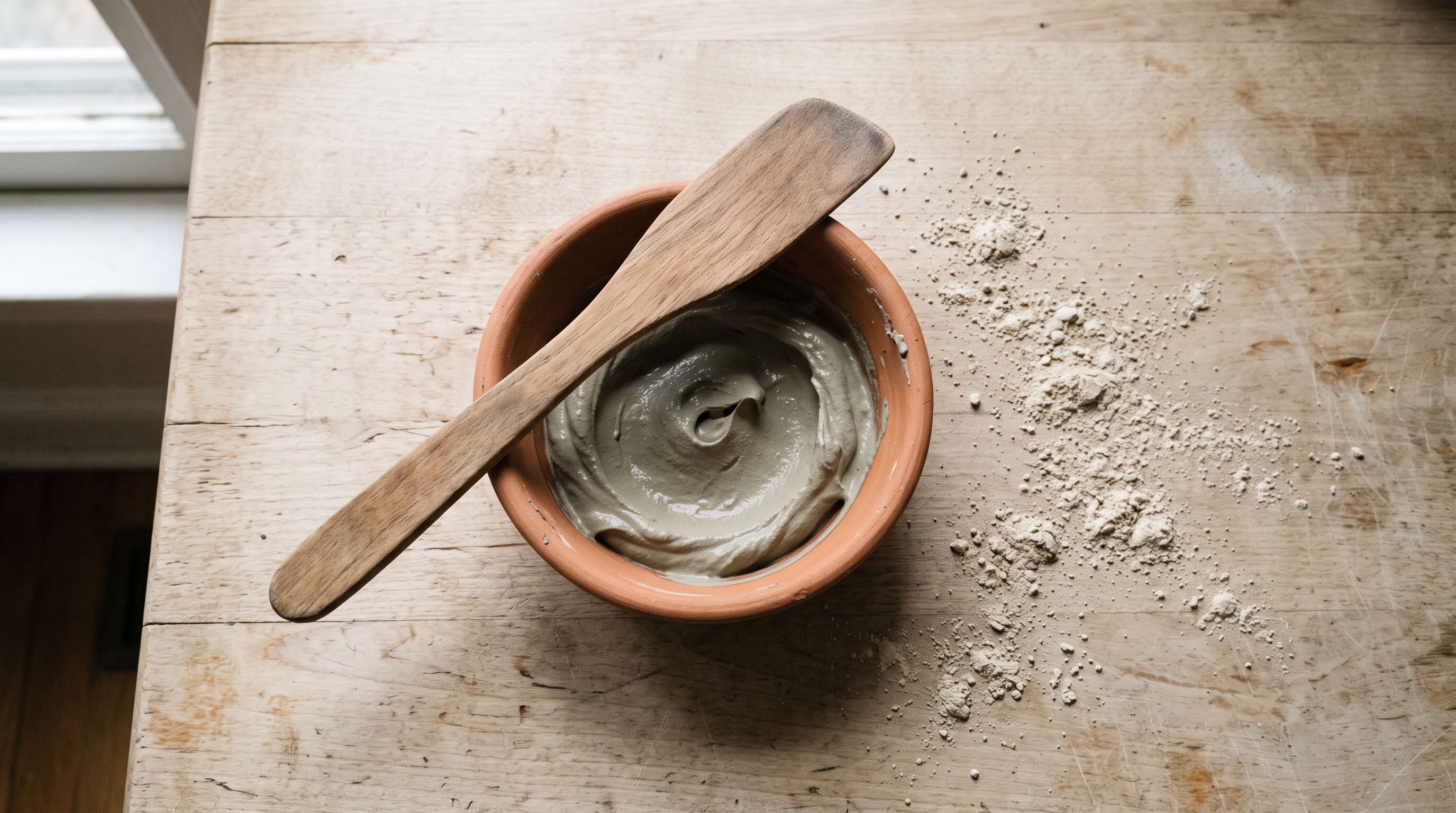
Clay works while it is wet. The adsorption happens at the interface between the moist clay and the skin surface, and it stops once the mask has dried out.
Yet nearly everyone leaves a clay mask on until it cracks, because a tight, cracking mask feels like it is working. Past the point of dryness the mask has stopped absorbing sebum and started pulling water out of the stratum corneum instead. What follows is the same barrier disruption that over-aggressive cleansing produces: raised transepidermal water loss, tightness, and a rebound in oil production. Work on cleanser mildness documents that pattern clearly, showing how surfactant and drying insults compromise barrier function rather than improving it [5].
The rule follows directly. Take the mask off while it is still tacky, usually five to ten minutes in, well before it turns to a cracked mud flat. If it is drying too fast, mist your face lightly and let it stay soft. Once or twice a week is enough for oily skin, and once a week or less for anything mature or reactive. Layering a clay mask on top of an exfoliating acid the same evening is how people end up with a compromised barrier and blame the clay, and the differences between mask categories are worth understanding before mixing them, which our guide to face masks for aging skin sets out.
Changing the follicle rather than emptying it
If a pore refilling on schedule is the problem, the only category with real evidence for altering that schedule is the retinoids. They work on follicular keratinization, normalising how cells within the follicle shed rather than removing what has already accumulated. A review of topical retinoids covers that mechanism and the clinical outcomes it produces in follicular disorders [6].
That effect depends entirely on the molecule reaching the living epidermis. Conventional retinol formulations get there by disturbing the skin barrier, which is a particularly unhelpful bargain for someone whose barrier is already being tested by absorbent clay every week.
Nanoretinol takes a different route. It carries retinol inside biomimetic lipid nanoparticles that the skin recognises as “self” and permits through the epithelial barrier, so nothing has to be broken down for delivery to happen. In North Biomedical’s clinical study, the system proved 232% more effective than conventional retinol in collagen recovery and 73% more effective in elastin recovery at a concentration of only 0.2%, with drastically reduced cytotoxicity in cellular assays [7]. It is water-based rather than oil-based, which suits the same skin that reaches for clay in the first place. Since the dermal collagen around a pore is part of what holds it open, this is the half of the problem a mask was never going to reach. The distinction matters most for sebaceous filaments, which people routinely mistake for blackheads and try to mask away.
Putting it together
Buy for the mineral. Check the ingredient list for the specific clay rather than trusting the front of the jar, and match it to your skin as it is now rather than as it was. Bentonite for genuinely oily, resilient skin. Kaolin for dry, mature, sensitive or thinning skin. Rhassoul when you want the middle.
Then set your expectations at the right level. A clay mask is a good weekly reset that makes skin look cleaner and matte for an evening. It is a maintenance tool. The thing that changes what your pores look like in six months is what you do on the other six nights of the week.
References
- Carretero MI. “Clay Minerals and Their Beneficial Effects Upon Human Health. A Review.” Applied Clay Science. 2002;21(3-4):155-163. doi:10.1016/S0169-1317(01)00085-0
- Roh M, Han M, Kim D, Chung K. “Sebum Output as a Factor Contributing to the Size of Facial Pores.” British Journal of Dermatology. 2006;155(5):890-894. PMID: 17034515
- Lee SJ, Seok J, Jeong SY, Park KY, Li K, Seo SJ. “Facial Pores: Definition, Causes, and Treatment Options.” Dermatologic Surgery. 2016;42(3):277-285. PMID: 26918966
- Pochi PE, Strauss JS, Downing DT. “Age-Related Changes in Sebaceous Gland Activity.” Journal of Investigative Dermatology. 1979;73(1):108-111. PMID: 448169
- Ananthapadmanabhan KP, Moore DJ, Subramanyan K, Misra M, Meyer F. “Cleansing Without Compromise: The Impact of Cleansers on the Skin Barrier and the Technology of Mild Cleansing.” Dermatologic Therapy. 2004;17(Suppl 1):16-25. PMID: 14728695
- Thielitz A, Gollnick H. “Topical Retinoids in Acne Vulgaris: Update on Efficacy and Safety.” American Journal of Clinical Dermatology. 2008;9(6):369-381. PMID: 18973403
- North Biomedical LLC. “Nanoretinol vs. Conventional Retinol: Efficacy in Collagen and Elastin Recovery.” Clinical Study Summary, 2024. Study summary