Cheek Wrinkles: What Causes Them and How to Make Them Fade
The science behind wrinkles on the cheeks — and the ingredients that address them at the source
Why Your Cheeks Are the First Place Aging Becomes Visible
The cheeks sit at the intersection of two aging forces working simultaneously against you. First, the fat pads that give the midface its smooth, lifted appearance gradually deflate and descend. Second, the dermis — the structural layer beneath the skin surface — steadily loses the protein scaffolding that once kept it taut and resilient. The result is texture you didn’t acquire overnight but accumulated over a decade.
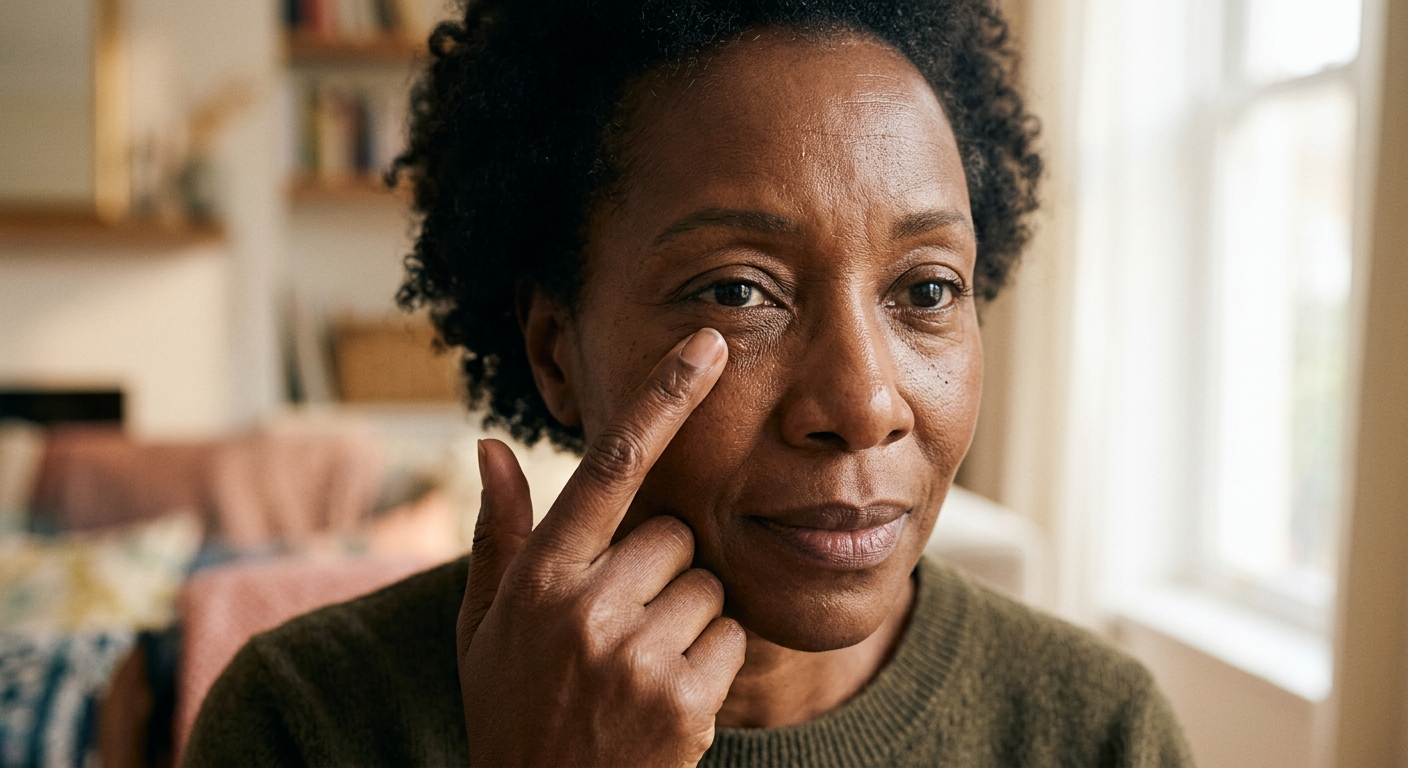
Cheek wrinkles take several forms. Fine surface lines appear first, typically running diagonally across the upper cheek or fanning out beneath the eye. Then come deeper furrows — mid cheek lines that persist even at rest, often described as a fold running from under the outer eye downward. There are also the dynamic creases that deepen when you smile, which can etch into permanence over time.
All of these share the same root cause: progressive collagen loss in the dermal layer.
What’s Actually Happening Inside the Dermis
The dermis is roughly 70% collagen by dry weight, and almost all of that is type I collagen — the structural protein responsible for skin’s firmness and resistance to deformation [1]. From age 25 onward, net collagen production falls by approximately 1% per year. By the time visible cheek lines appear, you may have lost 20–30% of your youthful collagen density.
It’s not just that fibroblasts (the collagen-producing cells) make less collagen as they age. There’s a second, compounding problem: the physical environment those fibroblasts live in stops working properly. Healthy fibroblasts stay stretched and attached to an intact collagen matrix, and that mechanical tension signals them to keep producing. When collagen fragments — as it does in aged and UV-exposed skin — fibroblasts lose their grip. They collapse, round up, and reduce production even further [1].
Ultraviolet exposure dramatically accelerates this cycle. Photoaged skin shows not just reduced collagen synthesis but active collagen destruction driven by matrix metalloproteinases (MMPs) — enzymes the skin ramps up in response to UV radiation [2]. This explains why identical-aged twins who differ in sun exposure can have dramatically different cheek skin: one with smooth midface texture, the other with pronounced lines.
Why Cheek Skin Is Particularly Vulnerable
The midface presents a unique mechanical challenge. The skin overlying the cheeks must accommodate constant movement — smiling, chewing, talking, sleeping — while simultaneously losing the fat padding beneath it. As structural support thins, those dynamic movements leave deeper impressions.
By the time visible cheek lines appear, you may have lost 20–30% of your youthful collagen density.
Deep wrinkles on the face tend to form wherever movement meets collagen depletion. On the cheeks, this translates to diagonal creases from repeated lateral pulling of the zygomaticus muscle, and vertical nasolabial-adjacent lines from years of smile motion pressed against thinning skin.
Addressing this requires more than surface-level hydration. The solution must target what actually caused the problem: impaired fibroblast function and reduced collagen synthesis. This is what points toward retinoids as the most clinically validated approach.
The Retinoid Mechanism — and Why It Works for Cheek Lines
Retinoids are the most extensively studied topical agents for reversing visible skin aging. Their mechanism is direct: retinol converts to retinoic acid within skin cells, which then binds to nuclear retinoic acid receptors (RARs), reprogramming gene expression toward collagen synthesis while suppressing the MMPs that degrade it [3].
In a randomized controlled trial of topical retinol applied to naturally aged skin in older adults, participants showed significant improvements in fine wrinkling after 24 weeks. The mechanism was confirmed biologically: glycosaminoglycan production increased, procollagen I levels rose, and the skin’s structural matrix strengthened [3].
A comprehensive review of retinoid clinical studies confirms consistent improvements in wrinkle scores, skin texture, and dermal thickness across multiple formulations and concentrations [4]. Tretinoin shows the fastest clinical response but with significant irritation risk — making it poorly tolerated for regular use on the sensitive cheek area. Retinol produces similar biological effects with meaningfully better tolerability, particularly in modern stabilized formulations.
What to Look for in a Cheek Wrinkle Treatment
Applying a retinoid to cheek skin successfully requires two things: sufficient penetration to reach fibroblasts in the lower dermis, and tolerability that allows consistent daily use without inflammation-driven barrier damage.
A 0.2% retinol formulation engineered for deep dermal delivery will outperform a 1% retinol in a standard emulsion base.
Delivery system matters more than concentration. A 0.2% retinol formulation engineered for deep dermal delivery will outperform a 1% retinol in a standard emulsion base. This is because most conventional retinol struggles to traverse the lipid-rich epidermal barrier intact — a significant portion oxidizes or fails to penetrate before it can act [5]. Encapsulated delivery systems, particularly lipid nanoparticles, solve this by protecting retinol until it reaches target cells and allowing passage through the skin barrier without disrupting it.
How to improve skin elasticity is closely related to cheek wrinkle treatment — addressing elastin alongside collagen produces more comprehensive structural results.
For persistent cheek lines, early and consistent application matters. Collagen rebuilds slowly; studies showing meaningful wrinkle reduction typically run 24 or more weeks. A product used three times per week inconsistently will underdeliver compared to a well-tolerated daily formula applied nightly.
The Role of Sun Protection
No topical treatment works well in isolation if daily UV exposure continues to degrade collagen faster than the active ingredient can rebuild it. Sunscreen is not optional when targeting cheek wrinkles. Even broad-spectrum SPF 30 applied consistently reduces the MMP activation and inflammatory cascade that accelerates cheek line deepening. Think of it as plugging the drain before filling the tub.
A Smarter Approach to Cheek Wrinkle Treatment
Nanoretinol uses lipid nanoparticle encapsulation to deliver retinol through the skin barrier in the same way the body recognizes its own cells — biomimetically. In a clinical study, Nanoretinol demonstrated +232% greater collagen recovery compared to conventional retinol, with +61% improvement in skin firmness and +56% improvement in elasticity after 56 days — without the irritation that typically limits retinoid compliance. For cheek skin, where both consistency and gentleness matter, the delivery system is as important as the active molecule.
Retinol for skin firmness loss and cheek rejuvenation works when the delivery matches the biology. That combination — verified science, effective delivery, daily tolerability — is what separates products that gradually improve cheek lines from those that merely moisturize them.
References
-
Varani J, Dame MK, Rittie L, et al. “Decreased collagen production in chronologically aged skin: roles of age-dependent alteration in fibroblast function and defective mechanical stimulation.” American Journal of Pathology. 2006;168(6):1861–1868. doi:10.2353/ajpath.2006.051302
-
Uitto J. “The role of elastin and collagen in cutaneous aging: intrinsic aging versus photoexposure.” Journal of Drugs in Dermatology. 2008;7(2 Suppl):s12–16. PMID:18404866
-
Kafi R, Kwak HS, Schumacher WE, et al. “Improvement of naturally aged skin with vitamin A (retinol).” Archives of Dermatology. 2007;143(5):606–612. doi:10.1001/archderm.143.5.606
-
Mukherjee S, Date A, Patravale V, et al. “Retinoids in the treatment of skin aging: an overview of clinical efficacy and safety.” Clinical Interventions in Aging. 2006;1(4):327–348. doi:10.2147/ciia.2006.1.4.327
-
Quan T. “Human Skin Aging and the Anti-Aging Properties of Retinol.” Biomolecules. 2023;13(11):1614. doi:10.3390/biom13111614