
Eye Wrinkles When Smiling: Why Dynamic Lines Form and How to Soften Them
The creases that appear around your eyes and cheeks when you smile follow a predictable physics — and respond to the right approach
The Wrinkles That Only Show Up When You’re Happy
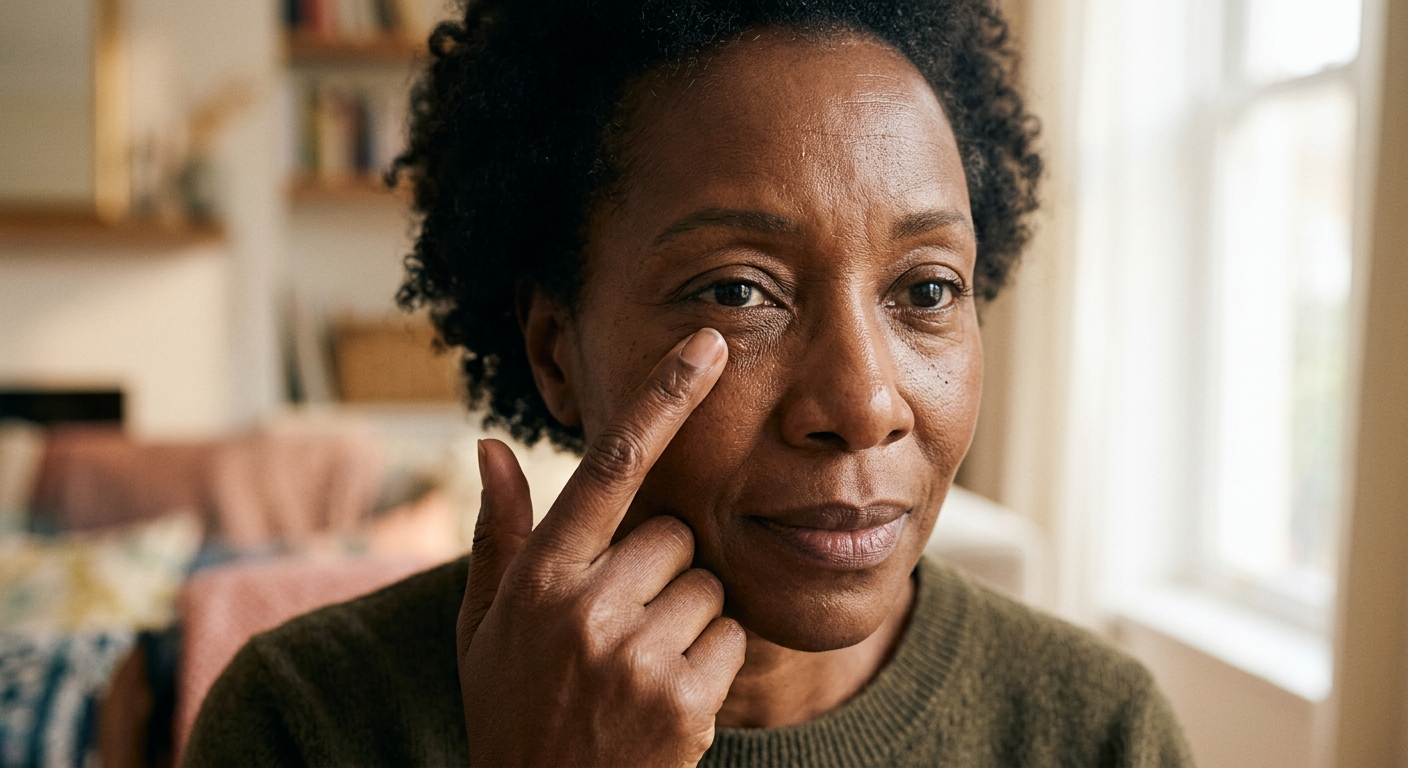
There’s a particular kind of frustration in noticing wrinkles that appear the moment you smile. You catch yourself mid-laugh in a photo and see fans of lines spreading from the outer corners of your eyes, creases stacking on your upper cheeks, maybe a few around your mouth. Relax your face and most of them vanish. Smile again and they snap right back. These are dynamic wrinkles, also called expression lines, and they behave very differently from the static wrinkles etched permanently into resting skin.
Understanding that difference is the key to treating them — because the same line that disappears when you relax your face today can become permanent in a decade, and what you do now determines which path it takes.
The Physics of a Smile
Every facial expression is a small mechanical event. When you smile, the muscles around your eyes and mouth contract and pull the overlying skin into folds. Scientists who study this describe it as a buckling phenomenon: a layered material under sideways compression will buckle into ridges once the compression crosses a threshold, exactly the way a rug ruckles when you push its ends together. Facial skin sits on top of contracting muscle, and a smile applies meaningful compression — enough to fold the skin into the lines you see [1].
Crucially, wrinkles form perpendicular to the direction of muscle pull. The muscle that circles your eye, the orbicularis oculi, contracts inward when you smile, so the skin buckles into the radiating lines we call crow’s feet. The same logic produces horizontal forehead lines from the muscle that lifts your brows, and cheek folds from the big muscles that pull the corners of your mouth up and back. Modern studies using 3D imaging and facial-mapping systems have traced exactly which muscles drive which creases, confirming that expression lines are not random — they are the predictable signature of the muscle beneath them [2].
Understanding that difference is the key to treating them — because the same line that disappears when you relax your face today can become permanent in a decade, and what you do now determines which path it takes.
When a Dynamic Line Becomes a Static One
Here is the part that matters for prevention. A dynamic wrinkle that only appears during expression is, at first, completely reversible. The skin folds, then unfolds, and at rest the surface is smooth. But skin is not infinitely elastic, and the dermis pays a price for being folded the same way tens of thousands of times.
Each contraction concentrates mechanical stress in the deeper skin layers right beneath the fold. Over years, that repetitive stress degrades the collagen and elastin in those exact spots, carving a permanent groove that no longer needs the muscle to be visible [3]. This is the transition from dynamic to static: the line that used to need a smile now stays put at rest. The crease becomes part of your face’s resting topography.
Two things accelerate that transition. The first is the sheer number of repetitions — expressive people who smile and squint a lot simply rack up folds faster. The second is the underlying quality of the skin. A dermis already thinned by age and sun damage has less collagen scaffolding to resist the buckling stress, so it etches in faster. This is why the same amount of smiling produces deeper lines on sun-damaged, collagen-depleted skin than on young, resilient skin — and why protecting and rebuilding the dermis is a genuine anti-wrinkle strategy, not just a moisturizing one.
What Actually Helps — Matched to the Mechanism
Because two different processes are at work — muscle movement on top, dermal breakdown underneath — the smart approach treats both.
In North Biomedical’s clinical study, this delivery system was 232% more effective at collagen recovery and 73% more effective at elastin recovery than conventional retinol, with a gel-light, water-based formula gentle enough for the eye contour.
Address the dermis with proven actives
You can’t stop smiling, and you shouldn’t want to. But you can make the skin that gets folded more resistant to etching by rebuilding its collagen scaffold. Retinoids are the most evidence-backed topical for this. They stimulate fibroblasts to produce new collagen and simultaneously block the enzymes that break it down [4]. In photodamaged skin, topical retinoids have been shown to restore new collagen formation in the dermis on biopsy [5]. A thicker, better-organized dermal matrix resists buckling stress more effectively, which softens the static component of expression lines and slows the dynamic-to-static transition. This is the same collagen-first logic behind treating smile lines around the mouth.
Protect what you build
Ultraviolet light is the great accelerator of the dermal breakdown that turns dynamic lines permanent. Daily broad-spectrum sunscreen — and sunglasses, which also reduce the reflexive squinting that drives crow’s feet — is foundational. There is no point rebuilding collagen each night if you degrade it each afternoon. The most effective way to prevent wrinkles is to stop the damage that lets them set in.
Relax the muscle, if you choose
For the movement side of the equation, neuromodulators like botulinum toxin temporarily reduce the muscle contraction itself, which both softens existing dynamic lines and — by reducing the folding — slows new etching. Many people start this preventatively; it’s worth understanding the case for starting earlier rather than later before deep static lines form. It’s a personal choice, but mechanistically it complements topical collagen-building rather than competing with it.
Getting Retinol Past the Barrier
The limiting factor with retinol has always been delivery. The skin barrier is designed to keep molecules out, and conventional retinol formulations often muscle their way through by disrupting that barrier — which is why so many people experience the redness, flaking, and stinging that makes them abandon retinol within weeks. Around the delicate eye area, where the very creases you’re targeting live, that irritation is even less welcome.
Nanoretinol takes a different route. It packages retinol inside biomimetic lipid nanoparticles that the skin recognizes as its own and admits through the barrier intact, rather than breaking the barrier down to force entry. The payoff is more active ingredient reaching the fibroblasts with far less irritation. In North Biomedical’s clinical study, this delivery system was 232% more effective at collagen recovery and 73% more effective at elastin recovery than conventional retinol, with a gel-light, water-based formula gentle enough for the eye contour. For lines driven by collagen and elastin loss in the dermis, getting the active where it works — comfortably enough to actually keep using it — is what changes outcomes.
The Takeaway Worth Smiling About
Eye and cheek wrinkles that appear when you smile are not a verdict; they’re a stage. While they still disappear at rest, you have a real window to keep them that way. The folding itself is harmless — what etches lines in is the slow erosion of the dermal scaffold underneath, accelerated by sun and time. Build and protect that scaffold with a proven, well-delivered retinoid, shield it from UV every day, and consider relaxing the muscle if it suits you. Do that, and you can keep smiling like you mean it without your face keeping a permanent transcript of every laugh.
References
- Santoprete R, Hourblin V, Foucher A, Dufour O, Bernard D, Domanov Y, Querleux B, Potter A. “Reduction of wrinkles: From a computational hypothesis to a clinical, instrumental, and biological proof.” Skin Research and Technology. 2023;29(3):e13267. PMID: 36973988
- Moon HJ, Lee W, Choi JY. “Dynamic evaluation of facial muscles: 3D skin displacement vector analysis using a facial painting model.” Laryngoscope Investigative Otolaryngology. 2021;6(4):650-656. PMID: 34401486
- Wei H, Chen M, Wang S, Wang Z, Liao B, Lin Z, He L, He W. “Study on the Wrinkling Mechanisms of Human Skin Based on the Digital Image Correlation and Facial Action Coding System.” Applied Sciences. 2025;15(12):6803. doi:10.3390/app15126803
- Mukherjee S, Date A, Patravale V, Korting HC, Roeder A, Weindl G. “Retinoids in the treatment of skin aging: an overview of clinical efficacy and safety.” Clinical Interventions in Aging. 2006;1(4):327-348. PMID: 18046911
- Griffiths CE, Russman AN, Majmudar G, Singer RS, Hamilton TA, Voorhees JJ. “Restoration of collagen formation in photodamaged human skin by tretinoin (retinoic acid).” New England Journal of Medicine. 1993;329(8):530-535. PMID: 8336752