Cocoa Butter for Skin: What a Randomized Trial Found About Its Most Famous Claim
It is one of the best occlusives in the drugstore and one of the most oversold — the gap between those two facts is where most of the confusion lives
Cocoa butter has one of the strongest reputations in skincare and one of the weakest evidence bases behind the specific claim that built it. Almost everyone has been told it prevents stretch marks. Almost no one has been told that this was tested properly, against a placebo, and failed.
That single fact is worth sitting with, because once you set the stretch mark claim aside, what remains is a genuinely good ingredient being used for the wrong reason.
What Cocoa Butter Actually Is
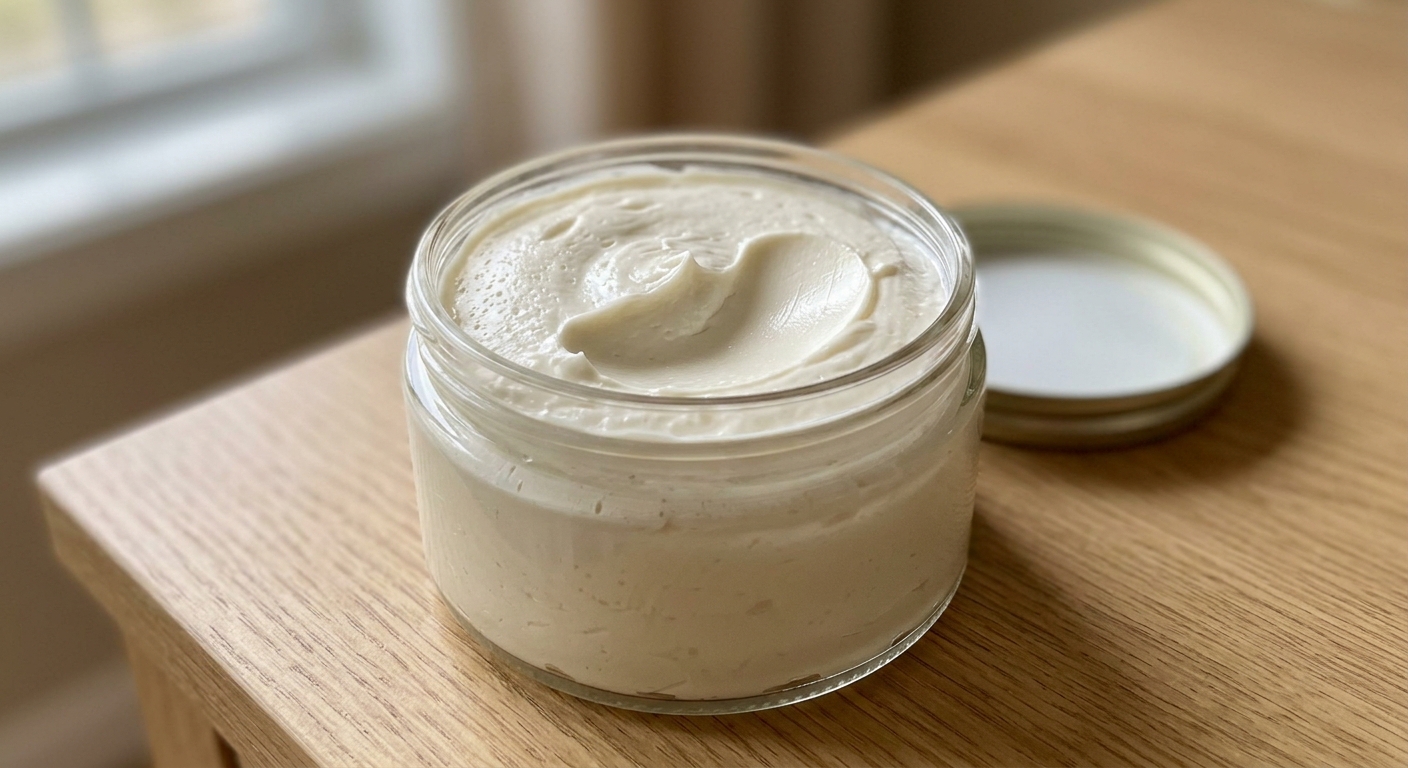
Cocoa butter is the fat pressed from the roasted beans of Theobroma cacao. Unlike almost every other plant oil in skincare, it is solid at room temperature — a pale, brittle block that snaps rather than pours.
That texture comes from its fatty acid profile. Cocoa butter is roughly a third stearic acid, a quarter to a third palmitic acid, and about a third oleic acid. Stearic and palmitic are long, saturated, straight-chain fats that pack tightly together, which is why the butter stays firm. Its melting point sits between roughly 34°C and 38°C — just at skin temperature. Press it against your forearm and it liquefies in your hand.
This is a specific and useful property. It means cocoa butter arrives as a solid, melts on contact, and then resolidifies slightly into a dense film as it cools on the skin surface. That dense film is what makes it a staple of body butter formulations.
Its Real Job Is Occlusion
Moisturizers work through three mechanisms: humectants pull water in, emollients fill the gaps between skin cells to smooth texture, and occlusives form a physical barrier that slows transepidermal water loss [1]. Most products blend all three. Cocoa butter is overwhelmingly the third kind.
That is not a criticism. Occlusion is the most reliably effective moisturizing mechanism there is — it is why petrolatum remains the reference standard — and reviews of moisturizer therapy consistently find that reducing water loss is what drives measurable improvement in dry, damaged skin [2]. On shins, elbows, heels, and the kind of winter dryness that cracks, a heavy occlusive is exactly the right tool.
The authors concluded that topical cocoa butter does not appear to reduce the likelihood of developing stretch marks.
Where cocoa butter differs from shea butter is density. Shea has a softer, more unsaponifiable-rich profile and spreads more easily at room temperature. Cocoa butter is heavier, sets into a firmer film, and lasts longer on the surface — better for a body balm, harder to justify on a face.
The Stretch Mark Claim, Tested Properly
In 2008, researchers ran a double-blind, randomized, placebo-controlled trial on exactly this question. Women in their first trimester applied either a cocoa butter lotion or an identical placebo lotion daily until delivery. Of 210 enrolled, 175 completed the study.
The result: 45.1% of the cocoa butter group developed striae gravidarum, versus 48.8% of the placebo group (P = 0.730) [3]. The authors concluded that topical cocoa butter does not appear to reduce the likelihood of developing stretch marks.
This is not an isolated finding. A separate randomized trial of olive oil for the same indication similarly found no significant preventive effect [4]. The pattern across the literature is consistent: stretch marks are dermal tears driven by rapid mechanical stretch and hormonal changes in collagen and elastin architecture. They happen below the reach of anything sitting on the stratum corneum.
What topical application does deliver during pregnancy is real relief from the itching and tightness of stretched, dry skin. That is a legitimate reason to use it. It is just not the reason on the label.
The Chocolate Antioxidant Confusion
Cocoa is genuinely rich in polyphenols, and reviews have examined those compounds for cytoprotective and antioxidant effects relevant to skin [5]. The most striking human data comes from a study in which women drinking a high-flavanol cocoa beverage for 12 weeks showed reduced UV-induced erythema and improved skin hydration and blood flow compared with a low-flavanol control [6].
It carries 0.2% retinol inside biomimetic lipid nanoparticles that the skin recognizes as “self” and lets through the epithelial barrier intact — no petroleum-derived penetration enhancers, no barrier damage.
Here is the catch that marketing tends to skip: those flavanols live in the cocoa solids, not the butter. Cocoa butter is the fat fraction, separated from the polyphenol-rich mass during processing, and the refining that makes it cosmetically stable strips most of what remains. The photoprotection study was also an ingestion trial — women drank the cocoa.
So the antioxidant story about cocoa is real, and it is largely not a story about the ingredient in your body butter.
On the Face, Be Careful
The same density that makes cocoa butter excellent on shins makes it a questionable choice above the neck. A high proportion of solid saturated fats forming a persistent film is the classic recipe for congestion in pore-prone skin. If your face clogs easily, this is not the fat to experiment with.
It is also the wrong texture for barrier repair on inflamed or compromised skin, where a lighter, more physiologically matched lipid blend is usually better tolerated than a heavy occlusive block.
Where it genuinely shines: post-shower body application on damp skin, hands after washing, and the thin, dry, crepey skin on arms that benefits from anything that slows water loss overnight.
Where the Structural Work Happens
If your goal is comfort and softness, cocoa butter delivers well. If your goal is changing how aging skin is built — firmness, fine lines, the loss of elasticity that shows on the arms, chest, and neck — no occlusive can get you there. That requires signaling fibroblasts to produce new collagen and elastin, and only a small number of ingredients do that.
Retinoids do. In a controlled comparison on human skin, both retinol and retinoic acid increased epidermal thickness and the molecular markers of dermal remodeling, with retinol delivering comparable histological change and better tolerability [7]. The persistent problem has been getting enough retinol past the barrier without wrecking it in the process.
Nanoretinol solves that with delivery rather than dose. It carries 0.2% retinol inside biomimetic lipid nanoparticles that the skin recognizes as “self” and lets through the epithelial barrier intact — no petroleum-derived penetration enhancers, no barrier damage. In North Biomedical’s clinical study, that route produced 232% greater collagen recovery and 73% greater elastin recovery than conventional retinol, with drastically reduced cytotoxicity. Because it is a light, water-based gel, it goes on first and a butter goes over it.
Using It for What It Is
Buy cocoa butter as a body occlusive and it will serve you for years: cheap, stable, effective on genuinely dry skin, pleasant to use. Buy it to prevent stretch marks and the best available trial says you will be disappointed.
The most useful mental model is a layered one — an active that works in the dermis, and a butter that seals the surface above it. Each does something the other cannot.
References
- Sethi A, Kaur T, Malhotra SK, Gambhir ML. “Moisturizers: The Slippery Road.” Indian Journal of Dermatology. 2016;61(3):279-287. doi:10.4103/0019-5154.182427
- Purnamawati S, Indrastuti N, Danarti R, Saefudin T. “The Role of Moisturizers in Addressing Various Kinds of Dermatitis: A Review.” Clinical Medicine & Research. 2017;15(3-4):75-87. doi:10.3121/cmr.2017.1363
- Osman H, Usta IM, Rubeiz N, Abu-Rustum R, Charara I, Nassar AH. “Cocoa butter lotion for prevention of striae gravidarum: a double-blind, randomised and placebo-controlled trial.” BJOG: An International Journal of Obstetrics and Gynaecology. 2008;115(9):1138-1142. doi:10.1111/j.1471-0528.2008.01796.x
- Soltanipour F, Delaram M, Taavoni S, Haghani H. “The effect of olive oil and the Saj® cream in prevention of striae gravidarum: A randomized controlled clinical trial.” Complementary Therapies in Medicine. 2014;22(2):220-225. doi:10.1016/j.ctim.2013.11.011
- Scapagnini G, Davinelli S, Di Renzo L, De Lorenzo A, Olarte HH, Micali G, et al. “Cocoa bioactive compounds: significance and potential for the maintenance of skin health.” Nutrients. 2014;6(8):3202-3213. doi:10.3390/nu6083202
- Heinrich U, Neukam K, Tronnier H, Sies H, Stahl W. “Long-term ingestion of high flavanol cocoa provides photoprotection against UV-induced erythema and improves skin condition in women.” The Journal of Nutrition. 2006;136(6):1565-1569. doi:10.1093/jn/136.6.1565
- Kong R, Cui Y, Fisher GJ, Wang X, Chen Y, Schneider LM, et al. “A comparative study of the effects of retinol and retinoic acid on histological, molecular, and clinical properties of human skin.” Journal of Cosmetic Dermatology. 2016;15(1):49-57. doi:10.1111/jocd.12193