
Is Drinking Water Good for Your Skin? What the Controlled Trials Found
The honest answer depends entirely on how much you were drinking before — and the studies are unusually clear about where the ceiling sits
“Drink more water” is the most repeated skincare advice in existence, and it occupies a strange position: too obvious to question, too vague to test. Either it is the free foundation of good skin, or it is the thing people say when they have nothing useful to offer.
It has actually been tested, several times, with instruments rather than opinions. The results are more interesting than either camp expects — because the answer is not yes or no. It is it depends on your starting point, and the studies are unusually precise about where the effect runs out.
The Controlled Trial
The most informative study on this question followed 49 healthy women for a month [1]. Researchers split them by baseline habit: one group habitually drank under 3,200 mL of fluid a day, the other above it. Then they added roughly two extra liters of water daily to the diet and measured skin at day 0, day 15, and day 30 using corneometry for surface and deep hydration, transepidermal water loss for barrier function, and a Cutometer for mechanical properties.
The split in results was stark.
In the lower-intake group, hydration rose substantially and at nearly every site measured. Deep hydration at the forehead climbed from 29.20 to 40.62 arbitrary units over the month, a highly significant change. Biomechanical measures moved too: maximum extensibility improved at the leg, forearm, hand, and forehead, and the skin’s capacity to return to its original position after being stretched increased across most sites.
In the higher-intake group, almost nothing happened. A few modest shifts, mostly failing significance, at far fewer sites.
One more finding deserves attention, because it is the one that explains the ceiling: transepidermal water loss did not meaningfully change in either group. More water going in did not reduce the rate of water escaping.
It has actually been tested, several times, with instruments rather than opinions.
What the Systematic Review Concluded
A 2018 systematic review in Skin Research and Technology gathered the controlled studies on fluid intake and skin physiology and reached the same shape of conclusion [2]. Across six controlled studies, additional water intake did increase stratum corneum hydration and deeper skin hydration, with slight improvements in elasticity — and the effect was concentrated in people with lower prior consumption. Consistent with the trial above, the review found no significant differences in transepidermal water loss between higher- and lower-intake groups.
That combination is the whole story in one line. Drinking more water can raise the water content of your skin. It does not improve your skin’s ability to hold that water.
Why the Effect Has a Ceiling
To understand why two extra liters do so little for someone already well hydrated, you have to look at what governs surface hydration in the first place.
The stratum corneum — the outermost layer, the one that determines whether skin looks plump or papery — does not get its water passively from the bloodstream and keep it. Water moves upward from the well-hydrated dermis through the epidermis and then evaporates from the surface. Hydration at the top is the balance between that upward supply and that evaporative loss, and the loss side is controlled almost entirely by local structures [3].
Two of those structures do the heavy lifting. Natural moisturizing factor, a mixture of low-molecular-weight humectants generated when the protein filaggrin breaks down inside corneocytes, physically binds water in the surface layer. Intercellular lipids — ceramides, cholesterol, and free fatty acids arranged in ordered lamellae — form the seal that slows evaporation [4]. Neither is manufactured by drinking. Both decline with age.
There is even a dedicated transport system: aquaporin-3, a water and glycerol channel expressed in the membranes of epidermal keratinocytes, which helps maintain hydration in the layers beneath the stratum corneum [5]. Its expression, too, is a property of the tissue rather than of your fluid intake.
Its expression, too, is a property of the tissue rather than of your fluid intake.
So when someone is chronically under-drinking, the supply side is genuinely limiting, and correcting it produces a measurable change. Once supply is adequate, the bottleneck moves to the barrier, and pouring more into the top of the system does nothing about the leak. This is the same distinction that separates dehydrated skin from dry skin — one is a water problem, the other is a lipid problem, and they respond to entirely different interventions.
The Mineral Water Footnote
One study adds a wrinkle worth knowing about. A pilot investigation published in the International Journal of Cosmetic Science had participants drink over two liters daily and found significant effects on skin physiology — but with distinctly different outcomes depending on whether the water was mineral water or tap water [6]. The mineral content, not merely the volume, appeared to matter.
It is a small exploratory study and it should not be over-read. But it does suggest that “how much water” is an incomplete question, and it is a reminder of how coarse the popular advice is relative to the actual physiology.
What Actually Moves Surface Hydration
If your intake is already reasonable and your skin still reads as tight, dull, or finely lined, the useful levers are all topical or environmental:
- Humectants — glycerin, hyaluronic acid, urea — add binding capacity at the surface, doing from the outside what natural moisturizing factor does from the inside.
- Barrier lipids — ceramides and cholesterol in physiologic ratios — reduce the evaporative loss that the water you drink cannot touch. This is the core of any real barrier repair strategy.
- Removing the aggravators — hot water, high-pH cleansers, low ambient humidity, over-exfoliation. Most cases of persistent dry skin on the face after 40 are a barrier problem being made worse daily.
- Rebuilding the tissue itself, which is the only approach that addresses why the barrier degraded in the first place.
Where Nanoretinol Fits
Hydration is a surface state. The reason skin at 50 loses water faster than skin at 25 is structural: a thinner dermis, degraded collagen, and reduced lipid production. Retinoids remain the best-evidenced topical intervention for that structural problem — a vehicle-controlled trial in naturally aged skin showed that topical retinol significantly increased glycosaminoglycan content and procollagen I synthesis, with visible improvement in fine wrinkling [7].
The catch has always been that conventional retinol reaches the dermis by compromising the barrier on the way in, using solvents and petroleum derivatives that increase water loss precisely while you are trying to reduce it. That is the trade that produces flaking and tightness in the first weeks.
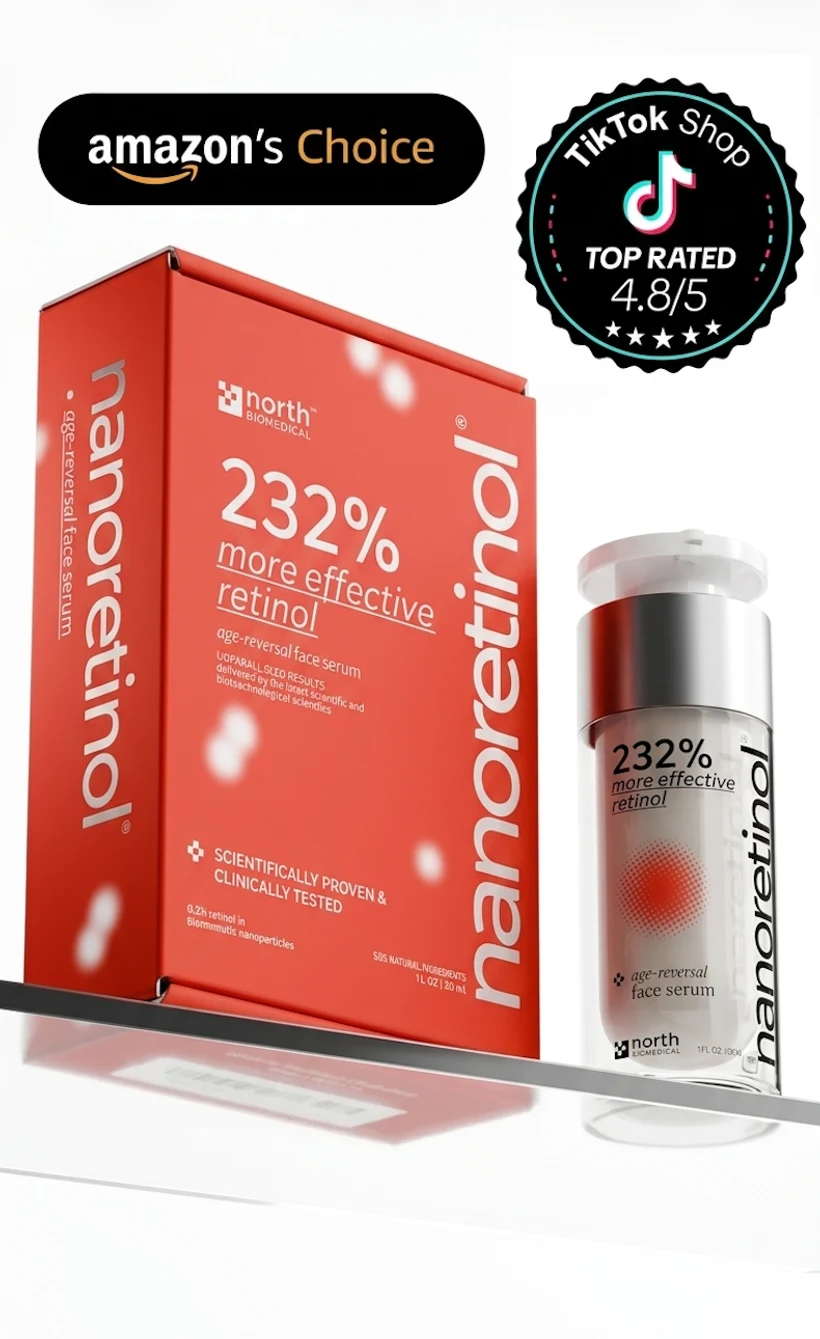
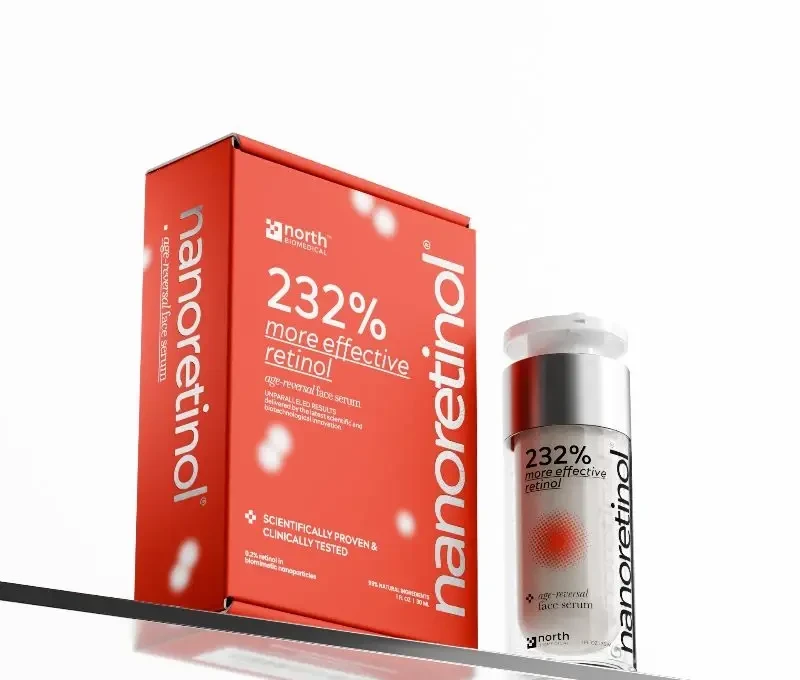
Nanoretinol avoids the trade. It delivers 0.2% stabilized retinol inside biomimetic lipid nanoparticles that the skin recognizes as “self” and admits through the epithelial barrier without damaging it, in a water-based, gel-like formula of 99% natural ingredients. In North Biomedical’s clinical study, this route produced 232% greater collagen recovery and 73% greater elastin recovery than conventional retinol, with drastically reduced cytotoxicity — and, over 56 days, a 61% increase in firmness and a 56% increase in elasticity.
So Should You Drink More Water?
If you are genuinely under-drinking, yes — and expect a real, measurable improvement in how hydrated your skin is, plus a modest gain in elasticity. The data supports that plainly.
If you already drink a normal amount, adding more will not do much for your face, and the studies say so directly. At that point the water in your skin is not limited by what you drink. It is limited by how well your barrier holds on to it, and that is a question of lipids, humectants, and the condition of the tissue underneath — none of which arrive in a glass.
References
- Palma L, Marques LT, Bujan J, Rodrigues LM. “Dietary water affects human skin hydration and biomechanics.” Clinical, Cosmetic and Investigational Dermatology. 2015;8:413-421. doi:10.2147/CCID.S86822
- Akdeniz M, Tomova-Simitchieva T, Dobos G, Blume-Peytavi U, Kottner J. “Does dietary fluid intake affect skin hydration in healthy humans? A systematic literature review.” Skin Research and Technology. 2018;24(3):459-465. PMID:29392767
- Verdier-Sévrain S, Bonté F. “Skin hydration: a review on its molecular mechanisms.” Journal of Cosmetic Dermatology. 2007;6(2):75-82. PMID:17524122
- Rawlings AV, Harding CR. “Moisturization and skin barrier function.” Dermatologic Therapy. 2004;17(Suppl 1):43-48. PMID:14728698
- Sougrat R, Morand M, Gondran C, Barré P, Gobin R, Bonté F, Dumas M, Verbavatz JM. “Functional expression of AQP3 in human skin epidermis and reconstructed epidermis.” Journal of Investigative Dermatology. 2002;118(4):678-685. doi:10.1046/j.1523-1747.2002.01710.x
- Williams S, Krueger N, Davids M, Kraus D, Kerscher M. “Effect of fluid intake on skin physiology: distinct differences between drinking mineral water and tap water.” International Journal of Cosmetic Science. 2007;29(2):131-138. PMID:18489334
- Kafi R, Kwak HSR, Schumacher WE, Cho S, Hanft VN, Hamilton TA, et al. “Improvement of naturally aged skin with vitamin A (retinol).” Archives of Dermatology. 2007;143(5):606-612. doi:10.1001/archderm.143.5.606