Collagen Serum: How to Tell a Collagen Builder From a Collagen Moisturizer
Two very different products share the same name. Here is what each one can do, how to read the label, and which ingredients actually help your skin make more collagen
Search for a collagen serum and you will find two different products sold under the same name. The first kind contains collagen itself, usually hydrolyzed collagen, and promises to “replenish” what age has taken away. The second kind contains no collagen at all. It contains ingredients that signal your skin to make more of its own.
Both can be worth buying, but they do different jobs, and the label rarely tells you which one you are holding. This guide explains why the difference matters, what the evidence shows for each type, and how to choose a serum that fits what you actually want to change.
Why your skin runs short of collagen
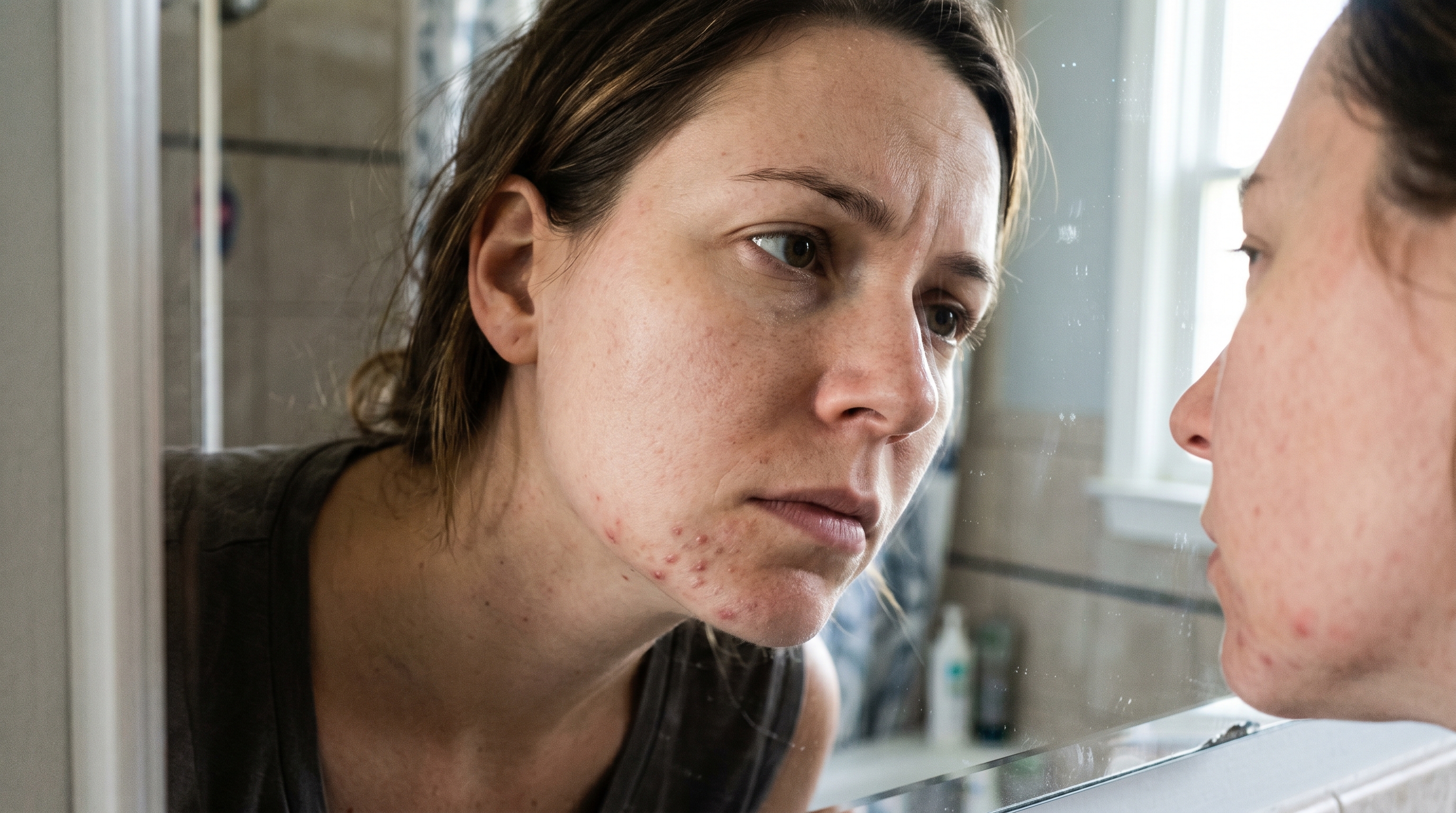
Collagen is the protein scaffold of the dermis, the deeper layer of skin that gives the face its firmness. With age, the cells that build it slow down. In one study, skin cells taken from adults over 80 produced about 32% less of the raw material for collagen than cells from people aged 18 to 29 [1].
Your skin cells make about 32% less of collagen’s raw material in your eighties than in your twenties, and no serum can pour the missing protein back in.
Sun exposure speeds the loss by switching on enzymes that break collagen down. The result is the familiar mix of fine lines, thinner texture and softer contours. A serum can help with that, but only if it reaches the cells doing the building.
Type one: serums that contain collagen
The outer layer of skin is an effective filter. A widely cited rule in dermatology holds that a molecule generally needs to weigh less than about 500 daltons to cross it, and almost every drug designed to work through the skin falls under that limit [2]. Whole collagen weighs around 300,000 daltons. Hydrolyzed collagen is broken into smaller pieces, but most of those pieces are still far above the threshold.
So collagen in a serum does not top up the collagen in your dermis. What it does is moisturize. A review of hydrolyzed collagen describes it as a safe cosmetic ingredient with good moisturizing properties in the outermost layer of skin [3]. Hydrated skin reflects light more evenly, so fine dryness lines look softer for a few hours, and a thin collagen film can make makeup sit more smoothly.
Your skin cells make about 32% less of collagen’s raw material in your eighties than in your twenties, and no serum can pour the missing protein back in.
That is a real benefit, and it is the same one you get from hyaluronic acid or glycerin. It is simply not collagen replacement. If a collagen-containing serum is the only active step in your routine, expect comfort and a smoother surface, not firmer skin.
Type two: serums that help your skin build collagen
A booster serum takes the opposite approach. Instead of adding collagen from outside, it uses smaller, active molecules that reach skin cells and prompt them to work harder. Three ingredients have the clearest evidence.
Vitamin C. Vitamin C is required for the body to assemble collagen and also acts as an antioxidant. In a six-month, double-blind trial on sun-damaged skin of the neck and arms, a 5% vitamin C cream improved the overall appearance of the skin, increased the density of its fine surface pattern and reduced deep furrows compared with the base cream alone [4]. Our guide to the best vitamin C serum explains how to judge the form and concentration in a bottle.
Signal peptides. Some short peptides are small enough to act in the upper layers of skin. In a 12-week split-face trial in 93 women, a moisturizer containing palmitoyl pentapeptide-4 reduced wrinkles and fine lines more than the identical moisturizer without it [5]. If a peptide formula is what you are after, our guide to the best peptide serum walks through which peptides have human data behind them and which ones are mostly marketing.
Retinol. Retinol has the deepest evidence of any cosmetic collagen builder. In aged, sun-protected skin, one week of topical retinol increased collagen synthesis and lowered the enzymes that degrade collagen [6]. In a 24-week trial in elderly volunteers, 0.4% retinol lotion reduced fine wrinkling and raised collagen production compared with the plain base [7].
Your skin needed 24 weeks of retinol in one trial of elderly volunteers to show clearly smoother fine lines, which is a far slower and more lasting change than the instant plumping of a collagen moisturizer.
Your skin needed 24 weeks of retinol in one trial of elderly volunteers to show clearly smoother fine lines, which is a far slower and more lasting change than the instant plumping of a collagen moisturizer.
The mechanism behind that result is covered in our explainer on how retinol rebuilds collagen, which walks through why vitamin A derivatives reach the dermis and switch the cells there back toward building rather than breaking down.
How to read a collagen serum label
A quick scan of the ingredient list tells you which type you have:
- “Collagen”, “hydrolyzed collagen” or “soluble collagen”: a moisturizing serum. Useful, but not a builder.
- “Ascorbic acid”, “sodium ascorbyl phosphate” or “tetrahexyldecyl ascorbate”: a vitamin C serum, best used in the morning under sunscreen.
- “Palmitoyl” followed by “tripeptide”, “tetrapeptide” or “pentapeptide”: a signal peptide serum.
- “Retinol” or “retinal”: a retinoid, the strongest evidence for collagen, used at night.
- “Collagen-boosting” with none of the above: marketing language without an active ingredient behind it.
Packaging matters for the boosters. Pure vitamin C oxidizes quickly once exposed to air and light, and a serum that has turned dark orange has lost much of its strength. Retinol is also light-sensitive. Look for opaque, airless or tinted bottles rather than clear droppers that sit on a sunny shelf.
Many products combine the two types, pairing hydrolyzed collagen with a peptide or vitamin C. That can be a sensible design: the collagen gives immediate comfort while the active does the slower work. Just judge the serum by its active, not by the word on the front.
Building a routine around a collagen serum
A simple structure works for most people:
- Morning: a vitamin C serum, then moisturizer and a broad-spectrum sunscreen. Sunscreen protects whatever collagen your serum helps you build.
- Evening: a retinoid or peptide serum on clean, dry skin, followed by moisturizer.
- Any time: a collagen or hyaluronic acid serum as a hydrating layer, applied before heavier creams.
Introduce one new active at a time and give each one at least eight weeks before you judge it. If you also use a richer cream, our guide to the best collagen cream for face covers how to read those labels. Avoid stacking several strong actives on the same night; irritation is the most common reason people quit a routine that would have worked.
A collagen builder that does not cost you your barrier
If your goal is firmer skin rather than a short-term glow, a retinol serum is the booster with the strongest case. The catch is tolerance. Conventional retinol formulas often push retinol into the skin by loosening the barrier’s protective lipids, which is why so many people get redness, burning and peeling and stop before the collagen benefits arrive.
Nanoretinol takes a different route. It delivers 0.2% stabilized retinol inside biomimetic lipid nanoparticles that the skin recognizes as its own, so the retinol reaches skin cells without breaking down the barrier first. The water-based gel absorbs completely and suits all skin types, including sensitive skin. In North Biomedical’s study summary, Nanoretinol was 232% more effective in collagen recovery and 73% more effective in elastin recovery than conventional retinol, and clinical testing over 56 days found a 61% increase in skin firmness and a 56% increase in elasticity [8].
Use it at night as your collagen-building step, keep vitamin C and sunscreen for the morning, and skip other retinoid serums while you use it. A collagen moisturizer can still have a place in that routine; it just should not be the step you rely on to change how firm your skin is.
References
- Varani J, Dame MK, Rittie L, et al. “Decreased collagen production in chronologically aged skin: roles of age-dependent alteration in fibroblast function and defective mechanical stimulation.” American Journal of Pathology. 2006;168(6):1861-1868. doi:10.2353/ajpath.2006.051302
- Bos JD, Meinardi MM. “The 500 Dalton rule for the skin penetration of chemical compounds and drugs.” Experimental Dermatology. 2000;9(3):165-169. doi:10.1034/j.1600-0625.2000.009003165.x
- Aguirre-Cruz G, León-López A, Cruz-Gómez V, Jiménez-Alvarado R, Aguirre-Álvarez G. “Collagen Hydrolysates for Skin Protection: Oral Administration and Topical Formulation.” Antioxidants. 2020;9(2):181. doi:10.3390/antiox9020181
- Humbert PG, Haftek M, Creidi P, et al. “Topical ascorbic acid on photoaged skin. Clinical, topographical and ultrastructural evaluation: double-blind study vs. placebo.” Experimental Dermatology. 2003;12(3):237-244. doi:10.1034/j.1600-0625.2003.00008.x
- Robinson LR, Fitzgerald NC, Doughty DG, et al. “Topical palmitoyl pentapeptide provides improvement in photoaged human facial skin.” International Journal of Cosmetic Science. 2005;27(3):155-160. doi:10.1111/j.1467-2494.2005.00261.x
- Varani J, Warner RL, Gharaee-Kermani M, et al. “Vitamin A antagonizes decreased cell growth and elevated collagen-degrading matrix metalloproteinases and stimulates collagen accumulation in naturally aged human skin.” Journal of Investigative Dermatology. 2000;114(3):480-486. doi:10.1046/j.1523-1747.2000.00902.x
- Kafi R, Kwak HS, Schumacher WE, et al. “Improvement of naturally aged skin with vitamin A (retinol).” Archives of Dermatology. 2007;143(5):606-612. doi:10.1001/archderm.143.5.606
- North Biomedical LLC. “Nanoretinol vs. Conventional Retinol: Efficacy in Collagen and Elastin Recovery.” Clinical Study Summary, 2024. Study summary