Dark Lips: The Science of Lip Pigmentation and How to Lighten Them
Why the vermilion darkens — and the evidence-based routine that fades it
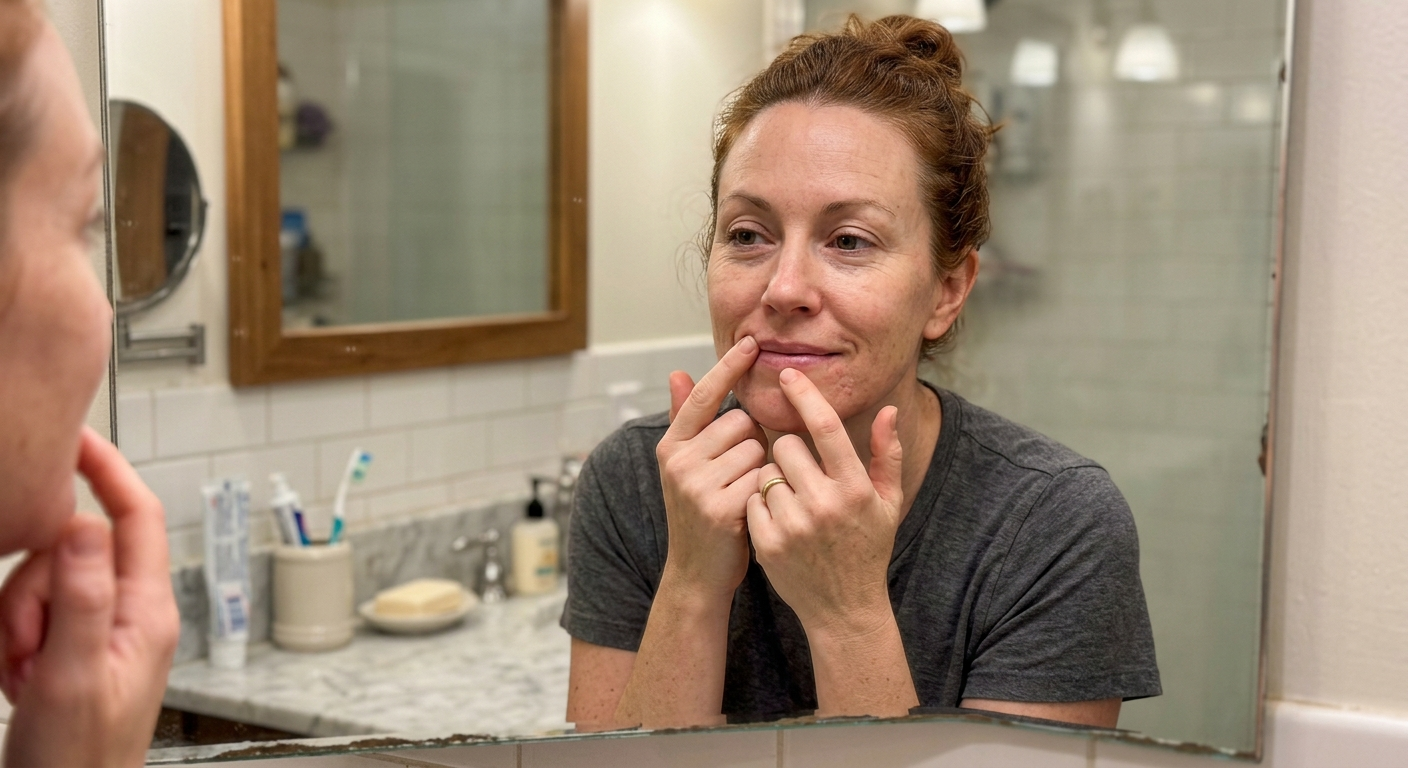
You reach for a nude lipstick and it looks muddy. You wipe your lips clean and the color underneath is deeper, greyer, or browner than you remember. If this sounds familiar, you are noticing hyperpigmentation of the vermilion — the exposed pink-to-red border of the lips. It is one of the most common cosmetic concerns women raise after 40, and one of the most misunderstood.
Let me be precise about what we are discussing. This article is about the lip surface itself darkening. That is different from the faint shadow that can appear on the skin above the upper lip, which we cover separately in our guide to the dark upper lip. Here, the pigment sits in the lip tissue you color with balm or gloss.
Why Lips Darken in the First Place
The vermilion is unusual skin. It has almost no protective outer layer and very few oil glands, so it is thin, translucent, and quick to react. Beneath the surface sit melanocytes, the same pigment-producing cells found across your body. When these cells are provoked, they switch on an enzyme called tyrosinase, the molecular ignition key for melanin production. More tyrosinase activity means more pigment, and on skin this delicate, that pigment shows through fast.
Several triggers turn that ignition key. Chronic sun exposure is a leading one; lips are frequently left unprotected while the rest of the face gets sunscreen. Ultraviolet light directly stimulates melanocytes, which is the same mechanism behind hyperpigmentation elsewhere on the face. Repeated friction and heat — lip-licking, aggressive wiping, rough exfoliation, even a warm mug held to the mouth — irritate the tissue and drive a low-grade inflammatory response that deposits pigment over time.
Then there is smoking, which deserves its own paragraph.
Dark Lips From Smoking
If you smoke, the darkening you see has a name: smoker’s melanosis. Tobacco smoke contains compounds that stimulate melanocytes in the lips and gums directly, and the effect is dose-dependent — the more you smoke, the darker the tissue. In one clinical study, every smoker examined showed lip and gingival pigmentation, while most non-smokers showed none [1]. A broader epidemiologic survey found excessive oral melanin pigmentation was strongly tied to tobacco habits, appearing far more often in smokers than non-users [2].
You wipe your lips clean and the color underneath is deeper, greyer, or browner than you remember.
Here is the encouraging part. Smoker’s melanosis is largely reversible. Pigmentation tends to build during the first year of smoking and then fade back toward baseline within roughly three years of quitting. Stopping smoking is, quite literally, a lip-lightening treatment — and the single most effective one available if tobacco is your trigger.
Other contributors round out the picture. Iron deficiency and chronic dehydration can leave lips looking dusky. Certain medications — some chemotherapy agents, antimalarials, and drugs that cause fixed pigment reactions — darken the vermilion. Hormonal shifts, including those of pregnancy and perimenopause, can amplify melanin activity, the same force behind melasma. And genetics matter: naturally deeper lip tone runs in families and across ethnic backgrounds, which is normal pigmentation, not a problem to be fixed.
How to Lighten Dark Lips
Because so many causes converge on one enzyme, an effective plan attacks the problem from several angles at once. Consistency, not intensity, wins here.
Protect First
Sunscreen is the foundation of every pigmentation treatment, full stop. Without it, you are bailing water from a boat with the hole still open — UV keeps re-firing the melanocytes faster than any active can quiet them. Use a lip balm with broad-spectrum SPF 30 or higher every morning and reapply through the day. This is the same logic we lay out in our guide to sunscreen for hyperpigmentation, applied to your most exposed and least protected feature.
Exfoliate Gently
A soft weekly exfoliation lifts pigment-laden surface cells and helps brightening actives penetrate. The operative word is gently — a damp washcloth or a mild sugar-based scrub, not a stiff brush. Over-scrubbing inflames the vermilion and can deepen the very darkness you are trying to erase.
Vitamin C brightens and doubles as an antioxidant; you can read more in our piece on vitamin C serum benefits.
Reach for Tyrosinase Inhibitors
This is where the science gets satisfying. A family of well-studied actives works by dialing down tyrosinase, the pigment ignition key. Vitamin C brightens and doubles as an antioxidant; you can read more in our piece on vitamin C serum benefits. Kojic acid is one of the most potent tyrosinase inhibitors studied — several times stronger than older agents in laboratory comparisons [3]. Niacinamide interrupts pigment transfer to surface cells. Licorice extract calms and lightens. And tranexamic acid, once used only in dermatology clinics, has strong evidence for fading stubborn pigment by quieting the melanocyte-activating signals that inflammation sets off [4].
You do not need all of these at once. One or two, used faithfully on clean lips, applied under your SPF, will do more than a crowded shelf of products used sporadically.
Hydrate and Wait
Dehydrated tissue reads darker and heals slower. Keep lips moisturized with an occlusive balm, address dietary iron if bloodwork flags a deficiency, and give any regimen a fair trial. Pigment turns over on a cellular timescale; expect eight to twelve weeks before you judge results.
When to See a Dermatologist
Most dark lips are a cosmetic matter. But see a professional if the darkening is sudden, one-sided, growing, textured, or bleeding, or if a single spot behaves differently from the rest of the lip. These features can signal something that needs a medical eye rather than a skincare routine, and a dermatologist can rule it out quickly.
The Cell-Turnover Connection
Notice a thread running through every lightening strategy above: you are trying to move pigment out faster than melanocytes lay it down. That is fundamentally a cell-turnover problem, and it is exactly what retinoids do best. Vitamin A derivatives accelerate epidermal renewal and interrupt melanin production, and an evidence-based review confirms their value across pigmentary disorders [5].
The catch has always been the lip border. Conventional retinol works by mildly disrupting the skin barrier — a trade-off that thin, sensitive vermilion tissue tolerates poorly, often responding with the redness and peeling that scare people off retinoids entirely.
This is the problem Nanoretinol was engineered to solve. It carries 0.2% stabilized retinol inside biomimetic lipid nanoparticles — a biological Trojan horse the skin recognizes as “self,” so it crosses the epithelial barrier without damaging it. In a water-based, 99% natural, vegan gel that is gentle enough for the eye contour, it delivers retinol’s turnover-accelerating, pigment-fading benefits precisely where fragile skin needs a lighter touch. Against conventional retinol it showed +232% collagen recovery and +73% elastin recovery, with drastically reduced cytotoxicity [6]. Encapsulation is why a low 0.2% dose outperforms harsher, higher-percentage formulas: better delivery beats brute strength.
Dark lips are rarely permanent and almost never a mystery once you understand the mechanism. Protect the tissue, quiet the enzyme, support turnover — and give it time.
References
- Multani S. “Interrelationship of Smoking, Lip and Gingival Melanin Pigmentation, and Periodontal Status.” Addiction & Health. 2013;5(1-2):57-65. PMID:24494159
- Axéll T, Hedin CA. “Epidemiologic study of excessive oral melanin pigmentation with special reference to the influence of tobacco habits.” Scandinavian Journal of Dental Research. 1982;90(6):434-442. doi:10.1111/j.1600-0722.1982.tb00760.x
- Chang TS. “An Updated Review of Tyrosinase Inhibitors.” International Journal of Molecular Sciences. 2009;10(6):2440-2475. doi:10.3390/ijms10062440
- Perper M, Eber AE, Fayne R, et al. “Tranexamic Acid in the Treatment of Melasma: A Review of the Literature.” American Journal of Clinical Dermatology. 2017;18(3):373-381. doi:10.1007/s40257-017-0263-3
- Kang HY, Valerio L, Bahadoran P, Ortonne JP. “The role of topical retinoids in the treatment of pigmentary disorders: an evidence-based review.” American Journal of Clinical Dermatology. 2009;10(4):251-260. doi:10.2165/00128071-200910040-00005
- North Biomedical LLC. “Nanoretinol vs. Conventional Retinol: Efficacy in Collagen and Elastin Recovery.” Clinical Study Summary, 2024. Study summary