Dark Knuckles: What Causes Them and How to Lighten the Skin
Hyperpigmented knuckles are usually friction and melanin — not dirt — and they respond to the right brightening routine.
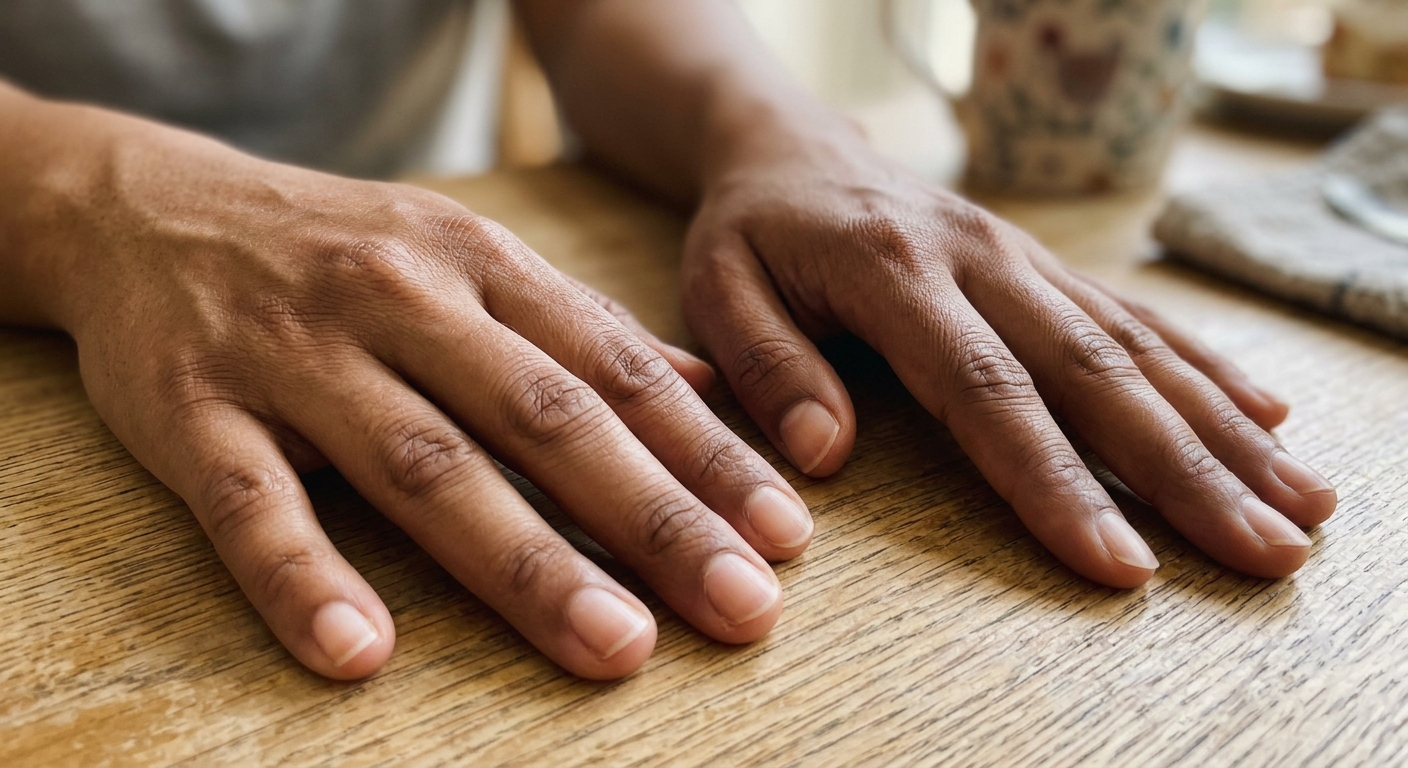
If the skin over your knuckles is noticeably darker than the rest of your hands, you have probably scrubbed at it more than once, assuming it was dirt or dryness. It isn’t. Dark knuckles are a form of hyperpigmentation — concentrated melanin in skin that has been repeatedly rubbed, stretched, and inflamed — and scrubbing harder usually makes them worse, not better.
The good news is that knuckle pigmentation responds well to a routine built on how melanin actually behaves.
Why Knuckles Darken in the First Place
The skin over your finger joints does an unusual amount of work. Every time you make a fist, that skin folds, stretches, and rubs against itself and against surfaces. Over months and years, that mechanical friction triggers low-grade inflammation, and inflammation is one of the most powerful switches for melanin production.
When skin is irritated, inflammatory signals tell pigment-producing cells (melanocytes) to ramp up and hand off extra melanin to surrounding skin cells — a process dermatologists call post-inflammatory hyperpigmentation, or PIH. A comprehensive review of PIH in skin of color describes exactly this cascade: inflammation stimulates melanocytes, excess pigment accumulates in the epidermis and sometimes leaks into the deeper dermis, and the result is a stubborn dark patch that long outlasts the original irritation [1].
Knuckles are a textbook setting for this because the trigger — friction — never really stops. The pigment isn’t sitting on top of the skin where a washcloth can reach it; it is built into the living tissue.
Why It Shows Up More on Some People
Dark knuckles are far more common and more pronounced in people with naturally deeper skin tones, and that is straightforward biology. Skin with more active melanin production responds to any inflammatory trigger by making more pigment, so the same amount of friction that leaves one person’s knuckles unchanged can leave another’s visibly darkened [2]. Differences in melanocyte activity and pigment distribution across skin types explain why the same habit produces very different results from one person to the next.
If the skin over your knuckles is noticeably darker than the rest of your hands, you have probably scrubbed at it more than once, assuming it was dirt or dryness.
This is also why darker skin tones experience hyperpigmentation as one of the most common reasons to seek skin care help — the tendency to over-pigment in response to inflammation is a feature of the skin, not a flaw in how someone cares for it.
Dryness compounds the problem. The skin over the knuckles has few oil glands and bends constantly, so it cracks and flakes easily, and each bout of dryness is another small inflammatory insult that nudges melanin production upward. That is why a fading routine has to protect and moisturize the skin as much as it brightens it — calming the irritation is half the battle.
When Dark Knuckles Are a Medical Sign
Most dark knuckles are simple friction-driven pigmentation, but one pattern deserves a doctor’s eye. If the darkening appeared relatively quickly, feels thickened or velvety, and also shows up on the neck, armpits, or other body folds, it can be a sign of acanthosis nigricans — a skin change associated with insulin resistance and metabolic conditions rather than friction alone.
If that description fits, see a physician, because the underlying metabolic cause matters more than the cosmetic appearance. (The same caution applies to a sudden dark neck or darkening in the body folds.) Interestingly, even in clinical studies of acanthosis nigricans, the topical that performed best for reducing the pigmentation itself was a retinoid [3] — which points directly at the most effective at-home approach for ordinary dark knuckles, too.
How to Actually Fade Dark Knuckles
Because the pigment lives inside the skin, fading it means doing two things: stopping the trigger and accelerating how quickly pigment-laden cells are replaced.
Daily sunscreen on the backs of the hands is non-negotiable if you want pigment to fade rather than rebound.
Reduce the friction. Be mindful of habits that grind the knuckles — leaning on them, cracking them aggressively, abrasive cleaning without gloves. You cannot out-treat a trigger you keep pulling.
Protect from the sun. UV exposure deepens any existing pigmentation, and hands are chronically exposed. Daily sunscreen on the backs of the hands is non-negotiable if you want pigment to fade rather than rebound.
Use targeted brightening actives. Ingredients that interrupt melanin production — such as niacinamide and tyrosinase inhibitors — reduce how much new pigment is made. Pair them with consistent moisturizing, since a healthy barrier inflames less.
Speed up cell turnover with a retinoid. This is the cornerstone. Retinoids push pigmented surface cells to shed faster while reducing tyrosinase activity, the enzyme that builds melanin. The evidence here is unusually strong: in a landmark vehicle-controlled trial, topical tretinoin significantly lightened post-inflammatory hyperpigmented lesions, with measured drops in epidermal melanin content compared to placebo [4]. The same logic that fades dark spots elsewhere applies to knuckles — see our guide to retinol for dark spots.
Expect this to take time. Pigmentation that built up over years fades over months, not days.
Why the Form of Retinol Matters Here
Retinoids are the most proven tool for knuckle pigmentation, but the skin over the joints is also prone to dryness and cracking — and conventional retinol is notoriously drying and irritating. Push it too hard on already-stressed knuckle skin and you can trigger more inflammation, which means more pigment: the exact opposite of the goal.
That trade-off is what makes delivery so important. Nanoretinol encapsulates a stabilized 0.2% retinol inside biomimetic lipid nanoparticles that pass through the skin barrier without the chemical disruption conventional formulas rely on. Because it is significantly gentler on skin cells — with drastically reduced cytotoxicity confirmed in laboratory assays — it delivers the turnover-and-tyrosinase benefits that fade pigment while sparing skin the irritation that can feed it. Its light, water-based, 99% natural-ingredient base is also far more pleasant on rough, friction-worn skin than a harsh, peeling formula.
The Bottom Line on Brighter Knuckles
Dark knuckles are melanin responding to friction and inflammation, not a stain you can scrub away. Stop the rubbing, shield the skin from sun, and pair brightening actives with a gentle retinoid to clear pigmented cells faster than your skin can make new ones. Stay consistent, give it a few months, and the contrast steadily fades. And if the darkening looks velvety or spreads to other body folds, let a doctor rule out an underlying cause first.
References
- Davis EC, Callender VD. “Postinflammatory Hyperpigmentation: A Review of the Epidemiology, Clinical Features, and Treatment Options in Skin of Color.” The Journal of Clinical and Aesthetic Dermatology. 2010;3(7):20-31. PMID: 20725554
- Rawlings AV. “Ethnic skin types: are there differences in skin structure and function?” International Journal of Cosmetic Science. 2006;28(2):79-93. doi:10.1111/j.1467-2494.2006.00302.x
- Alamri A, Alraddadi RA, Alzahrani D, et al. “The efficacy of topical treatments for acanthosis nigricans: a systematic review of randomized controlled trials.” Frontiers in Medicine. 2025;12:1641322. doi:10.3389/fmed.2025.1641322
- Bulengo-Ransby SM, Griffiths CE, Kimbrough-Green CK, Finkel LJ, Hamilton TA, Ellis CN, Voorhees JJ. “Topical tretinoin (retinoic acid) therapy for hyperpigmented lesions caused by inflammation of the skin in black patients.” New England Journal of Medicine. 1993;328(20):1438-1443. doi:10.1056/NEJM199305203282002