Dimethicone for Skin: What the Silicone in Your Moisturizer Is Doing
The most common ingredient nobody chose, and the difference between looking smoother and being smoother
Turn over almost any moisturizer, primer, or barrier cream in your bathroom and dimethicone is somewhere in the first six ingredients. Almost nobody bought it on purpose. It arrived inside products chosen for other reasons, and then a decade of ingredient-avoidance content taught people to be suspicious of it — that it suffocates skin, traps bacteria, blocks everything else from working.
The reality is duller and more useful than either the marketing or the fear. Dimethicone is a silicone polymer that does one narrow physical job extremely well, and understanding exactly where that job ends is the most valuable thing you can know about it.
It is too large to go anywhere
Most skincare anxiety assumes absorption. The worry is that an ingredient gets into you and does something there. With dimethicone, that premise fails at the first step.
Polydimethylsiloxane is a long-chain polymer, and the cosmetic grades used in moisturizers are far too large to cross the stratum corneum. A 2024 review of dermal absorption across cyclic and linear siloxanes found that high molecular weight linear silicones remain on the surface rather than penetrating [1]. The Cosmetic Ingredient Review panel’s safety assessment reached the same conclusion from the toxicology side: dimethicone is not absorbed after dermal exposure, was negative across genotoxicity assays, and behaved as a minimal irritant and non-sensitizer [2].
The ingredient people worry about absorbing is the one ingredient in the bottle that is physically too large to get in.
That non-absorption is the whole point. Dimethicone is not trying to reach a fibroblast or signal a receptor. It is a film-former, and it works entirely at the interface between your skin and the air.
What the film does to how you look
Aging skin scatters light unevenly. Fine lines, roughened texture, and shallow creases create micro-shadows, and the eye reads that scatter as dullness and crepiness before it consciously registers any individual line.
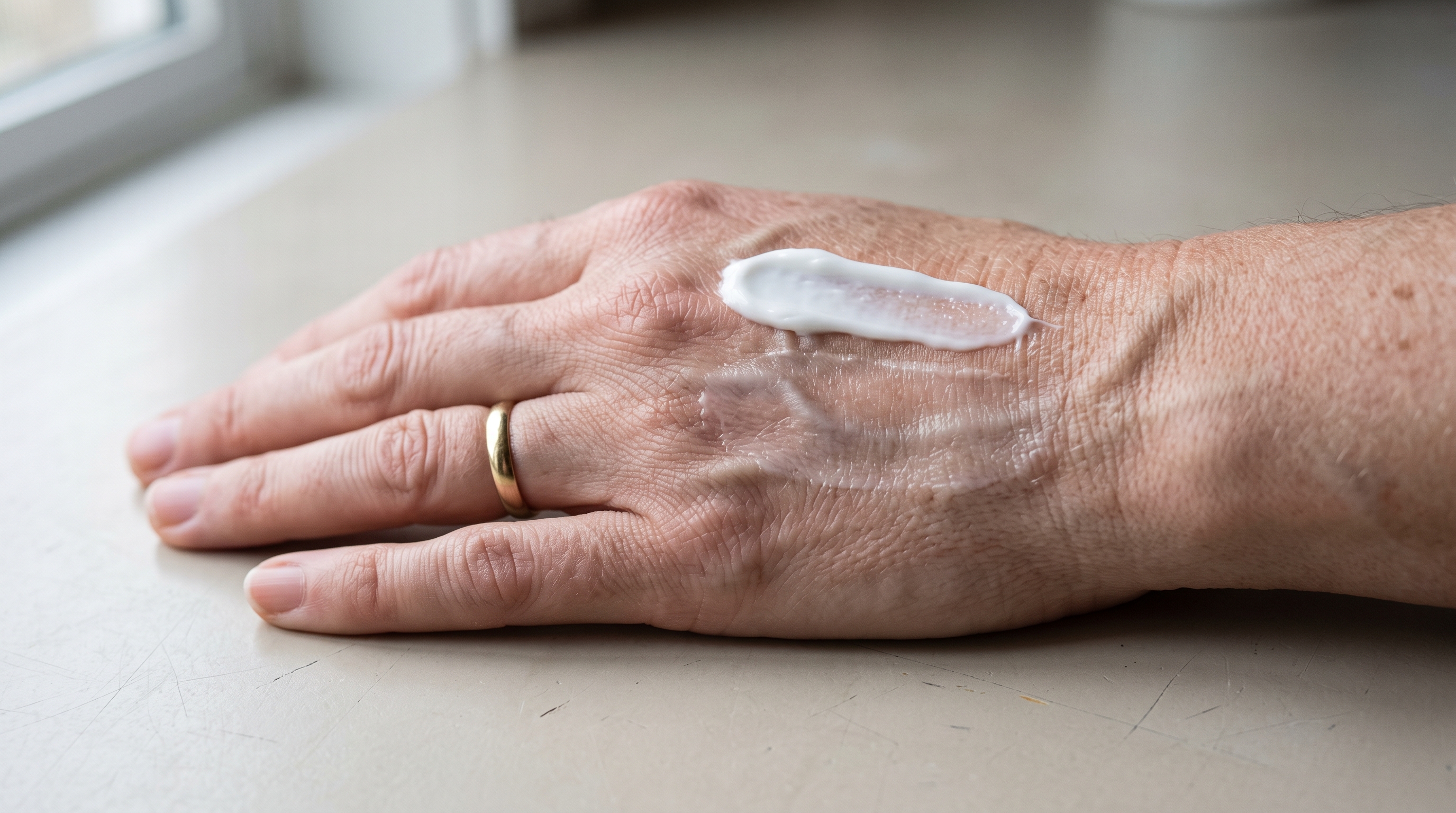
A dimethicone film fills those micro-irregularities and presents a more uniform optical surface. Light reflects more evenly, the micro-shadows soften, and skin reads smoother within about thirty seconds of application. This is the same physics that makes a silicone-based primer work, and it is not a trick — the improvement is real and immediately visible.
It is also entirely superficial. Nothing about the tissue under the film has changed. When the film comes off in the evening, the surface underneath is exactly as it was that morning. That distinction between optical smoothing and structural change runs through everything else in this article, and it is the one most product marketing is careful not to draw. Our guide to how to fix skin texture covers the interventions that work on the other side of it.
It does not seal your skin, and that is the good news
This is where most explanations get it backwards. Dimethicone is routinely described as an occlusive that locks moisture in the way petrolatum does. The direct comparison does not support that.
A human study in 26 volunteers put silicones head to head against petrolatum and found that silicone films are permeable to water vapour and did not occlude the skin — they reduced water loss only transiently and not significantly against untreated control, while petrolatum both occluded and moisturized [3]. Silicones were explicitly characterized as nonocclusive topical agents.
So dimethicone is a breathable film, not a seal. If you have been avoiding it because you believed it suffocates skin, the evidence points the other way: the reason it is so widely tolerated, including on oily and congested skin, is precisely that it does not behave like a heavy occlusive.
The pore-clogging question
The comedogenicity worry is a holdover from ingredient-level ratings compiled decades ago, usually from rabbit ear assays, and then copied indefinitely across the internet.
Those ratings do not predict how a finished product behaves. A re-evaluation of the comedogenicity concept using human cyanoacrylate biopsy found that products formulated with so-called comedogenic ingredients were not necessarily comedogenic themselves, because concentration, vehicle, and the rest of the formula all change the outcome [4]. A rating attached to a raw material in isolation tells you very little about the cream it ends up in.
That is not a clearance certificate for every silicone product. It means the ingredient list is the wrong place to look. If a moisturizer congests your skin, the moisturizer is the problem, not one line on its label.
A comedogenic rating attached to a raw ingredient tells you almost nothing about the finished cream it ends up in.
Where it genuinely earns its place
The strongest evidence for dimethicone is not cosmetic at all. In a randomized, double-blind bioengineering study, a dimethicone-containing protectant lotion significantly reduced both visual irritation scores and water loss after sodium lauryl sulfate challenge [5]. That is a real protective effect against a real irritant, measured instrumentally.
The same film logic underpins twenty years of silicone use in scar management, where continuous silicone sheeting hydrates the stratum corneum and alters keratinocyte signalling to the fibroblasts below [6]. Worth noting that a thick, continuously worn sheet is a very different proposition from a thin cosmetic film applied once a day — the scar literature explains why silicones are useful materials, not why your moisturizer is doing the same thing.
Practically: if your skin is exposed to cold, wind, friction, frequent hand washing, or a course of something drying, a dimethicone-containing product is a sensible buffer. That is also why it appears so often in formulas aimed at a compromised skin barrier.
Why it pills
The one legitimate complaint. Silicone films do not mix with everything, and layering a dimethicone-rich product with certain water-based gels or sunscreens produces the small grey rolls people find on their jaw ten minutes into a routine.
This is a film-interaction problem, not an ingredient defect. Fewer layers, more time between them, and putting the silicone product on last usually resolves it — our guide to moisturizer pilling works through the specific combinations. If you want a smoothing finish without a silicone film at all, squalane oil is the closest alternative in feel, though it behaves quite differently on the surface.
Smoother-looking and smoother are not the same thing
Here is the honest limit of the entire category. Dimethicone improves the optics of your skin. It does not increase collagen, it does not thicken the dermis, and it does not slow the loss of the scaffold that produces lines and slackening in the first place. Its benefit is entirely present-tense and washes off.
The structural work belongs to a different class of ingredient, and the evidence gap is not subtle. Type I collagen formation is 56% lower in photodamaged skin than in protected skin, and topical tretinoin produced an 80% increase in collagen I formation against a 14% decrease on vehicle [7]. Non-prescription retinol does comparable work on naturally aged skin, raising procollagen I and glycosaminoglycan expression in a randomized, vehicle-controlled trial [8].
So the sensible way to think about a silicone moisturizer is as the finish layer, not the treatment. The problem is that most people who try to add the treatment layer stop within a month, because conventional retinol formulations have to disrupt the skin barrier to push the molecule through, and the burning and peeling that follows is exactly what the dimethicone product was bought to soothe.
Nanoretinol was designed around that conflict. The 0.2% retinol is encapsulated in biomimetic lipid nanoparticles that are externally similar to skin cells, so the body recognizes them as “self” and allows passage through the epithelial barrier without damaging it. North Biomedical’s clinical study found it 232% more effective than conventional retinol in collagen recovery and 73% more effective in elastin recovery, with a 61% increase in firmness and a 56% increase in elasticity over 56 days. It is water-based and layers cleanly under the kind of moisturizer this article is about.
What to Actually Do With It
Stop treating dimethicone as something to avoid, and stop expecting it to treat anything. It is a well-tolerated, non-absorbed, breathable film that makes skin look better immediately and protects it from external irritation, and it has essentially no effect on how your skin ages. Judge the product it lives in on that product’s merits. Then decide separately what, if anything, in your routine is doing structural work — because a film that washes off at night is not a candidate.
References
- Clewell H, Greene T, Gentry R. “Dermal absorption of cyclic and linear siloxanes: a review.” Journal of Toxicology and Environmental Health, Part B: Critical Reviews. 2024;27(3):106-129. doi:10.1080/10937404.2024.2316843
- Nair B. “Final report on the safety assessment of stearoxy dimethicone, dimethicone, methicone, and related silicones.” International Journal of Toxicology. 2003;22(Suppl 2):11-35. doi:10.1177/1091581803022S204
- De Paepe K, Sieg A, Le Meur M, Rogiers V. “Silicones as nonocclusive topical agents.” Skin Pharmacology and Physiology. 2014;27(3):164-171. doi:10.1159/000354914
- Draelos ZD, DiNardo JC. “A re-evaluation of the comedogenicity concept.” Journal of the American Academy of Dermatology. 2006;54(3):507-512. doi:10.1016/j.jaad.2005.11.1058
- Zhai H, Brachman F, Pelosi A, Anigbogu A, Ramos MB, Torralba MC, Maibach HI. “A bioengineering study on the efficacy of a skin protectant lotion in preventing SLS-induced dermatitis.” Skin Research and Technology. 2000;6(2):77-80. doi:10.1034/j.1600-0846.2000.006002077.x
- Mustoe TA. “Evolution of silicone therapy and mechanism of action in scar management.” Aesthetic Plastic Surgery. 2008;32(1):82-92. doi:10.1007/s00266-007-9030-9
- Griffiths CE, Russman AN, Majmudar G, Singer RS, Hamilton TA, Voorhees JJ. “Restoration of collagen formation in photodamaged human skin by tretinoin (retinoic acid).” New England Journal of Medicine. 1993;329(8):530-535. doi:10.1056/NEJM199308193290803
- Kafi R, Kwak HS, Schumacher WE, Cho S, Hanft VN, Hamilton TA, King AL, Neal JD, Varani J, Fisher GJ, Voorhees JJ, Kang S. “Improvement of naturally aged skin with vitamin A (retinol).” Archives of Dermatology. 2007;143(5):606-612. doi:10.1001/archderm.143.5.606