Do Wrinkle Patches Really Work? The Science Behind Silicone Patches
What silicone and 'frownie' patches actually do to your skin — and what they can't do
If you have scrolled skincare TikTok at any point in the last two years, you have seen them: little adhesive triangles pressed between the brows, smooth strips stretched across the forehead, crescent pads tucked under the eyes overnight. Wrinkle patches promise a wide-awake, ironed-out face by morning — no needles, no prescriptions, no irritation. The before-and-after photos are genuinely striking.
So the obvious question is whether the effect is real, and if it is, how long it lasts. The honest answer is “yes, but” — and the “but” is the part the marketing leaves out. Wrinkle patches do something measurable to your skin. They just do not do the thing most people think they are paying for.
What a wrinkle patch actually is
There are two broad families on the market, and they work by completely different mechanisms.
Silicone patches are thin, reusable, slightly tacky sheets of medical-grade silicone. They are a direct descendant of silicone scar sheets, which dermatologists have used for decades. Paper or “frownie”-style patches are stiff adhesive pads that physically splint the skin, holding the muscle still so you cannot crease the area while you sleep.
Both create the same visual outcome in the morning. The mechanism behind that outcome is where the science gets interesting — and where the limits become obvious.
The real mechanism: occlusion and hydration
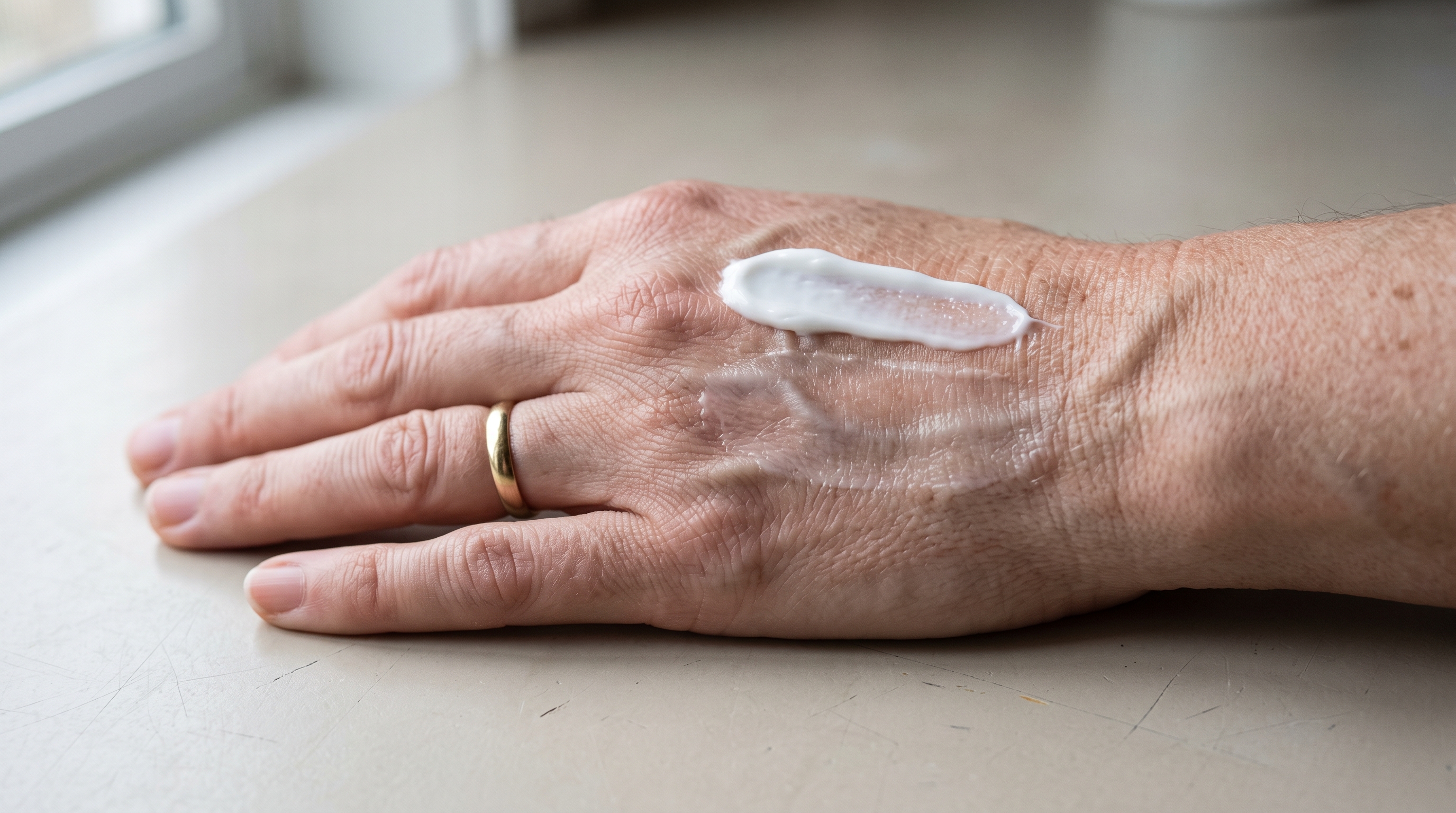
When you seal skin under an impermeable layer, you block the water that normally evaporates from its surface, a process called transepidermal water loss. Trapped moisture floods back into the uppermost layer of skin, the stratum corneum. As those flattened, dead surface cells swell with water, they plump, and fine lines visibly soften.
The moment you peel the patch off and your skin re-equilibrates with the dry air of a room, water evaporates again, the swollen cells deflate, and the crease returns.
This is not a marketing theory. In a controlled study measuring skin under silicone gel sheeting, researchers found that occlusion induced clear hydration of the skin surface and pushed transepidermal water loss far below that of normal, uncovered skin [1]. A separate comparative study of scar treatments confirmed that the benefit of silicone comes specifically from this occlusion-and-hydration effect, not from any active drug diffusing out of the sheet [2].
In other words, a silicone wrinkle patch is a very efficient, very localized humidity chamber. Frownie-style patches add a second trick: by mechanically immobilizing the muscle overnight, they prevent the repeated folding that presses expression lines deeper, the same logic behind not sleeping face-down to avoid sleep wrinkles.
Why the magic fades by lunchtime
Here is the catch built into the biology. Stratum corneum hydration is, by definition, temporary. The moment you peel the patch off and your skin re-equilibrates with the dry air of a room, water evaporates again, the swollen cells deflate, and the crease returns. Most people notice the smoothing softening within a few hours.
That is fundamentally different from changing the structure of the skin. A wrinkle has two components: the surface texture you can temporarily inflate with water, and the deeper architecture — the collagen and elastin scaffolding in the dermis — that has thinned and disorganized over the years. Patches act entirely on the first. They cannot reach the second.
This is the same reason a hot shower makes your face look smoother for ten minutes. The water is real; the remodeling is not. If you are chasing genuine, lasting change in forehead wrinkles or crow’s feet, surface hydration is a pleasant short-term cosmetic, not a treatment.
Instead of forcing retinol through a compromised barrier, it carries a fully stabilized 0.2% retinol inside biomimetic lipid nanoparticles — particles the skin recognizes as “self” and waves through intact, no barrier damage required.
Where patches genuinely earn their place
None of this makes wrinkle patches useless. Used realistically, they have a real niche:
- Event mornings. For a few hours of smoother skin before a wedding, a shoot, or a big meeting, an overnight patch delivers exactly what it promises.
- Sleep-crease and expression-line management. Immobilizing the area while you sleep is a legitimate way to interrupt the daily mechanical folding that etches lines in over time — a passive cousin of face taping.
- Sealing in a serum. Because occlusion dramatically increases penetration of whatever sits underneath, a patch applied over an active treatment can boost that ingredient’s delivery.
That last point is the bridge from gimmick to genuine strategy — because it depends entirely on what you put under the patch.
What actually rebuilds the architecture
To change a wrinkle rather than briefly inflate it, you have to convince the cells in the dermis to lay down new collagen. The single most studied ingredient that does this is a retinoid. In a controlled trial on naturally aged skin, topical retinol significantly increased collagen production and visibly reduced fine wrinkles over the study period — actual structural change, not a water mirage [3]. A broad review of the retinoid literature reaches the same conclusion: vitamin A derivatives remain the gold-standard topical for reversing the signs of skin aging at the level of the dermis [4].
The problem most people hit is tolerance. Traditional retinol is delivered in formulations that push the active through the skin barrier by partially disrupting it, which is why beginners so often get redness, flaking, and stinging and quit before the collagen ever arrives. (If that sounds familiar, our guide to retinol for sensitive skin walks through why.)
This is precisely the problem Nanoretinol was built to solve. Instead of forcing retinol through a compromised barrier, it carries a fully stabilized 0.2% retinol inside biomimetic lipid nanoparticles — particles the skin recognizes as “self” and waves through intact, no barrier damage required. In North Biomedical’s clinical testing, that delivery system proved 232% more effective at collagen recovery and 73% more effective at elastin recovery than conventional retinol, with a 61% increase in skin firmness over 56 days. That is the deep-scaffolding work a patch can never do.
The smartest move, then, is to stop treating patches and actives as rivals. Apply your retinol at night, let it begin the slow work of remodeling, and — on the mornings you want an extra edge — use a patch to inflate the surface and seal everything in. One handles the architecture; the other handles the photo. The under-eye versions follow the same rules with one extra category worth knowing about — see eye patches for wrinkles.
The bottom line on wrinkle patches
Wrinkle patches are real, in the narrow sense that they genuinely smooth your skin for a few hours through occlusion and hydration. They are also oversold, in the broader sense that they do nothing permanent to the collagen and elastin that actually determine how your skin ages. Think of them as the skincare equivalent of steam-pressing a shirt: a fast, satisfying smoothing that lasts exactly until the conditions change. For lasting results, the work has to happen underneath — and that is a job for a proven collagen-building active, not an adhesive square.
References
- Suetake T, Sasai S, Zhen YX, Tagami H. “Effects of silicone gel sheet on the stratum corneum hydration.” British Journal of Plastic Surgery. 2000;53(6):503-507. doi:10.1054/bjps.2000.3388
- Hoeksema H, De Vos M, Verbelen J, Pirayesh A, Monstrey S. “Scar management by means of occlusion and hydration: a comparative study of silicones versus a hydrating gel-cream.” Burns. 2013;39(7):1437-1448. doi:10.1016/j.burns.2013.03.025
- Kafi R, Kwak HS, Schumacher WE, et al. “Improvement of naturally aged skin with vitamin A (retinol).” Archives of Dermatology. 2007;143(5):606-612. doi:10.1001/archderm.143.5.606
- Mukherjee S, Date A, Patravale V, Korting HC, Roeder A, Weindl G. “Retinoids in the treatment of skin aging: an overview of clinical efficacy and safety.” Clinical Interventions in Aging. 2006;1(4):327-348. doi:10.2147/ciia.2006.1.4.327