Elastin: The Forgotten Protein That Determines Whether Your Skin Bounces Back
Collagen gets all the attention — but elastin is what controls your skin's snap, firmness, and resilience
Two Proteins, One Outcome
Every dermatologist-approved anti-aging conversation eventually comes back to collagen. Collagen supplements. Collagen inducers. Collagen-stimulating ingredients. The word saturates skincare marketing to the point of exhaustion.
What receives far less attention is elastin — the protein that determines whether skin actually bounces back after it is pressed, stretched, or pulled. Collagen gives skin structure and volume. Elastin gives it resilience.
The difference matters because when skin loses elastin, the changes look and feel distinctly different from collagen loss alone. Collagen depletion shows as volume loss — hollower cheeks, flatter lips, thinner skin overall. Elastin depletion shows as sagging, laxity, and what researchers call “reduced snap-back” — press the skin and it does not return to position as quickly. The skin on the back of your hand provides an easy demonstration: press it gently and watch how fast it relaxes. At 25, it happens in under a second. At 55, it takes noticeably longer.
What Elastin Actually Does
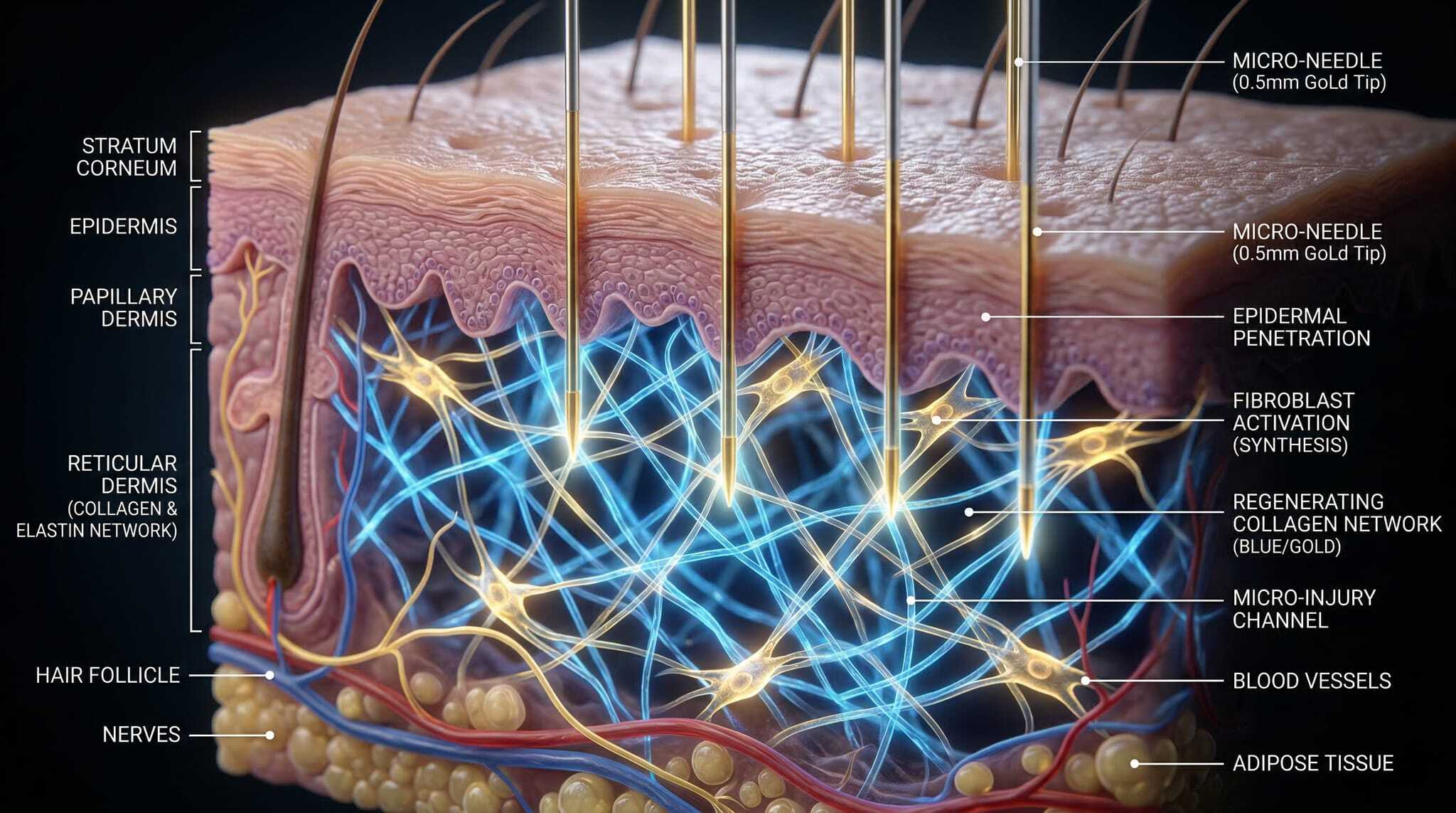
Elastin fibers form a network throughout the dermis — the layer beneath the visible skin surface. These fibers are highly cross-linked, capable of stretching to roughly 150% of their resting length and returning to their original shape without permanent deformation. This elastic recoil keeps skin taut across facial structures, even as facial expressions are constantly moving and stretching it [4].
Unlike collagen, which the body can synthesize throughout adult life (at a declining rate), elastin production largely stops after puberty. The elastin in adult skin is essentially the same elastin assembled during early development — which means damage to existing elastin fibers is effectively permanent at the structural level.
This biological reality explains why elastin-focused skincare is, in some ways, even more important than collagen-focused skincare. Collagen can be continuously rebuilt. Elastin cannot be replaced through new production at meaningful scale once the foundational network is degraded.
How Elastin Breaks Down
Research has identified two main mechanisms of elastin degradation: chronological aging and UV radiation.
With chronological aging, elastin fibers gradually fragment over time through enzymatic activity. Elastases — enzymes that break down elastin — become more active in aged tissue. A study examining molecular-level changes found progressive modification of elastin’s cross-links and amino acid composition with aging, resulting in fibers that become stiffer, more fragile, and less able to spring back [3].
UV radiation is a more aggressive and faster-acting threat. Photoaged skin shows a condition called solar elastosis — a buildup of abnormal, degraded elastin that has been damaged and cross-linked by UV-induced reactive oxygen species. Paradoxically, solar elastosis involves accumulation of damaged elastin material rather than simple depletion, but this accumulated material is functionally useless: fragmented, tangled, and unable to provide elastic recoil [1].
When you see deep folds that do not flatten when skin is stretched, that is primarily collagen loss.
A foundational study of cultured human skin fibroblasts measured actual elastin production across age groups and found that elastin synthesis begins declining in early adulthood and continues decreasing through each subsequent decade — independent of UV exposure [2]. Chronological aging alone is enough to reduce the rate at which even undamaged elastin fibers are maintained.
The Collagen-Elastin Distinction
Since both proteins decline with age and both affect skin appearance, it is worth being precise about what each contributes.
Collagen provides compressive strength — resistance to being compressed or crushed. Elastin provides tensile resilience — recovery from stretching and pulling. When you see deep folds that do not flatten when skin is stretched, that is primarily collagen loss. When you see general drooping and a lack of tightness in the skin, that is primarily elastin loss.
Most aging faces show both, to varying degrees. A comprehensive review of elastin’s clinical relevance noted that skin’s mechanical behavior depends on the two proteins operating together — and that loss of either disrupts the system in characteristic ways [4].
This distinction matters for treatment: ingredients that stimulate collagen do not necessarily stimulate elastin, and vice versa. Pursuing only collagen-focused interventions addresses part of the problem. The skin elasticity loss that manifests as sagging requires a different or broader treatment approach.
What Actually Stimulates Elastin
The research on elastin-stimulating ingredients is considerably thinner than on collagen-stimulators, partly because elastin synthesis is harder to measure in clinical settings. But retinol stands out as the ingredient with the most evidence across both proteins.
A study specifically examining retinol’s effects on elastin found that retinol induces elastin synthesis and promotes the formation of new, organized elastin fibers in skin tissue [5]. The mechanism involves retinol activating nuclear receptors that upregulate the genes responsible for tropoelastin — the precursor protein from which mature elastin fibers are assembled.
A subsequent molecular study confirmed these findings in aged human skin in vivo: retinol treatment increased elastin gene expression and improved the structural organization of elastin fibers, with results measurable at the gene expression level within weeks of treatment [6].
When you see general drooping and a lack of tightness in the skin, that is primarily elastin loss.
This is a clinically important finding. The general assumption has been that adult elastin cannot be regenerated at meaningful scale. The retinol research suggests the reality is more nuanced — not full structural replacement of lost fibers, but genuine biological stimulation of new elastin synthesis in remaining fibroblasts.
Supporting Elastin Through Daily Habits
Given that UV damage is one of the two primary causes of elastin loss, sun protection is as important for elastin as for collagen — arguably more so, because UV-damaged elastin cannot be replaced the way UV-damaged collagen can. A broad-spectrum SPF applied consistently limits solar elastosis accumulation, which is the most preventable form of elastin destruction.
Smoking induces oxidative stress throughout the dermis and accelerates elastin fragmentation through a similar mechanism to UV. Antioxidant intake through diet — vitamins C and E, polyphenols, carotenoids — reduces baseline oxidative damage to the extracellular matrix.
Retinol applied nightly, extended to the neck and décolletage where elastin damage manifests earliest as visible sagging, addresses the stimulation side. SPF addresses the damage prevention side. These two interventions, applied consistently, address both mechanisms by which elastin is lost.
The Delivery Factor
Retinol’s effectiveness for elastin stimulation depends on how much of it reaches the fibroblast cells in the dermis. Traditional retinol formulations penetrate the epithelial barrier inefficiently — the solvents and emulsifiers used to improve penetration can damage the barrier itself, creating irritation without necessarily improving therapeutic delivery.
Nanoretinol encapsulates retinol in biomimetic lipid nanoparticles, allowing passage through the skin barrier without disrupting it. The nanoparticles are recognized by skin cells as structurally compatible and pass through intact rather than forcing their way through a damaged barrier. Clinical comparison to conventional retinol shows +73% greater elastin recovery — a metric that maps directly to the bounce and firmness outcomes that represent successful elastin stimulation.
For a protein that stops being actively produced after puberty and is progressively damaged by cumulative sun exposure, having a delivery system that reliably reaches target cells is not a minor consideration — it determines whether the biological stimulation retinol is capable of actually reaches the fibroblasts responsible for elastin synthesis.
Where to Focus
The practical protocol for preserving and stimulating elastin combines three consistent behaviors: daily SPF to stop ongoing UV-induced elastin destruction; a retinol applied nightly to stimulate remaining fibroblast activity; and patience with the timeline, since elastin fiber formation and reorganization is slow, with clinical studies showing measurable results at 12 weeks minimum.
Collagen receives the marketing attention. But if your primary concern is skin that no longer bounces back the way it once did — the laxity, the sagging, the skin that moves differently than it used to — elastin is where the conversation should begin.
References
-
Weihermann AC, Lorencini M, Brohem CA, de Carvalho CM. “Elastin structure and its involvement in skin photoageing.” International Journal of Cosmetic Science. 2017;39(3):241–247. doi:10.1111/ics.12372
-
Sephel GC, Davidson JM. “Elastin production in human skin fibroblast cultures and its decline with age.” Journal of Investigative Dermatology. 1986;86(3):279–285. doi:10.1111/1523-1747.ep12285424
-
Mora Huertas AC, Schmelzer CEH, Hoehenwarter W, Heyroth F, Heinz A. “Molecular-level insights into aging processes of skin elastin.” Biochimie. 2016;128–129:163–173. doi:10.1016/j.biochi.2016.08.010
-
Baumann L, Bernstein EF, Weiss AS, Bates D, Humphrey S, Silberberg M, Daniels R. “Clinical Relevance of Elastin in the Structure and Function of Skin.” Aesthetic Surgery Journal Open Forum. 2021;3(3):ojab019. doi:10.1093/asjof/ojab019
-
Rossetti D, Kielmanowicz MG, Vigodman S, Hu YP, Chen N, Nkengne A, Oddos T, Fischer D, Seiberg M, Lin CB. “A novel anti-ageing mechanism for retinol: induction of dermal elastin synthesis and elastin fibre formation.” International Journal of Cosmetic Science. 2011;33(1):62–69. doi:10.1111/j.1468-2494.2010.00588.x
-
Shao Y, He T, Fisher GJ, Voorhees JJ, Quan T. “Molecular basis of retinol anti-ageing properties in naturally aged human skin in vivo.” International Journal of Cosmetic Science. 2017;39(1):56–65. doi:10.1111/ics.12348